What does an airport see before the queue forms?
An airport does not fail all at once. It fails nine minutes earlier.
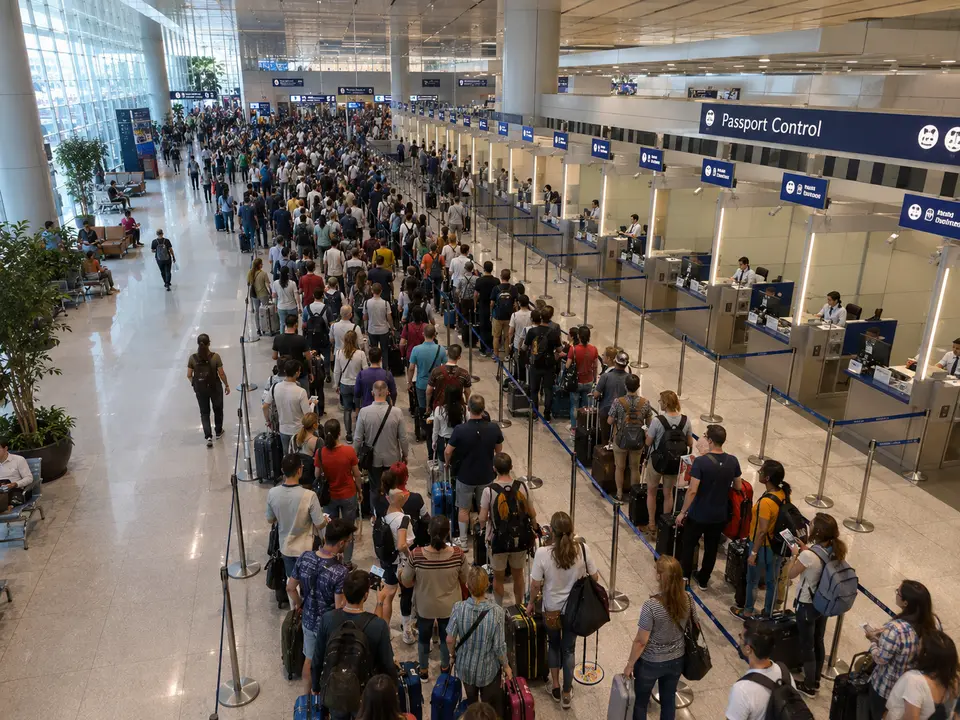
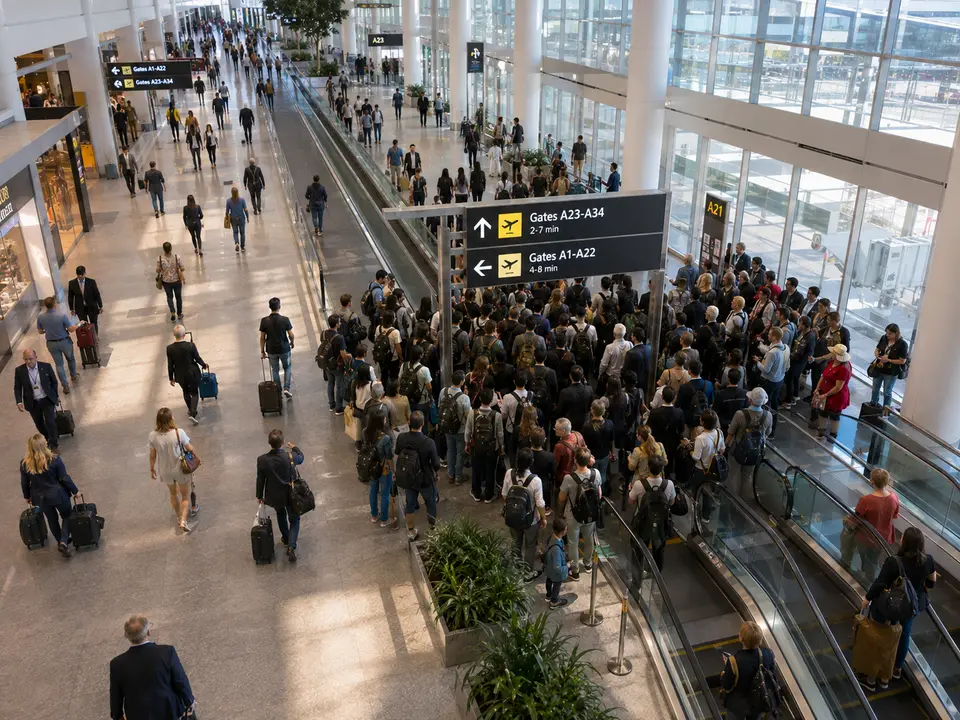
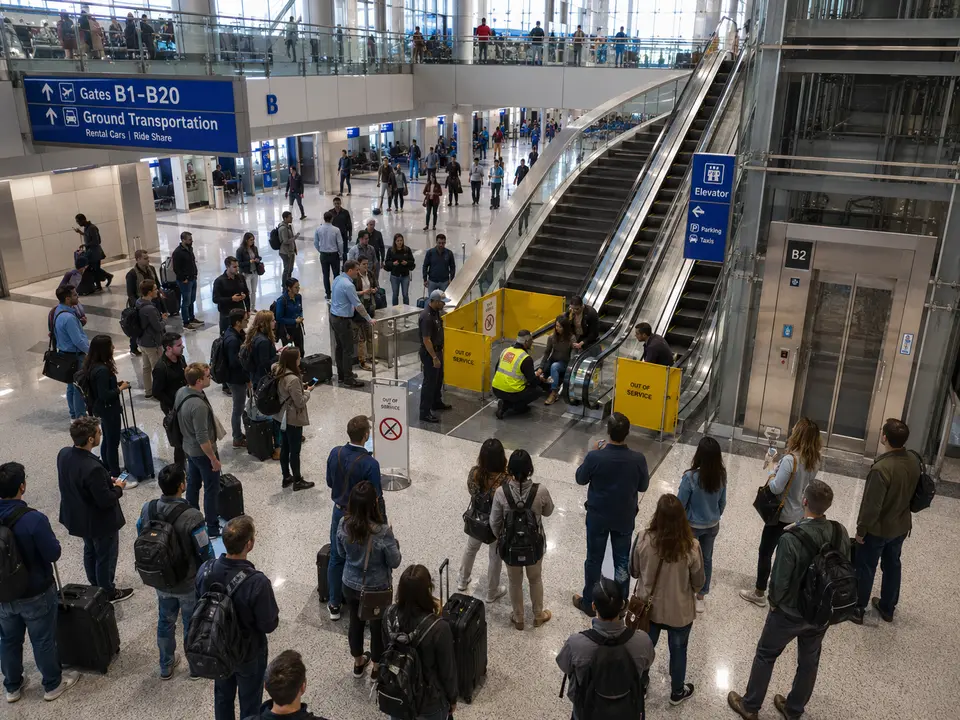
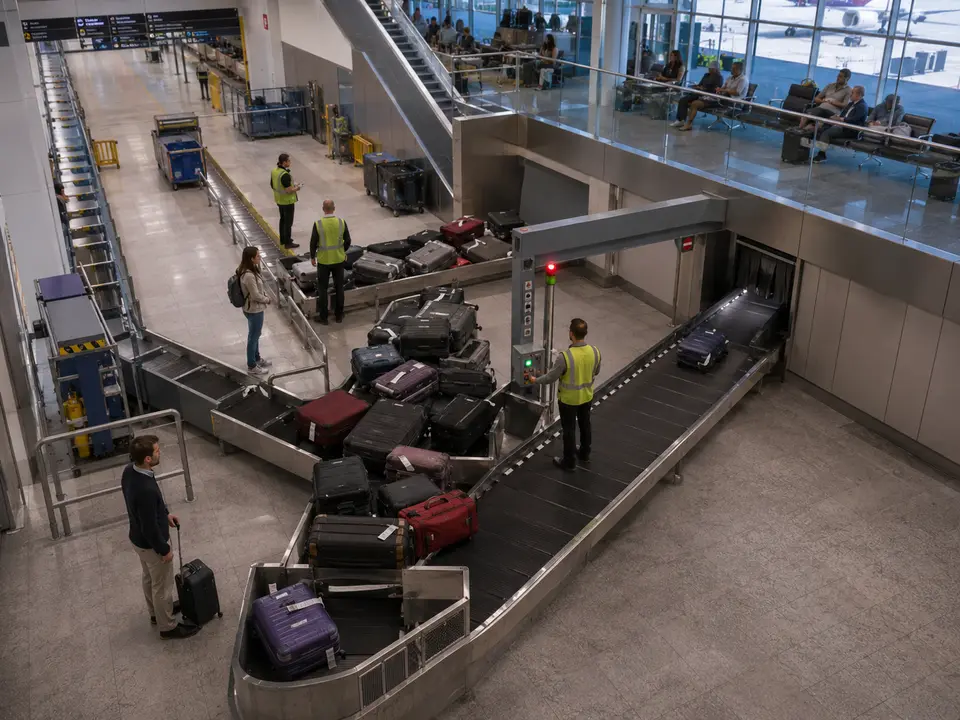
An open lane with nobody going through it. A jammed baggage conveyor in the basement. A shut-down escalator with eighty people in front of it. All of it happens in front of cameras the airport already has, and today it is found out when somebody calls to complain. We show fourteen cameras here: some measure, others raise alerts. A real terminal has thousands. The system is the same. And none of it identifies anybody.

Without IRIS, this is just an airport full of people.
AI-generated image
What IRIS is
IRIS keeps watch over the airport for you.
IRIS is an artificial intelligence that looks at the cameras you already have and understands what's happening at security checkpoints, the baggage belt and the access points. If a queue grows, the belt stops, or something you need to watch happens, it alerts you right away; and whatever can be counted, it counts in numbers. All day long, without anyone having to stare at a screen.
You tell it what you need to watch, and IRIS does it.
Works with the cameras you already have. Nothing to replace.
A person replies, not a form.
- Your footage never leaves your premises.
- It doesn't identify people.
- Certifications →
Nine minutes earlier
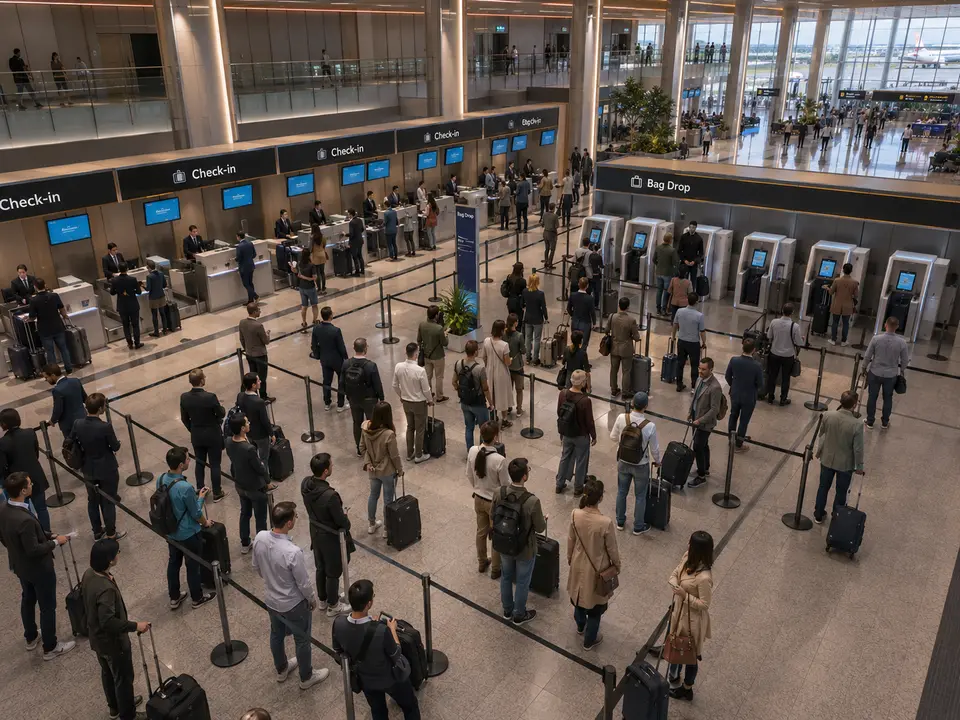
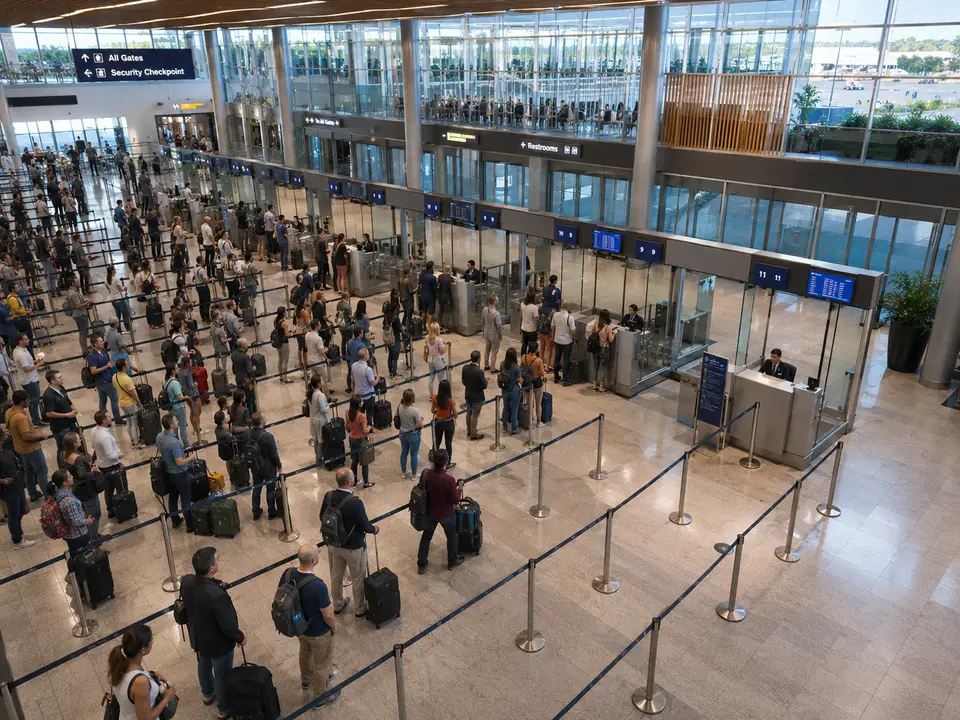
At half past six in the morning there is a twenty-four minute queue at security. Fifteen metres away there is an open lane nobody has gone through in nine minutes. Nobody calls to report that: the people waiting cannot see it, and the person at the lane assumes the queue will come. By the time the supervisor finds out, the peak has passed and the delay is already spread across half the terminal.
IRIS reads the cameras the airport already has. It measures how many minutes people really wait in each queue, how many positions are open while they wait, how long the first bag takes to appear and how many people walk past each retail unit. And it flags what has stopped: a jammed conveyor in the basement, a shut-down escalator, a staff door somebody leaves open, a bag that has stood alone in the middle of a concourse for six minutes.
And there are two ways to ask it for things, because they are two different things. What you watch is described in words: one sentence, and IRIS alerts you when it happens. What you measure is drawn: a line at the mouth of the queue, a zone over the floor. A line will not fit in a sentence, it has to be traced — and that is why a Tuesday and a Sunday are measured the same way. Asking is for finding. Counting is for measuring.
The real scale
Fourteen here. Thousands in a real terminal.
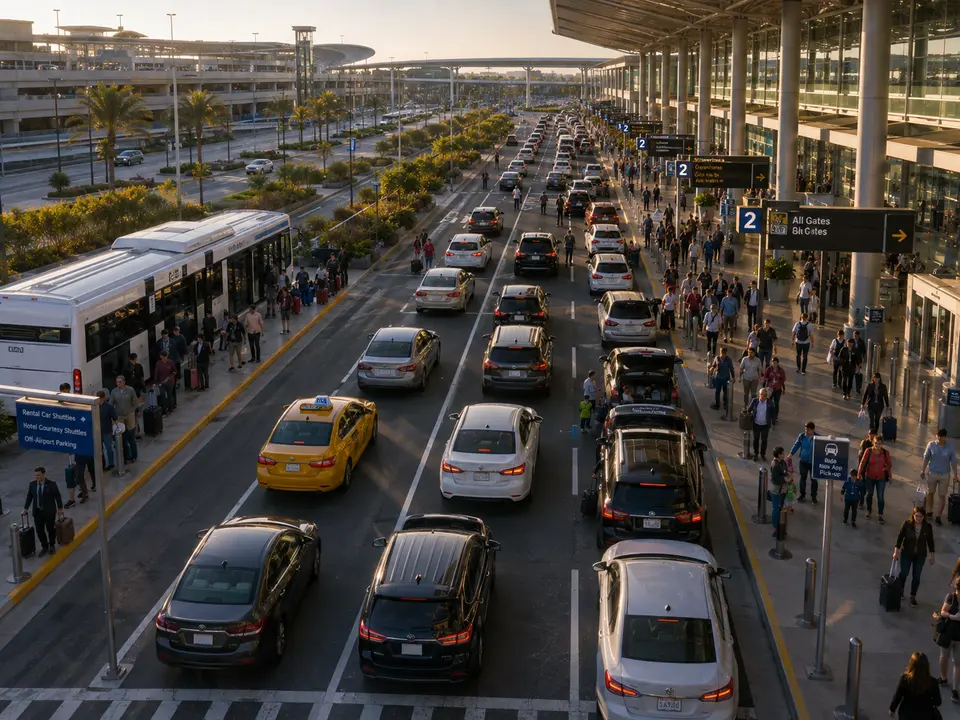
This demonstration shows fourteen cases because fourteen fit on a screen. A real airport has cameras at the kerb and in the car parks, at every check-in desk, at security and at passport control, in every concourse and at every gate, in the baggage basement, on the loading docks and along the perimeter fence. IRIS reads them all with the same rules. Where there is no IRIS camera is exactly where there never should be one: inside a toilet, inside a search room and inside a staff changing room.
Examples
These fourteen are only examples.
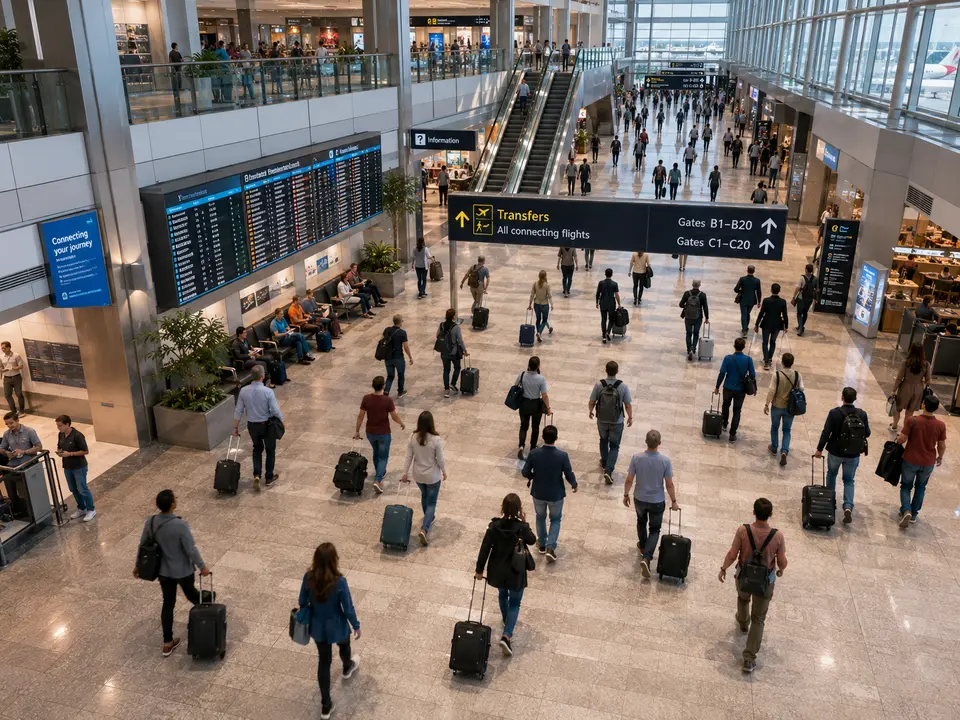
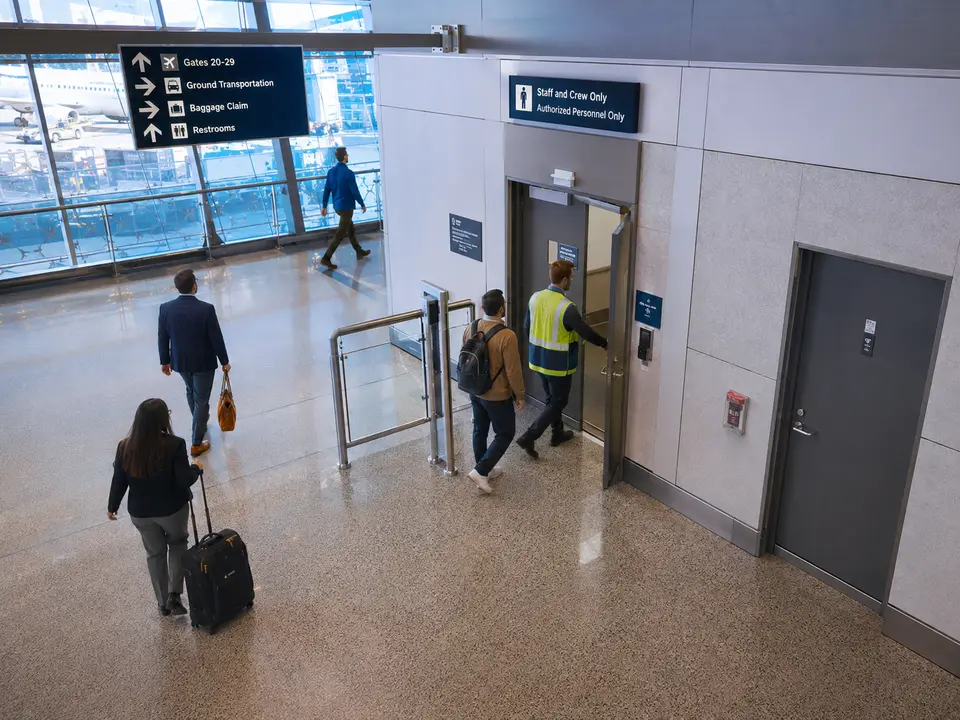
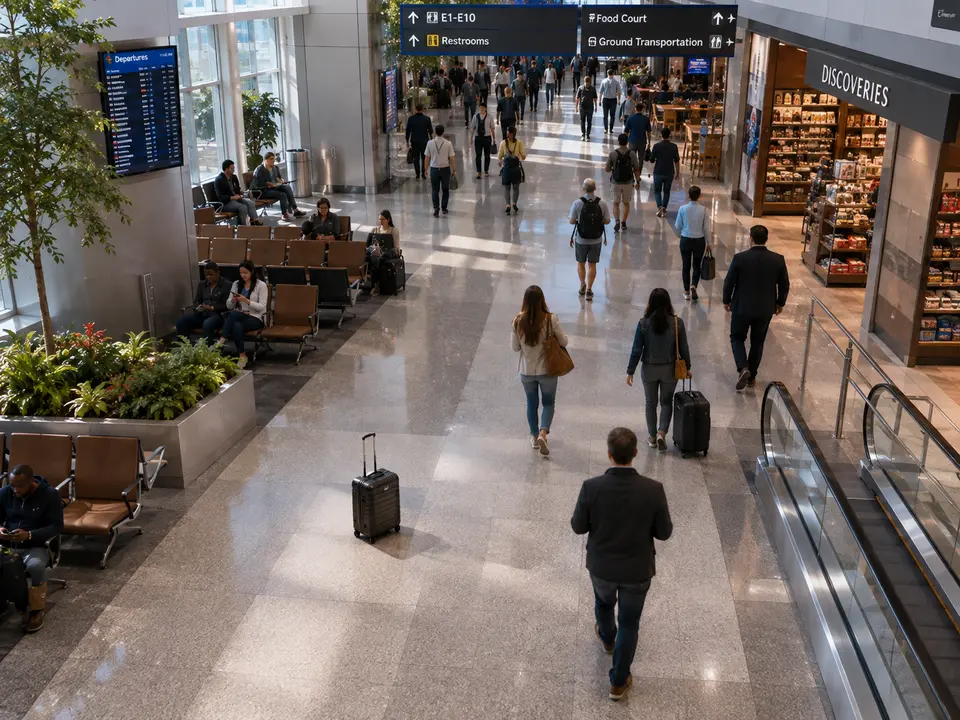
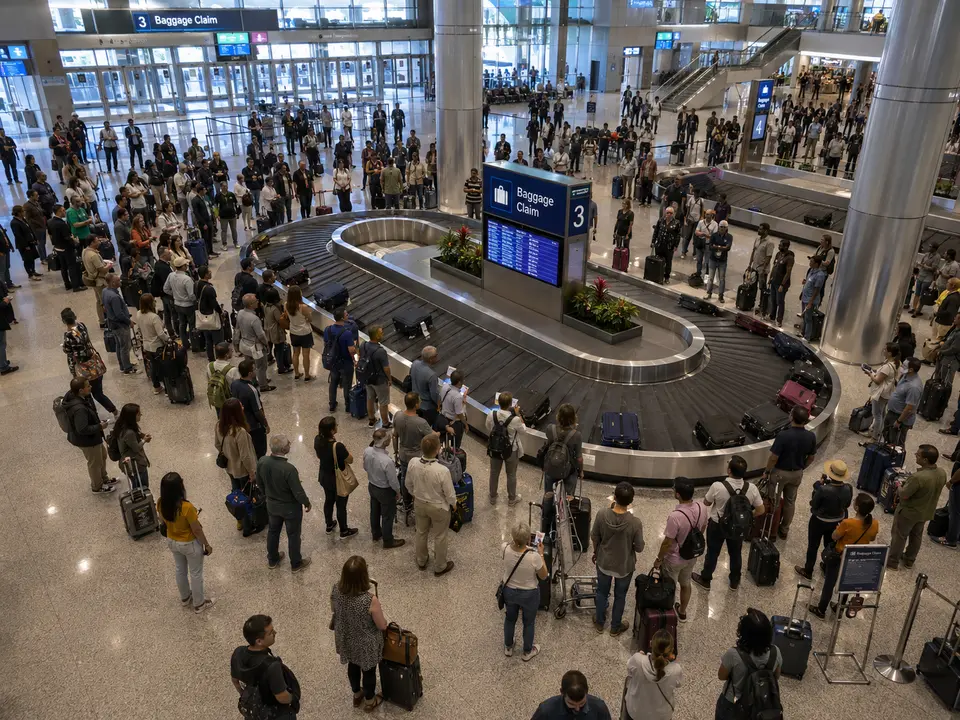
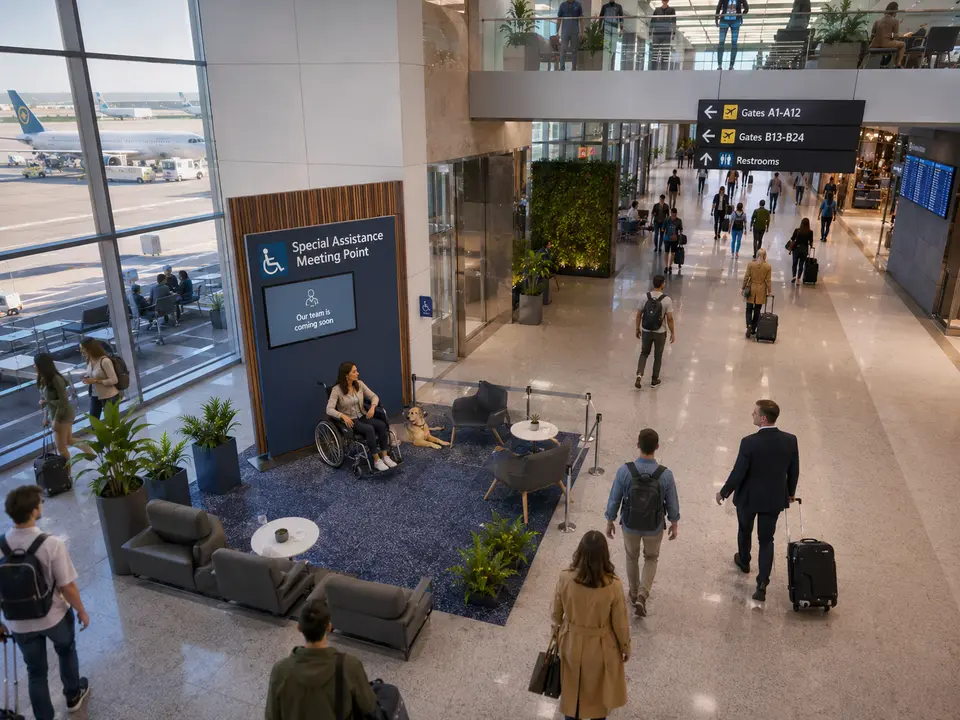
Each one shows a different kind of thing: a kerb, a queue, an empty lane, a narrowing concourse, a staff door, a shop, a baggage belt, an assistance point. They are not the fourteen things IRIS can do: they are the ones that fit on a screen. Seven measure and seven raise alerts, and both halves are needed.
See it in action
A different case every time
This isn’t a video. It’s a slice of the real screen.
A summary of the real interface, played hands-free. You see one case from start to finish; what you do not see are the other screens, and there are many.
- Cameras on the map
- You draw an area
- What passed shows up
Now think about yours
Imagine knowing a lane has been open and empty for nine minutes.
The basement conveyor has been jammed for three minutes while two hundred people upstairs keep staring at an empty belt. An escalator has been shut down for a quarter of an hour and nobody has sent people to the lift right next to it. At the assistance point, somebody has been waiting for twenty-two minutes and no one from the service has come by. None of that is a new fault: those are minutes already being lost.
All of it is happening in front of cameras your airport already has and has already paid for. And nobody knows until somebody complains. IRIS reads them, measures what has to be measured and flags what has stopped, with the camera, the time and the video of that minute. It identifies nobody, it recognises no faces and it decides for nobody: the person on duty still decides.
What gets asked in the operations centre
The ten questions that come up before the first camera is connected.
Answered in the first line, straight, with no promises that fall apart in front of a camera. IRIS measures flows and reports operational facts: identifying anyone is not one of its jobs, and it is not going to become one.
Does it work with the cameras the terminal already has?
Yes, it works with the cameras the terminal already has. IRIS connects to the feed of the IP cameras that are already installed and analyses it as it arrives: what changes is not the equipment, it is what gets understood from the picture. During the project we check camera by camera whether the framing is good enough for what you want to measure there — a camera set up to cover the whole hall may not reach far enough to count the mouth of a queue — and we tell you plainly which ones fall short and which would only need turning a few degrees. Adding a new camera is the exception, not the starting point.
Does IRIS identify passengers or recognise faces?
No, IRIS does not identify passengers and does not recognise faces. It compares them against no database, keeps no record of who anyone is, does not follow a person through the terminal and is not cross-referenced with any passenger list or boarding pass. And it is worth saying where the line runs: IRIS does no document control, verifies no documents, replaces neither the scanner nor the officer and touches none of the airport security systems. What it does is measure flows and report operational facts: a queue growing, a desk open and empty, a belt at a standstill. A counted passenger is a one: nothing else of them is kept.
Does the video leave the airport?
The video leaves the airport or stays inside depending on the deployment you choose, and there are two of them. In the on-site mode it does not leave: the servers sit in your own facilities, the video comes in over your network, is analysed in there, and the system does not need internet to work. In the other one it is processed in our data centre — which is our cloud, not somebody else’s — and then it does leave, encrypted and under the terms set in the contract. At an airport the usual thing is to mix the two: the sensitive stays in, the rest goes out.
Is the security queue wait a reliable number?
The security queue wait is a reliable number because it is not set up by talking, it is set up by drawing: a line at the mouth of the queue, another at the point where people pass through, an area on the floor. A line does not fit in a sentence, you have to trace it, and that is why the figure comes out the same way every day, can be repeated, compared week to week and audited. And it is not only the wait that gets measured: also how many desks were open while people waited, which is the missing half of the explanation for opening another one. On people counting you do not have to take our word for it: it is certified by the Spanish Metrology Centre, an independent third party. To be precise: that certification covers people counting, not the whole product.
Does it detect abandoned luggage?
IRIS detects abandoned luggage in the literal sense of what a camera sees: an object that has been on the floor for a while with nobody beside it, inside an area you drew and for a length of time you set. That is all it knows. It does not say whose it is, does not say what is inside, looks for nobody and decides nothing: the alert arrives with the camera, the time and the video, and who decides what to do is the person on duty, with the airport protocol in front of them. And this has to be said before anyone signs: in a crowded hall an object can be hidden by the people walking past, and then the camera does not see it.
How many alerts are going to reach the operations centre?
You will get the alerts you decide on, because a rule is bounded: area, time band and duration. A system that fires two hundred times a shift is switched off within a week, and rightly so: when everything alerts, nothing does. That is why a rule is not «tell me if there is a queue» but «tell me if this queue goes over twenty minutes between six and nine». By changing the area, the time band and the minimum duration, the same detector goes from ringing all day to ringing when it really matters. And it is adjusted afterwards, with what came out in the first two weeks in your terminal, not in a generic one.
Who decides what is watched and what is measured?
The airport decides, not IRIS. What is watched is written by talking: a sentence anyone can read and anyone can change. What is measured is drawn: a line on the floor, an area over a hall. They are two different things and they are not set up the same way, which is why both have to be decided. IRIS ships with no list of behaviours and does not decide what is normal in your hall at six in the morning: the person who has worked there for twenty years knows that. And if a night flight moves, a corridor closes for works or a new gate opens, the rule is rewritten in a few minutes and nothing has to be ordered.
What does IRIS not see in a crowded terminal?
What IRIS does not see is real, and it is better said before anything gets signed. A camera only understands what falls inside its frame: with the hall full, some people block others and it stops telling them apart one by one. That happens to any vision system, ours included, and anyone who says otherwise has not tried it on a Sunday afternoon. What is not lost is occupancy, which is exactly what is needed most when it is full: measuring how many people are in an area does not require telling each person apart. What does degrade is counting one by one in a narrow, heavily loaded passage, and there the counting is moved to where people walk in single file. Against the backlight of a big glass front, with a dirty lens or a badly aimed camera, it sees worse. And where there is no camera, it sees nothing.
How long does it take to be up and running?
How long it takes depends on the size of the installation, and we are not going to give you a date we cannot yet control. The work has three clear phases: connecting the cameras that already exist, drawing on each image the areas to be measured and writing the rules to be watched, and tuning those rules against what actually happens in the terminal at six in the morning and at eleven at night, which look nothing alike. The first measurements and the first detections show up early; the fine tuning takes longer. Specific dates go in the proposal, once we know how many cameras there are and what you want to see on each one.
How much does it cost?
The cost is worked out from how many cameras are analysed, what is measured or detected on each one, which deployment mode you choose and whether the hardware is yours or ours. There is no single price list, because measuring the security filter and the baggage reclaim hall does not cost the same as covering a whole terminal with its shops, its corridors and its basement. And you can start small: the filter and the baggage hall, look at the numbers with your own team and decide afterwards. Tell us how many cameras you have and what you want to see, and we will give you a figure. The number is +34 93 566 70 22.
See it somewhere else

Who is watching the cameras of a whole branch network?
13 cases: 12 raise an alert when something happens and one only measures. You see each image as it is, and then with what IRIS understands on top.

How long does it take to find a hand played two hours ago?
12 cases: 9 raise an alert when something happens and 3 only measure. You see each image as it is, and then with what IRIS understands on top.


And the best part
A recording gets watched when nothing can be done.An alert lands while there is still time to act.
IRIS raises the alert while it is happening and says where: the camera, the time and the images from that moment. With that, whoever is on duty is still in time to act.
Tell us your problem and we will say whether IRIS understands it, or not yet.
We reply the same working day.