How is it different from a VMS?
The VMS stopped at recording. The NVMS starts at the decision.
Recording is a solved problem; the expensive part is still watching, searching, counting and deciding by hand.
What IRIS is
IRIS watches the cameras for you.
IRIS Neural is an artificial intelligence that watches the cameras you already have and understands what happens in front of them. When something important happens —or something you told it you need to keep an eye on—, it alerts you; and whatever can be counted, it counts in numbers. All day long, without anyone having to watch a screen.
You tell it what you need to watch, and IRIS does it.
Works with the cameras you already have. Nothing to replace.
A person replies, not a form.
- Your footage never leaves your premises.
- It doesn't identify people.
- Certifications →
What NVMS means
Four letters. The one that changes everything is the N.
VMS stands for Video Management System: the software that runs the cameras of a building, a factory or a city. It records, it stores, it shows live video and it lets you rewind. It has done its job well for thirty years, and its job is to keep. What it does not do is understand what is inside the picture. For that you need a person watching.
NVMS stands for Neural Video Management System. Same thing, except the part that watches is not a person: it is a neural network that understands what it sees. On every camera at once, all the time. It still records and still stores exactly as before, nothing is lost. What is added is that it also understands.
A picture makes it clearer. A VMS is a huge, well-ordered archive: everything is in there, but to find out what happened on Tuesday at three, somebody has to sit down and look. An NVMS is that same archive plus someone who has already seen all of it and can tell you where to look.
Two things are worth spelling out before we go on. This is not the old VMS with an AI module bolted on top: the understanding is not an add-on, it is the centre. And you do not need different cameras. IRIS works with the ones already installed.
Neural: who watches
A neural network, not a shift in front of a wall of screens. It watches every camera at once, without tiring and without drifting off at four in the morning.
Video: what it watches
The video from the cameras already there. No new sensors, no special cameras: the same footage that today is only stored.
Management: what happens next
Understanding is not enough. What it sees becomes an alert, a number, a case or a piece of stored evidence. Somebody has to be able to act on it.
System: one, not seven
Watching, searching, counting, alerting and storing in one place. When each of those lives in a different tool, nobody knows which one is telling the truth.
A classic VMS does its job well: it takes in the cameras, shows the video, records it, plays it back and exports it. That is not the problem. The problem is everything that stays manual afterwards: watching, searching, counting, timing and deciding. Each new camera adds more than coverage; it adds person-hours. Recording is not what costs. What costs is still watching, searching, counting and deciding by hand.
NVMS stands for Neural Video Management System. It is the same base as a VMS — cameras, recording, playback, export — with a layer that understands what is happening inside the image. The difference is not video quality: it is that the system stops merely storing and starts interpreting, measuring and applying judgement.
A VMS shows cameras; IRIS ranks which one deserves attention right now. A VMS detects motion; IRIS links objects, zones, durations and context. A VMS forces you to review recordings; IRIS turns the archive into something you query by describing it. And to cover more ground, a VMS asks for more operators; an NVMS asks for less repeated work per operator.
This is not about the VMS having been wrong. The VMS solved recording; IRIS solves what comes next. In some projects IRIS acts as the complete platform and in others it lives alongside the video infrastructure already installed. That is a project decision, not a condition of purchase, and it is taken by looking at the site.
Storing or understanding
A VMS keeps what happened so somebody can look at it later. IRIS reads the scene while it is happening and says what is going on.
Alarm or decision
An alert says something happened; a decision knows what to do about it. IRIS applies the rule, opens the incident, alerts the right person and keeps the evidence.
Footage or figures
The same stream that today is only recorded can count people, measure queues and log process times. Not everything that matters is an alarm: sometimes what matters is a number.
Tape or memory
Searching in a VMS means picking a camera and dragging a timeline. In IRIS you describe what you are after and land on the candidates: the video stops being a tape and becomes a memory you can query.
Is IRIS a VMS?
IRIS includes capabilities you would expect from a VMS — taking in cameras, recording, playback and export — but what it offers goes beyond that. IRIS understands what happens in the image, applies the organisation's rules, turns video into metrics and lets you investigate without reviewing hours of footage.
Do I have to replace the VMS I already have?
Not necessarily. Depending on the project, IRIS can act as the complete platform or live alongside the existing video infrastructure, using the available streams and integrations. The sensible thing is to review it case by case: which cameras, which recording and which systems can be reused.
What exactly does NVMS mean?
NVMS stands for Neural Video Management System: a video management system that also understands what is happening inside the images. The difference from a VMS is at the centre of the model: a VMS revolves around the screen and the operator; an NVMS revolves around the decision.
Do you do custom development?
Yes. A detection is worth little if it ends up on a screen nobody looks at, so usually something is needed around it: a screen built for how your team works, a report in your format and with your names, a calculation that only makes sense in your operation. That gets built. What we will not tell you is that it all fits in the same budget: some things are solved in an afternoon and others are a project, and which is which gets said at the start, while there is still time to change the plan, not after signing.
Does it integrate with what I already have?
Yes, and that is the norm: almost nobody starts from scratch. The alert can land where your team already works, the number can end up in the dashboard you already read, and what IRIS decides can lean on something your system already knows. What we will not tell you is that we fit with everything. What gets integrated and how is decided by looking at your actual system, not before: some connections take an afternoon and others depend on whether the other side lets you in, and that sometimes depends on neither of us. It is checked at the start, with your system in front of us, and if something is not going to be possible, that is said then.
Does IRIS record?
Yes. IRIS takes in the cameras, records, plays back and exports, just like whatever system you have now. Recording is not what changes: what changes is what happens after recording, because IRIS understands what is in the image and applies the rules you write. And if you already have a VMS recording, IRIS can live alongside it instead of replacing it.
When it is not worth it
When is moving from a VMS to an NVMS not worth it?
If all you need is to record and rewind, a VMS already covers that and an NVMS is paying for more than you use. IRIS starts to be worth it when somebody has to watch, search, count or time things by hand every day, and that work no longer fits in the shift.
Nor is IRIS the cheap option. It needs computing capacity inside the site, a camera-by-camera survey and someone to write the first rules with your team. If a tender is decided on licence price alone, there will be cheaper bids than ours. What it saves is person-hours, and you have to be willing to count those.
And we do not promise to be able to take the place of any VMS on the market. In some projects IRIS is the complete platform; in others it works on top of the video infrastructure already in place. Which of the two depends on which cameras exist, what recording is in place and which integrations are available — and that is examined before signing, not after.
If recording is all you need
A VMS already stores and rewinds, and it does that well. Switching only makes sense if you also need to understand, measure or search without reviewing hours of footage.
Not the cheapest bid
There is a server, a commissioning phase and a camera-by-camera survey. What you save is person-hours, not licence euros: if nobody counts them, the figure never adds up.
It coexists or replaces, case by case
In some projects IRIS is the complete platform; in others it works on top of what is already in place. That is decided by looking at the site, not at a catalogue.
The cameras stay yours
You do not have to replace them to start. You do have to review them: some will need re-aiming and some will not give the image the detection you want requires.
VMS vs IRIS NVMS
What each one is, and how your team works.
Both take in the same cameras and both record. What changes is what sits at the centre of the system, and who has to do the looking.
VMS
Video Management System
Core: recording
Traditional video management
Cameras
- Live and recording
- Playback and export
- Searches by camera, date, time and attributes
Recorder / NVR
It keeps the archive.
Basic analytics and rules
It detects configured events.
Counting
The operator supplies the context.
The operator watches and filters
When thousands of alarms come in, the operator has to go through them and throw out the ones that do not matter.
Human attention is finite
More cameras, the same attention.
IRIS NVMS
Neural Video Management System
Core: artificial intelligence
IRIS watches the cameras and applies your rules
Cameras
One single platform
AI and understanding
It reads the scene and understands the context.
Built-in VMS
Live, recording and playback.
Advanced search
By description, attributes and similarity.
Rules and operations
Automations, incidents and cases. Procedures and response.
Evidence and data: recordings and IRIS Data
Counting that is repeatable and auditable
Your organisation sets the rules. Your team decides.
Incident detected
Exit blocked for 30 seconds
The team gets the context and acts
Continuous analysis, no fatigue
Capacity grows with the infrastructure.
How it all fits together
VMS/NVR + outside solutions
Several platforms wired together
- Video · VMS + NVR
- Analytics
- Incidents
- Communication
In a deployment built from separate solutions, the functions are spread across platforms that have to be wired together.
IRIS NVMS
One single platform
IRIS
- Video
- Artificial intelligence
- Operations
- Communication
Video, understanding, rules and response work together inside IRIS. Your team works in one single place.
The recorder is the visual memory
It keeps what happened. IRIS connects that video with the detection, the alert and the response.
20 cameras × 24 hours = 480 hours of video a day
An example of volume, not a technical limit.
From context to response
When this happens, do this
An example of a configured rule. It is checked against real video.
01When…
The exit has been blocked for 30 seconds.
02…IRIS…
It alerts whoever is in charge.
03Evidence
It opens the camera and keeps the video.
04Response
The team checks and acts.
Your team has one more colleague: IRIS.
A comparison of approaches. Search, analytics and rules vary from one VMS to another and depend on its integrations. IRIS can be the complete platform or live alongside compatible infrastructure.
This is what it looks like
This is not a mock-up. This is IRIS running.
Real screenshots of the interface: the rule editor, the camera map, search by description and the incident panel. It is the same software across all eight environments; the only thing that changes is what is in front of the camera.
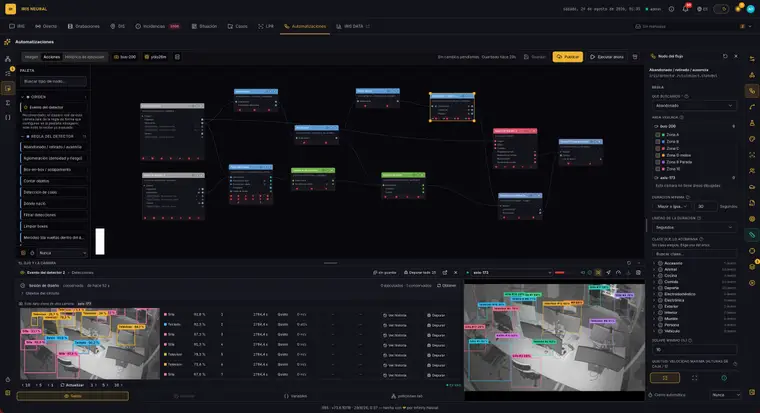
Automation editor: the rule laid out as a block diagram, with the cameras it applies to alongside.
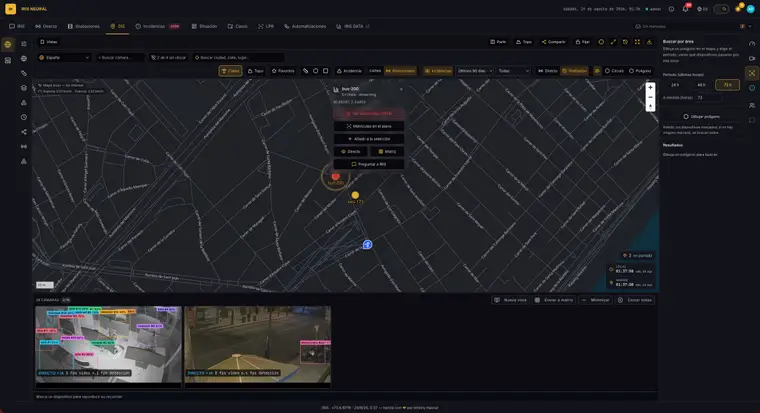
City map with the cameras placed on it, and two of them live underneath.
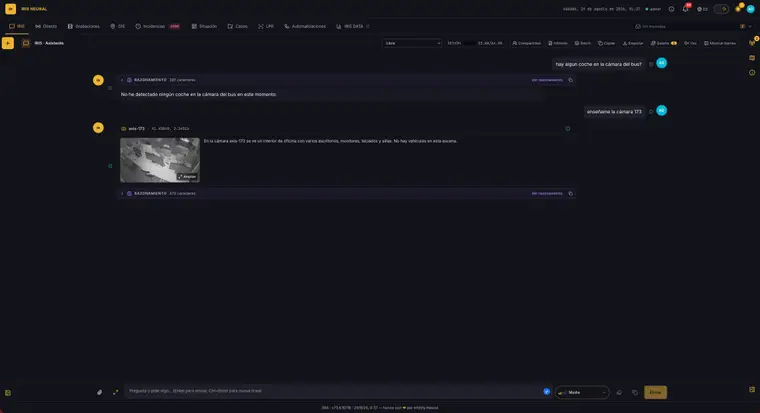
Asking IRIS in writing: “is there a car on the bus camera?”, and the answer with the frame.
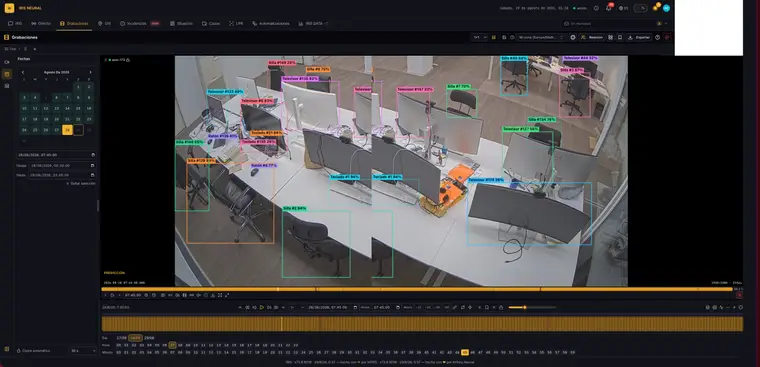
A recording with what IRIS recognises marked on top, object by object.
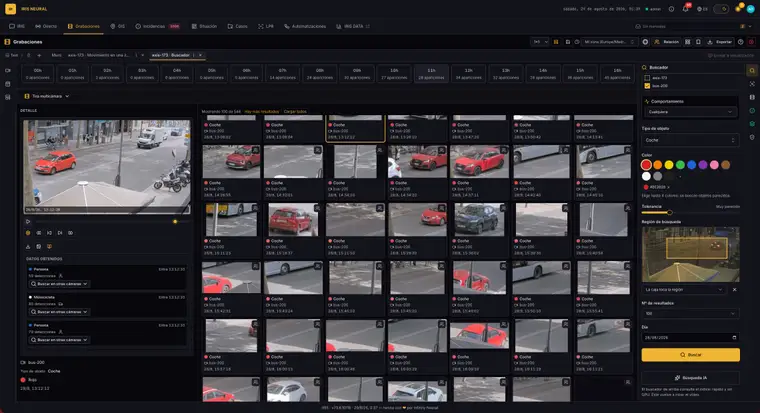
Searching the archive: every red car from one day, without reviewing hours of video.
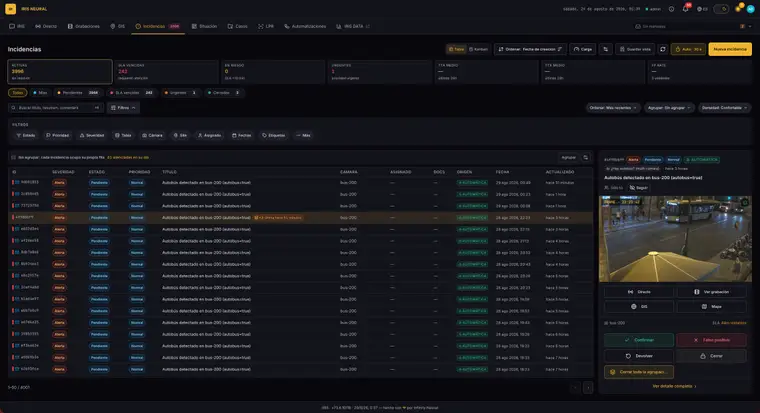
Incident panel: what is open, at what priority and who it is assigned to.


They are small on purpose: this shows what the product looks like, not what it says inside. If you want to see it properly, we will show you in a demo and you can use it yourself.
Every simulation
Twenty rules, and not one of them was written twice.
Each one was written once, in a sentence, and fires in six places with nothing in common: a hospital, a car park, a school playground, a refinery, a station, a stadium. It plays by itself; pick one above if you want a specific one.
Every simulation
Someone on the ground
Tell me if someone stays on the ground for more than twenty seconds and does not get up.
- The sentence
- Where it applies
- What it finds
- The same rule
Every simulation
Fire where it should not be
Alert me as soon as you see a flame outside where it belongs, day or night.
- The sentence
- Where it applies
- What it finds
- The same rule
Every simulation
Smoke where it should not be
Tell me if smoke appears somewhere it should not, even if there is no visible fire yet.
- The sentence
- Where it applies
- What it finds
- The same rule
Every simulation
Water where it should not be
Tell me if water shows up where it should not be and keeps spreading.
- The sentence
- Where it applies
- What it finds
- The same rule
Every simulation
Something has spilled
Tell me if there is liquid or foam outside its place and it is still there two minutes later.
- The sentence
- Where it applies
- What it finds
- The same rule
Every simulation
Something nobody comes back for
Tell me if a bag appears that was not there before and is still there, with nobody beside it, after two minutes.
- The sentence
- Where it applies
- What it finds
- The same rule
Every simulation
Without the right gear
Tell me if someone is in this area without the gear required here, or with their face covered where that does not belong.
- The sentence
- Where it applies
- What it finds
- The same rule
Every simulation
Too many people in one place
Tell me how many people are in this area, and alert me when it goes above three people per square metre.
- The sentence
- Where it applies
- What it finds
- The same rule
Every simulation
Queues that don’t move
Alert me when more than five people have been waiting over ten minutes, and tell me how many desks are open.
- The sentence
- Where it applies
- What it finds
- The same rule
Every simulation
Someone in a closed area
Tell me if someone crosses into the closed area, or if a car sits by the fence for more than five minutes.
- The sentence
- Where it applies
- What it finds
- The same rule
Every simulation
Someone working alone
Tell me if someone is left alone in that area for more than ten minutes, with nobody else nearby.
- The sentence
- Where it applies
- What it finds
- The same rule
Every simulation
The way out is blocked
Tell me if the emergency exit, or the way to it, stays blocked for more than five minutes.
- The sentence
- Where it applies
- What it finds
- The same rule
Every simulation
On foot among machines
Tell me if someone walks into where a machine is moving and stays there for more than five seconds.
- The sentence
- Where it applies
- What it finds
- The same rule
Every simulation
Someone or something out of place
Tell me if someone or something enters a restricted area and stays there for more than a minute.
- The sentence
- Where it applies
- What it finds
- The same rule
Every simulation
At night, with nobody watching
Tell me if anything moves on any camera on the site between eleven at night and six in the morning.
- The site
- The rule in place
- An alert fires
- The camera
Every simulation
Car stopped where it shouldn’t
Tell me if a vehicle stays put for more than two minutes on a roadway, on a ramp or in front of a door.
- The site
- The rule in place
- An alert fires
- The camera
Every simulation
Search by number plate
Show me every time that plate crossed the barrier this week, with the time and the video.
- What you are looking for
- Where to look
- What matches
- Who looks
Every simulation
Search by what you can see
Show me where you have seen somebody walking out carrying a large box over the last half hour.
- What you are looking for
- Where to look
- What matches
- Who looks
Every simulation
Something goes out the wrong way
Tell me if something crosses a door that is not a thoroughfare, or if material leaves the site between eleven at night and six.
- What you are looking for
- Where to look
- What matches
- Who looks
Every simulation
How many pass, and when
Draw me a line on each door and a zone inside the room, and tell me how many cross and how many are in there each hour.
- The sentence
- Where it applies
- What it finds
- The same rule
Every simulation
On the edge of a drop
Tell me if someone steps to the edge of a drop with nothing holding them.
- The sentence
- Where it applies
- What it finds
- The same rule
Every simulation
Inside, and nobody outside
Tell me if someone enters a pit, a silo or a vessel and nobody is left in the watch area outside.
- The sentence
- Where it applies
- What it finds
- The same rule
Every simulation
Hands inside, machine live
Tell me if someone puts their hands into a machine that still has power: no lockout, no padlock, beacon still lit.
- The sentence
- Where it applies
- What it finds
- The same rule
Every simulation
Underneath something moving
Tell me if someone is under a suspended load or in the path of something heavy that is already moving.
- The sentence
- Where it applies
- What it finds
- The same rule
Every simulation
Emergency gear blocked
Tell me if something blocks an exit, an emergency shower or a fire lane, or if the equipment is not where it belongs.
- The sentence
- Where it applies
- What it finds
- The same rule
Every simulation
Inspect them all every day
Every day at ten in the morning, look at every camera and tell me which have got worse.
- The sentence
- Where it applies
- What it finds
- The same rule
Every simulation
Somebody is touching a camera
Alert me if a camera suddenly stops seeing, or if somebody reaches it.
- The sentence
- Where it applies
- What it finds
- The same rule
Every simulation
Which ones are seeing nothing?
Show me the cameras that are not giving a usable picture right now.
- What you are looking for
- Where to look
- What matches
- Who looks
Everything it knows how to watch
What IRIS detects, said in your own words.
Each line is a real rule: on the left what it is called, on the right the sentence you would say to IRIS to set it up. There is no new language to learn and no menu to open.
- Someone on the ground
- Tell me if someone stays on the ground for more than twenty seconds and does not get up.
- Fire where it should not be
- Alert me as soon as you see a flame outside where it belongs, day or night.
- Smoke where it should not be
- Tell me if smoke appears somewhere it should not, even if there is no visible fire yet.
- Water where it should not be
- Tell me if water shows up where it should not be and keeps spreading.
- Something has spilled
- Tell me if there is liquid or foam outside its place and it is still there two minutes later.
- Something nobody comes back for
- Tell me if a bag appears that was not there before and is still there, with nobody beside it, after two minutes.
- Without the right gear
- Tell me if someone is in this area without the gear required here, or with their face covered where that does not belong.
- Too many people in one place
- Tell me how many people are in this area, and alert me when it goes above three people per square metre.
- Queues that don’t move
- Alert me when more than five people have been waiting over ten minutes, and tell me how many desks are open.
- Someone in a closed area
- Tell me if someone crosses into the closed area, or if a car sits by the fence for more than five minutes.
- Someone working alone
- Tell me if someone is left alone in that area for more than ten minutes, with nobody else nearby.
- The way out is blocked
- Tell me if the emergency exit, or the way to it, stays blocked for more than five minutes.
- On foot among machines
- Tell me if someone walks into where a machine is moving and stays there for more than five seconds.
- Someone or something out of place
- Tell me if someone or something enters a restricted area and stays there for more than a minute.
- At night, with nobody watching
- Tell me if anything moves on any camera on the site between eleven at night and six in the morning.
- Car stopped where it shouldn’t
- Tell me if a vehicle stays put for more than two minutes on a roadway, on a ramp or in front of a door.
- Search by number plate
- Show me every time that plate crossed the barrier this week, with the time and the video.
- Search by what you can see
- Show me where you have seen somebody walking out carrying a large box over the last half hour.
- Something goes out the wrong way
- Tell me if something crosses a door that is not a thoroughfare, or if material leaves the site between eleven at night and six.
- How many pass, and when
- Draw me a line on each door and a zone inside the room, and tell me how many cross and how many are in there each hour.
- On the edge of a drop
- Tell me if someone steps to the edge of a drop with nothing holding them.
- Inside, and nobody outside
- Tell me if someone enters a pit, a silo or a vessel and nobody is left in the watch area outside.
- Hands inside, machine live
- Tell me if someone puts their hands into a machine that still has power: no lockout, no padlock, beacon still lit.
- Underneath something moving
- Tell me if someone is under a suspended load or in the path of something heavy that is already moving.
- Emergency gear blocked
- Tell me if something blocks an exit, an emergency shower or a fire lane, or if the equipment is not where it belongs.
- Inspect them all every day
- Every day at ten in the morning, look at every camera and tell me which have got worse.
- Somebody is touching a camera
- Alert me if a camera suddenly stops seeing, or if somebody reaches it.
- Which ones are seeing nothing?
- Show me the cameras that are not giving a usable picture right now.
This list is not everything you can ask for: these are the rules already built, which you can watch running. A new rule is written as a sentence, which is why the list keeps growing.
See it somewhere else

What does a shopping centre see beyond the visitor count?
12 cases: 4 raise an alert when something happens and 8 only measure. You see each image as it is, and then with what IRIS understands on top.

What does an airport see before the queue forms?
14 cases: 7 raise an alert when something happens and 7 only measure. You see each image as it is, and then with what IRIS understands on top.


And the best part
You do not need to buy cameras:you need yours to understand what they see.
Nothing gets built, mounted or rewired. It plugs into what is already up and running, and the only thing that changes is what those cameras understand.
Tell us your problem and we will say whether IRIS understands it, or not yet.
We reply the same working day.