Who watches a whole station at rush hour?
Thousands of people pass through a station every hour. IRIS watches all its cameras at once.
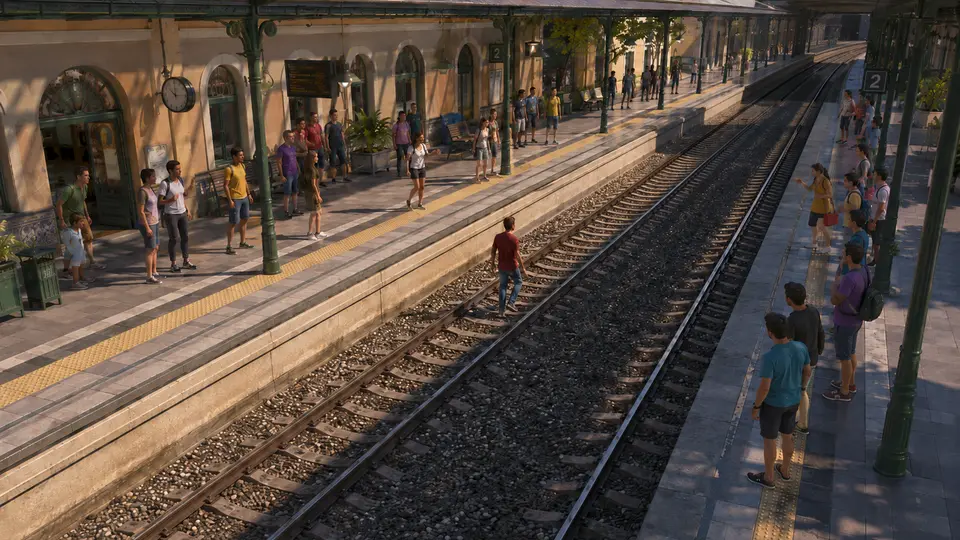
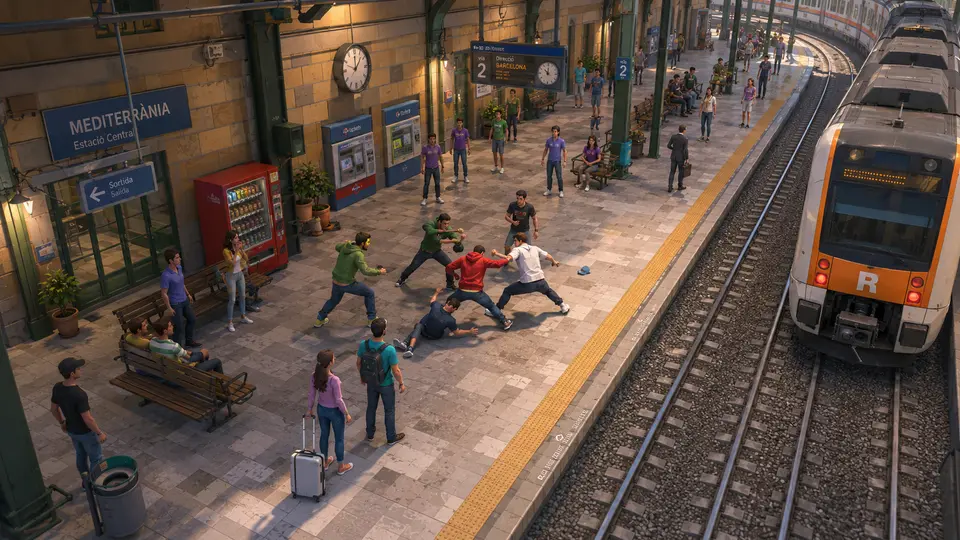
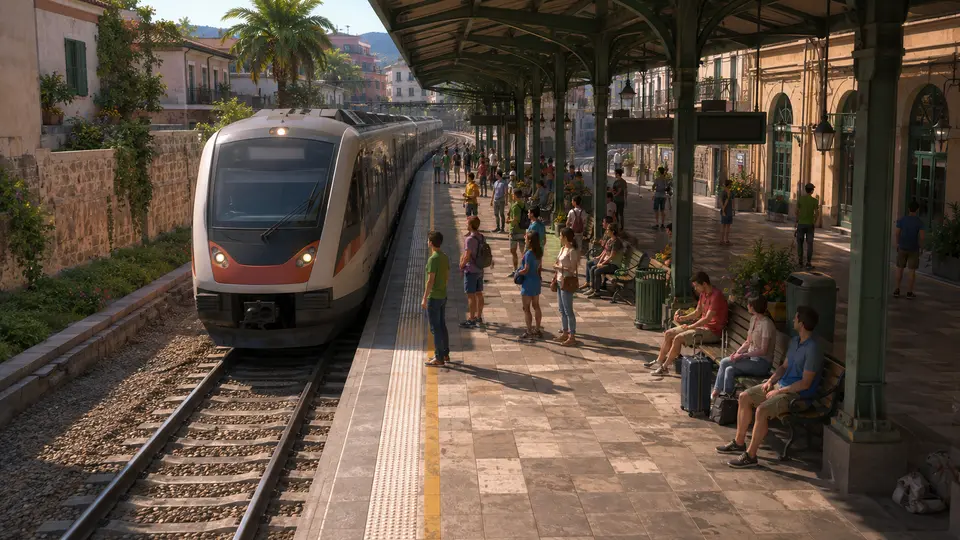
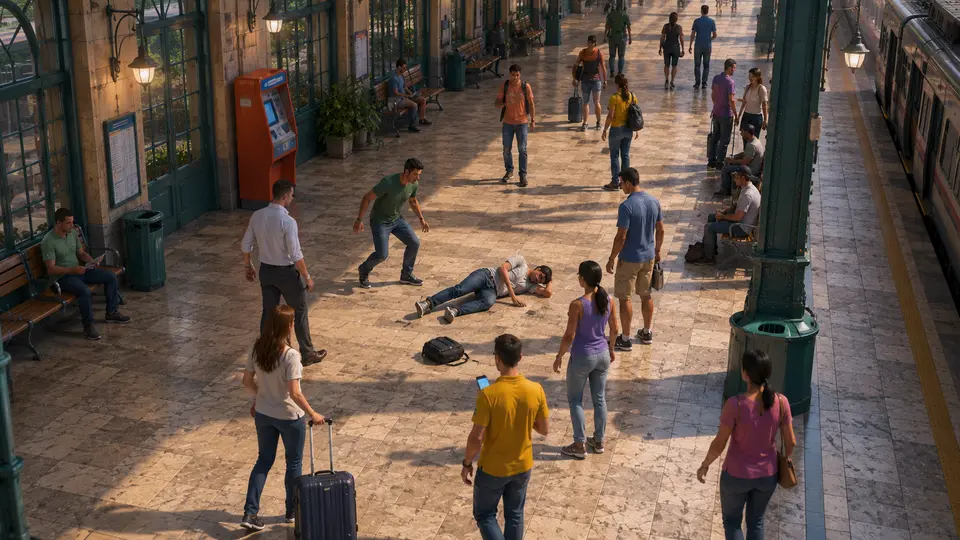
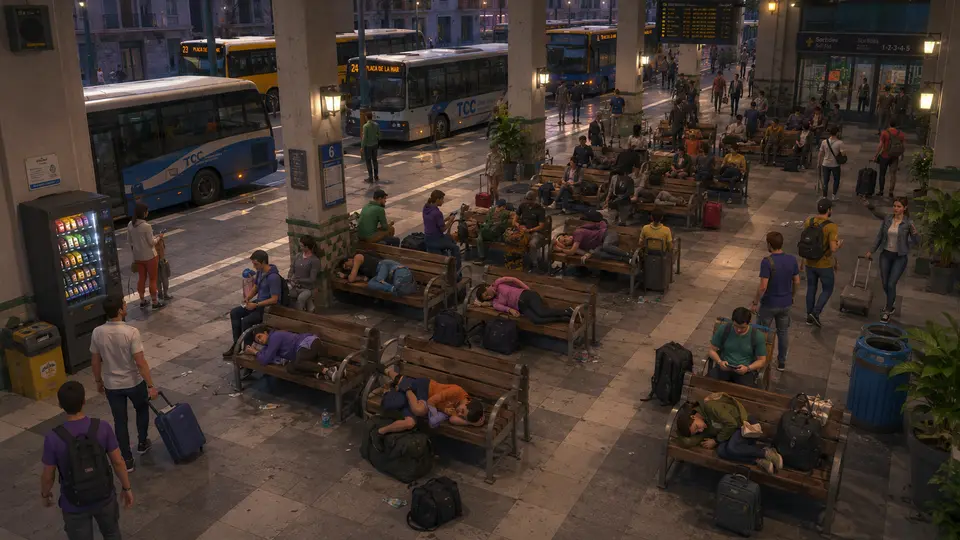
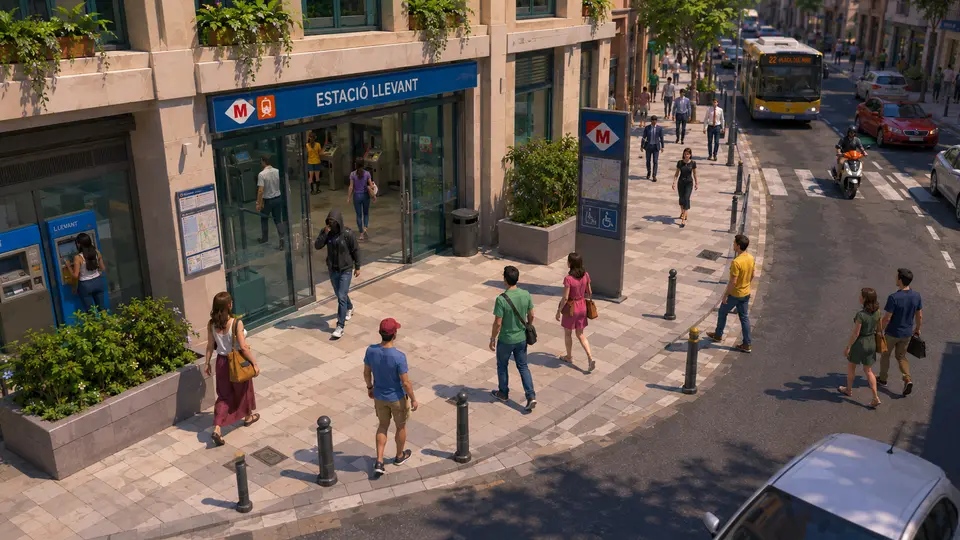
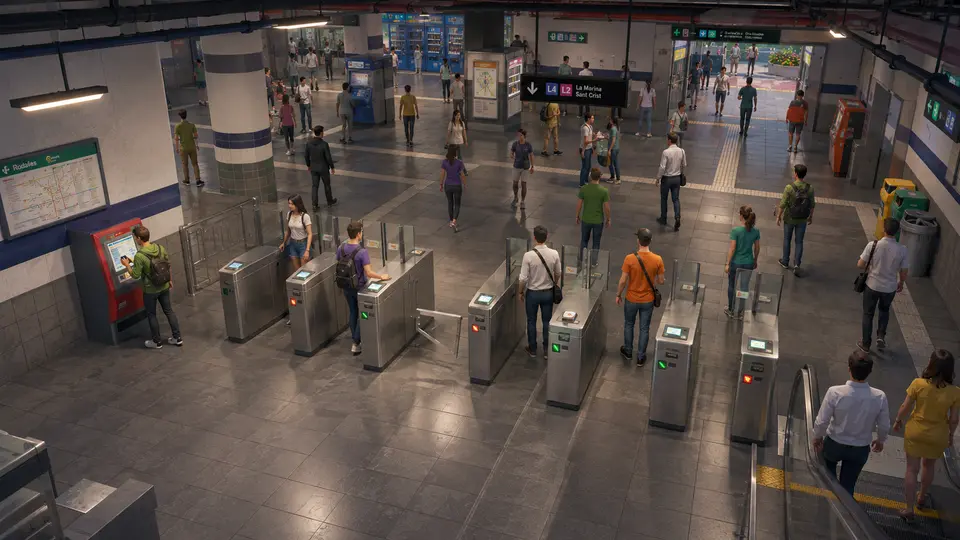
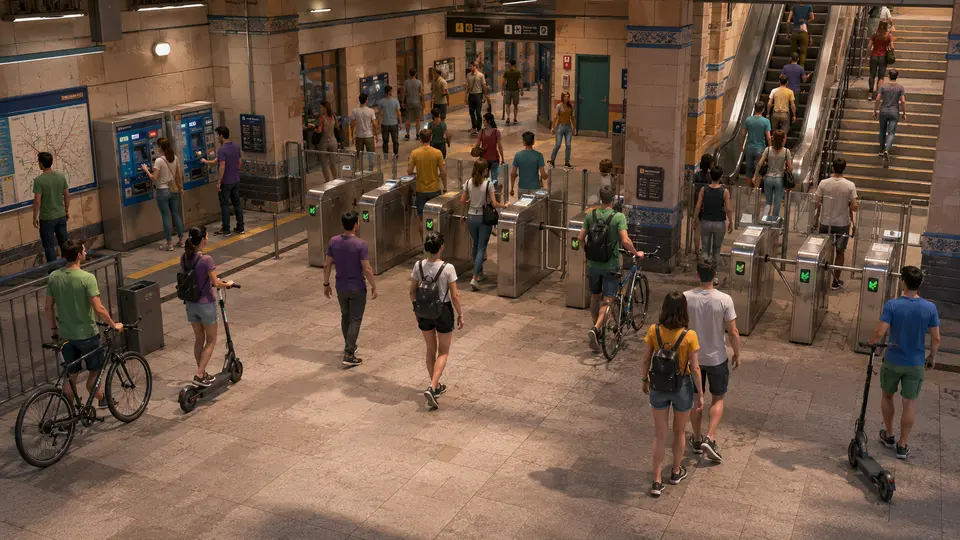
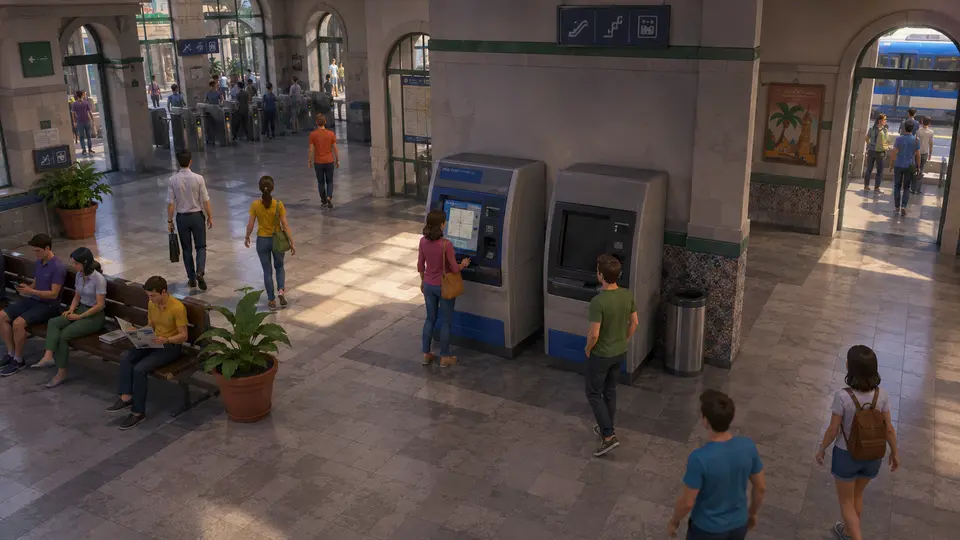
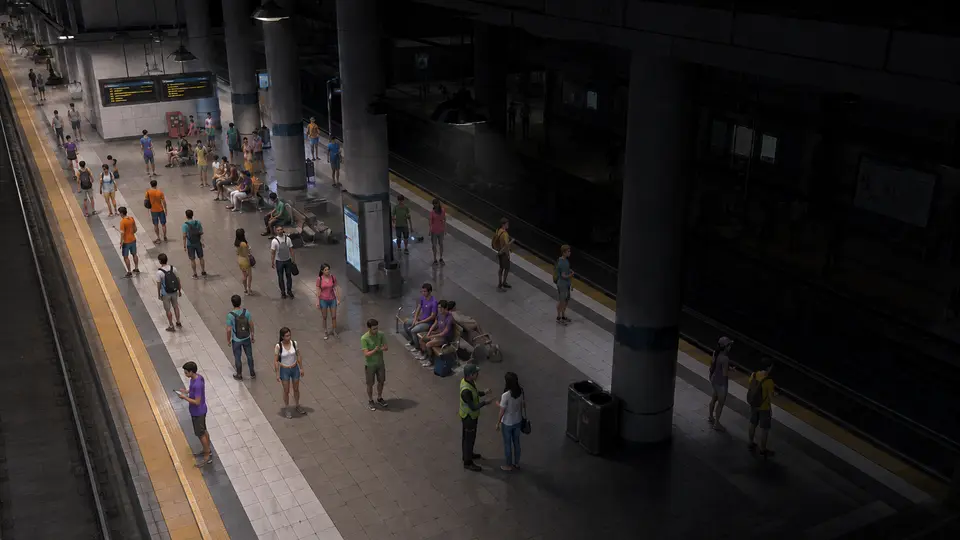
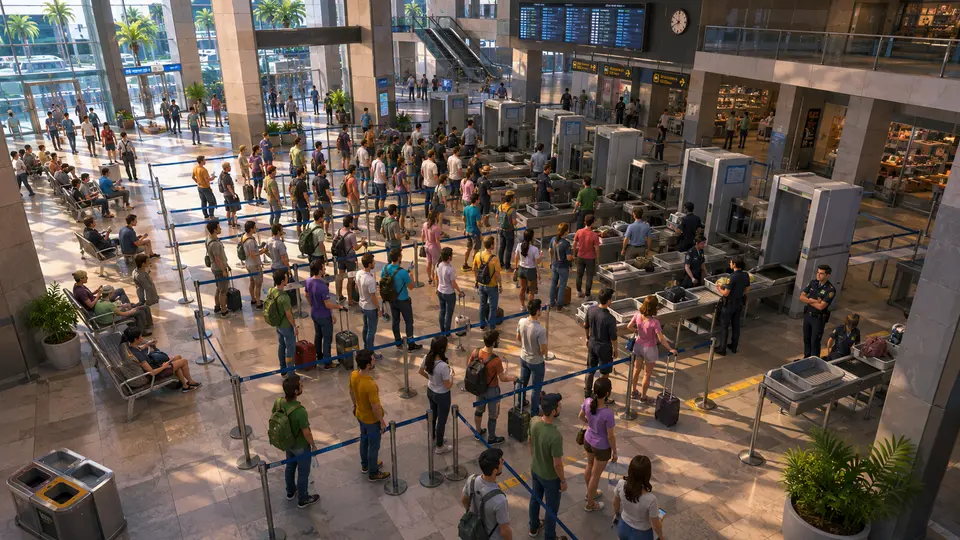
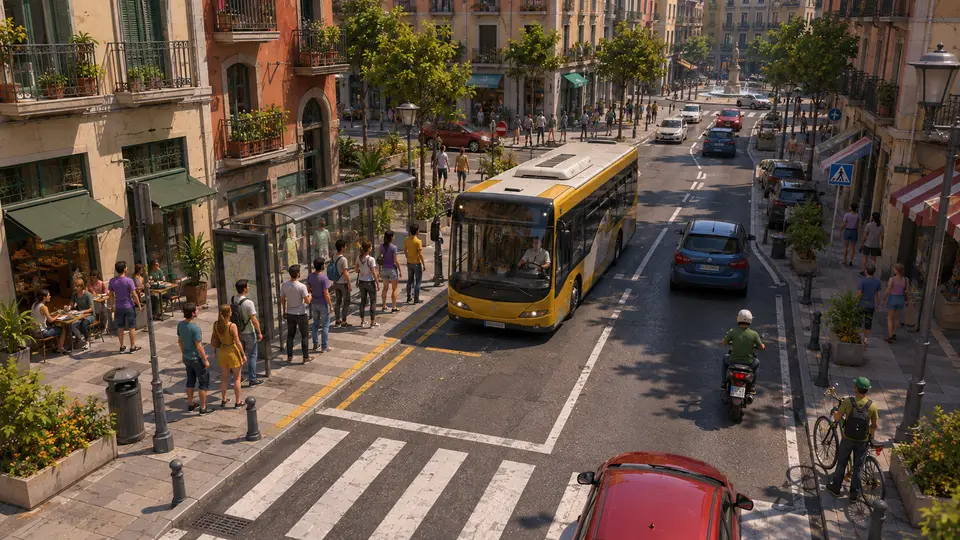
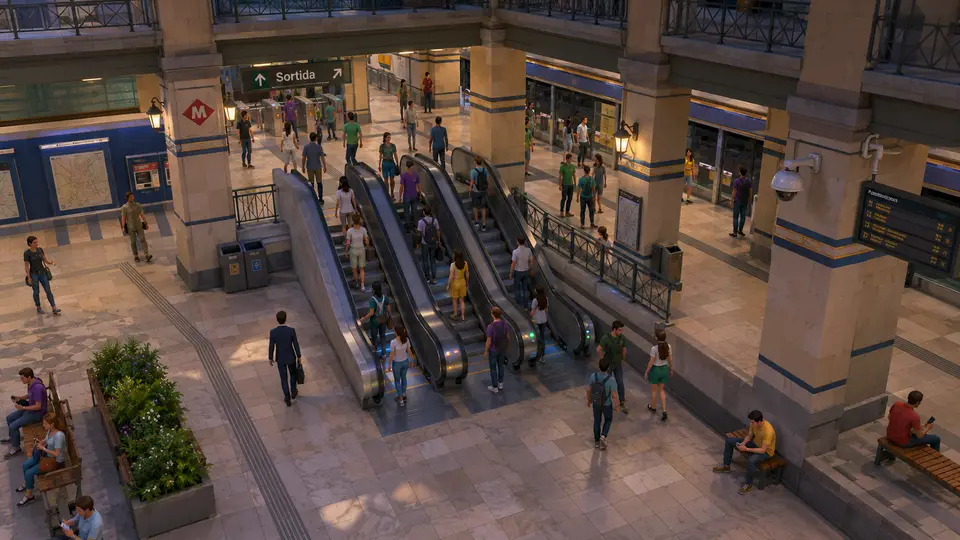
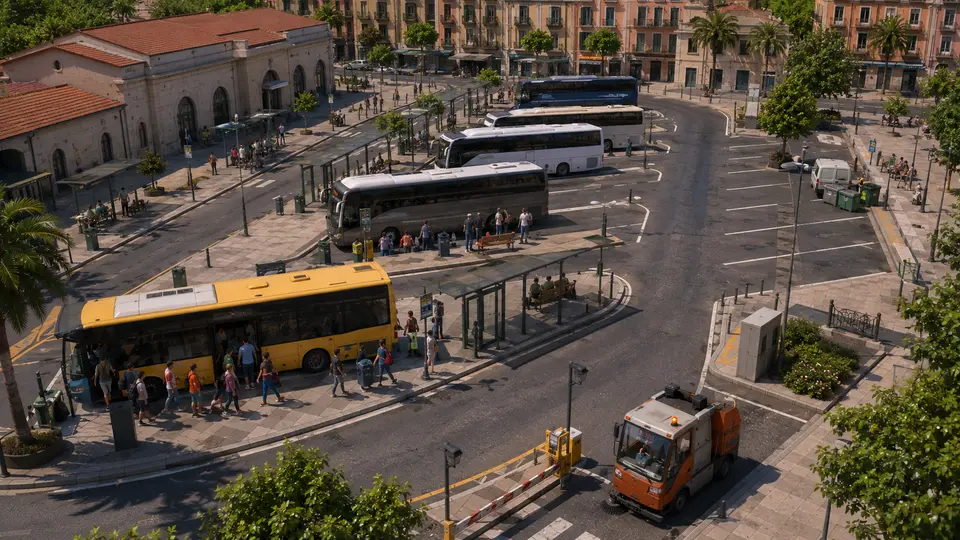
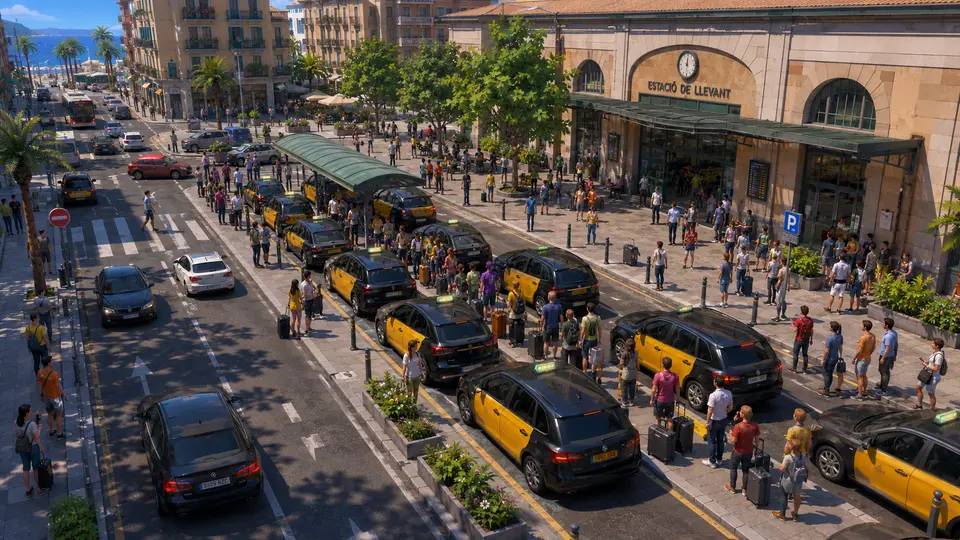
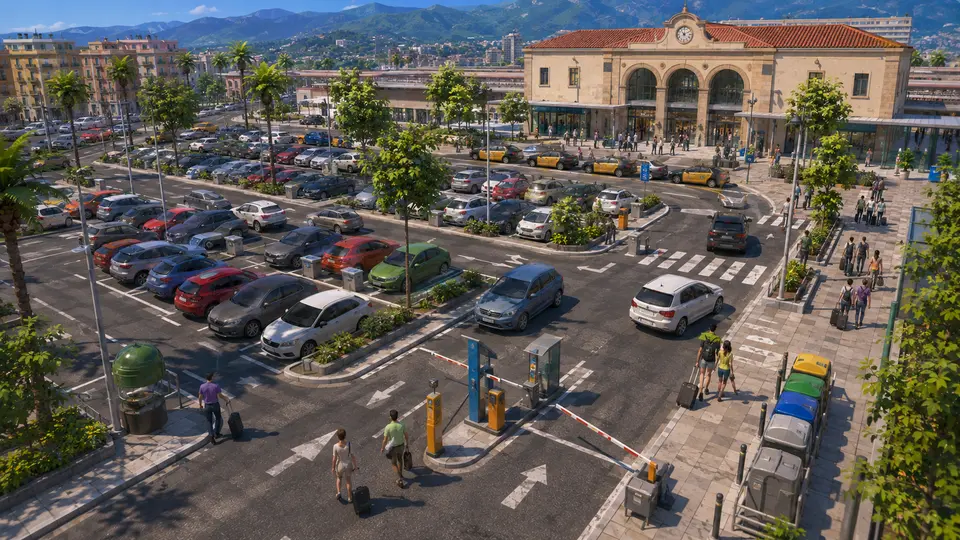
We show seventeen cameras here: eleven that raise an alert when something happens and six that alert nobody, they just measure. A real station has cameras on the platforms, in the concourse, in the corridors, at the gatelines, in the bus bays, at the taxi rank and in the car park, and a control room with a handful of people per shift. The system is exactly the same.

Without IRIS this is just a station full of people.
AI-generated image
What IRIS is
IRIS keeps watch over the platform for you.
IRIS looks at the cameras you already have on platforms, gates and entrances and understands what's happening: an overcrowded platform, someone falling onto the tracks, a fight or a forced gate. When something important happens, it alerts you; and whatever can be counted, it counts. All day long, with no one watching a screen.
You tell it what you need to watch, and IRIS does it.
Works with the cameras you already have. Nothing to replace.
A person replies, not a form.
- Your footage never leaves your premises.
- It doesn't identify people.
- Certifications →
The whole station, understood
What really keeps you awake in a station is something happening to a passenger. Somebody falling onto the track just before the train comes in. Somebody collapsing in a corridor while people stand around not knowing what to do. A platform so full that the people at the back push towards the edge without meaning to. There are a few people in the control room and a lot of screens, and almost always the passenger standing next to it finds out before the system does.
IRIS watches for the control room. It analyses every camera in the station at once and only interrupts when a rule your own team set is met: a person down on the track, a person on the ground, a fight on the platform, a platform over the capacity you set, somebody crossing the safety line right where the train brakes. The alert arrives with the camera, the time and what can be seen, not with «something seems to be going on at platform 3».
And one thing has to be said before anything else, because a station is full of people: IRIS does not identify anyone. It detects objects, behaviours and situations. It does not recognise faces, it does not compare them against any database and it does not store who anybody is. That is why the two most delicate scenes are told the honest way round. Somebody asleep on a bench is not a security alarm: it is information for social services, who need to know where and how many people are sleeping there in order to go out to them. And a covered face is not a trait of a person: it is a situation at one specific entrance, and it only makes sense combined with another condition you set yourself.
And then there is everything that is not an emergency but ends up as a complaint: the ticket machine that has not sold a ticket for two days, the gate that was left open last night, the corridor that has gone dark. IRIS sees it from the camera itself and reports it the same day. And where there is nothing to alert about, it measures: how many people are on the platform, how long the wait at the security check really is, how many people are left behind at the bus stop, how many cars come into the car park and when. That is what tells you whether you need another security lane or another bus, with data from every day instead of a three-day count.
The real scale
Seventeen cameras here. Thousands of passengers an hour out there.
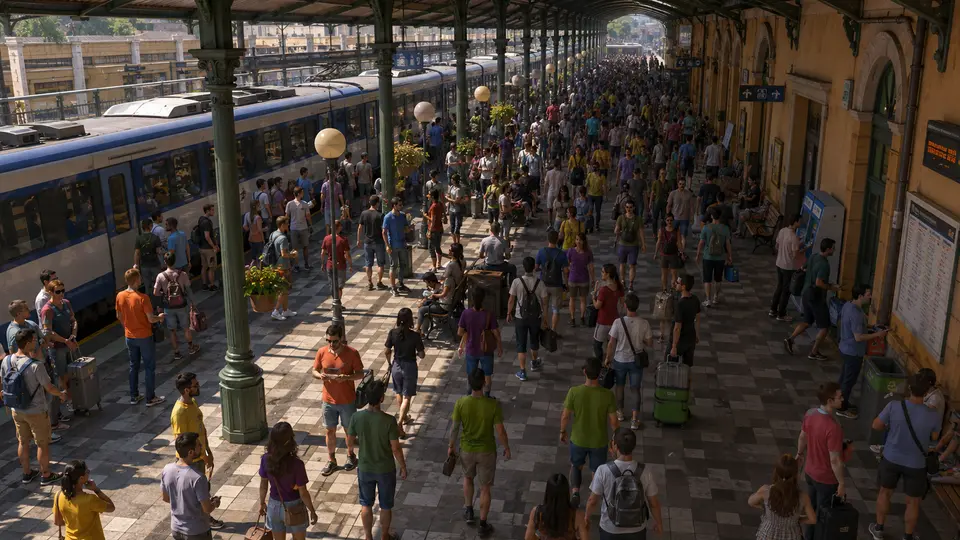
This demo shows seventeen cameras because seventeen fit on a screen. A station does not fit: at rush hour thousands of people go through it, and they all head at the same time for a platform, a gateline, an escalator or a bus. In front there are cameras on platforms, in the concourse, in corridors, at entrances, in the bus bays and in the car park; behind them, a control room with a handful of people per shift. Nobody can watch all of that, and it is nobody's fault: there are not enough eyes. That is exactly the problem IRIS solves: it analyses however many cameras there are, all at once, and only interrupts when a rule is met. And where there is nothing to watch for, it counts: how many people there are, how long they wait and which way they leave.
Examples
These seventeen are just examples.
Eleven raise an alert when something happens and six alert nobody: they only measure. They are not the seventeen things IRIS can do in a station; they are the ones that fit on a screen. Open any of them and you will see the image as it is, and then with what IRIS understands on top.
See it in action
See it for yourself
Everything comes in. Only what matters gets through.
This sums up what IRIS does with one alert, from the moment it appears until it is closed. The real screen holds far more; this is the main thread.
- Four cameras at once
- Each understands its own view
- The numbers climb by themselves
Now think about your own station
Imagine finding all of that out without a passenger having to tell you.
A ticket machine that has not sold a ticket since yesterday. A gate left open last night that people are still walking through. A blown bulb in the corridor down to the car park. How many people were left behind by the eight o'clock bus. How long the wait at the security check really was on Friday afternoon. An escalator stopped at rush hour with everybody diverted to the one next to it. How many people slept on the concourse benches last night, so that social services know where to go.
All of that is happening right now, in front of cameras your station already owns and already paid for. And right now nobody knows, because there is a handful of people in the control room and a whole station out there. IRIS watches all those cameras at once and tells you when it happens, not when the complaint arrives. In front of cameras that already exist.
What the operator's committee asks
The ten questions that come up before signing.
Answered in the first line, straight, with no promises that fall apart on a packed platform on a Friday afternoon.
Does it work with the cameras we already have in the station?
Yes, IRIS works with the cameras you already have in the station. It connects to the feed of the IP cameras on platforms, in the concourse, in corridors, at the gatelines and at the entrances, and analyses it as it arrives: what changes is not the camera on the ceiling, it is what gets understood from the picture. During the project we check camera by camera whether the framing is enough for what you want to detect at that spot — a camera looking along the platform is not the same as one looking across it — and we tell you plainly which ones fall short. Replacing a camera is the exception, not the starting point.
Does IRIS identify passengers?
No, IRIS does not identify passengers. It detects objects, behaviours and situations: a person down on the track, a person on the ground, a platform filling up, an open gate, a machine that is off, a stopped escalator. It does not recognise faces, it does not compare them against any database and it does not store who anybody is. When it counts people, the result is a number — how many people are in an area or how many go past a point — never a list of who went through. And what is stored, for how long and who may see it is your decision: the system can run entirely inside the station, without a single image leaving it.
Does it detect somebody falling onto the track?
Yes, IRIS detects a person falling onto the track, because the track is an area drawn on the image and a person inside that area is a rule that triggers by itself. The alert goes out with the camera and the time, and the control room has the picture open without waiting for a passenger to hit the emergency button or use the intercom. The honest part: the detection depends on that camera actually seeing the track, and not all of them do. During the project we review platform by platform what framing is needed and tell you which ones fall short.
Does it work when the platform is packed with people?
IRIS works when the platform is packed, with one caveat we would rather say before signing: when people block each other, some things stop being visible. Somebody who falls to the ground behind a tight group can be hidden from that camera, and what cannot be seen cannot be detected. Occupancy, on the other hand, is still measured just the same: telling how full a platform is getting does not require telling one person from another. That is why platforms are best covered with more than one framing: two perspectives of the same platform block each other far less than one.
How does the alert go out, and to whom?
The alert is sent to whoever you decide, over the channel you decide. Every rule carries its recipient: the control room position, the station manager, the maintenance team, the security detail. On screen it opens the camera with what was seen, the time and the video of the moment, so that the person deciding sees exactly what the system saw and not a bare label. And a person on the track does not have to travel the same route as a broken ticket machine: each alert goes to whoever can deal with it. Who decides what to do is always a person: IRIS opens the camera, shows it and waits.
Can it replace the passenger counts we do today?
IRIS can replace the passenger counts you do today, and it does what they cannot: count every day of the year, at every hour, at every point you care about. A three-day count gives you a snapshot of three days; a camera with IRIS gives you the whole season, showing which way people come in, how long they wait at the security check and how many are left behind at a stop. And for people counting, our system is type-approved by the Spanish Metrology Centre: that is the guarantee that the figure you present is the right one, because the one who checked it is a third party and not us. Worth putting precisely: that approval covers people counting, not the whole product.
Does the video leave the station?
The video leaves the station or stays inside depending on the option you choose, and there are exactly two. In the on-site option it does not leave: the servers are in your own facilities, the video comes in over your network, it is analysed there and the system does not need the internet to work. In the other one it is processed in our data centre, which is our own cloud and not a third party's. In both, communications are encrypted and the terms are set out in the contract. It is worth deciding early, because it drives how the station's network and servers are sized.
And what about data protection, with so many people in front of the cameras?
Data protection is handled by configuring the processing piece by piece: what is stored, for how long, who can access it and from where. That is the starting point, and above it sits the part that weighs most: IRIS does not identify anyone, so there are no identities to protect. Compliance, though, does not depend on the software alone: it also depends on how you deploy it and what you decide to process, and that is signed off by your organisation, not by us. What we can put on the table is that our way of working is certified for information security and for privacy by an external auditing body. That paper is not signed by a salesperson: it is signed by an auditor, and you can ask us for it before you sign anything.
What about false alarms in a busy station?
False alarms exist in a busy station, and anyone who tells you otherwise has never put a detection system in front of that many people. An emotional goodbye looks like a scuffle. A rucksack on the floor looks like an abandoned bag. A reflection on a wet floor looks like anything at all. That is why a rule is never a single condition, but what is seen, where it is seen and how long it has been there. Those three values get tuned with your operators over the first few weeks, platform by platform and entrance by entrance, until what reaches the control room is what the control room wants to get. An alert the afternoon shift learns to ignore is a badly tuned alert, and that can be fixed.
How much does it cost to put IRIS on a station's cameras?
The cost is worked out from how many cameras are analysed, what is detected or measured on each one, which deployment option you choose and whether the hardware is yours or we supply it. There is no single price list, because analysing the platforms of a small station does not cost the same as a whole station with concourse, gatelines, bus bays, taxi rank and car park, and neither costs the same as a network of twenty stations. Tell us how many cameras you have and what you want to detect on each, and we will give you a number. The phone number is +34 93 566 70 22.
See it somewhere else
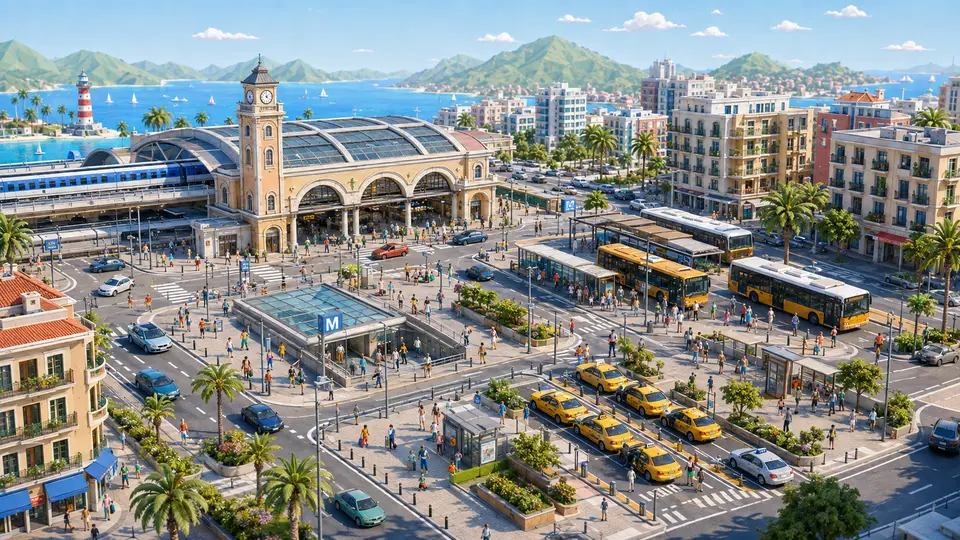
Who watches a whole station at rush hour?
17 cases: 11 raise an alert when something happens and 6 only measure. You see each image as it is, and then with what IRIS understands on top.

Who sees the sales that never reach the till?
10 cases: 4 raise an alert when something happens and 6 only measure. You see each image as it is, and then with what IRIS understands on top.


And the best part
You write the rule yourself, in your own words.Nobody has to program it for you.
“Tell me if a fire door is left open.” That is the whole rule. From then on it applies on every camera and at any hour, without ever touching it again.
Tell us your problem and we will say whether IRIS understands it, or not yet.
We reply the same working day.