When does a bad review get decided?
The review gets written afterwards. IRIS sees the queue while you can still fix it.
There are fifteen cameras here: eleven that raise an alert when something is going wrong and four that alert nobody, they just count. They are at reception, in the lounge, in the dining room, in the kitchen, at the door and in the back of house. None in a bedroom, a bathroom or a changing room.

Without IRIS these are fifteen screens nobody watches while the queue grows.
AI-generated image
What IRIS is
IRIS looks after every corner of the hotel for you.
IRIS is an artificial intelligence that watches the cameras you already have at the hotel and understands what's happening at reception and in the common areas. When a queue builds up, an area gets busier than usual, or something you've asked it to watch happens, it alerts you — and whatever can be counted, like how busy each space is, it counts in numbers. All day long, with no one needing to watch a screen.
You tell it what you need to watch, and IRIS does it.
Works with the cameras you already have. Nothing to replace.
A person replies, not a form.
- Your footage never leaves your premises.
- It doesn't identify people.
- Certifications →
What happens before the review
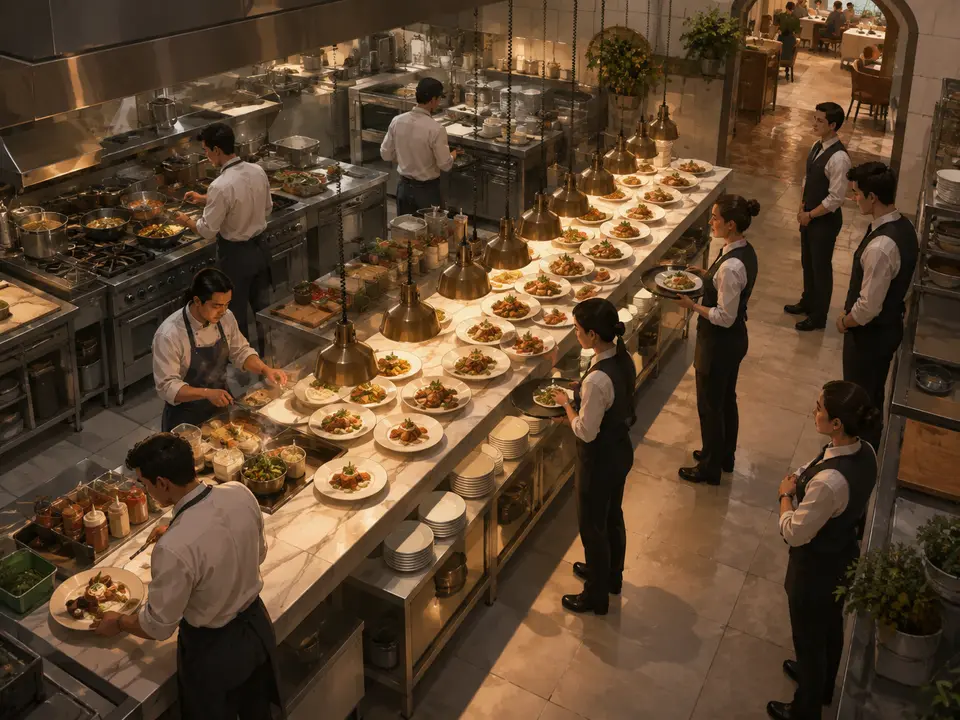
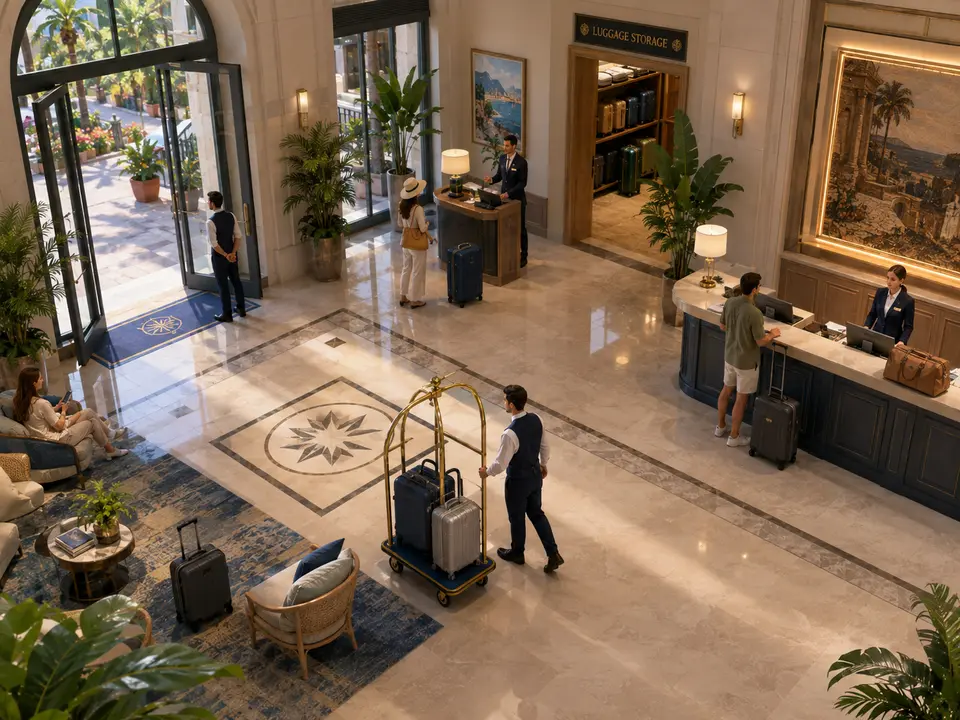
A whole coach pulls up and there is one person at the desk. Nineteen guests standing with their bags beside them. In the dining room four people are looking for a table while five tables have sat uncleared for eight minutes. A finished plate is going cold on the pass. The buffet tray is empty and the guest is already in front of it. None of this is a breakdown. It is a bad moment, and a bad moment costs you a star.
IRIS watches those cameras all the time and only interrupts when a rule you wrote is met: this many people waiting at reception, this many minutes with a table uncleared, a plate stuck on the pass, an empty tray. The alert reaches whoever is on shift with the camera, the time and the video. And alongside it, alerting nobody, other cameras count: how many people come down to breakfast and when, how long the queue lasts on a Thursday, how many people are in the room right now.
And now the limit, in full and up front, because in this business it is the first thing anyone needs to hear. Bedrooms, bathrooms, changing rooms and any private space are out: no camera, no detection, no alert. IRIS works at reception, in circulation areas, in food service, outside and in the back of house. Nowhere else. A hotel sells on how it treats people, and that starts with not looking where you do not look.
The real scale
Fifteen here. Two hundred in a real hotel.
This demo shows fifteen cameras because fifteen fit on a screen. A mid-sized hotel has hundreds: reception, shared corridors, lifts, lounges, meeting rooms, dining room, kitchen, pantry, car park, pool, loading dock and service door. And a group with fifteen hotels multiplies that by fifteen, with the same operations director watching. Nobody can keep an eye on that many screens; that is exactly the problem IRIS solves: it analyses however many there are, all at once, and only interrupts when it should. On the rest it counts, and at the end of the season you have the number.
Examples
These fifteen are just examples.
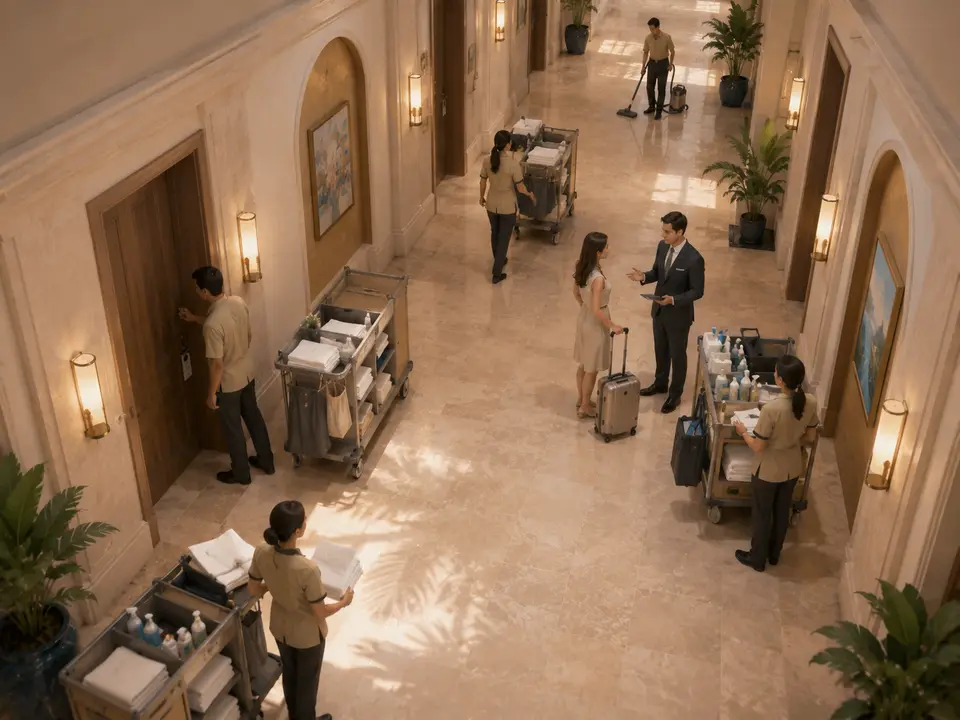
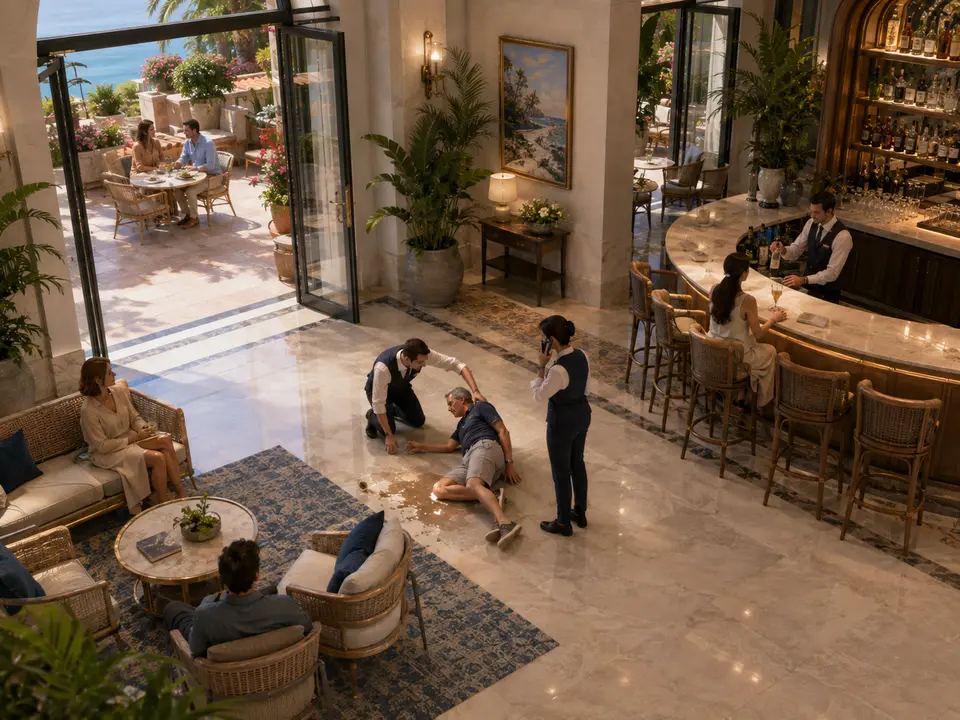
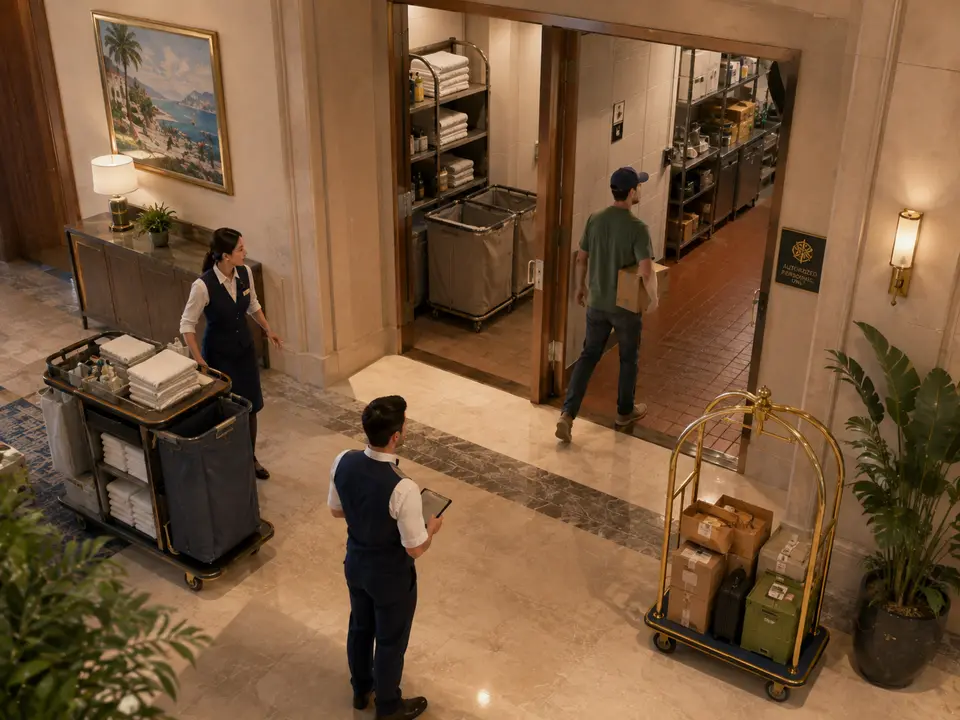
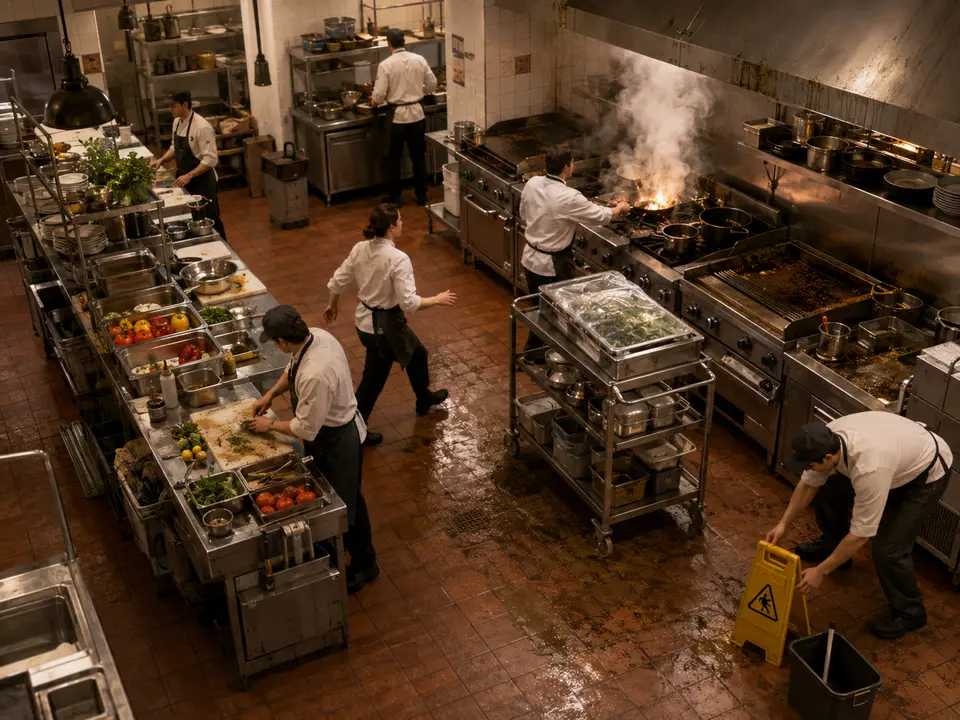
Each one shows a different kind of thing: a queue, a table, a plate, a suitcase, a flare-up. They are not the fifteen things IRIS can do: they are the ones that fit on a screen. Open any of them and you will see the image as it is, and then with what IRIS understands on top.









See it in action
Simulation · how IRIS works
A camera looks. IRIS understands what it sees.
An extract of the real screen, no voice-over and hands-free. Each round poses another situation. What sits behind it is a good deal bigger than what you see.
- The rule gets built
- It goes to every camera
- Published, it watches alone
- And then it fires
Now think about yours
Imagine finding out while it can still be fixed.
The check-in queue at four on a Saturday afternoon. Breakfast packed at nine and half the room empty at eleven. The table left uncleared for ten minutes while people wait standing for a seat. The plate going cold on the pass. The empty buffet tray. The suitcase left on its own in the lounge. The person who has fallen in the lobby and is not getting up. The smoke in the kitchen. And how many people are in the room right now, without counting by eye.
All of that is happening in front of cameras your hotel already owns and already paid for. And here is the other limit, the one that matters twice as much in this business: IRIS does not measure an employee. The alert is there to open another desk or send somebody to the pass, not to point at a waiter or score a receptionist. It measures the situation, never the person. And in the bedrooms, the bathrooms and the changing rooms there is nothing to measure, because there is no camera there.
What comes up in the management meeting
The ten questions that come up before anyone says yes.
Answered in the first line, no detours. And two get answered before all the rest: where there is no camera, and why this does not measure a waiter.
Are there cameras in the rooms?
No, there are no cameras in the rooms. None in the bathrooms or in the staff changing rooms either. There is nothing to measure there, because there is no camera there and there will not be one. The cameras this page talks about are at reception, in the lounge, in the dining room, in the kitchen, at the door and in the service area: shared spaces, where cameras already hang today. If anyone offers you analysis inside a guest room, know that we do not do it, and that it is not an oversight: it is a decision.
Is this for keeping tabs on my staff?
No, this is not for keeping tabs on your staff, and it needs saying plainly. IRIS measures the situation, never the person: it sees “a table uncleared for eight minutes”, not who was meant to clear it. The alert is there so you open another desk or send someone to the pass, not to single out a waiter or score a receptionist. It identifies nobody, it is no time clock and it is no basis for discipline. If there is a works council, this is the first thing to be able to show them, and the sooner the better.
Does IRIS identify guests or recognise faces?
No, IRIS does not identify guests and does not recognise faces. It detects objects, behaviours and situations: a queue building up, a suitcase alone in the lounge, an empty tray, a person on the floor. It compares no face against any database, it follows nobody from one room to another and it is never cross-referenced with the loyalty programme or the booking record. Counting is aggregated and anonymous: it says how many people are in the dining room at half past nine, never who they were. A counted person is a one: nothing else of them is kept.
Does it work with the cameras we already have in the hotel?
Yes, it works with the cameras you already have in the hotel. IRIS connects to the feed of the installed IP cameras and analyses it as it arrives: what changes is not the equipment, it is what gets understood from the picture. Now the uncomfortable part: not all of them are good enough. A camera hung to watch the door may not tell whether a buffet tray is empty, and the reception camera facing a glass façade at midday gives a burnt-out picture where counting goes wrong. During the project we look camera by camera, and we tell you plainly which ones fall short and which would only need moving a few degrees.
Does it really measure how long people wait at reception?
Yes, it really measures how long people wait at reception, and it is done by drawing, not by talking. You trace the waiting area and the desk line onto the image. IRIS counts how many people enter the area and how many get served: the difference is whoever gave up and left. Asking is for searching. Counting is for measuring. And they are not done the same way: a line cannot be described in a sentence, it has to be traced. For people counting our system is type-approved by the Spanish Metrology Centre, so that figure has been verified by a third party, not by us. Worth putting precisely: that approval covers people counting, not the whole product.
Does it work in the kitchen, with the steam and the heat?
It works in the kitchen with one caveat we would rather state before signing. A flare-up over the pan shows clearly: it is big, it is bright and it appears all at once. So does a puddle on the floor. What shows badly is thin smoke, and steam from a dishwasher or a stockpot can cover half the picture and pass for smoke. Grease also builds up on the lens and blurs the framing, so the kitchen camera has to be cleaned. And the important part: IRIS is not a type-approved fire detector and does not replace the kitchen suppression system. It warns; it does not put anything out.
How many alerts will we get, and who receives them?
You will get the alerts your rule asks for, and tuning that rule is the work of the first month. A system that fires a hundred alerts a day gets switched off within a week. That is why a rule is not “alert if there is a queue”: it is “alert if more than ten people are waiting at reception for more than five minutes with fewer than three desks open”. You set the area on the image, the time band, how long the situation must last and who receives it. And they land on the duty manager’s or the director’s phone, not on a back-office screen nobody watches. You review a week of alerts with your team and adjust.
Does the video leave the hotel?
The video leaves the hotel or stays inside depending on the mode you choose, and there are two modes. In the local mode it does not leave: the servers are on your premises, the video comes in over your network, it is analysed there and the system needs no internet to work. In the other, it is processed in our data centre, which is our cloud and not a third party’s. In both, communications are encrypted and the terms are signed in the contract. In a chain it is worth deciding early, because a server per hotel is not the same as taking the analysis to one place: it shapes the network of every property.
Is it for a single hotel or do you need a chain?
It works for a single hotel and it works for a chain; what changes is not the system, it is what you do with the data. In a single hotel it helps you decide your hotel: when to open the second desk, when to reinforce breakfast, whether the dining room is really full or only looks it. In a chain something appears that one hotel cannot have: comparison against the same yardstick. The same rule, written the same, measured the same across forty properties. The hotel where the queue spikes half an hour earlier than everywhere else. Starting with one, seeing what comes out and deciding afterwards is perfectly normal, and it is what we usually recommend.
How much does it cost to put IRIS on a hotel’s cameras?
The cost is worked out from how many cameras are analysed, what is detected or measured on each one, how many properties are included, which deployment mode you choose and whether the hardware is yours or ours. We publish no single price list, because it would not be honest: measuring reception and the dining room of a sixty-room hotel does not cost the same as covering a whole resort, nor does one property cost the same as forty. What you can do is start small: reception and the dining room, the two or three rules that really matter there, and look at the alerts and the figures with your team before deciding anything. The number is +34 93 566 70 22.
See it somewhere else

What does an airport see before the queue forms?
14 cases: 7 raise an alert when something happens and 7 only measure. You see each image as it is, and then with what IRIS understands on top.

What can a camera see without pointing at anyone?
13 cases: 9 raise an alert when something happens and 4 only measure. You see each image as it is, and then with what IRIS understands on top.


And the best part
Nothing changes on the wall.On the screen, everything changes.
Same brackets, same cabling, same cameras. The only difference is that those images are now understood as they come in, instead of waiting for someone to open them.
Tell us your problem and we will say whether IRIS understands it, or not yet.
We reply the same working day.