Who is watching when the load swings over somebody?
On a site, data is not there to keep watch. It is there so everyone goes home.
We show eleven cameras here: nine that raise an alert when a risky situation is under way and two that alert nobody, they just measure. And first of all, because it is the first thing anybody thinks of on hearing «cameras» and «building site»: this is not about keeping watch on the workers. IRIS detects that a person is not wearing a helmet; it does not detect who that person is.

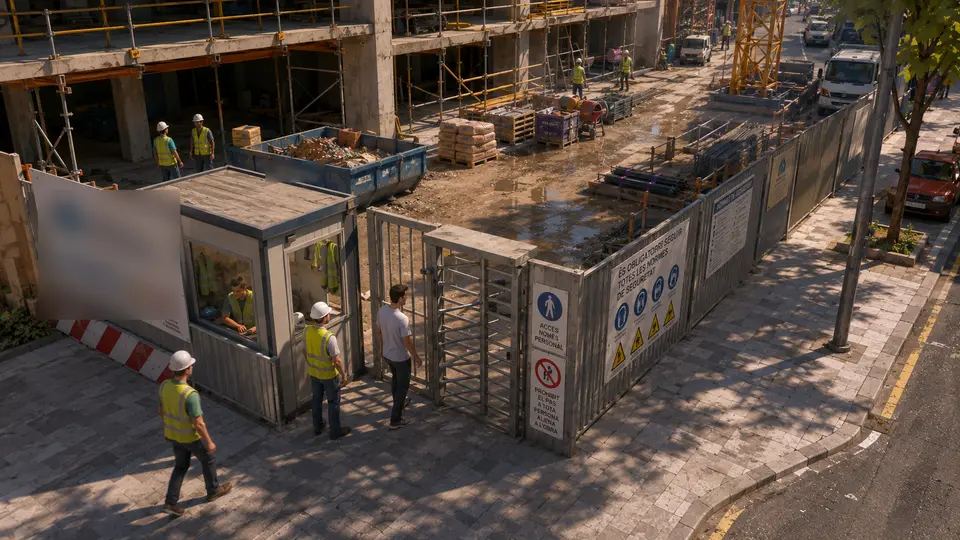
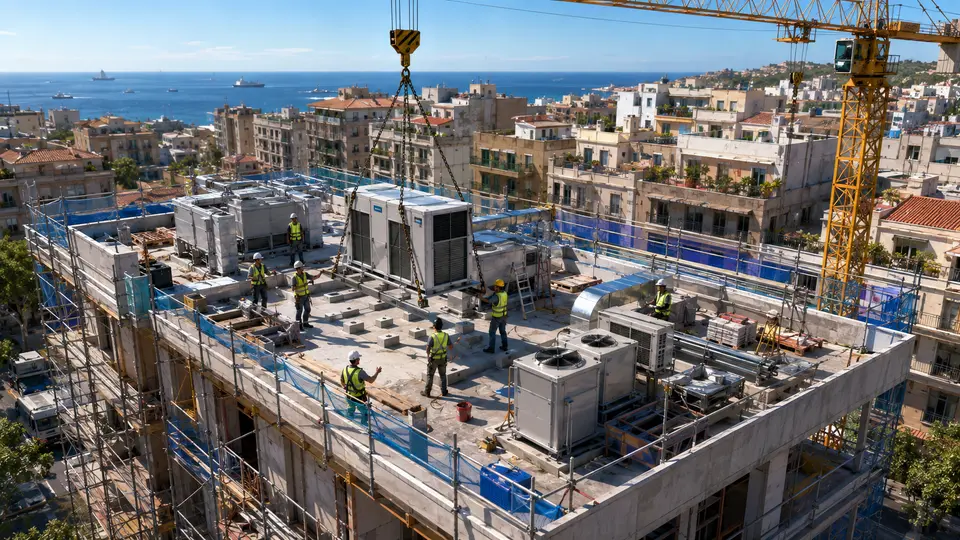
Without IRIS this is just a big building site.
AI-generated image
What IRIS is
IRIS looks after the site for you.
IRIS looks at the cameras you already have on the construction site and understands what's happening: someone entering without a helmet or safety gear, a person too close to a machine or a vehicle at the gates. When something important happens, it alerts you; and whatever can be counted, it counts. All day long, with no one watching a screen.
You tell it what you need to watch, and IRIS does it.
Works with the cameras you already have. Nothing to replace.
A person replies, not a form.
- Your footage never leaves your premises.
- It doesn't identify people.
- Certifications →
What is at stake on a building site
On a building site nobody is watching: everybody is working. The crane operator is watching his load, the banksman is watching his truck, the site foreman is up on floor five and the safety coordinator is on another site this morning. The manoeuvre that swings over two people lasts eight seconds and, from outside, nobody sees it. Whoever walks in through the truck gate without a helmet is ten steps from the work face. None of that reaches the daily report, because nearly always nothing happens.
IRIS watches for you. It analyses every camera the site already has, all at once, and only interrupts when a rule your own team set is met: a suspended load with somebody underneath, a person without a helmet in the plant area, somebody walking in where the trucks come in, a worker on their own where the procedure calls for two. The alert arrives with the camera, the time and the video. And it arrives while it is happening, to whoever can call a stop on the radio.
And where there is nothing to alert about, IRIS measures. How many people are inside each work area right now — the first thing anybody asks on the day you have to evacuate. And how congested the gate is: how many trucks and how many people meet at the same entrance, and at what time of day it always happens. That is not set up by talking, it is set up by drawing: a line cannot be described in a sentence, it has to be traced on the image. That is why the number comes out the same way every day and can be audited. And for people counting our system is type-approved by the Spanish Metrology Centre: the figure you see has been verified by a third party, not by us. Worth putting precisely: that approval covers people counting, not the whole product.
And two things said out loud, because they are the first ones anybody thinks of on hearing «cameras» and «building site». First: this is not about keeping watch on the workers. IRIS does not identify anyone. It detects that a person is not wearing a helmet; it does not detect who that person is. It does not recognise faces, does not compare them against any database, is not there to clock people in, is not there to discipline a particular worker and does not replace the site's access control. What it sees is «a person without a helmet in the plant area», where they are and since when. Second: IRIS does not stop the crane. It touches no machine and it does not replace the safety officer on site, the banksman or the site safety plan. It flags a risky situation while it is happening, so that whoever is directing the manoeuvre can stop it.
The real scale
Eleven cameras here. A site that in three months will look nothing like this one.
This demo shows eleven cameras because eleven fit on a screen. A building site does not fit. And here the axis is not the kilometres of a road or the passengers of a station: it is the phases. Where there is an open pit today there will be a floor slab in a few months; where the trucks come in today there will be a ramp; what is fenced off today is the work face tomorrow. The cameras move, the zones get redrawn and the rules change with them: that is why a new rule has to be something you write in a while, not something you order in. And a contractor does not have one site: it has dozens at once, each in a different phase, and very few people answer for safety across all of them. That is the problem IRIS solves: it analyses however many cameras there are, on every site, for every hour there are people inside, and only interrupts when a rule is met.
Examples
These eleven are just examples.
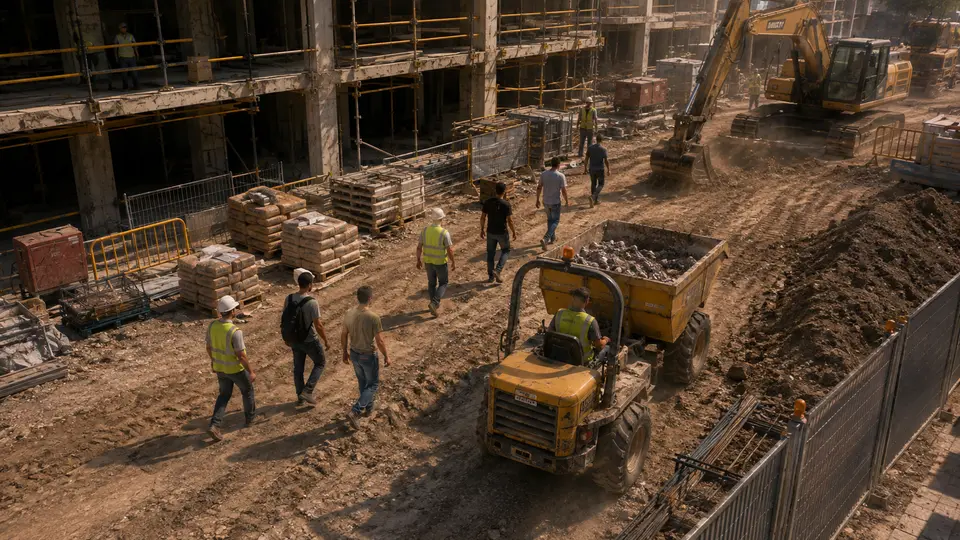
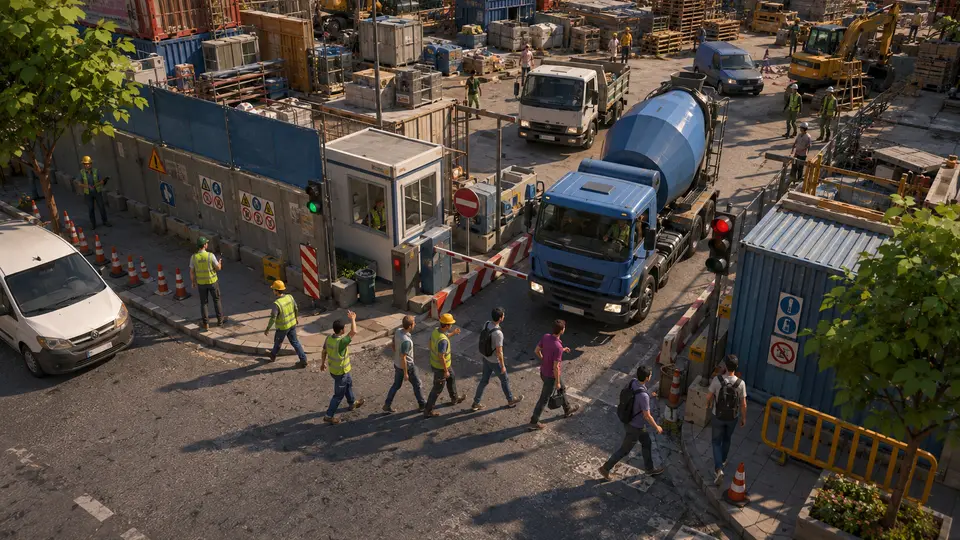
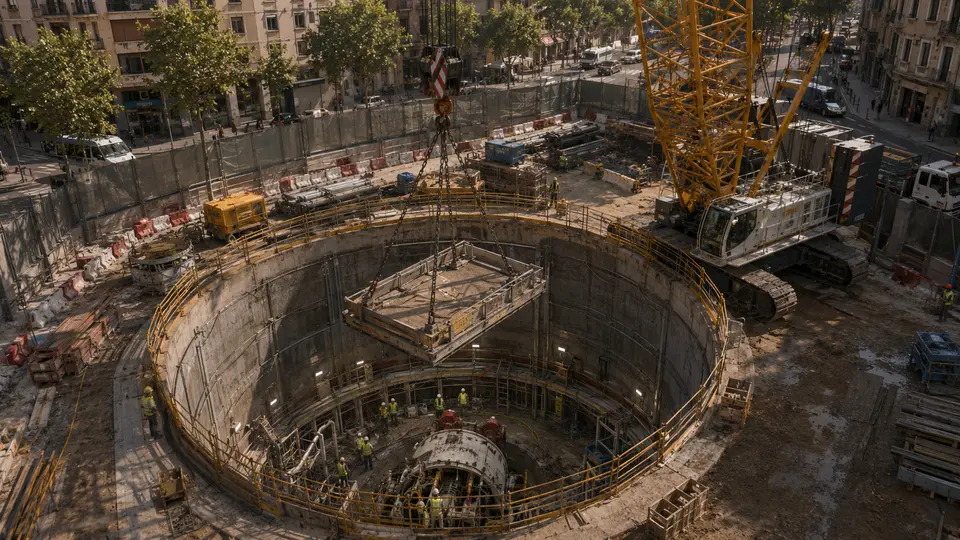
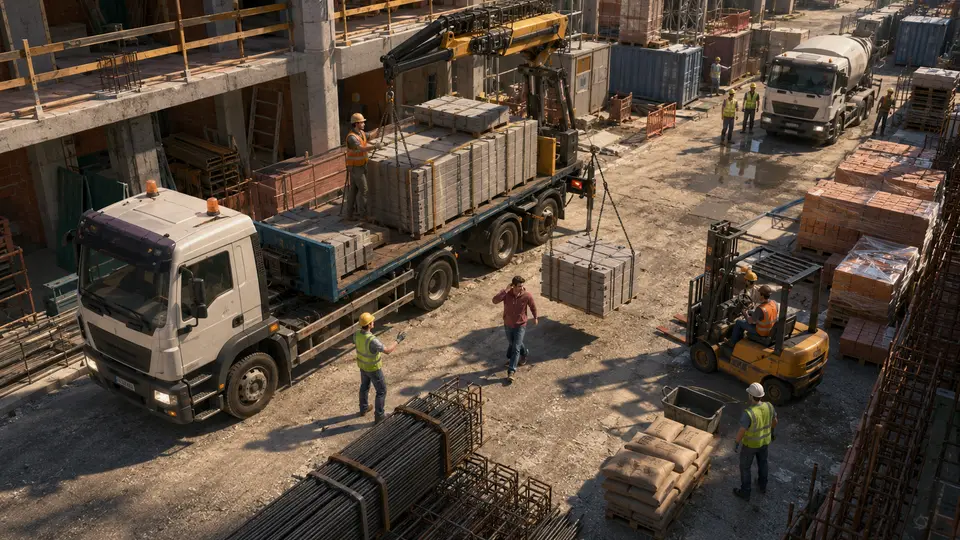
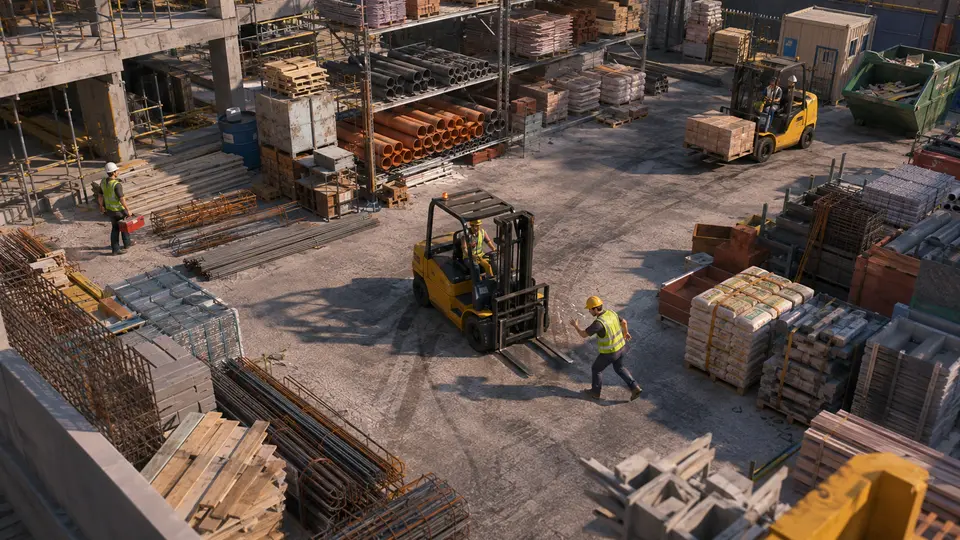
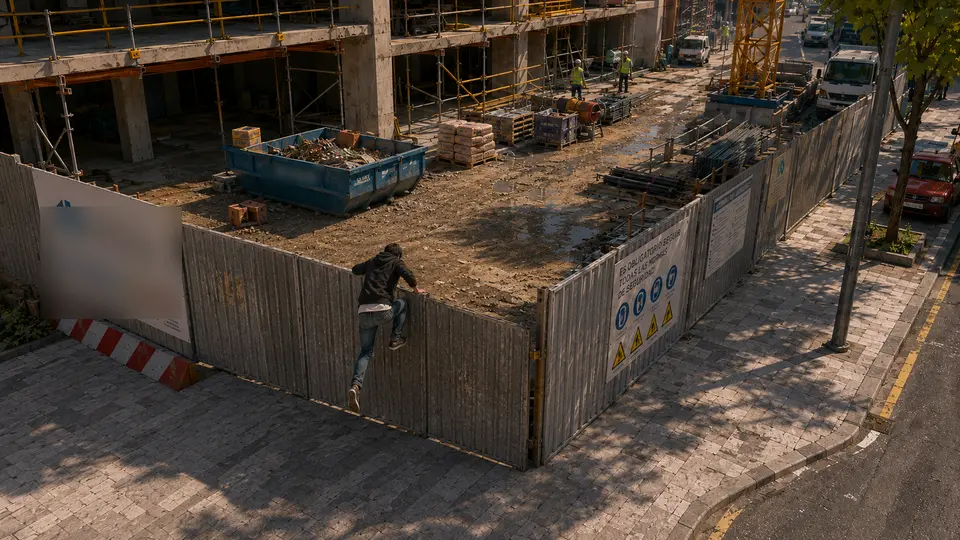
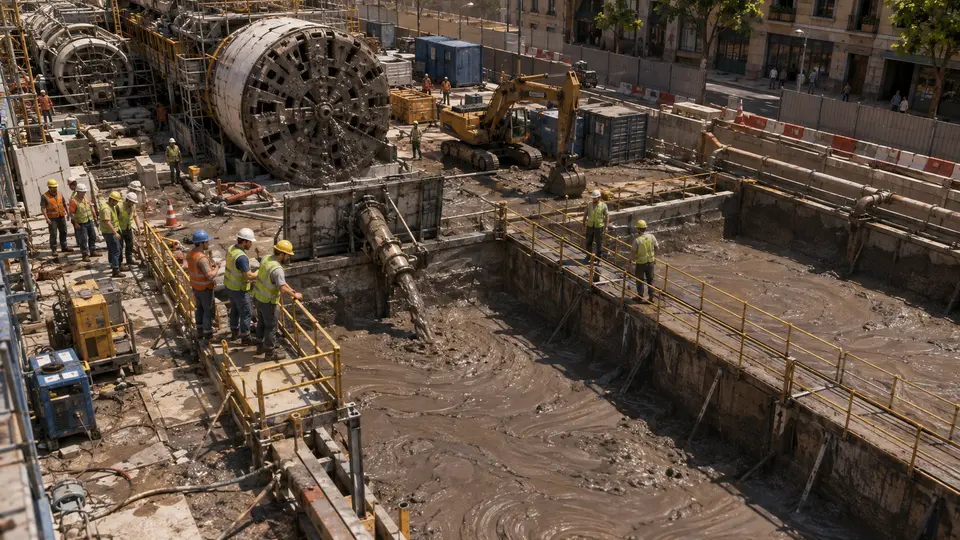
Nine raise an alert when a risky situation is under way and two alert nobody: they only measure. They come in four groups, ordered by type of risk and not by type of data: the kit that is not being worn, machines and loads, the site and its perimeter, and measuring the site. They are not the eleven things IRIS can do on a site; they are the ones that fit on a screen. Open any of them and you will see the image as it is, and then with what IRIS understands on top.
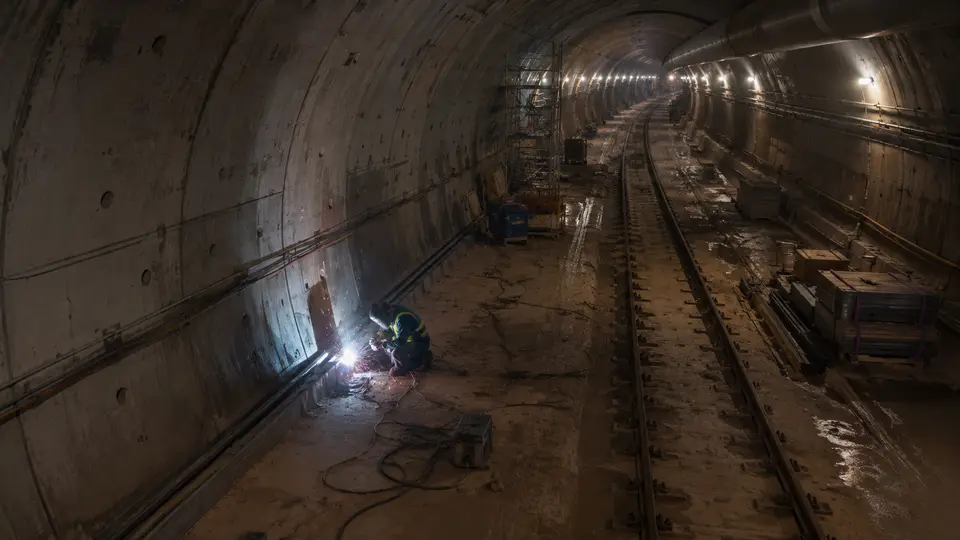
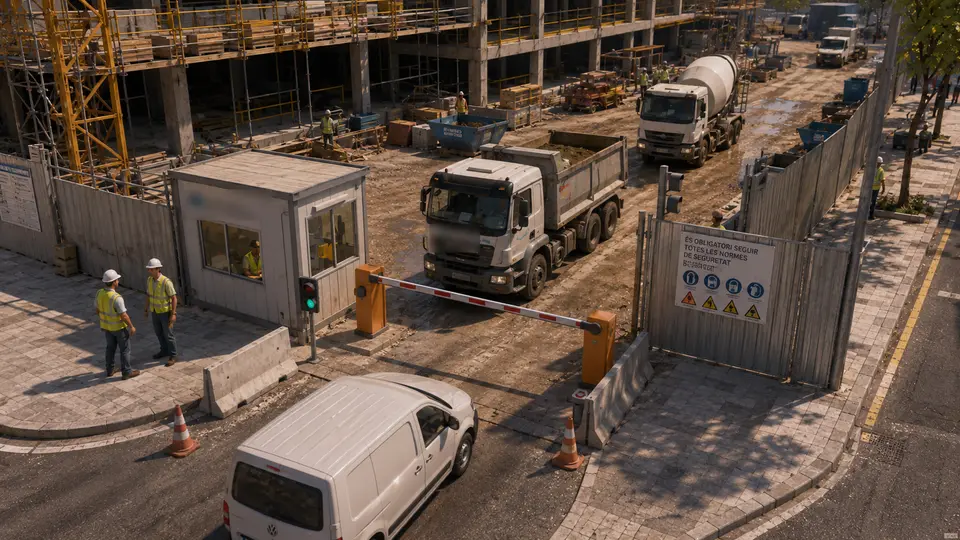
Every simulation
Something has spilled
Tell me if there is liquid or foam outside its place and it is still there two minutes later.
- The sentence
- Where it applies
- What it finds
- The same rule
Now think about your own site
Imagine knowing all of it while the shift is still on site.
The load that swung over two people this morning while the crane operator could not see them. The man who came in at ten past seven through the truck gate, no helmet, without going by the site office. The four who stood less than a step from the forklift in the laydown area. The one who climbed the fence on Sunday afternoon. The slurry pit that has been rising for three days. The one who spent half an hour alone in the basement, where the procedure calls for two. And the twelve who were inside zone two when the site manager thought there were four.
All of that is happening in front of cameras the site already has up. And right now nobody knows: the foreman is on floor five, the safety coordinator is on another site and the report gets written at the end of the shift, when nothing can be done about it. IRIS watches all those cameras at once and says it while it is happening, to whoever can stop the manoeuvre. In front of cameras that already exist.
What gets asked on the site walk
The ten questions that come up before anyone says yes.
Answered in the first line, straight, and without promising that any system prevents an accident. IRIS raises the alert; the decision stays with a person.
Is this here to keep watch on our workers?
No, this is not here to keep watch on your workers, and it needs saying in plain words. IRIS does not identify anyone: it detects that a person is not wearing a helmet, it does not detect who that person is. It does not recognise faces, does not compare them against any database, does not store who anybody is, is not there to clock people in, is not there to discipline a particular worker and does not replace the site's access control. What it sees is «a person without a helmet in the plant area», where they are and since when, and that is what the alert carries. If the site has a works council, this is the first thing you should be able to show them: a system that looks at situations, not at people.
Does IRIS stop the crane when it sees the load pass over somebody?
No, IRIS does not stop the crane. It touches no machine, cuts no control and does not replace the safety officer on site, the banksman or the site safety plan. What it does is flag a risky situation while it is happening — with the camera, the time and the video — so that whoever is directing the manoeuvre can stop it. The decision stays with a person, and it has to: on a building site, the judgement of whoever is standing there is worth more than any automation. What IRIS adds is what that person is missing, which is a pair of eyes on the spot where, right now, nobody is looking.
How many alerts are we going to get a day?
You will get the alerts your rule asks for, and tuning that rule is the work of the first month. A system that fires a hundred alerts a day gets switched off within a week; we know that, which is why a rule is never «alert if someone has no helmet». It is «alert if someone without a helmet is inside the plant area, during working hours, for more than a few seconds». You bound the zone on the image, the hours, how long the situation has to last and who the alert goes to. You start with what really matters on that site, review a week of alerts with your own team and adjust. The goal is not to alert about everything: it is to alert about what makes you look up, and stay quiet about the rest.
Does it work with the cameras we already have on site?
Yes, IRIS works with the cameras you already have on site, including the ones that go up and come down as the job moves on. It connects to the feed and analyses it as it arrives: what changes is not the hardware, it is what gets understood from the picture. During the project we check camera by camera whether the framing is enough for what you want to see there — a camera put up to watch the laydown area at night may not be able to make out a helmet on the far side of the plot — and we tell you plainly which ones fall short and which just need moving or lowering. Dust, backlight and rain get checked on the spot, because a building site is not a corridor with fixed lighting. Adding a new camera is the exception, not the starting point.
The site changes every few weeks. Do we have to redo it all each time?
The site changes every few weeks, and that is exactly why the system is built so that changing it costs little time. When a camera moves or a zone is redrawn, you mark the zone on the image again and carry on: nothing to order in, nobody to wait for. Alert rules are written in words, so a rule for the phase that is starting is written in a while and tested the same day. That is the difference between a system that is useful for the first month and one that is still useful at fit-out, when the site looks nothing like it did at setting-out.
Can we know how many people are inside each area?
Yes, you can know how many people are inside each work area, and that is one of the two cameras on this page that alert nobody: they only measure. You draw the zone on the image and IRIS counts who comes in and who goes out, never saying who they are. It serves the moment — how many people are in the basement right now — and it serves the record, showing at what time everybody ends up in the same place. Asking is for searching and counting is for measuring, and they are not done the same way: a line cannot be described in a sentence, it has to be traced. For people counting our system is type-approved by the Spanish Metrology Centre, so the figure you see has been verified by a third party, not by us. Worth putting precisely: that approval covers people counting, not the whole product.
Where does the video get processed? Connectivity on site is not always good.
The video gets processed wherever you decide, and on a building site that matters because connectivity is not always there. There are two options and only two. The first is inside the site itself: a unit in the site office analyses the cameras right there and works with no internet, so if the line drops the system keeps seeing and keeps alerting. The second is our own data centre, which is our cloud: the video is processed there and the site only needs a connection. You can start with one and move to the other, and in a contractor with many sites the two live side by side.
What do we tell the works council?
The works council gets told exactly this, and the sooner the better: what the system looks at, what it does not look at and who receives the alerts. IRIS detects situations, not people: it does not recognise faces, does not identify anyone and is not there to discipline a particular worker. What is processed, how long it is kept and who can see it is configured, and it is configured with you. And we say it without dressing it up: data protection compliance is signed off by your organisation, not by a salesperson of ours; we hand over the tool and the documentation of how it processes data. A site where the workforce's representatives understand what the system is for works; a site where they do not, does not.
Is this for one site or for all the company's sites?
This works for a single site and takes on another meaning across all the company's sites. On one site, the value is the alert: somebody finds out about the situation while it is happening. In a contractor with dozens of sites at once, something appears that a single site does not have — comparison with the same yardstick: the same rule, written the same way, applied everywhere. Then you can see which site piles up more risky situations in the same kind of work, which one fixed them after a toolbox talk and which one is worth a visit. Today that is decided by the gut feeling of whoever walks the most sites. With the numbers in front of you it is decided better, and it can be explained.
How much does it cost?
It costs according to how many cameras get analysed, what each one is asked to do and where the video is processed. We do not publish a price list because it would not be honest: a site with six cameras and two rules and a contractor with twenty sites open are not the same project. What you can do is start small: a couple of points on one site, the two or three rules that really matter there, and look at the alerts and the numbers with your own team before deciding anything. Write to us and we will go through it with your drawings and your cameras in front of us.
See it somewhere else
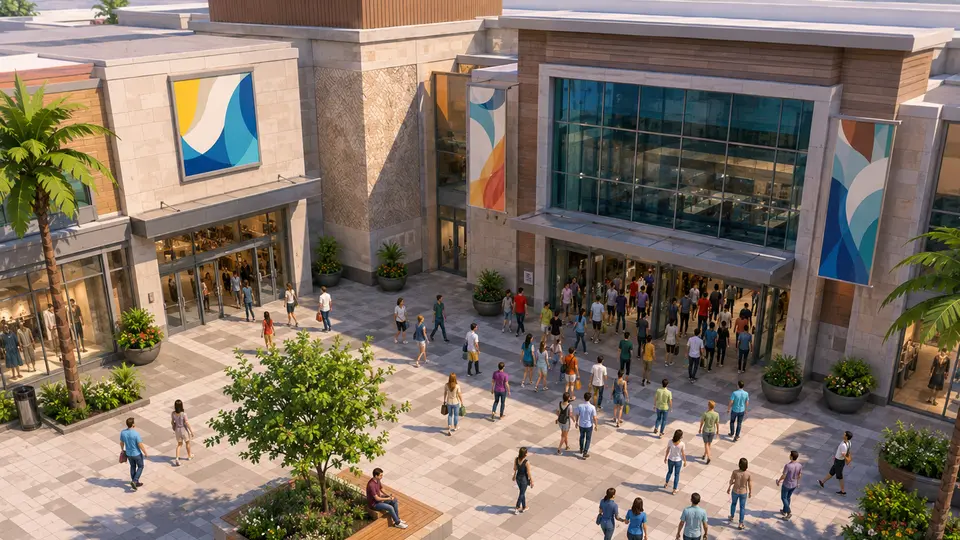
What does a shopping centre see beyond the visitor count?
12 cases: 4 raise an alert when something happens and 8 only measure. You see each image as it is, and then with what IRIS understands on top.
What does an airport see before the queue forms?
14 cases: 7 raise an alert when something happens and 7 only measure. You see each image as it is, and then with what IRIS understands on top.


And the best part
Behind one camera you can put a person.Behind four thousand you cannot put anyone.
Adding a camera costs little; adding another pair of eyes does not. So the cameras keep growing and the attention does not. IRIS watches all four thousand at once and flags what matters today.
Tell us your problem and we will say whether IRIS understands it, or not yet.
We reply the same working day.