The building sitePersonal safety
CAM-56
On foot in front of the forklift
The lane between material stacks in a site materials yard. A forklift is moving forward, forks first, towards the right. A worker in a helmet and hi-vis vest walks into that path from the right, less than a step from the tips of the forks. From the seat, the machine's mast sits exactly between the driver and him.

Turn on IRIS Vision
AI-generated image
What IRIS is
IRIS looks after the site for you.
IRIS looks at the cameras you already have on the construction site and understands what's happening: someone entering without a helmet or safety gear, a person too close to a machine or a vehicle at the gates. When something important happens, it alerts you; and whatever can be counted, it counts. All day long, with no one watching a screen.
You tell it what you need to watch, and IRIS does it.
Here, for example, IRIS spots someone walking straight across in front of the forklift and alerts right at that instant. Since it also tracks where that crossing keeps happening, you use the data to move a stack of materials or shift the walkway, then check whether it stops happening.
Works with the cameras you already have. Nothing to replace.
A person replies, not a form.
- Your footage never leaves your premises.
- It doesn't identify people.
- Certifications →
What IRIS understands
What it recognises in this scene
- forklift
- worker on foot
- second forklift
- worker by the racks
- palletised stacks
The rule
You decide once. IRIS applies it always.
If
a person on foot and a moving machine come closer than the distance the site has set
Then
- alert the yard supervisor with the camera and the video of that moment
- mark the machine and the person on the image, and the path each of them came along
- log the time and the spot, so the site learns which crossings keep repeating
The instruction that set it up«Tell me when somebody is walking where the forklifts run, and tell me before the machine is right on top of him.»
What changes
What changes for whoever answers for the site
In a site materials yard, machines and people share the same ground all day. There is a marked walkway, and it is there; the thing is that people cut across the middle because it is quicker. The driver cannot always see that side: the load, the mast and the machine itself get in the way. Today nobody hears about these near misses unless one ends badly, so nothing gets fixed. IRIS raises an alert while the near miss is happening, and it also logs where they keep repeating — which is what lets you move a stack or reroute the walkway. IRIS does not touch the forklift and does not brake it: the one who stops is the driver, or whoever runs the yard.
What people usually ask
Does IRIS brake the forklift?
IRIS does not brake the forklift and does not act on any machine. It raises an alert while the situation is happening, with the camera and the video, and the one who brakes is the driver or whoever is in charge of the yard. It does not replace the operator's training or the site traffic plan either: it is one more warning, delivered at the moment it can still make a difference.
Does IRIS recognise the driver or the worker walking past?
IRIS recognises neither of them. It tells a machine apart from a person and measures the distance between the two; it does not know who either of them is. It does not recognise faces, it does not compare them against any database and it does not store anyone's identity. The alert points at a near miss that needs breaking up, not at a particular worker.
At what distance does the alert fire?
The distance at which the alert fires is set by the site, and it can differ from spot to spot. A narrow lane between stacks needs more clearance than an open apron, and the spot where a lorry is loaded needs more still. It is adjusted on each camera's image and changed when the stacks are moved. An alert that fires every two minutes stops being read, so the distance is tuned until the alert means something.
Simulation · how IRIS works
This isn’t a video. It’s a slice of the real screen.
A summary of the real interface, played hands-free. You see one case from start to finish; what you do not see are the other screens, and there are many.
- The rule gets built
- It goes to every camera
- Published, it watches alone
- And then it fires
See it somewhere else
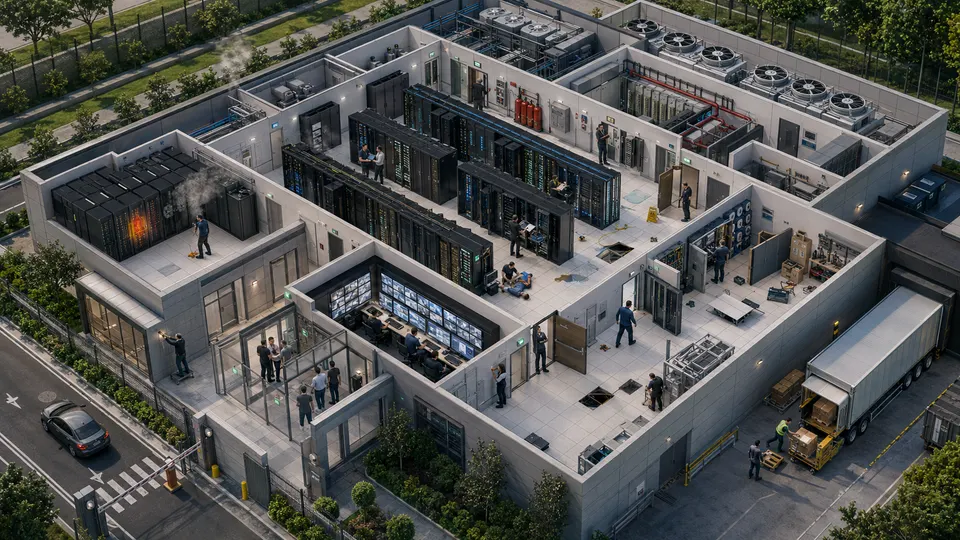
What if the outage does not start with an attack?
13 cases, and in every one of them IRIS raises an alert when something happens. You see each image as it is, and then with what it understands on top.
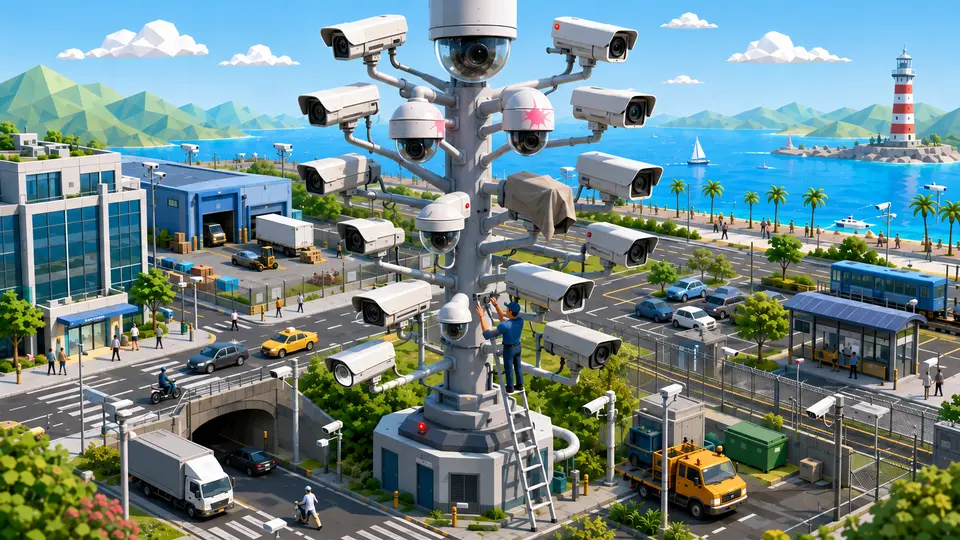
And who watches the cameras?
34 cases, and in every one of them IRIS raises an alert when something happens. You see each image as it is, and then with what it understands on top.


And the best part
What happens outside the framedoes not exist for IRIS. No camera sees the whole world.
So the first thing we do is check what each camera covers and write it down: from here you can understand this, and not that. A dull hour that saves a lot of misunderstandings.
Tell us your problem and we will say whether IRIS understands it, or not yet.
We reply the same working day.