CAM-60
How many people are up on the floor
The top floor of a building under construction, the slab still bare and scaffolding all the way round the perimeter. A crane is landing an air-conditioning unit onto the deck, held by four slings. Spread across the floor there are workers in helmets and hi-vis: two beside the units already in place, one guiding the load from below and another further back, among the machinery. IRIS counts how many people are on the floor at any moment and how many are inside the lifting area; it does not know who any of them are.

Turn on IRIS Vision
AI-generated image
What IRIS is
IRIS looks after the site for you.
IRIS looks at the cameras you already have on the construction site and understands what's happening: someone entering without a helmet or safety gear, a person too close to a machine or a vehicle at the gates. When something important happens, it alerts you; and whatever can be counted, it counts. All day long, with no one watching a screen.
You tell it what you need to watch, and IRIS does it.
Here, for example, IRIS counts how many people are on the floor and how many of them are inside the area where the load is moving, at every moment. That way you know instantly if too many people have gathered right where the machine is coming down. With that number you decide whether someone needs to be moved out of there, and you check afterwards if it happens again.
Works with the cameras you already have. Nothing to replace.
A person replies, not a form.
- Your footage never leaves your premises.
- It doesn't identify people.
- Certifications →
What IRIS understands
What it recognises in this scene
- suspended load
- worker guiding the load
- workers on the floor
- access ladder
What this camera gives back
Nobody gets an alert here. Here you get numbers.
- 11+3On the floor
- 2In the lifting area
- 38Gone up today
- 27Come down today
- 12:00Busiest moment
- 3 h 10 minAverage time up there
The figures on this screen are an example from the illustration, not any client's measurement.
IRIS incorporates NeuralPax, a separate licence certified by the Spanish Metrology Centre for people counting, occupancy and crowd-flow control. That the figure is right is guaranteed by a third party, not by us: the occupancy figure you show is measured and approved, not estimated. The certification covers that measurement — counting people — not the whole product.
The series, not one figure
One number says nothing. A curve does.
People on the floor, hour by hour
- People on the floor
| Slot | People on the floor |
|---|---|
| 06 | 2 |
| 08 | 13 |
| 10 | 8 |
| 12 | 14 |
| 14 | 5 |
| 16 | 11 |
| 18 | 4 |
| 20 | 1 |
| 22 | 0 |
Who goes up and who comes down
- Going up
- Coming down
| Slot | Going up | Coming down |
|---|---|---|
| 06 | 13 | 1 |
| 08 | 4 | 2 |
| 10 | 2 | 7 |
| 12 | 8 | 1 |
| 14 | 3 | 11 |
| 16 | 7 | 2 |
| 18 | 1 | 10 |
| 20 | 0 | 4 |
| 22 | 0 | 0 |
The figures on this screen are an example from the illustration, not any client's measurement.
How the counting works
Counting is not something you ask for. You draw a line.
Two lines and two areas are drawn onto the image. The lines go where people actually get on and off this floor: the ladder and the way in from the scaffolding. Each line has a direction, so crossing it inwards adds and crossing it outwards subtracts, and that subtraction is how many people are up there right now. The areas are painted over the surface you want to measure: the whole floor and, inside it, the lifting area. None of this is asked for out loud. Natural language is for searching and for describing a situation; counting needs to know exactly where the line runs and in which direction, and only a stroke drawn on the image settles that. It is traced once and stays there, so Monday's figure and Thursday's are measured the same way.
- the ladder crossing · Counting line
- the scaffolding crossing · Counting line
- the working floor · Dwell zone
- the lifting area · Dwell zone
What changes
What changes for whoever answers for the site
Knowing how many people are inside a work area is not attendance control: it is safety. If the site has to be evacuated, the difference between knowing there are eleven people up there and believing there are eight is enormous, because that is three people nobody will go looking for. Today that number lives in a notebook: it is written down at the start of the shift and stops being true ten minutes later, because one trade goes up, another goes down for materials and nobody knows how many are left on the floor. With the two lines and the two areas in place, the site manager has the figure as it happens and the curve for the whole day, and can see how many people are on the floor at the very moment a load is being landed. Afterwards, in a review, it reconstructs how many people were up there at the time something happened; how many, not who. The figures on the illustration are an example, not any site's measurement.
What people usually ask
Does IRIS know who is up on the floor?
No. It counts people; it does not know who they are. It does not recognise faces, it does not compare them against any database, it does not store anyone's identity and it does not follow a worker around the site. Nor does it replace access control or clocking in: it does not say whether a particular person has arrived, it says that there are eleven people on the floor. And that is exactly the figure you need if the site has to be evacuated.
Who guarantees that the figure is right?
IRIS people counting is type-approved by the Spanish Metrology Centre. The measurement has been verified by an outside body, not by us, and that is exactly what turns a figure into something you can defend in front of anyone. The scope is worth stating precisely: that approval covers people counting, not the whole product and no other function. On top of that, because the line is drawn onto the image, anyone can see where it is and why the figure came out as it did.
Is this count of any use in an evacuation?
It tells you how many people are inside each area at the moment the alarm goes off, which is what nobody has today. It does not replace the emergency plan or the head count at the assembly point: it is the number you check that head count against. If eight people have gathered below and the floor had eleven, somebody is still up there, and you know it as it happens rather than after twenty minutes on the radio.
The real interface, step by step
A camera looks. IRIS understands what it sees.
An extract of the real screen, no voice-over and hands-free. Each round poses another situation. What sits behind it is a good deal bigger than what you see.
- Checks the whole system
- Flags what is failing
- Puts it on one screen
See it somewhere else

Why did the line stop?
237 cases, and in every one of them IRIS raises an alert when something happens. You see each image as it is, and then with what it understands on top.
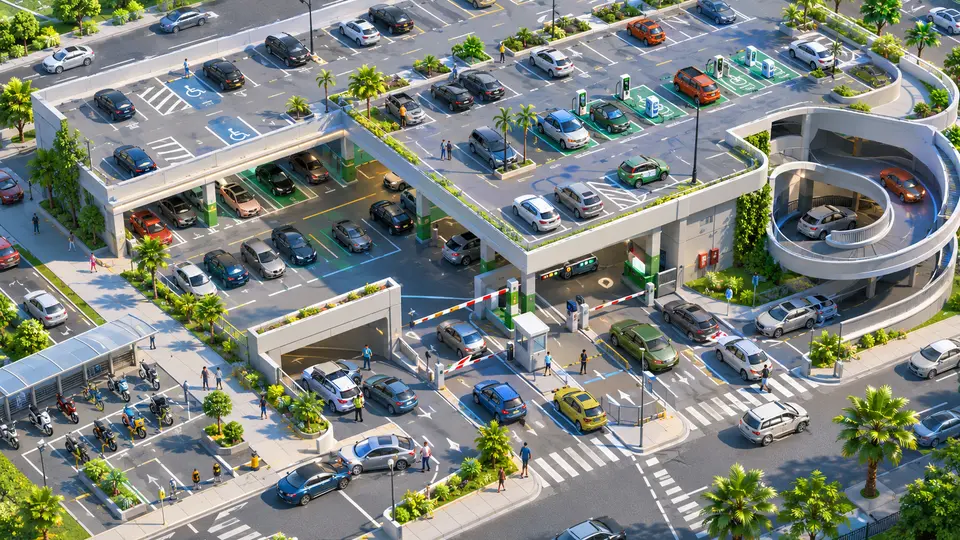
How many bays are free right now?
15 cases: 9 raise an alert when something happens and 6 only measure. You see each image as it is, and then with what IRIS understands on top.


And the best part
A wall of monitors is impressive.Nobody can read forty tiles at once.
The more tiles there are, the less each one gets looked at. IRIS watches all four thousand cameras at once and points at a single one: the one that needs someone right now.
Tell us your problem and we will say whether IRIS understands it, or not yet.
We reply the same working day.