Public transportPersonal safety
CAM-82
Fight on the platform
Two people are fighting in the middle of the platform and a ring of onlookers has closed around them, backing towards the edge. A train is coming in at the far end.

Turn on IRIS Vision
AI-generated image
What IRIS is
IRIS keeps watch over the platform for you.
IRIS looks at the cameras you already have on platforms, gates and entrances and understands what's happening: an overcrowded platform, someone falling onto the tracks, a fight or a forced gate. When something important happens, it alerts you; and whatever can be counted, it counts. All day long, with no one watching a screen.
You tell it what you need to watch, and IRIS does it.
Here, for example, the moment two people start fighting on the platform, IRIS pulls that camera up live for the control room operator. Within seconds they know what's happening and who to send, without hunting through dozens of screens. And the footage is saved from before the first punch, so it later backs up the complaint.
Works with the cameras you already have. Nothing to replace.
A person replies, not a form.
- Your footage never leaves your premises.
- It doesn't identify people.
- Certifications →
What IRIS understands
What it recognises in this scene
- fight
- ring of onlookers
- train coming in
- platform edge
The rule
You decide once. IRIS applies it always.
If
movements typical of a fight are detected between two or more people on the platform
And alsoa train is coming in, or the ring of onlookers moves towards the edge
Then
- open the live camera in the control room and alert the station supervisor
- save the video from before the first blow
- alert security and the platform staff with the platform number
The instruction that set it up«Tell me if there is a fight on a platform, and more urgently if a train is coming in.»
What changes
What changes for whoever runs the station
A fight on a platform is settled in minutes, and the danger is not the punches: it is the ring of people pushing towards the edge with a train coming in. The control room operator has dozens of cameras in front of him and is looking at another one; word reaches him when someone runs down to the office. With IRIS the live camera opens as soon as the pattern shows up, and in seconds he confirms what he is seeing and who he sends. The video is kept from before the first blow: that is what backs up the report afterwards.
What people usually ask
Can IRIS tell a fight from a group of people hugging goodbye?
In most cases yes, because it does not go by the noise but by the movement: fast arms, bodies colliding, people jerking backwards and a ring closing in. A hug is slow and makes nobody step back. Even so, the final call is a person's: IRIS opens the camera and the operator confirms in seconds. That is the difference between reviewing a thousand scenes and reviewing one.
Does IRIS know who the people fighting are?
No. IRIS does not recognise faces, does not compare them against any database and does not store who anybody is. What it sees is a situation — two people fighting on platform two — and what it hands over is the camera, the time and the video. Who they are is worked out, if it has to be, by whoever is entitled to do that.
Can the video be pulled out afterwards as evidence?
Yes, and that is half the value of this camera. The clip is tagged with the time, the platform and what was detected, so nobody has to scrub through eight hours of recording to find it: you search in words and it comes up. What gets exported and who receives it is decided by the station under its own rules and the law of its country, not by IRIS.
A different case every time
We won't just tell you. We'll show you.
It is a summary of the real screen: it plays by itself, step by step, and shows only the path of one case. The actual tool has far more than fits in here.
- You draw the line
- It counts by itself
- A number comes out
See it somewhere else
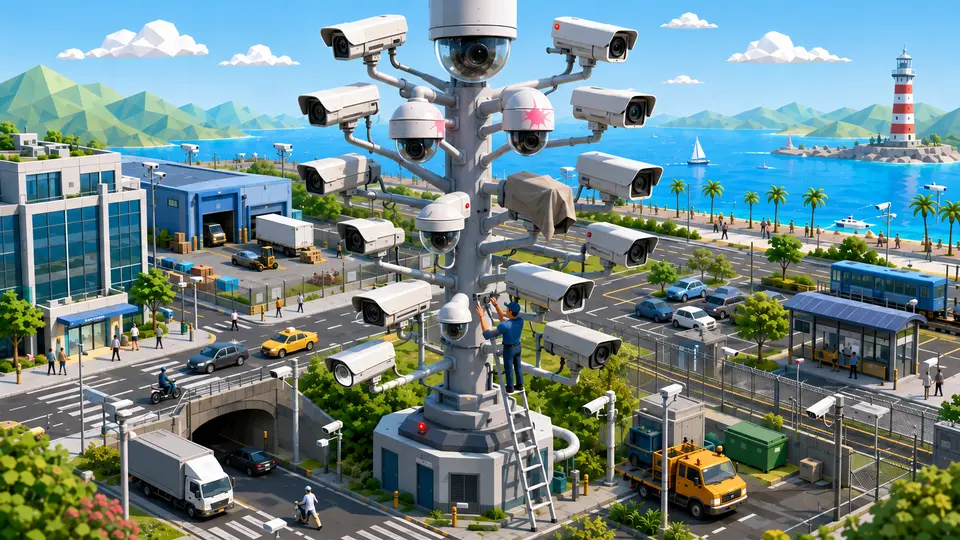
And who watches the cameras?
34 cases, and in every one of them IRIS raises an alert when something happens. You see each image as it is, and then with what it understands on top.

Who watches the cameras of a whole city?
23 cases: 18 raise an alert when something happens and 5 only measure. You see each image as it is, and then with what IRIS understands on top.


And the best part
Nobody covers the night shift:the camera that is already on covers it.
It does not tire, it does not blink and it does not go for coffee. What happens at night is understood just as it would be at midday, and whoever is on duty hears about it while it is happening.
Tell us your problem and we will say whether IRIS understands it, or not yet.
We reply the same working day.