CAM-591
Two hundred people watching an empty belt
Baggage reclaim, close to midnight. Around the carousel there is a ring of people two and three deep: two hundred and ten of them standing, with trolleys and with sleeping children. Four cases are going round on the belt. There is a long stretch coming out empty and it has been like that for six minutes. At the back, a second carousel with its own ring. IRIS measures how many people are waiting, how long the first bag took to appear, how long the belt has gone without producing one and how long a person stays in the hall on average.

Turn on IRIS Vision
AI-generated image
What IRIS is
IRIS keeps watch over the airport for you.
IRIS is an artificial intelligence that looks at the cameras you already have and understands what's happening at security checkpoints, the baggage belt and the access points. If a queue grows, the belt stops, or something you need to watch happens, it alerts you right away; and whatever can be counted, it counts in numbers. All day long, without anyone having to stare at a screen.
You tell it what you need to watch, and IRIS does it.
Here, for example, IRIS counts how many people are in the ring right against the belt and how long it's gone without a single bag coming out. So you know whether those six empty minutes are normal or already a problem. With that number you decide whether to call the handler or wait a bit longer, and then you compare it with the previous flight.
Works with the cameras you already have. Nothing to replace.
A person replies, not a form.
- Your footage never leaves your premises.
- It doesn't identify people.
- Certifications →
What IRIS understands
What it recognises in this scene
- the whole reclaim carousel
- cases going round
- stretch of belt coming out empty
- waiting ring on the left side
- waiting ring on the right side
- people waiting in the foreground, with trolleys
- belt board with its number
- second carousel at the back
What this camera gives back
Nobody gets an alert here. Here you get numbers.
- 210People waiting now
- 17 min+5 minTime to the first bag
- 34 minTime to the last bag
- 21 minAverage time in the hall
- 6 minTime without a single bag coming out
- 23:15Last updated
The figures on this screen are an example from the illustration, not any client's measurement.
How the counting works
Counting is not something you ask for. You draw a line.
There is a line at the mouth of the hall: whoever crosses it comes in to wait. And there are two zones painted on the floor: one is the ring hugging the carousel, which says how many people are actually waiting for their bag, and the other is the whole hall, which says how many people are inside and how long they stay. The belt is measured separately, watching a stretch of band: how many cases come out and how long goes by without a single one. All of this is drawn once on the image and there it stays, so two flights of the same kind really can be compared.
- line at the mouth of the hall · Counting line
- zone of the ring hugging the belt · Dwell zone
- zone covering the whole hall · Dwell zone
And also, one rule
You decide once. IRIS applies it always.
If
the belt has gone more than five minutes without producing a bag
And alsothere are still people waiting around it
Then
- alert the hall and whoever coordinates the unloading at once, with the belt and the minutes
- say how many people are still waiting at that belt
- log the stoppage in the flight's first-bag and last-bag record
The instruction that set it up«Tell me if the belt has gone more than five minutes without producing a bag and people are still waiting.»
What changes
What changes for operations, for the passenger and for maintenance
Almost midnight, two hundred and ten people around the belt and four suitcases going round. It is the last thing the passenger sees and what generates the most complaints. The figure the contract demands — how long the first bag takes and how long the last one — is supplied today by the handler doing the unloading, who is an interested party. Measured from the hall it stops being a declaration and becomes a measurement: the same line, the same place, every flight. With that the airport talks to the handler with figures in hand, and at the same time knows how many people are waiting right now, which is what decides whether somebody is needed at the baggage desk.
What people usually ask
Why measure this if the handler already declares it?
Because a figure declared by the party it is demanded of is not a measurement, it is a declaration, and both sides know it. Measured from the hall, with a line and a zone always drawn in the same place, the number is generated by the space itself and written by nobody. That is not distrusting anybody: it is that a contractual conversation needs a figure both sides can look at without arguing about where it came from.
Why does this camera not carry the counting certification?
Because what this camera lives on is bags, and what we hold certified by the Spanish Centre for Metrology, under the NeuralPax licence, is the counting of PEOPLE and nothing else. People are counted here too, but the number this camera stands on is the belt's, so putting the certification beside it would be stretching it. We prefer to say exactly how far it goes: that is what makes it worth anything when we do cite it.
Other cameras
- CAM-580 · The kerb jams before the terminal does
- CAM-581 · Eighteen minutes in one queue, four in the one beside it
- CAM-582 · How long the security wait really is, measured not guessed
- CAM-583 · An open lane nobody has gone through in nine minutes
- CAM-584 · Fifty-two minutes of queue and seven booths switched off
- CAM-585 · The aisle is clear and ten metres on, nobody moves
The real interface, step by step
A new case each time. Always the same screen.
It plays by itself and shows one case from start to finish. It is a summary: the real screen has far more functions than fit in this box.
- Four cameras at once
- Each understands its own view
- The numbers climb by themselves
See it somewhere else
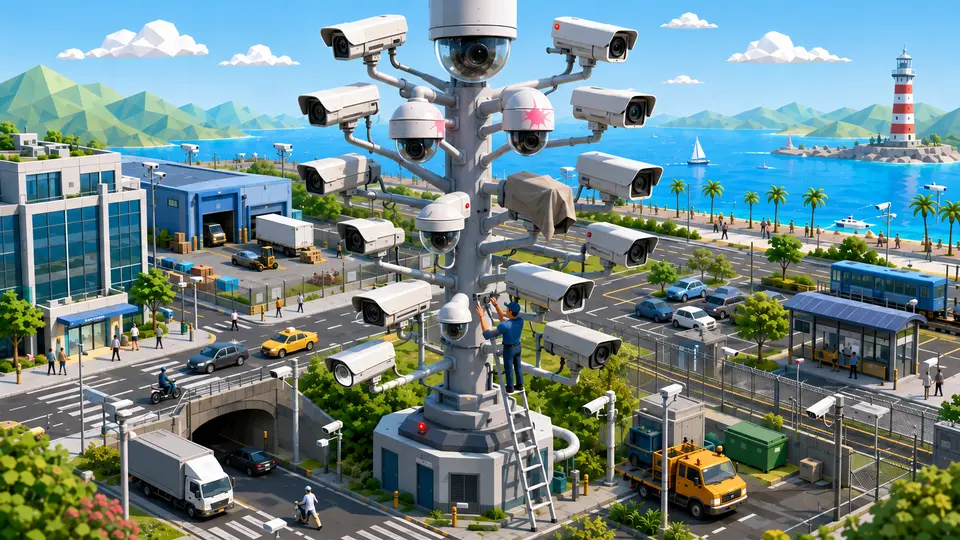
And who watches the cameras?
34 cases, and in every one of them IRIS raises an alert when something happens. You see each image as it is, and then with what it understands on top.

Who watches the cameras of a whole city?
23 cases: 18 raise an alert when something happens and 5 only measure. You see each image as it is, and then with what IRIS understands on top.


And the best part
Nothing changes on the wall.On the screen, everything changes.
Same brackets, same cabling, same cameras. The only difference is that those images are now understood as they come in, instead of waiting for someone to open them.
Tell us your problem and we will say whether IRIS understands it, or not yet.
We reply the same working day.