CAM-141
Cars speeding past the school gate
The street outside the gate at arrival time. A van crosses the pedestrian crossing so fast that it comes out blurred in the picture itself. At one end of the crossing, an adult has just thrown out an arm to stop three children who had already stepped off the kerb; on both pavements more are waiting, backpacks on. IRIS sees a vehicle, where it passes and how fast it goes along that stretch. It does not read the plate, it does not know whose car it is and it does not identify the driver.

Turn on IRIS Vision
AI-generated image
What IRIS is
IRIS keeps watch over the school for you.
IRIS looks at the cameras you already have at school and understands what it sees: a child alone, a child on the ground, a fight in the playground, someone odd at the entrance. When something like that happens, it alerts right away; and whatever can be counted, it counts in numbers. All day long, with no one needing to be glued to a screen.
You tell it what you need to watch, and IRIS does it.
Here, for example, IRIS measures how fast each vehicle goes past the school gate at drop-off time. So you know how many are speeding and at what time it happens most. With that number you decide whether you need a speed bump, a raised crossing or somebody on the gate, and next month you check again to see if it worked.
Works with the cameras you already have. Nothing to replace.
A person replies, not a form.
- Your footage never leaves your premises.
- It doesn't identify people.
- Certifications →
What IRIS understands
What it recognises in this scene
- vehicle over the set limit
- group at the edge of the crossing
- children waiting
- children on the far pavement
- pedestrian crossing sign
What this camera measures
An alert says something is happening. The reading says how much.
- 58 km/hSpeed of this vehicle
- 71 km/hFastest in the last hour
- 23+6Over the set limit in an hour
- 412Vehicles in the last hour
- 46Children who crossed in ten minutes
- 08:52Time it went past
The figures on this screen are an example from the illustration, not any client's measurement.
The rule
You decide once. IRIS applies it always.
If
a vehicle goes through the stretch by the gate above the speed the council has set for that street
Then
- alert the municipal duty service with the camera, the time and the video
- add the pass to the count for that time band
- leave the figure by day and by hour, to see at which hours people speed
The instruction that set it up«Tell me how fast people drive past the gate and at what hours, and alert me when someone goes well over what we have set for this street.»
What changes
What changes for the school team
The whole neighbourhood knows people drive fast past the school. What nobody has is the figure: how many, at what hour and how fast. Without it, asking for a speed hump, a raised crossing or an officer at the gate is one set of families' word against someone else's. IRIS fines nobody and does not replace an approved speed camera: that is not what it is for. What it gives is the measurement — how many vehicles go past, at what speed and in which time band — so that whoever has to decide can decide with a number in front of them. And most of the value is in the hours, not in this morning's van: if the speeding happens at a quarter to nine and at five, you already know when someone needs to be standing there.
What people usually ask
Is this a speed camera? Does anyone get fined?
No. It is not an approved speed camera, it does not measure in order to prosecute and it fines nobody: penalties need a verified device and an officer, and here there is neither. Nor are number plates read: IRIS does not read the plate of any vehicle, and in a school it is not switched on, so there is no way of knowing whose car it is. And it replaces nobody on the street: what there is, is the measurement of how people drive past that gate, so that someone can decide what to put there.
So what is the figure good for, if it is not an approved measurement?
For deciding, which is no small thing. A speed hump, a raised crossing, a wider pavement or an officer at the gate are asked for with a figure: at what hours people speed and how much traffic goes through. Today that figure does not exist outside almost any school, and the conversation is had with impressions. When there is a penalty to issue, an approved device and an officer go out; to know where and when to put them, this will do. The speeds shown on this page are example data from the picture, not any customer's measurement.
Does it know who is driving?
No. IRIS does not identify anyone: it does not recognise faces, it does not compare them against any database and it does not store who anyone is. What it detects is a vehicle and where it goes. Outside a school this matters twice over, because there are children on the pavements, and the rule is the same for everyone: situations are detected, not people.
The real interface, step by step
A camera looks. IRIS understands what it sees.
An extract of the real screen, no voice-over and hands-free. Each round poses another situation. What sits behind it is a good deal bigger than what you see.
- You draw the line
- It counts by itself
- A number comes out
See it somewhere else

Why did the line stop?
237 cases, and in every one of them IRIS raises an alert when something happens. You see each image as it is, and then with what it understands on top.
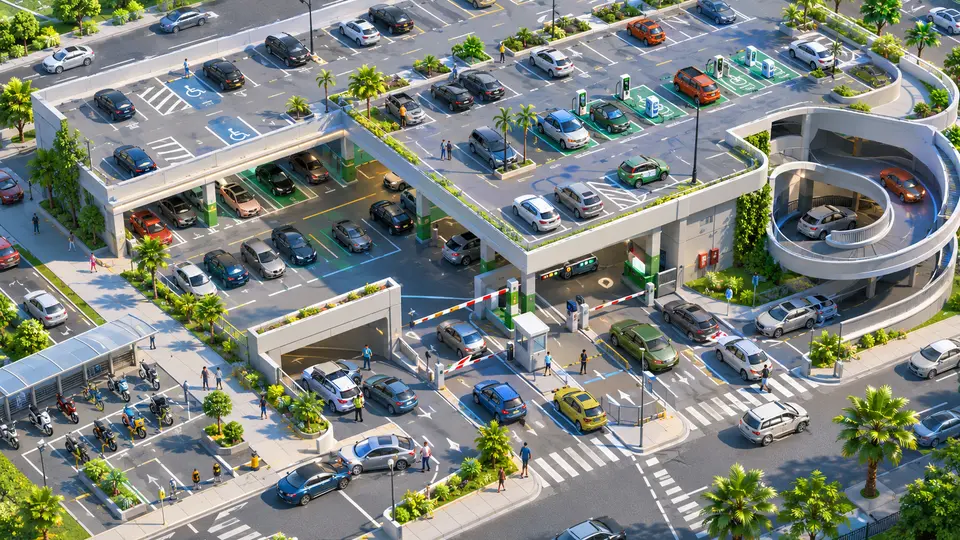
How many bays are free right now?
15 cases: 9 raise an alert when something happens and 6 only measure. You see each image as it is, and then with what IRIS understands on top.


And the best part
“The white van, Tuesday afternoon.”That is enough to find it.
You type it the way you would tell a colleague, and the matching minutes come back, each with its camera and its time. You do not need to remember the exact moment.
Tell us your problem and we will say whether IRIS understands it, or not yet.
We reply the same working day.