Shopping centresCustomer experience
CAM-537
Before, during and after: what the campaign actually brought in
Activation Saturday. In the atrium there is a blue stage with a screen, a balloon arch and two people presenting. In front, a ring of people standing and watching. Up on the balcony rails there are more onlookers, on both sides. On the right the café tables are full; on the left there is the sofa area. IRIS counts how many people are in the atrium, how many stop to watch and how long they stay, and keeps the same figure for the Saturday before and the Saturday after.

Turn on IRIS Vision
AI-generated image
What IRIS is
IRIS keeps an eye on the mall for you.
IRIS is an artificial intelligence that looks at the cameras you already have and understands what's happening in the aisles, queues and stores. When a queue grows long, an area fills up, or something you want to track happens, it alerts you; and whatever can be counted, it counts in numbers. All day long, without anyone having to stare at a screen.
You tell it what you need to watch, and IRIS does it.
Here, for example, IRIS counts how many people pass through the atrium, how many stop to watch the stage and how long they stay, on the Saturday before, the Saturday of the event and the one after. So you know whether the campaign brought in new people or just moved around the ones already there, and whether it left a queue at the café next door. With those three numbers you decide whether to repeat the event or change the spot, and next month you measure it again.
Works with the cameras you already have. Nothing to replace.
A person replies, not a form.
- Your footage never leaves your premises.
- It doesn't identify people.
- Certifications →
What IRIS understands
What it recognises in this scene
- activation stage
- balloon arch
- gathered audience
- upper floor balcony, left side
- upper floor balcony, right side
- café with the tables full
- sofa area
What this camera gives back
Nobody gets an alert here. Here you get numbers.
- 410People in the atrium right now
- 260People stopped and watching
- 9 minAverage time people stay
- 180 / hFootfall per hour before the activation
- 640 / h+460Footfall per hour during the activation
- 300 / hFootfall per hour after the activation
The figures on this screen are an example from the illustration, not any client's measurement.
How the counting works
Counting is not something you ask for. You draw a line.
There are two lines, one at each mouth of the atrium, and two zones: one over the ring of onlookers and one over the whole atrium floor. The lines say how many people come in and out; the audience zone says how many actually stop and how long they last; the big zone says how many walk through without stopping. None of this is asked for in words: it is drawn once and stays identical on the day before, the day of the event and the day after. That is why the three figures can sit side by side without an argument about where they came from.
- line at the left mouth of the atrium · Counting line
- line at the right mouth of the atrium · Counting line
- audience zone · Dwell zone
- whole atrium zone · Dwell zone
And also, one rule
You decide once. IRIS applies it always.
If
the atrium goes above the number of people the centre has set for an activation
Then
- alert the event lead with how many people are in the atrium right then
- send the alert to the security lead so the side routes can be reinforced
- save the video and the count for the minute that number was reached
The instruction that set it up«Compare the people who crossed the atrium on the event Saturday with the Saturday before, at the same hour.»
What changes
What changes for operations, for asset management and for security
Saturday morning, a stage in the atrium and a ring of people watching the screen. On Monday the marketing manager will have to justify what it cost, and today she justifies it with a photograph. With this camera she justifies it with three figures measured the same way: how many people crossed the atrium the previous Saturday, how many during the event and how many the Saturday after. That shows whether the activation brought people in, whether it only moved the ones already there, and whether it also put a queue in the café next door. Choosing next month’s event stops being a matter of taste, and the atrium space can be sold to a brand with a figure in front of it.
What people usually ask
Can you tell whether the campaign brought in new people?
You can tell how many more people crossed the atrium and how many stayed, compared with the same day and hour without an activation. That is what the camera measures, and it is already far more than most centres have. What it cannot tell you is whether those people were coming anyway or came because of the action: IRIS counts anonymous bodies and recognises nobody, so who was already a regular and who was not comes from the centre's own data, not from the image.
Does it also count the people watching from the upper floor?
Yes, if the balcony zones are drawn, and here they are. Part of the audience at an activation never comes down: they stay leaning on the upper rail. Leaving them out makes the figure come up short and the action look worse than it was. It is a good example of why counting is configured by drawing: where the upstairs audience ends does not fit in a sentence, you have to trace it.
Do you need new cameras to measure an event?
No, as long as the atrium already has cameras that see the floor. IRIS works with what is installed; what gets added is where the line goes and where the zone goes. That drawing is done once and saved, so next month's event is measured exactly the same way without touching anything again. When the frame does not reach — a corner nobody sees — we say so, and we do not fill the gap with an estimate.
Other cameras
- CAM-535 · How many people come in through each door, and when
- CAM-536 · An empty corridor twenty metres from a packed wing
- CAM-538 · Eighteen hundred walk past and two hundred stop
- CAM-539 · The ground floor packed and the upper walkway deserted
- CAM-540 · How many get out of the car and which door they end up using
- CAM-541 · The queue is not moving and there are barely any free tables left
Simulation · how IRIS works
Watch what happens. Then watch what IRIS does with it.
Not a recorded video and not a drawing: it is a summary of the real tool, with a different case each time round. The whole tool does not fit in a box.
- The rule gets built
- It goes to every camera
- Published, it watches alone
- And then it fires
See it somewhere else
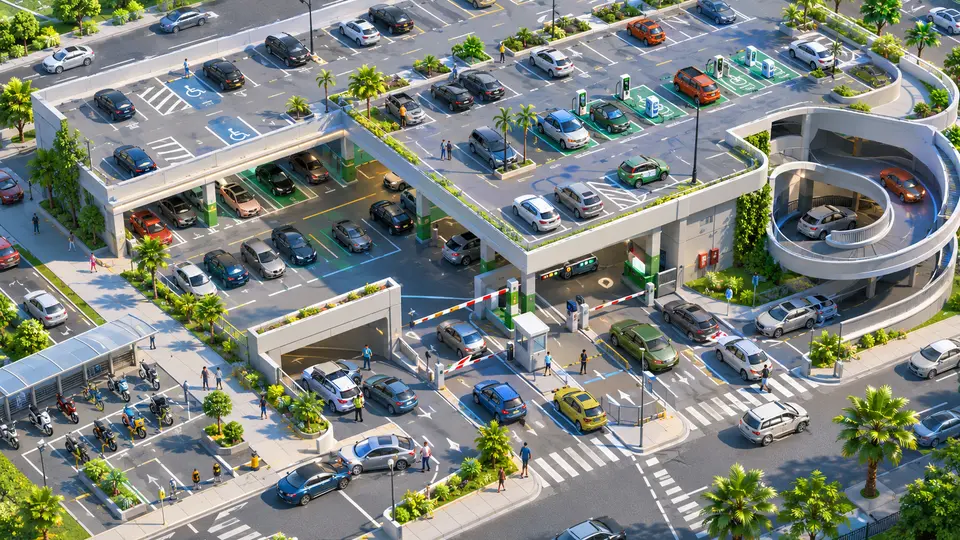
How many bays are free right now?
15 cases: 9 raise an alert when something happens and 6 only measure. You see each image as it is, and then with what IRIS understands on top.
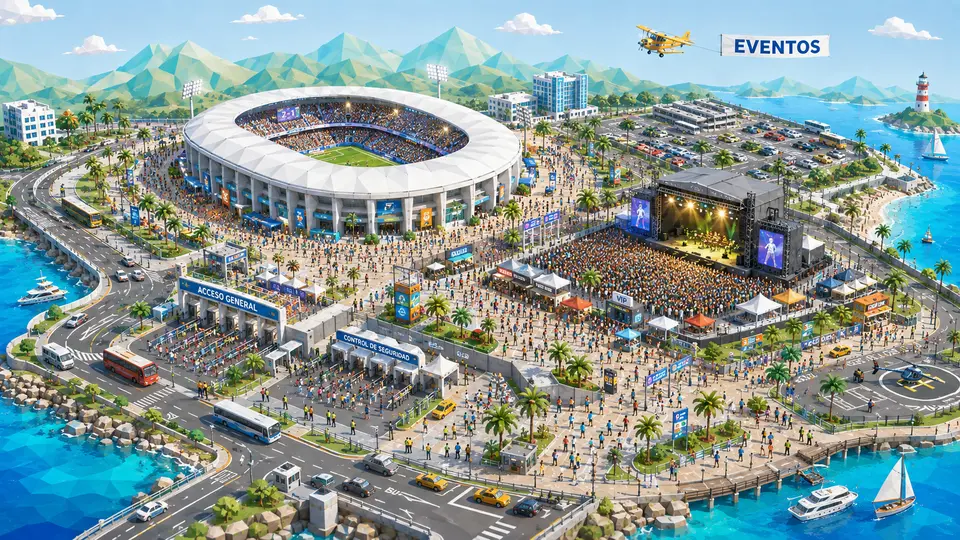
What does a venue with twenty thousand people inside see?
15 cases: 11 raise an alert when something happens and 4 only measure. You see each image as it is, and then with what IRIS understands on top.


And the best part
With two screens you watch.With twenty you look without seeing.
It is nobody’s fault: it happens to everyone. IRIS watches all twenty at once and only interrupts when something deserves a person’s attention.
Tell us your problem and we will say whether IRIS understands it, or not yet.
We reply the same working day.