Stadiums and venuesMobility analysis
CAM-481
One gate standing idle while the next one jams
Half an hour before the doors open, on the turnstile line. Four full-height gates side by side. Through the first one people walk without stopping. The second has bunched up: half a dozen people crowded in front of the reader. The third is closed, with a member of staff standing in front and nobody going through. The fourth is completely empty: nobody has used it at all. And out on the forecourt, forty-six people wait their turn for the first two.

Turn on IRIS Vision
AI-generated image
What IRIS is
IRIS keeps an eye on every gate for you.
IRIS is an artificial intelligence that watches the cameras you already have at the venue and understands what's happening at the gates and in the stands. When a crowd builds up at an entrance, a stand nears capacity, or something you've asked it to watch happens, it alerts you — and whatever can be counted, like people in each area, it counts in numbers. All day long, with no one needing to watch a screen.
You tell it what you need to watch, and IRIS does it.
Here, for example, IRIS counts how many people go through each turnstile and how many are waiting on the forecourt. That way you know which turnstile is empty and which one has a jam in front of it. With that number you decide to open the closed turnstile or move an employee, then check if the waiting queue goes down.
Works with the cameras you already have. Nothing to replace.
A person replies, not a form.
- Your footage never leaves your premises.
- It doesn't identify people.
- Certifications →
What IRIS understands
What it recognises in this scene
- entrance nobody has used
- entrance where people go through without stopping
- entrance with people bunched up in front
- closed entrance with a member of staff in front
- line of people waiting their turn
- member of staff beside the turnstile line
What this camera gives back
Nobody gets an alert here. Here you get numbers.
- 31 / minCrossings per minute at the entrance that flows
- 12 / minCrossings per minute at the jammed entrance
- 0Crossings at the unused entrance
- 46People waiting in line
- 9 minWait at the jammed entrance
- 3 480People counted on this line
The figures on this screen are an example from the illustration, not any client's measurement.
IRIS incorporates NeuralPax, a separate licence certified by the Spanish Metrology Centre for people counting, occupancy and crowd-flow control. That the figure is right is guaranteed by a third party, not by us: the occupancy figure you show is measured and approved, not estimated. The certification covers that measurement — counting people — not the whole product.
How the counting works
Counting is not something you ask for. You draw a line.
Each entrance has its own line drawn on the floor of the passage, and the one nobody uses has one too: that is the line that gives the zero, and the zero is precisely the figure nobody has today. Over the forecourt there is also a painted area saying how many people are waiting and how long they have been there. A line cannot be described in a sentence, it has to be drawn, and that is why the number is repeatable: the split from one show can be compared with the next without argument. Counting people is the only measurement we hold approval for from the Spanish Metrology Centre, and it is NeuralPax that does it, a separate licence built into IRIS. We don't claim accuracy. We certify it.
- crossing line for the first three entrances · Counting line
- crossing line for the unused entrance · Counting line
- waiting area · Dwell zone
And also, one rule
You decide once. IRIS applies it always.
If
one entrance goes five minutes without registering a crossing and another entrance on the same line has more than twenty people waiting
Then
- alert the entrance supervisor with the idle entrance and the saturated one
- save the video of both entrances at the same minute
- log how the crossings split between entrances in the event report
The instruction that set it up«Tell me when a gate has gone five minutes without a single person through and the one next to it has more than twenty people waiting.»
What changes
What changes for whoever runs security at the venue
Half an hour before the doors open. Forty-six people are waiting outside, the second gate has a knot of people in front of it and nobody at all has gone through the fourth. Gaining entry capacity is almost never a building job: almost always it is spreading better what is already there. An empty gate next to a jammed one is money standing still and people piling up in the street. IRIS counts how many people go through each entrance and per minute, and shows which one has room to spare and which one cannot cope. With that, the access supervisor moves one member of staff, opens the one that was closed, and the same crowd gets in a good deal faster. Without laying a single brick.
What people usually ask
Can you gain entry capacity without building anything?
Yes, and it is the usual case. Most venues do not have too few entrances: they have their entrances badly balanced. IRIS counts the crossings at each one per minute and shows which has room to spare, which is jamming and which nobody is using. Moving one member of staff and opening the closed one is usually worth more than any extension, and it can be decided with the event under way.
Does IRIS open or close a gate by itself?
No. IRIS does not act: it counts and it alerts. Opening an entrance, closing it or sending someone elsewhere is decided by the venue, which knows who comes in where and with which ticket. What changes is that the decision is made with the figure in front of you and at the time, not on the feeling that it looked very full.
Doesn't the ticket reader already count the same thing?
No, and that is why it is useful. The reader counts validations; the camera counts people crossing. When the two figures agree, all is well. When they do not, there is an explanation to look for: somebody went through on the same turn as another, a validation opened nothing, or an entrance was left open. The value is precisely in the gap between the two counts.
Other cameras
- CAM-480 · The queue tells you when the gates should open
- CAM-482 · Twenty-four arrive a minute, the search line clears nine
- CAM-483 · More people per square metre than three minutes ago, and nobody moves
- CAM-484 · The ramp is packed and the concourse next to it is empty
- CAM-485 · Twenty thousand people leaving at once, all through the same gate
- CAM-486 · A merchandise stall has eaten half the exit
The real interface, step by step
This isn’t a video. It’s a slice of the real screen.
A summary of the real interface, played hands-free. You see one case from start to finish; what you do not see are the other screens, and there are many.
- The rule gets built
- It goes to every camera
- Published, it watches alone
- And then it fires
See it somewhere else
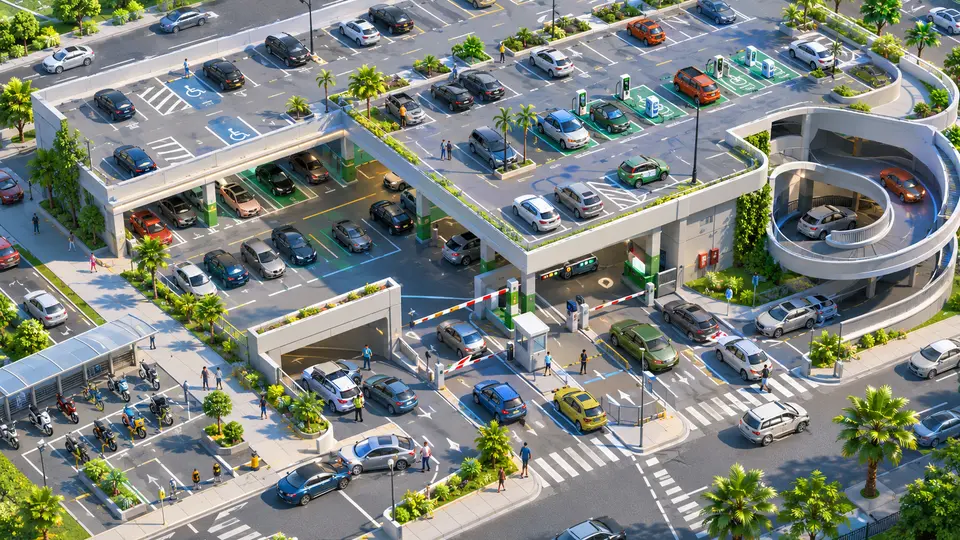
How many bays are free right now?
15 cases: 9 raise an alert when something happens and 6 only measure. You see each image as it is, and then with what IRIS understands on top.

What does a venue with twenty thousand people inside see?
15 cases: 11 raise an alert when something happens and 4 only measure. You see each image as it is, and then with what IRIS understands on top.


And the best part
We would rather promise less.Let the first week be the surprise, not the brochure.
What it cannot do gets said on day one, not on the last day. A short list that holds beats a long one that falls apart the moment it is switched on.
Tell us your problem and we will say whether IRIS understands it, or not yet.
We reply the same working day.