Solutions by typeMobility analysis
How many go by, where, and where should they not be?
Half the street now, and nobody counts them
It is 08:10 in the metro concourse. Among the people tapping through the gates, a bicycle and two scooters cross the line. One of the scooters goes through with its rider still on board, riding the gap left by the gate ahead. Nobody shouts, nobody stops anything, the whole thing lasts three seconds. The day’s incident sheet will not carry a single line about it.
3 cameras across 3 sectors
What IRIS is
IRIS watches the cameras for you.
IRIS Neural is an artificial intelligence that watches the cameras you already have and understands what happens in front of them. When something important happens —or something you told it you need to keep an eye on—, it alerts you; and whatever can be counted, it counts in numbers. All day long, without anyone having to watch a screen.
You tell it what you need to watch, and IRIS does it.
Works with the cameras you already have. Nothing to replace.
A person replies, not a form.
- Your footage never leaves your premises.
- It doesn't identify people.
- Certifications →
This is how you ask for it
«Alert me if bikes or scooters come through the gates, and tell me how many pass each day.»
Inside the station, a ridden scooter means a collision with someone stepping out of a passage, and a lithium battery heading down an escalator into a tunnel nobody leaves quickly. Outside, on the boulevard, it is the opposite: no immediate danger, just a city that has changed and nobody has measured it. And when it is time to decide whether the bike lane gets wider, the meeting fills with opinions because there is no figure on the table.
You decide once
You decide once, and per place, because not every place wants the same thing. At the gates: if a bike or a scooter crosses, alert the station supervisor with the camera open. On the boulevard: no alerts here, just the number of bikes and scooters per hour, and separately how many ride without a helmet. On the waste conveyor: if a scooter or a battery shows up, stop the line before the shredder. You set where, when and who. IRIS applies it every day, on every shift.
The scooter is the vehicle that has changed the street most in ten years, and the one that appears least in the numbers. Traffic counts were built for cars, and bikes and scooters fall between categories. So a city can know exactly how many cars cross a boulevard and have no idea how many people cross it on two wheels, or how many of them wear a helmet.
Then there is the other side: the places they should not enter. A station gate line is exactly that. And there is a third place where nobody looks for them and they are the most dangerous thing that can turn up: the sorting conveyor at a recycling centre. A scooter or a phone travelling among the bags towards the shredder is a fire with a name and a time, and no hose puts that out quickly.
IRIS looks at all three with the same idea and different answers. On the boulevard it counts and keeps the number, which is what you take to a meeting. At the gates it alerts right away, with the camera and the time, because there what you need is somebody to come down. On the conveyor it does the same, but against the clock: if something looks like a battery or a scooter, it has to be said before it reaches the end of the belt. No single alarm serves all three. There is one rule for each, written by whoever knows the place.
What changes
Before, the boulevard got a manual count two days a year and the station recorded whatever the nearest guard happened to see. Now the boulevard has its number for every hour of the year, and the station gets the alert as it happens, with the camera and the three seconds of video. Whoever runs a helmet campaign no longer argues with opinions: they show a month of curve and say what time to be out on the street.
Where we have seen it
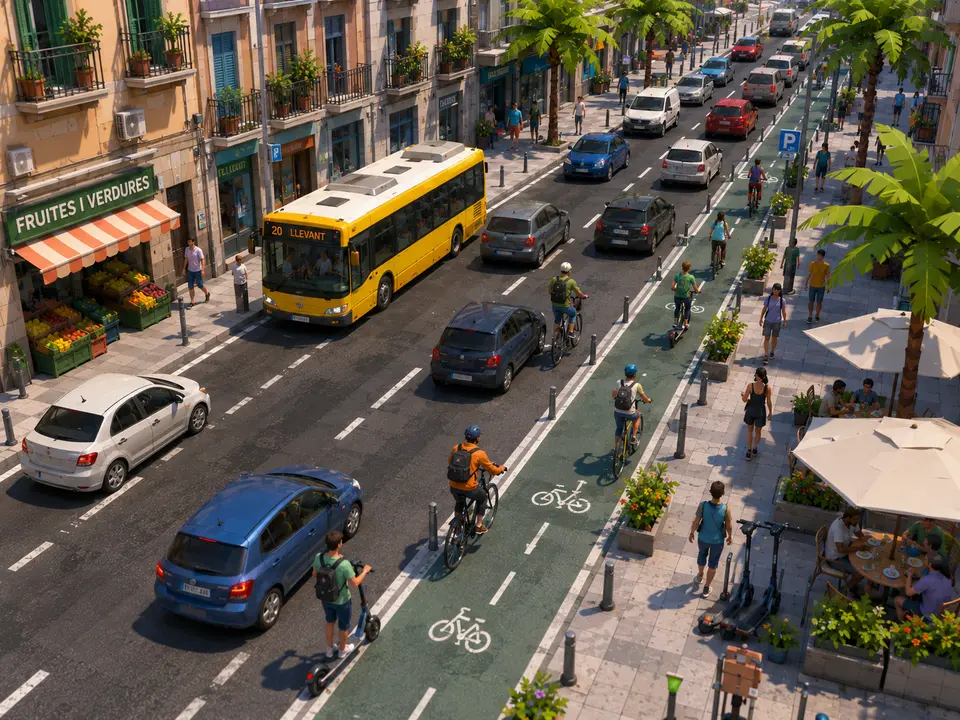
CAM-41Boulevard: cars, bikes and people
«Also tell me how many people ride past without a helmet, so I know whether we need a road-safety campaign.»
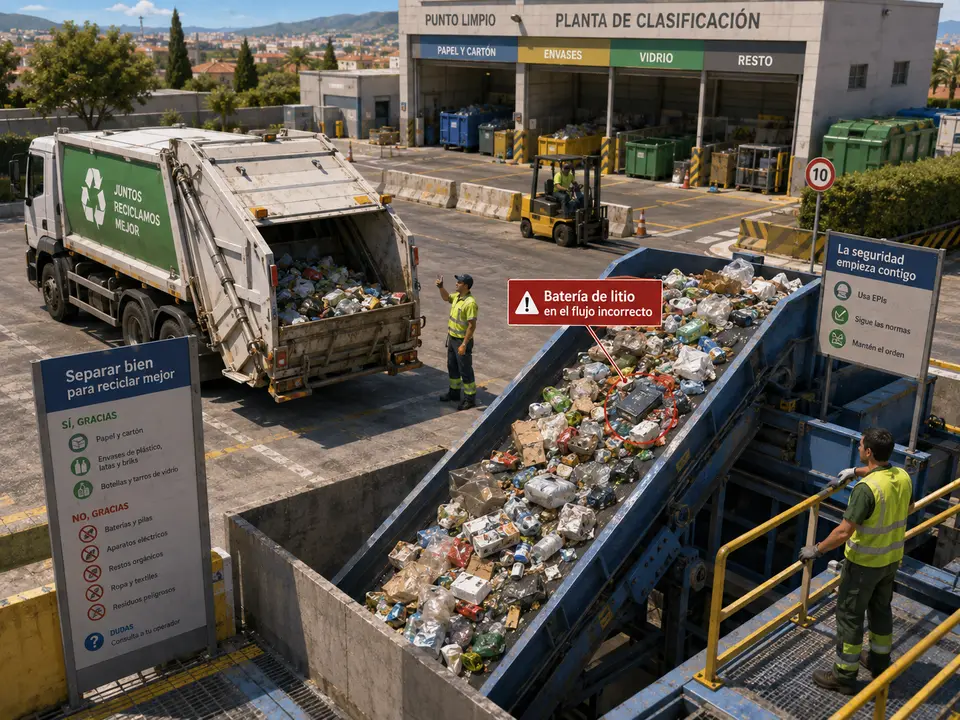
CAM-420A lithium battery is riding the belt towards the shredder
«Alert me the moment you see a battery, a phone or a scooter on the sorting belt, before it reaches the shredder.»
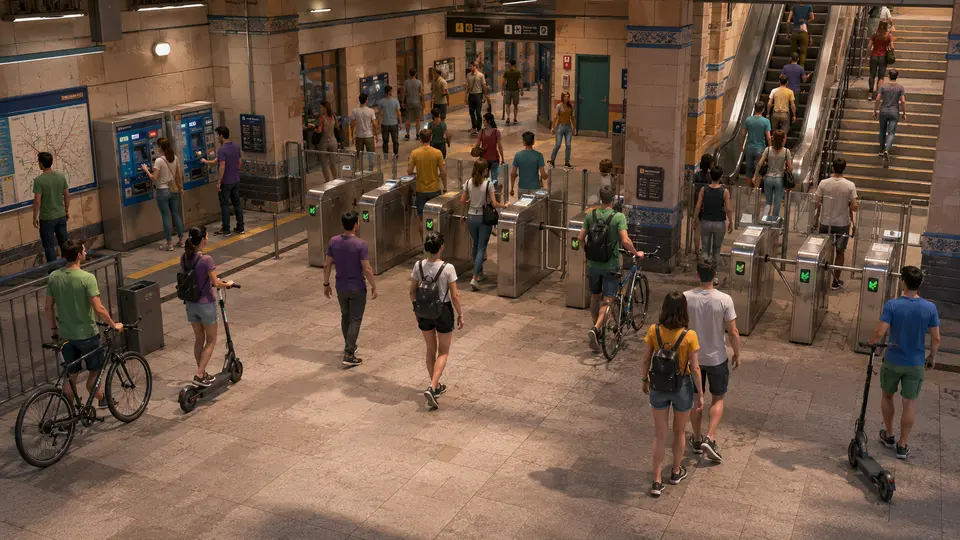
CAM-89Bikes and scooters through the gates
«Tell me if bikes or scooters come in through the gates, and how many go through each day.»


What it does not do
IRIS does not identify the rider, reads no scooter registration and does not know whether the vehicle is road-legal or rented.
And its eyesight has limits: at night, in rain or in a crowd, telling a bike from a scooter is harder, and a helmet seen from behind against the light is sometimes missed. Good enough to count; not good enough to accuse anyone.
Questions
- Can it tell a bike from a scooter?
- Yes, when they are clearly visible. The shapes differ: on a bike the rider sits between two large wheels, on a scooter they stand on a board. In normal light and at the distance a camera usually sits, IRIS separates the two and counts them apart. It gets harder at night, in a crowd or when they pass close together: in those conditions the total of two-wheelers is more reliable than the split between them.
- Can it work out who was on the scooter?
- No. IRIS does not recognise faces and identifies nobody. What it does is say that a scooter went through a place it should not have, at what time and on which camera, and keep the video of those seconds for whoever has to look at it. If that person has to be identified, someone with the authority does it, following the organisation’s procedure, by looking at that footage. IRIS shortens the path to the video; it does not replace whoever decides what to do with it.
- Can it count how many ride without a helmet?
- Yes, and that number is for a campaign, not for a fine. IRIS counts how many people cross the stretch by bike or scooter and how many of them wear a helmet, by hour and by day. That shows what no survey does: that at eight in the morning nearly everyone wears one and at eleven at night almost nobody, or that on one particular stretch the figure collapses. That is where the campaign goes. The numbers come out aggregated: there is no list of people, there is a curve.
- Does it also work on a recycling conveyor?
- Yes, and there a scooter stops being a traffic matter and becomes a fire matter. On the sorting conveyor, a battery, a phone or a scooter that reaches the shredder can burn inside the building. IRIS watches the belt and speaks up as soon as it sees that shape, before it reaches the end, so somebody stops the line and pulls it out. It will not catch everything buried under bags, which is why the alert does not replace the person at the sorting table: it gets there first.
A different case every time
Watch what happens. Then watch what IRIS does with it.
Not a recorded video and not a drawing: it is a summary of the real tool, with a different case each time round. The whole tool does not fit in a box.
- You ask
- IRIS searches
- It shows you
Not seeing yours here?
These words are the ones we have built, not the ones IRIS understands. The list falls short on purpose: you ask for it in a sentence, and sentences do not run out. Tell us what is in front of your cameras and we will tell you whether it understands it, or not yet.
And the best part
Sometimes you do not need an alarm:you need a number.
How many people came in, and when. You draw a line over the image and the camera counts. People counting is certified by the Centro Español de Metrología through NeuralPax.
Tell us your problem and we will say whether IRIS understands it, or not yet.
We reply the same working day.