CAM-79
The promotion island
A promotion island in the middle of the main aisle of an electronics store: a stand with product piled up, two people stopped in front of it looking, and a group walking straight past on the other side. IRIS counts how many go by and how many stop; it does not know who any of them are.

Turn on IRIS Vision
AI-generated image
What IRIS is
IRIS stays on top of the shop floor for you.
IRIS looks at the cameras you already have in the store and understands what's happening: long queues at the counter, fitting rooms in use or a spill on the floor. When something important happens, it alerts you; and whatever can be counted, it counts. All day long, with no one watching a screen.
You tell it what you need to watch, and IRIS does it.
Here, for example, IRIS counts how many people walk past the promotion island and how many actually stop to look. Dividing one by the other tells you what share of people really stop. With that number you decide whether the problem is the spot or what's on display, then check next week if it changed.
Works with the cameras you already have. Nothing to replace.
A person replies, not a form.
- Your footage never leaves your premises.
- It doesn't identify people.
- Certifications →
What IRIS understands
What it recognises in this scene
- promotion stand
- shopper stopped in front
- shopper walking straight past
What this camera gives back
Nobody gets an alert here. Here you get numbers.
- 860Walk past
- 112Stop
- 13%Stop (per 100)
- 48 sTime stopped
- 12:30Peak hour
- 1.340Total today
The figures on this screen are an example from the illustration, not any client's measurement.
IRIS incorporates NeuralPax, a separate licence certified by the Spanish Metrology Centre for people counting, occupancy and crowd-flow control. That the figure is right is guaranteed by a third party, not by us: the occupancy figure you show is measured and approved, not estimated. The certification covers that measurement — counting people — not the whole product.
The series, not one figure
One number says nothing. A curve does.
Those who pass and those who stop
- Walk past
- Stop
| Slot | Walk past | Stop |
|---|---|---|
| 06 | 60 | 4 |
| 08 | 140 | 18 |
| 10 | 190 | 26 |
| 12 | 230 | 34 |
| 14 | 150 | 17 |
| 16 | 120 | 12 |
| 18 | 210 | 30 |
| 20 | 170 | 21 |
| 22 | 70 | 6 |
The figures on this screen are an example from the illustration, not any client's measurement.
How the counting works
Counting is not something you ask for. You draw a line.
There is a line across the aisle in front of the island: whoever crosses it has walked past. And there is an area painted around the stand: whoever enters it and stands still for a few seconds has stopped. The second divided by the first gives the figure almost no chain has. A line and an area cannot be asked for in words: they are traced once onto the image, and that is why this week's promotion can be compared with next week's.
- the passing line · Counting line
- the stand area · Dwell zone
What changes
What changes for whoever runs the store
Today the success of a promotion is measured by what it sold, and that figure cannot tell whether the product worked or the spot it was put in did. Two different decisions taken from the same number. The store manager who puts the island in the main aisle and doesn't sell has no idea whether to change the product or move the stand three metres. With the line and the area he knows how many people walked past and how many stopped, and that already shows it: if plenty go by and few stop, the spot is fine and the problem is what is on the stand; if hardly anyone goes by, the problem is the spot. The numbers on the illustration are an example, not any store's measurement.
What people usually ask
What exactly counts as stopping?
Entering the area drawn around the stand and staying there for a few seconds. Someone who crosses the area without slowing down does not count; someone who stops to look does. How many seconds it takes is set by the store when the area is drawn, and once set it is not touched: change the criterion halfway through the month and two weeks can no longer be compared.
Does IRIS know who stops in front of the promotion?
No. It counts bodies crossing a line and bodies inside an area. It does not recognise faces, it does not compare them against any database, it does not store who anyone is and it does not follow a person from one store to another. What comes out is a number of people, not a list of names.
Can one island be compared with another, or one store with another?
Yes, as long as the line and the area have been set with the same criterion. That is exactly why counting is configured by drawing and not by talking: a sentence is read differently in each store, whereas a line is where it is. With that, a chain can run the same promotion in twenty stores and know where people stopped and where they didn't even look at it.
A different case every time
Watch what happens. Then watch what IRIS does with it.
Not a recorded video and not a drawing: it is a summary of the real tool, with a different case each time round. The whole tool does not fit in a box.
- Checks the whole system
- Flags what is failing
- Puts it on one screen
See it somewhere else

What if the outage does not start with an attack?
13 cases, and in every one of them IRIS raises an alert when something happens. You see each image as it is, and then with what it understands on top.
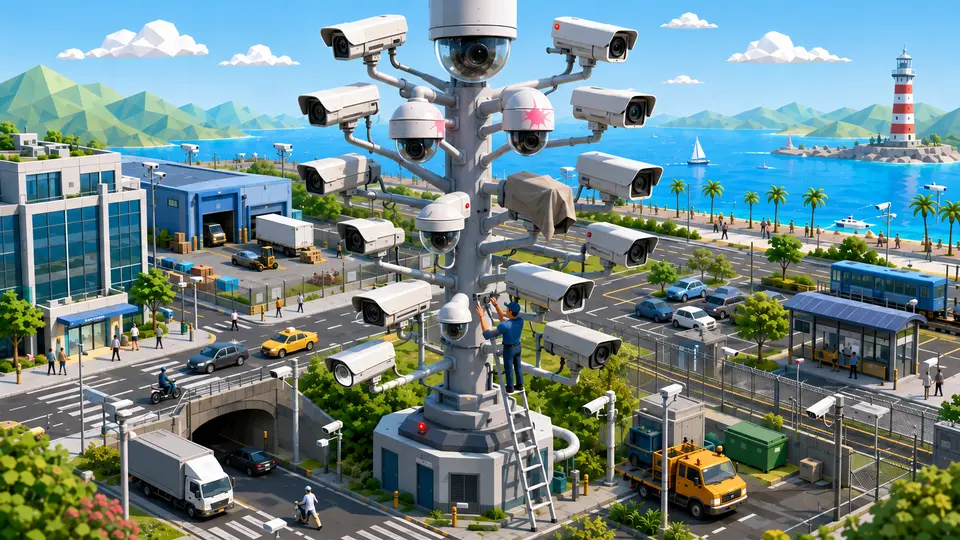
And who watches the cameras?
34 cases, and in every one of them IRIS raises an alert when something happens. You see each image as it is, and then with what it understands on top.


And the best part
You have cameras to spare.What you run out of is eyes to watch them.
One person can follow two or three screens. Nobody can follow forty. IRIS watches them all and speaks up when someone needs to decide.
Tell us your problem and we will say whether IRIS understands it, or not yet.
We reply the same working day.