Solutions by typeProduction efficiency
What if the customer spots the dent before we do?
The defect walks out the door
It is 11:40. A freshly finished grey car sits at the final inspection station, under the light rigs. On the front door, right above the crease, there is a dent the size of a coin, and the gap on that door does not match the one next to it. The car has been there forty seconds. In two minutes it leaves the line and goes to the despatch yard.
8 cameras across 6 sectors
What IRIS is
IRIS watches the cameras for you.
IRIS Neural is an artificial intelligence that watches the cameras you already have and understands what happens in front of them. When something important happens —or something you told it you need to keep an eye on—, it alerts you; and whatever can be counted, it counts in numbers. All day long, without anyone having to watch a screen.
You tell it what you need to watch, and IRIS does it.
Works with the cameras you already have. Nothing to replace.
A person replies, not a form.
- Your footage never leaves your premises.
- It doesn't identify people.
- Certifications →
This is how you ask for it
«Tell me if a part comes out with a dent, a crack or a gap that does not match, and keep the photo for me.»
That car travels a thousand kilometres on a truck before anyone looks at the door properly. The dealer looks at it, or the customer does on handover day. Then the panel is fixed in somebody else’s workshop, the transport is paid for twice, and somebody has to explain how it left a line that has an inspection station right at the end.
You decide once
You decide this once. Quality says what gets checked at each station — panels, gaps, welds, surface — where on the line it gets checked and who is told: if a dent or an uneven gap shows up at the final station, tell the quality manager with the photo and the station number before the part moves to despatch. IRIS applies that on every shift, part by part, with nobody having to remember.
A visual defect is cheap the minute it appears and ruinous three days later. On the line it is fixed with a polish and ten minutes of station time. At the customer’s it is fixed with a complaint, a return shipment and an awkward conversation. And it does not have to be a car: a steel plate with an open crack along the top face, a parcel that reaches the despatch table torn and wet, three rows of a solar field with shattered glass. It is always the same thing: something visible, in front of a camera, that nobody looked at in time.
The problem is not a shortage of people looking. It is that looking is tiring. An inspector watches hundreds of identical parts go by in a shift, and identical is exactly what switches attention off. At eleven in the morning he sees the dent. At seven in the evening, same part, same light, he does not. Nobody is to blame for that: it is how a person works.
IRIS always looks the same way. You explain what counts as a defect in your product — a dent, a crack, a burr, a crushed box, a broken panel — and it flags any part that does not look like the rest, with the photo and the point on the line. It does not say whether that part is scrapped or reworked: someone who knows decides that. It says the part needs looking at, and it says so while the part is still inside the plant.
What changes
Before, the defect turned up in final rework, in the yard audit or straight at the dealership, and by then nobody knew which station had produced it. Now a photo arrives with the part, the time and the point on the line, while the product is still on the belt. The difference is not only fixing it sooner: it is knowing where it is being produced, and being able to go and look at the machine making it.
Where we have seen it
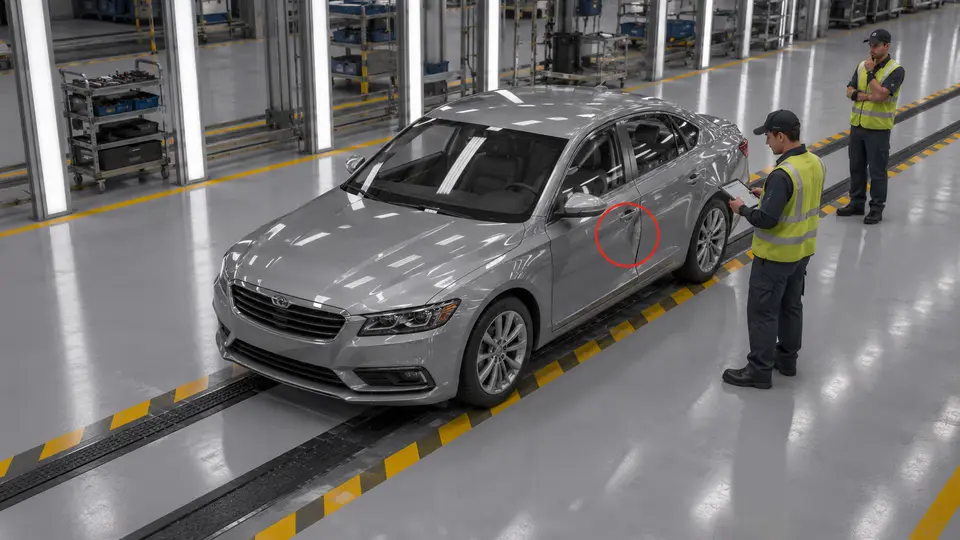
CAM-228A dent in the door and a gap that does not line up
«Tell me if a car goes past with a dent in the panel or an uneven door gap.»
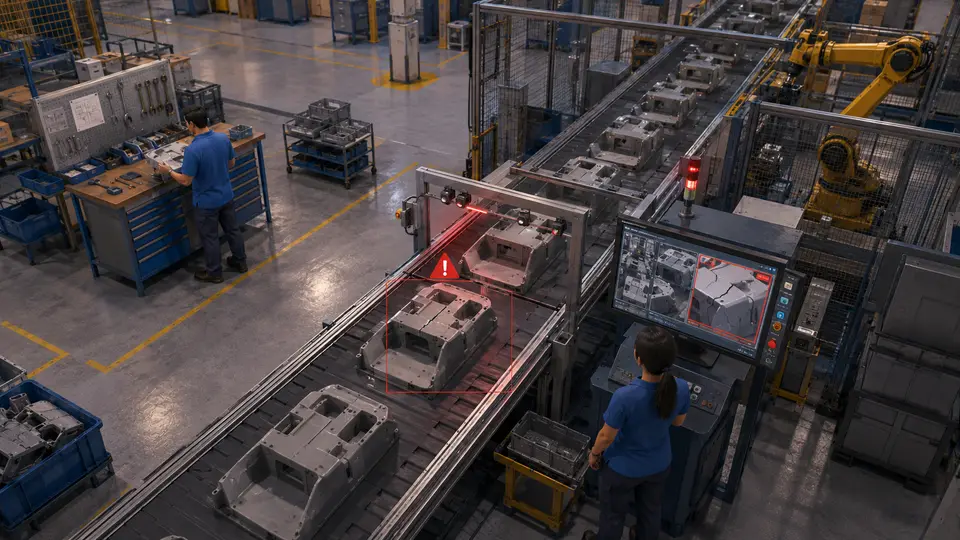
CAM-247A crack in the casting, caught under the vision portal
«Tell me if a part comes through with a crack or a burr on the outside face, and keep me the picture.»
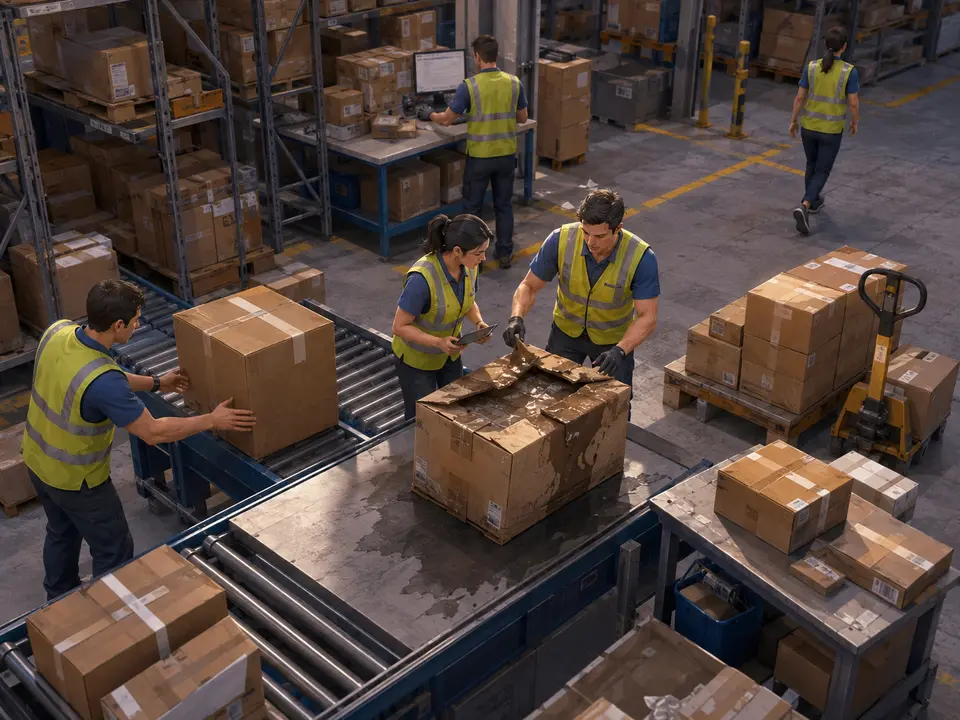
CAM-268A burst, soaked box about to go on the truck
«Tell me if a parcel reaches the dispatch table torn, crushed or wet, and keep the photo for me.»
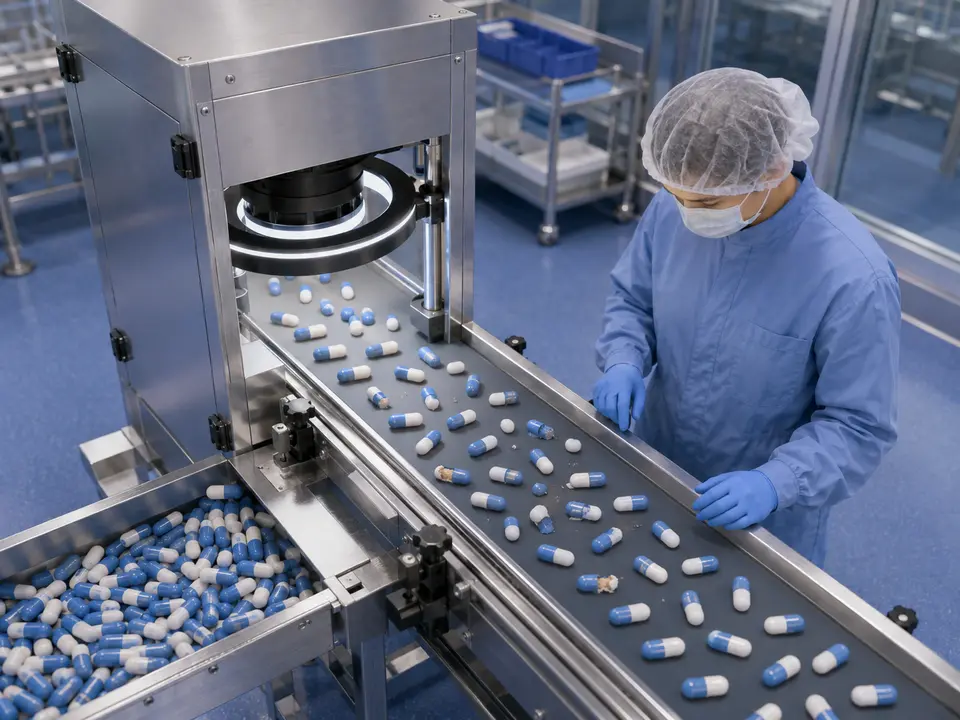
CAM-292Split capsules and loose powder among the good ones
«Alert me when split or broken capsules go past on the belt, or powder spilled around them.»
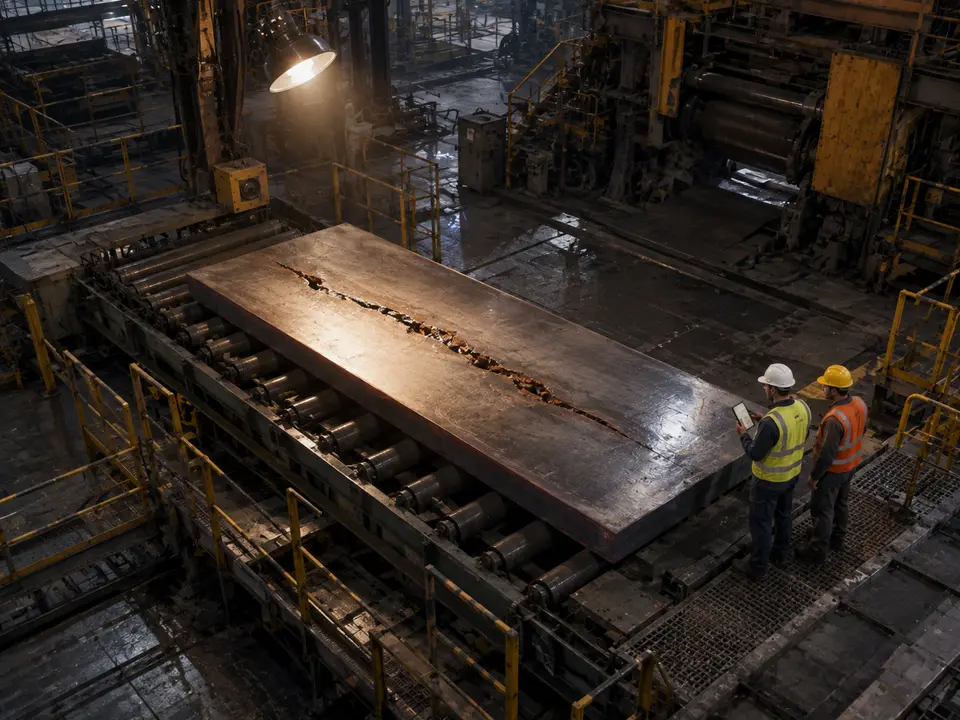
CAM-373An open crack running the length of the slab
«Tell me if a slab leaves the table with a crack or a fold on its top face, and save me the picture with the length.»
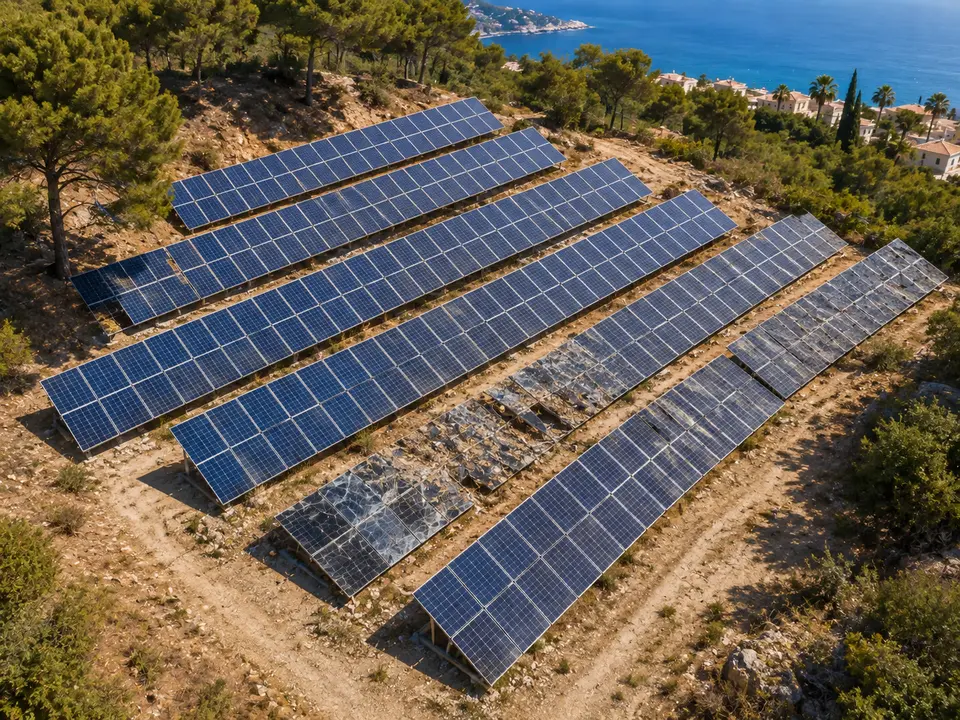
CAM-354Three rows of panels with the glass shattered
«Tell me if broken, dirty or displaced panels show up in any row of the field.»
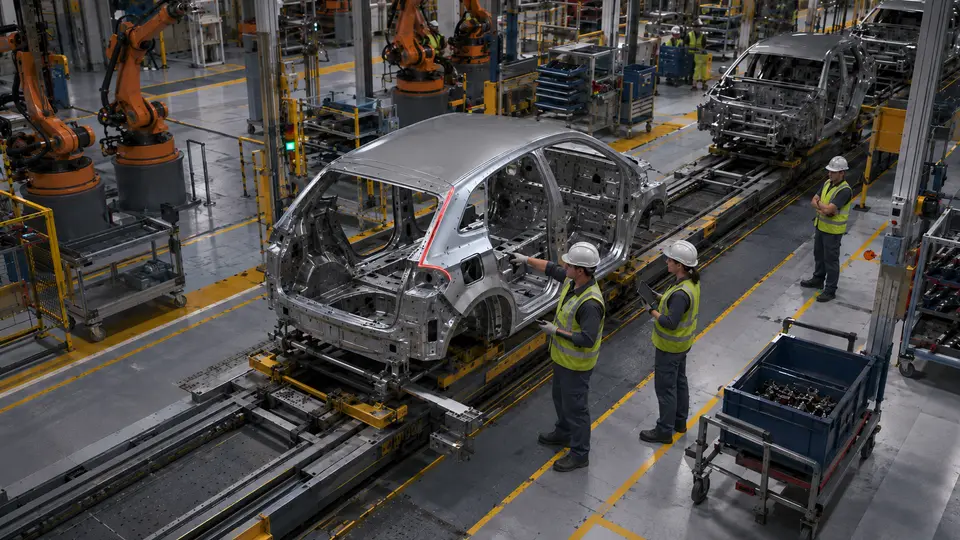
CAM-227A pillar weld seam that has not closed properly
«Tell me if the pillar-to-roof seam comes out uneven as the body leaves the cell.»
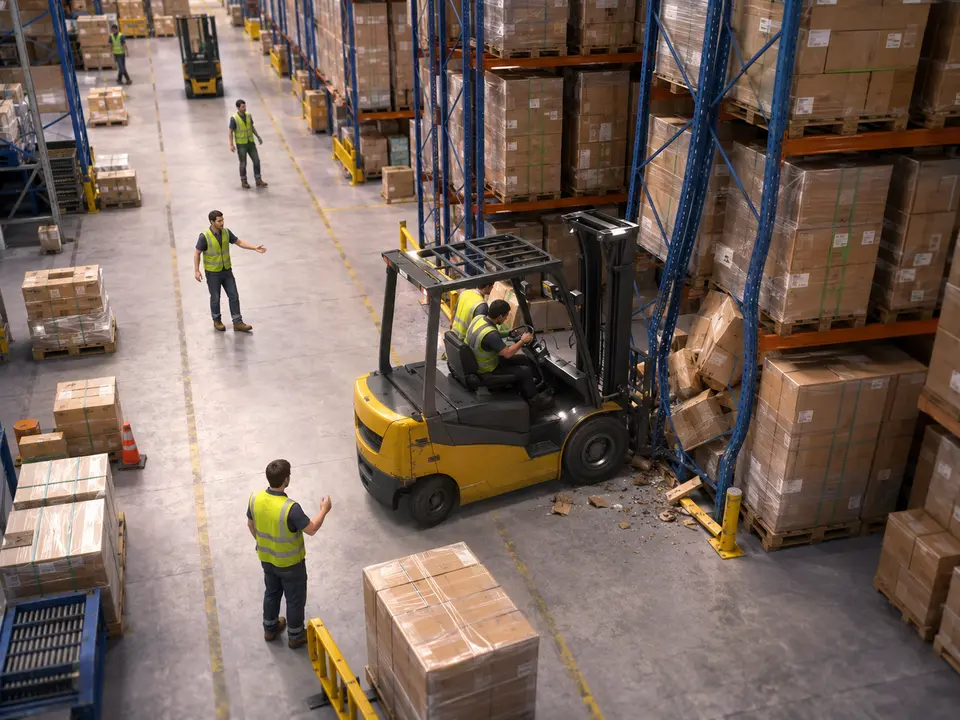
CAM-270A rack hit that nobody is going to report
«Tell me when a forklift hits a rack, and save me the video of the impact.»


What it does not do
IRIS does not measure. It will not tell you that a gap is three millimetres wide and the tolerance is two: that is the job of a gauge or a measuring bench.
And it only sees the face the camera sees. A defect under the car, on the inner face of a plate or inside a closed box is not in the image, and IRIS does not invent what is not in the image.
Questions
- Does this replace a machine vision system on the line?
- No. A machine vision cell works with the part held still, controlled lighting and tolerances in millimetres, and for that it beats IRIS. IRIS works with the cameras already hanging in the plant and looks at the part in motion: it covers the defect that is visible to the naked eye and that nobody catches today, because nobody can watch everything. The two sit together well: one controls the dimension, the other watches what goes past.
- How does IRIS know what counts as a defect in my product?
- You tell it, in words and with examples. You describe what worries you about your part — a dent in the panel, a crack along the top face, a box that is torn or wet — and you show it the area of the image to watch. From then on it flags anything matching that description. Nothing has to be programmed and no technical rule has to be written: you explain it the way you would explain it to someone starting on the station today.
- What if the defect is too small for the camera to tell apart?
- Then it does not see it, and we say so before we start. What IRIS can detect depends on the camera’s resolution, the distance to the part and the light in that spot. A fine scratch on dark paint, six metres away under raking light, is simply not in the image. Before a rule is accepted, that camera is checked with that part under the real light of the shift. If it cannot be told apart, we say so, change the framing, or drop it.
- Does the line stop by itself when a defect shows up?
- No, unless you decide it and it gets wired up. By default IRIS alerts: it sends the photo, the time and the point on the line to whoever needs to see it. Stopping a line is a decision with a cost, and a person with judgement takes it, not an automatic alert. If in your case a given defect should stop the belt, that action is defined with you and written down, so it is always clear who decided what and why.
A different case every time
Watch what happens. Then watch what IRIS does with it.
Not a recorded video and not a drawing: it is a summary of the real tool, with a different case each time round. The whole tool does not fit in a box.
- You ask
- IRIS searches
- It shows you
Not seeing yours here?
These words are the ones we have built, not the ones IRIS understands. The list falls short on purpose: you ask for it in a sentence, and sentences do not run out. Tell us what is in front of your cameras and we will tell you whether it understands it, or not yet.
And the best part
Sometimes you do not need an alarm:you need a number.
How many people came in, and when. You draw a line over the image and the camera counts. People counting is certified by the Centro Español de Metrología through NeuralPax.
Tell us your problem and we will say whether IRIS understands it, or not yet.
We reply the same working day.