Solutions by typeCustomer experience
How does help reach the counter before things escalate?
The tone at the counter is rising
Late in the shift at the A&E counter. Two people are very close together, one on each side, arms out, movements sharp. Another member of staff is coming down the corridor. Fifteen people in the waiting room are watching. The security team is two floors down and still knows nothing, because nobody has been able to let go of what they were doing long enough to call.
2 cameras across 2 sectors
What IRIS is
IRIS watches the cameras for you.
IRIS Neural is an artificial intelligence that watches the cameras you already have and understands what happens in front of them. When something important happens —or something you told it you need to keep an eye on—, it alerts you; and whatever can be counted, it counts in numbers. All day long, without anyone having to watch a screen.
You tell it what you need to watch, and IRIS does it.
Works with the cameras you already have. Nothing to replace.
A person replies, not a form.
- Your footage never leaves your premises.
- It doesn't identify people.
- Certifications →
This is how you ask for it
«Tell me when two people at the counter come very close together and move sharply, or when someone strikes the glass screen.»
Almost always nothing happens: the tone drops and it ends. The problem is the time it does not. An assault at a counter leaves someone off work, a report, a complaint to the police and a team that comes in the next day afraid. And it leaves something far harder to repair: the belief that if you draw that shift, you are on your own. In a casino the same scene costs a table stopped for twenty minutes, a written complaint and a lasting doubt about what really happened, because everyone tells it differently.
You decide once
You decide it once, and you decide it with the people who work the counter: which areas it covers, which hours it covers — a night in A&E is not midday — and who receives the alert, which should almost never be the person serving. IRIS applies it all year, on every shift and on every camera that sees that counter. Changing who receives it means changing one line, not explaining it again to each new team.
Nobody calls security at the start. People call once there has been shouting, and by then whoever is serving has spent five minutes alone with the problem in front of them. It is the same at an A&E counter at two in the morning, at a public service window first thing on a Monday, and at a casino table when a player stands up and objects.
And there is a very practical reason: the person serving cannot ask for help without stopping serving. Turning to find a phone, or standing up, makes the scene worse. So they hold on. The room is full, there are cameras everywhere, and those cameras feed a monitor nobody is watching, because at that hour whoever is on duty has ninety others in front of them.
IRIS does not read intentions and does not label anyone: it does not do that, and it should not. What it sees are things you can describe in words: two people very close on either side of a counter, sharp arm movements, a blow to the glass screen, a gaming table that stops and someone standing up. When that happens in the area you marked, someone who is not at that counter gets the camera open and decides whether to go down. Most of the time they will not need to. What has changed is that the person at the counter is no longer alone.
And there is something that hardly ever gets told: the pattern. When the alerts from a counter always cluster in the same window — Monday first thing, when appointments open, or the small hours of Saturday — it stops being the problem of one difficult person and becomes a design problem. A badly placed queue, a sign that does not explain the wait, an hour with no extra cover. It can be fixed upstream of the counter, and fixing it upstream is far cheaper than arriving at a run.
What changes
Before, help arrived when somebody managed to call, and calling was precisely what could not be done without making it worse. Now the alert goes out without anyone picking up a phone, and whoever receives it sees the scene before moving: often just appearing in the corridor is enough. And afterwards there is the video of the exact moment, which turns «apparently there was an incident» into a report that holds up.
Where we have seen it
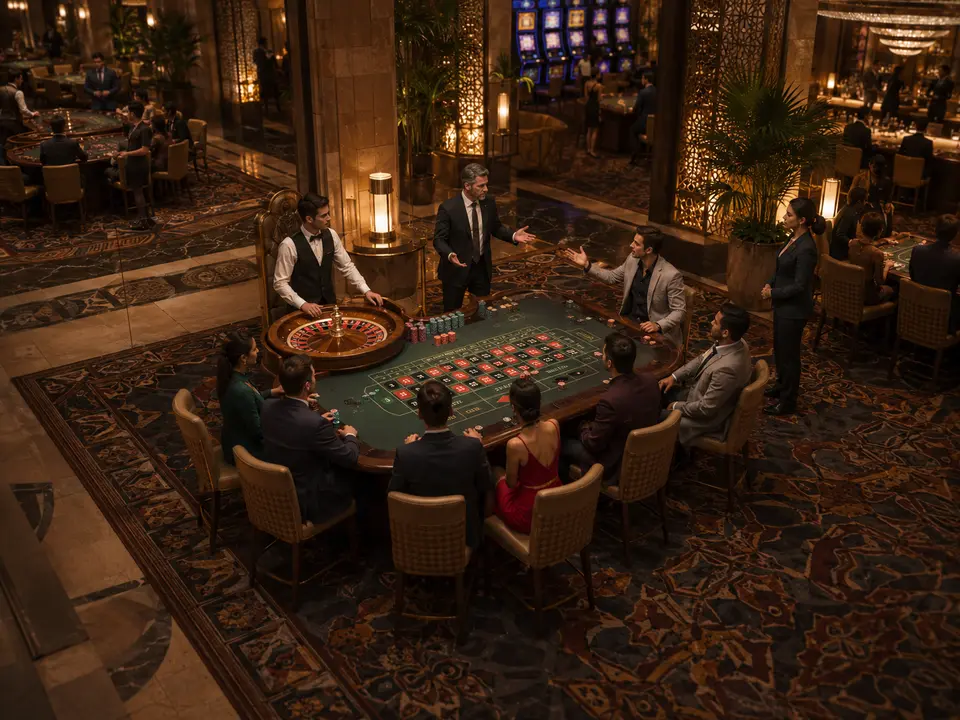
CAM-528A player raises a complaint and the table stops
«Show me the table where play stopped and a guest stood up, last night between eleven and one.»
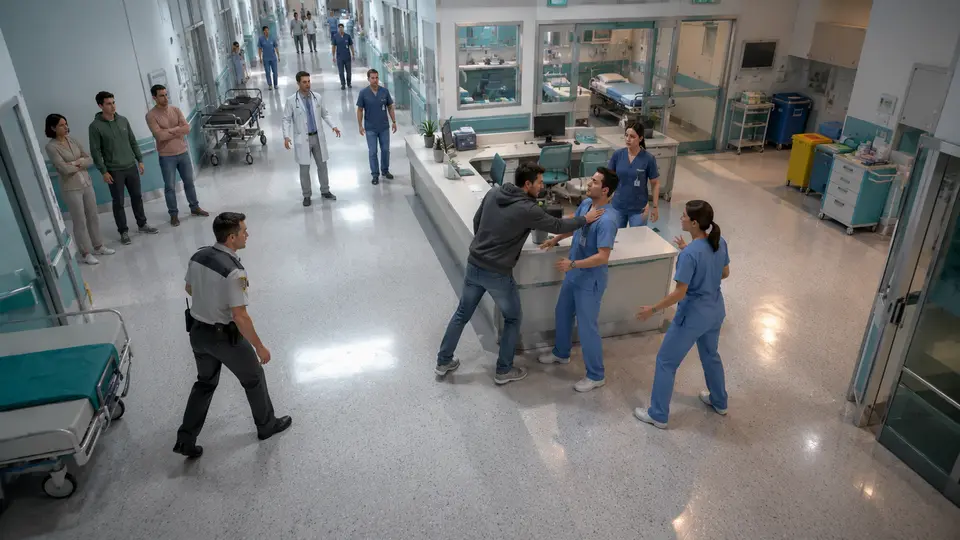
CAM-124Tension at the front desk
«Tell me when two people get very close at the desk and start moving abruptly, or when somebody bangs on the screen, so that someone gets there sooner.»


What it does not do
IRIS does not recognise faces, does not identify anyone and does not say who is right. It does not know whether a person is angry, drunk or frightened, and it never flags anybody as a problem.
It describes what is in the image: distance between two people, a sharp movement, a blow, a table that stops. Interpreting that, and deciding what to do, is a person’s job.
And it does not see what happens outside the frame. If it moves two metres and leaves the counter area, as far as IRIS is concerned it is over. That is why the area gets drawn with the people who know the place and work there, and not wherever there happened to be a free patch of wall.
Questions
- Does IRIS decide that someone is being aggressive?
- No, and this is the most important thing on this page. IRIS does not judge anyone, does not identify people and does not recognise faces. What it detects are visible, describable facts: two people very close together in the counter area, a sharp arm movement, a blow to the glass screen, a gaming table that stops. None of those things means on its own that anyone has done anything wrong. It means it is worth someone taking a look, and the one who looks is always a person.
- What if it is just an ordinary argument? Voices are raised at a counter every day.
- That is why the alert looks at the scene, not at the volume. Nothing is listened to here: there is no microphone. What is watched is the distance between two people, whether movements are sharp and whether there is a blow. And you set the threshold, with the counter staff in the room, because normal at three in the morning in A&E is not normal in an office mid-morning. If the alert fires every half hour, it gets tuned until it stops firing for nothing: an alert nobody believes is worse than no alert.
- Can it be used at a counter where patient data is on screen?
- Yes, and it must be done carefully. The camera is framed to see the scene, not the screens or the paperwork on the counter, and the rule area is drawn over the part where what matters happens. You do not need to see the far side of the counter to know that two people are very close and moving sharply. What does not need to be seen is not framed: it is the cheapest decision to take and the one that avoids the most trouble later.
- In a casino, does it help reconstruct what happened at the table?
- Yes, and it is usually the part people are most grateful for. When a player objects and the table stops, somebody has to explain afterwards what happened, and everyone tells it differently. With IRIS you search by what happened rather than by the clock: «the table where play stopped and a customer stood up, last night between eleven and one». The moment comes up with its video, and the complaint is answered by showing an image instead of stacking three versions that do not match.
Demo · IRIS at work
A new case each time. Always the same screen.
It plays by itself and shows one case from start to finish. It is a summary: the real screen has far more functions than fit in this box.
- Cameras on the map
- You draw an area
- What passed shows up
Not seeing yours here?
These words are the ones we have built, not the ones IRIS understands. The list falls short on purpose: you ask for it in a sentence, and sentences do not run out. Tell us what is in front of your cameras and we will tell you whether it understands it, or not yet.
And the best part
One camera,and you already have a watchman. Four thousand cameras, and you have four thousand watchmen.
None of them tires, none of them looks away and none of them works shifts. And there is nothing to install: the cameras you already have can start understanding what they see.
Tell us your problem and we will say whether IRIS understands it, or not yet.
We reply the same working day.