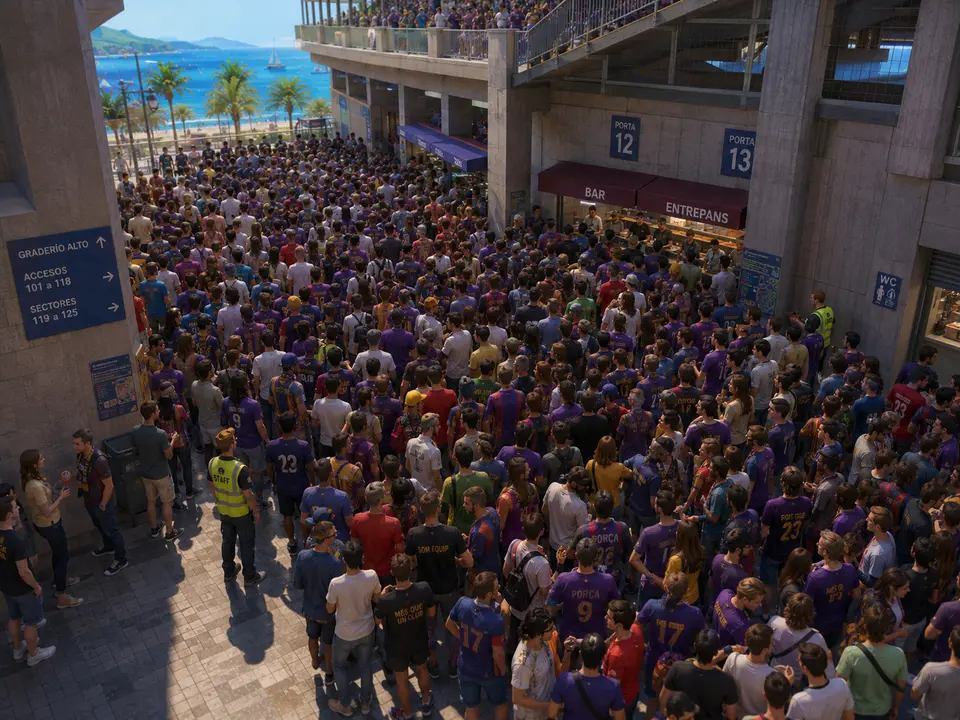
What does a venue with twenty thousand people inside see?
When twenty thousand people leave at once, more screens won’t help.
You need to know which gate is starting to block and how long you have to act. We show fifteen cameras here: eleven that raise an alert when something goes wrong and four that alert nobody, they just count. A large venue has hundreds. The system is exactly the same.

Without IRIS this is just a crowd on a screen.
AI-generated image
What IRIS is
IRIS keeps an eye on every gate so you don't have to.
IRIS is an artificial intelligence that watches the cameras you already have at the venue and understands what's happening at the gates and in the stands. When a line forms at an entrance, a section nears capacity, or something you've asked it to watch happens, it alerts you — and whatever can be counted, like the crowd in each area, it counts in numbers. All day long, with no one needing to stare at a screen.
You tell it what you need to watch, and IRIS does it.
Works with the cameras you already have. Nothing to replace.
A person replies, not a form.
- Your footage never leaves your premises.
- It doesn't identify people.
- Certifications →
A packed venue, understood
On event day there are more screens than eyes. Lines build up outside, the security check jams, a stairwell fills and the control room finds out when people are already pushing. And by then you aren’t redirecting a line: you’re clearing an area.
IRIS watches for them. It analyzes every camera at once and only interrupts when a rule written by the venue itself is met: density climbing in an access tunnel, an evacuation route blocked, a flare in the stand, someone on the ground. And it identifies nobody: it sees situations, not people. In a packed stand, that matters twice as much.
What arrives isn’t more video. It’s an alert with the camera, the time, what’s happening and what should be done. And when nothing happens, it’s numbers: how long it takes to get in through each gate, how many people each turnstile clears, how many people are inside. That last number is the only one a third party has verified: people counting is approved by the Centro Español de Metrología — Spain’s national metrology institute — through NeuralPax, the body that says whether a truck scale or a speed camera measures correctly. With that, a safe capacity is defended before the authorities with a measurement, not an estimate. Mind the scope: what’s approved is people counting, not the rest. The approval is Spanish. It doesn’t stand in for a U.S. certification, and we don’t present it as one.
The real scale
Fifteen here. Hundreds on event day.
This demo shows fifteen cases because fifteen fit on a screen. A real venue has cameras in the parking lot, at the bus stops, at the entrance gates, at the security check, at the turnstiles, in the concourses, on the stairs, in the access tunnels, in the stands, at the bars, in front of the stage and all along the perimeter. Hundreds of them, and a few more every season. No person can watch them all on a sold-out day; that’s exactly the problem IRIS solves: it analyzes however many there are, all at once, and only interrupts when a rule is met. And where there’s nothing to watch for, it counts: how many people come in through each gate, how long each line lasts, how many people are inside at any moment.
Examples
These fifteen are just examples.
Each one shows a different kind of thing: a line, a turnstile, a surge, an exit, a stand. They aren’t the fifteen things IRIS can do: they’re the ones that fit on a screen. Open any of them and you’ll see the image as it is, and then with what IRIS understands on top.
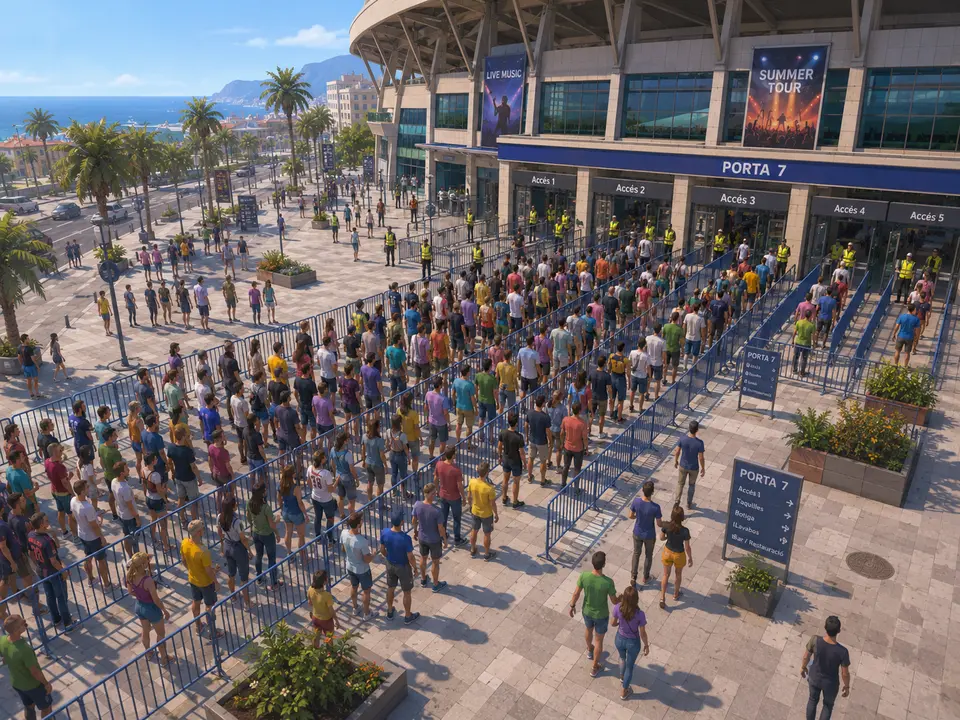
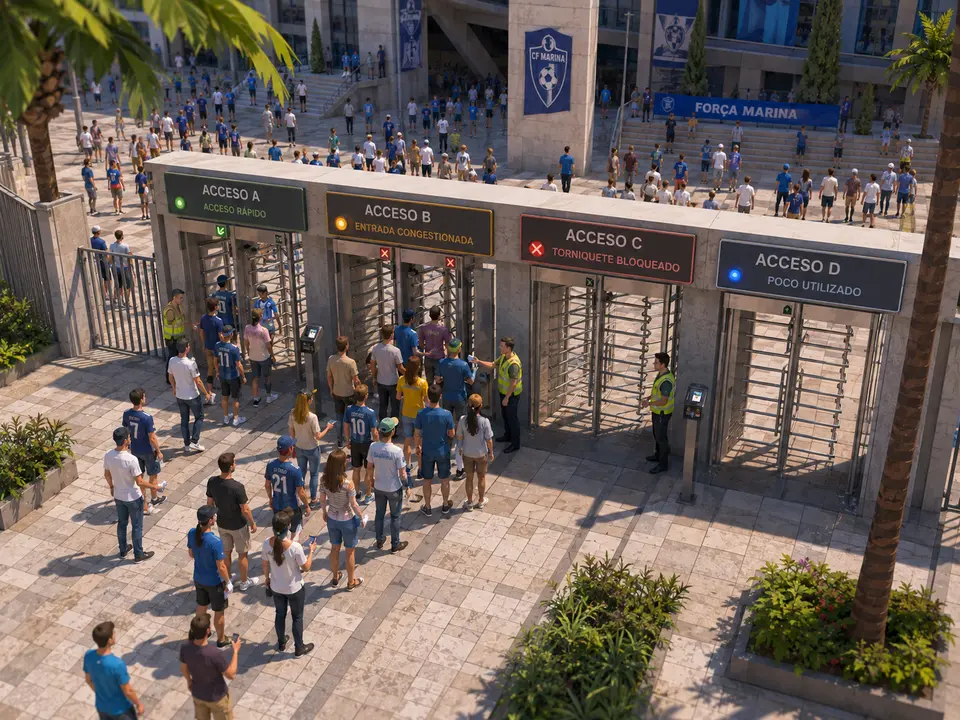
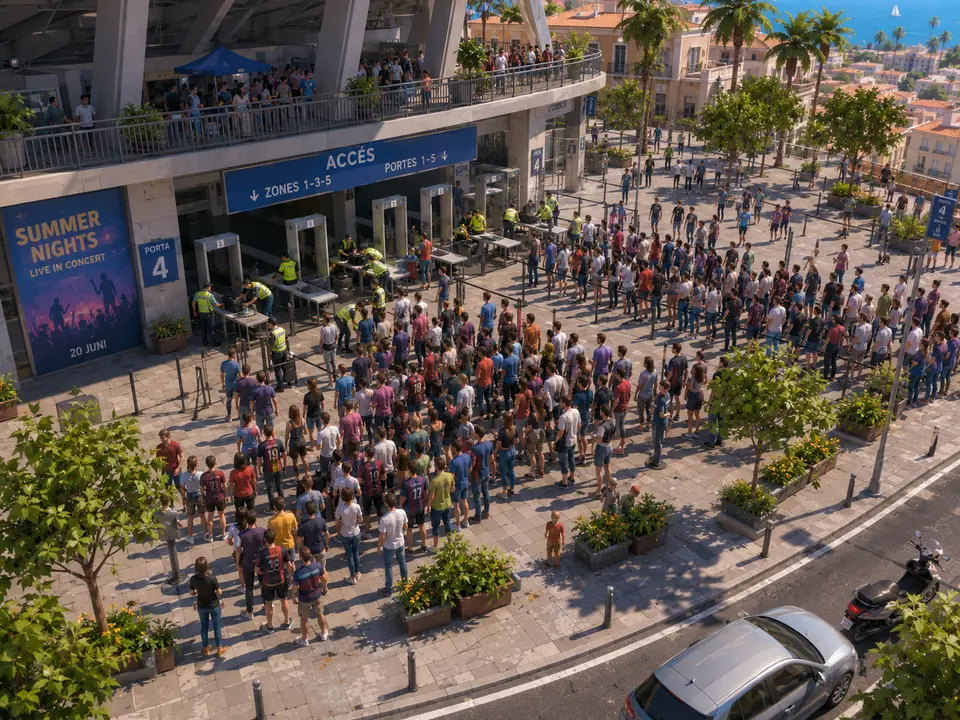
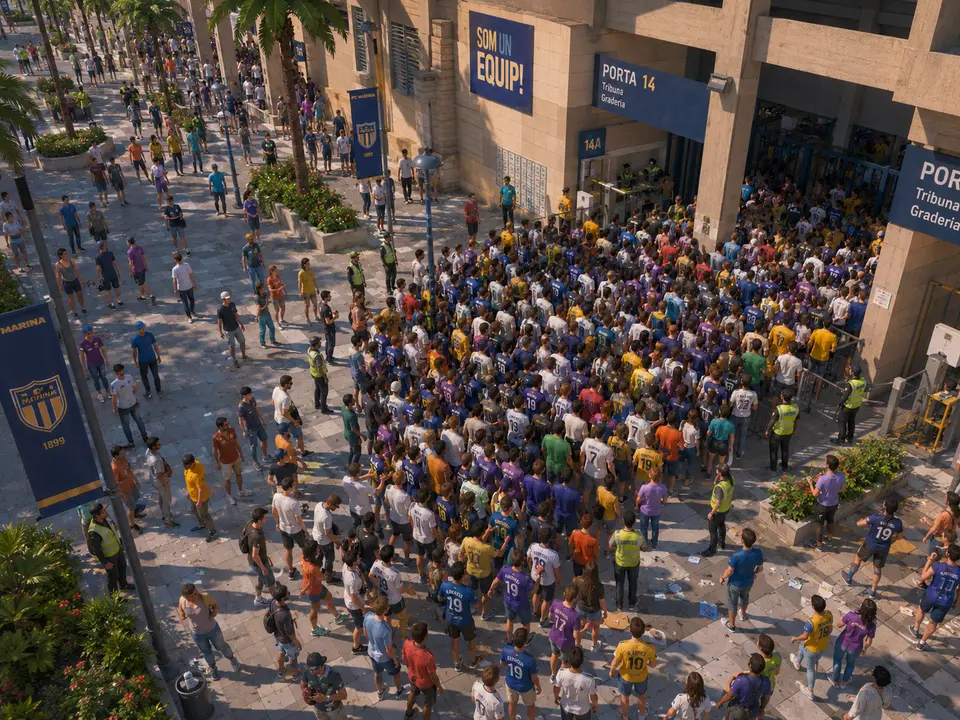
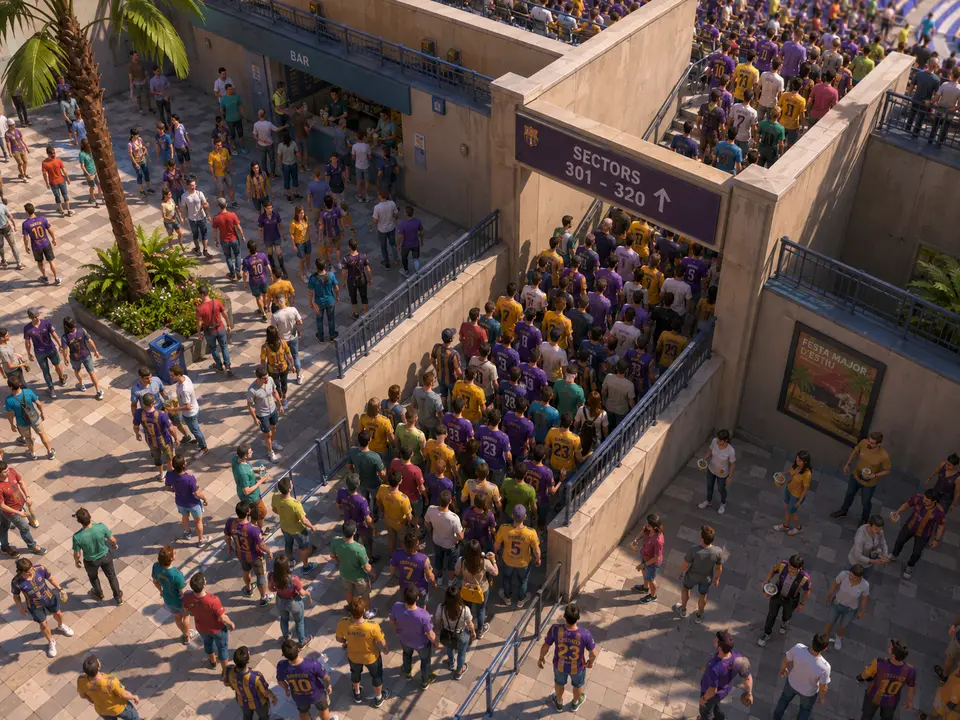
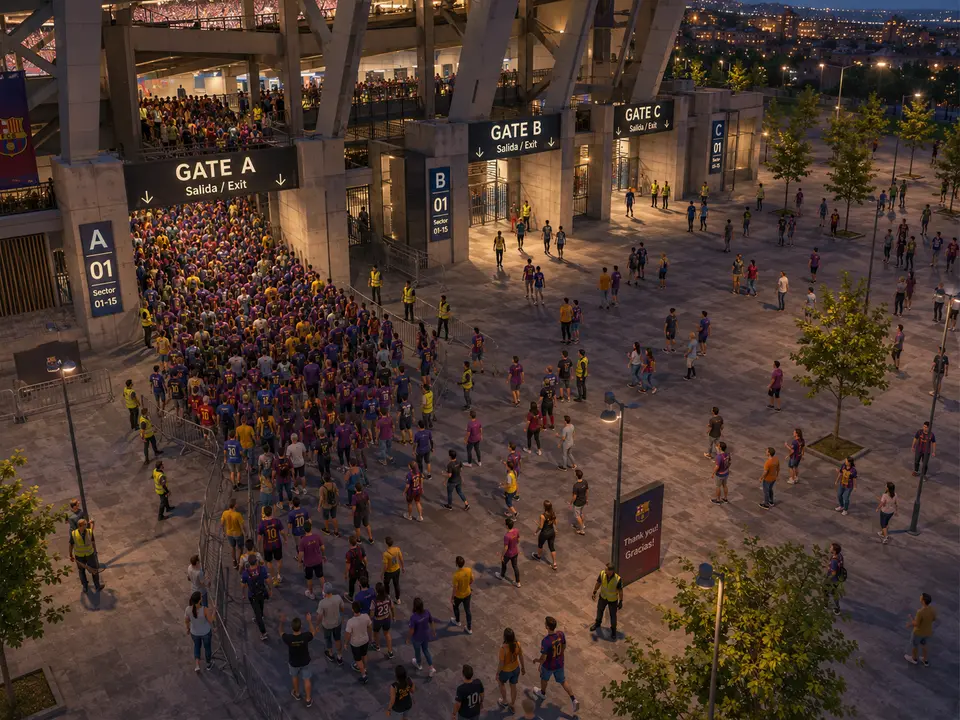
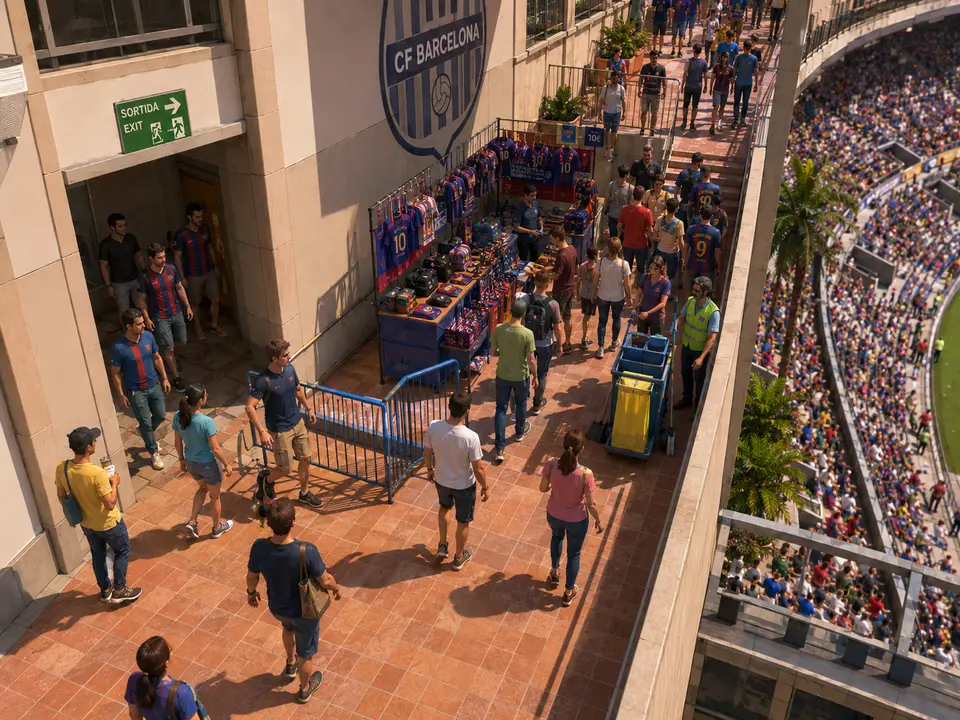
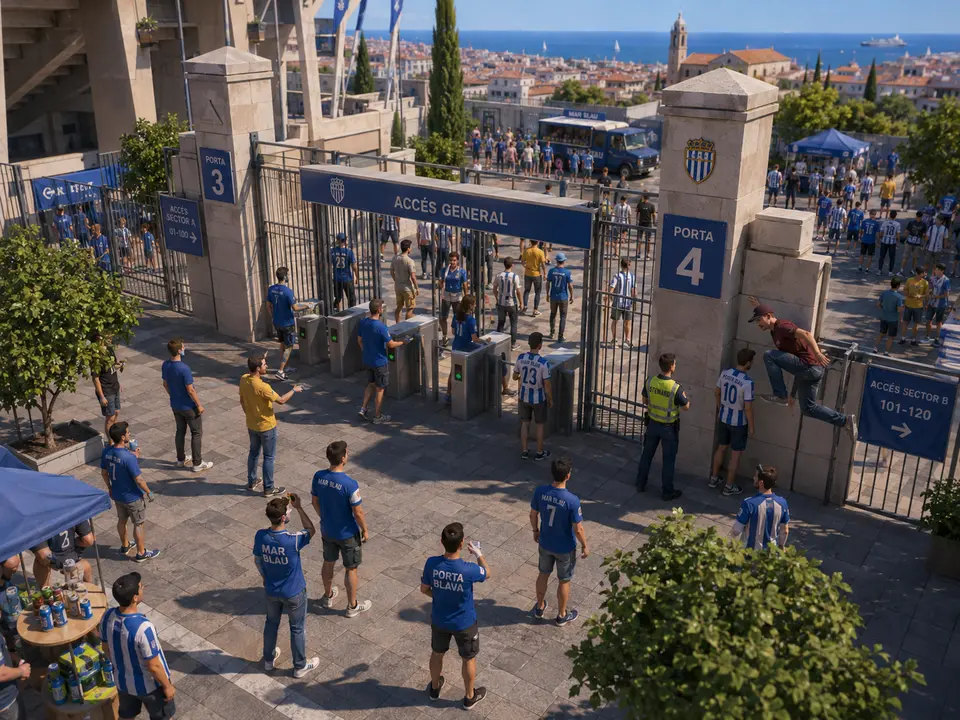
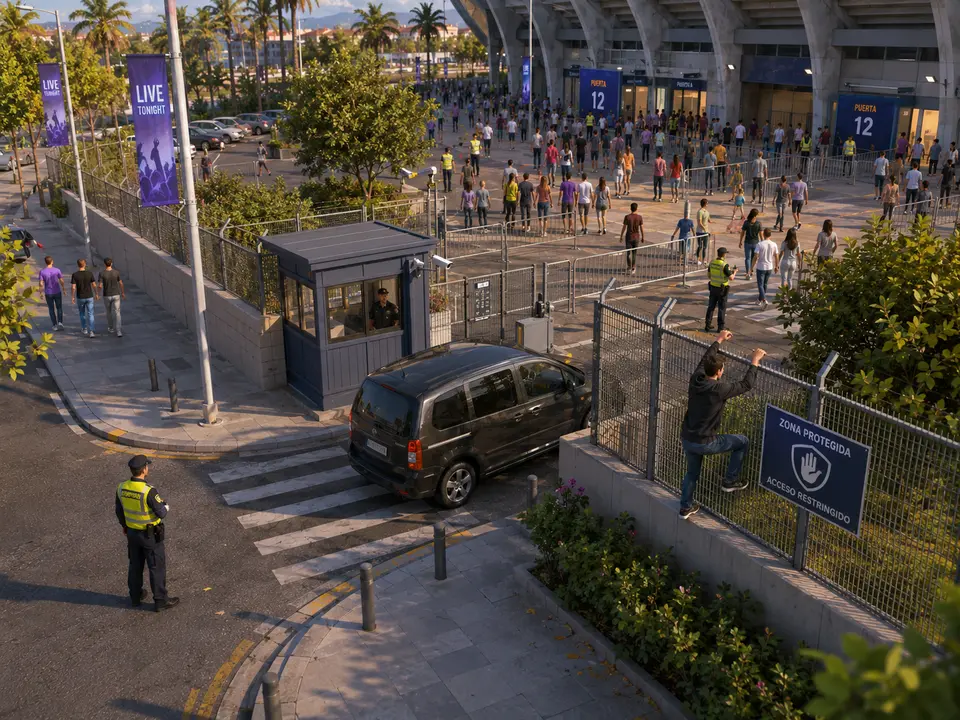
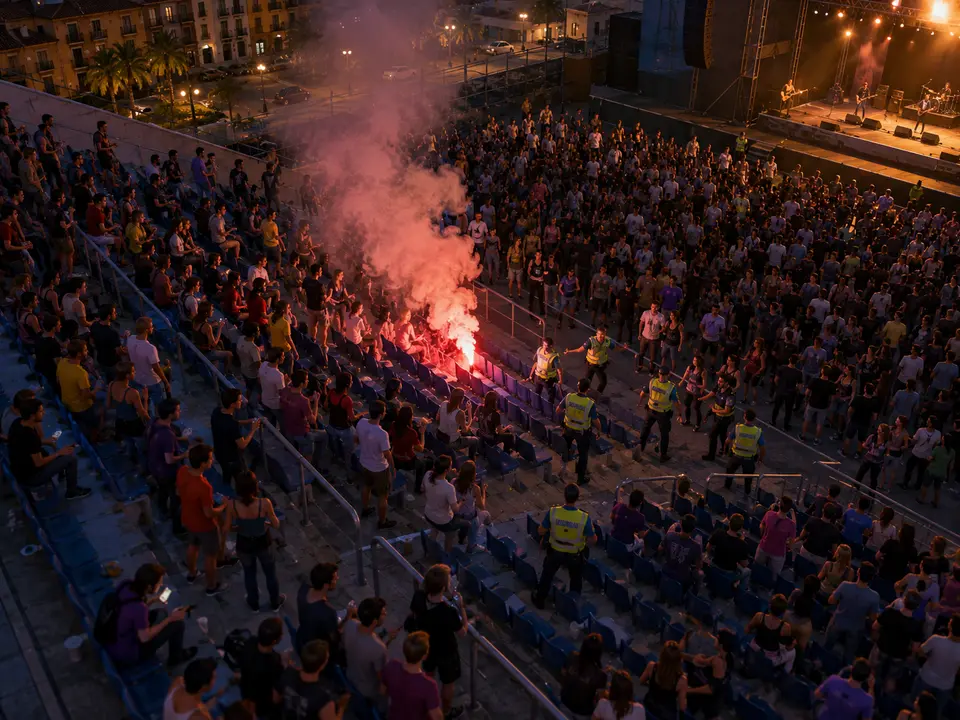
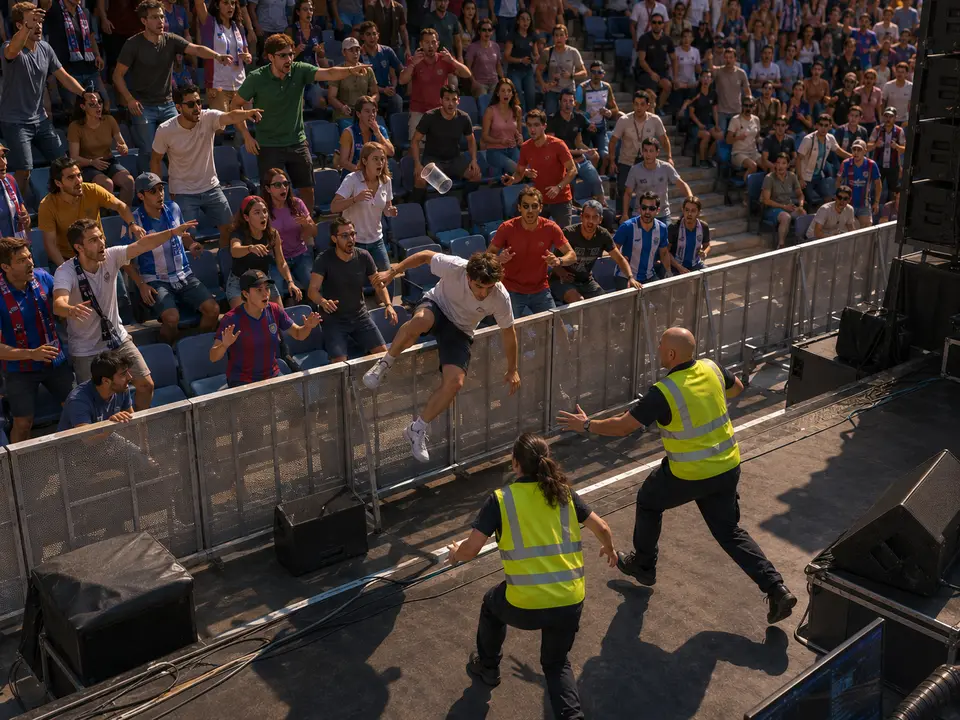
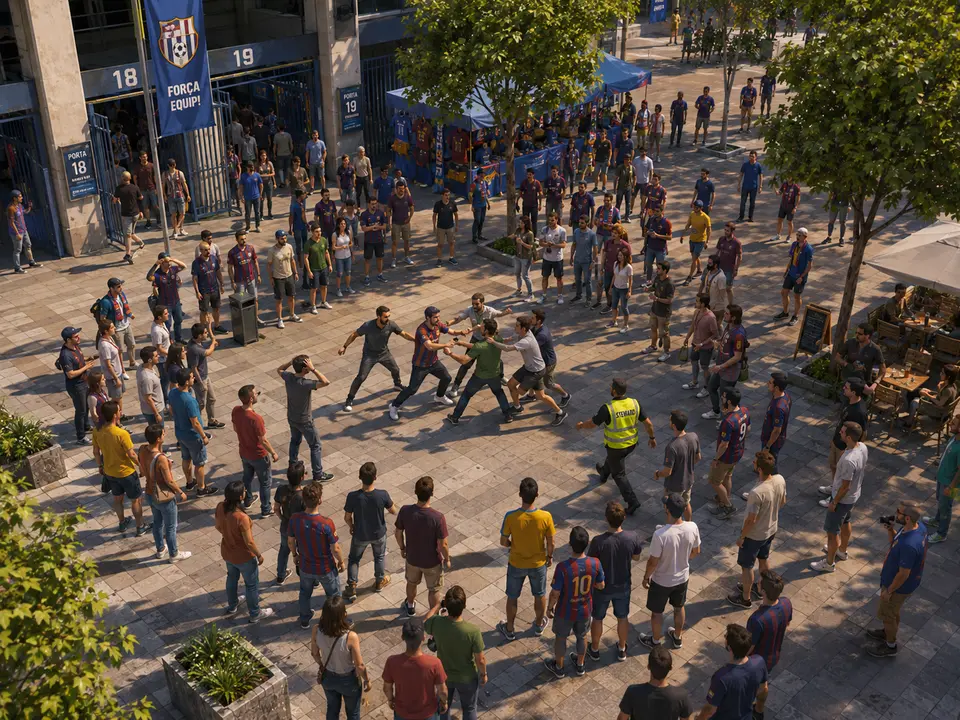
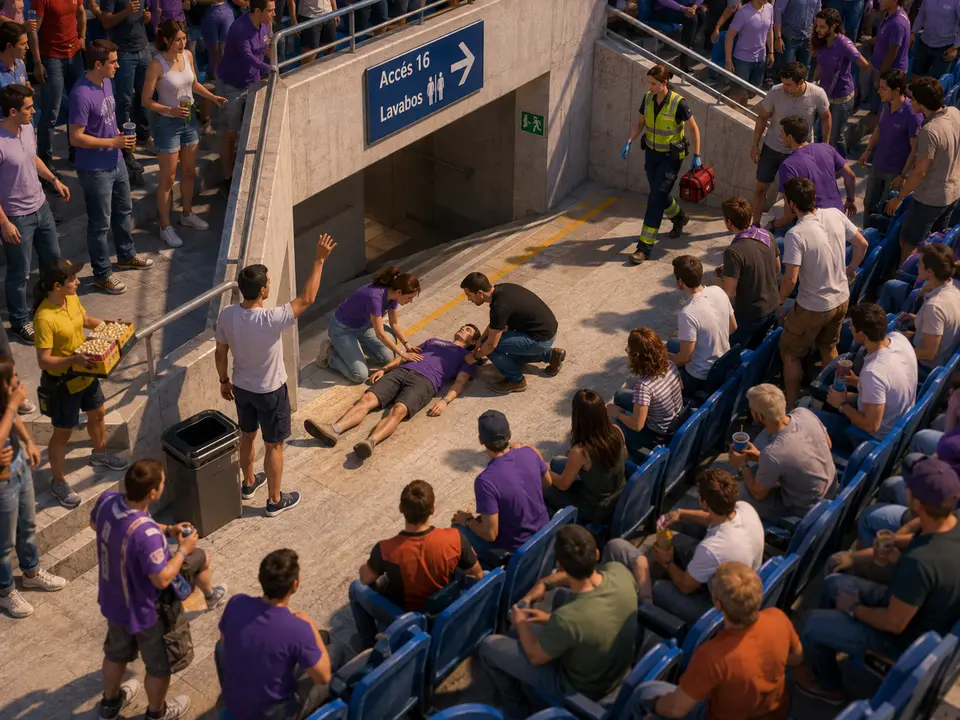
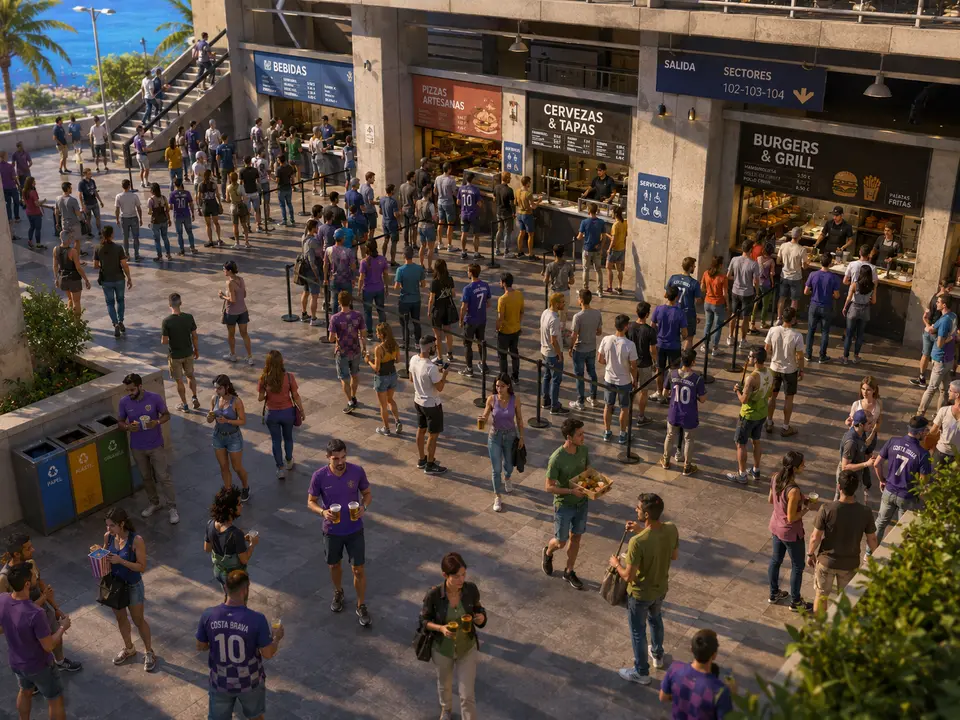
See it in action
Demo · IRIS at work
A camera looks. IRIS understands what it sees.
An extract of the real screen, no voice-over and hands-free. Each round poses another situation. What sits behind it is a good deal bigger than what you see.
- The rule gets built
- It goes to every camera
- Published, it watches alone
- And then it fires
Now think about yours
Imagine knowing while there’s still time to act.
A gate that takes twice as long as the one next to it to let people in. A turnstile standing idle while the one beside it jams. A security check clearing fewer people than arrive. A stand where each person has less room every minute and nobody moves anymore. A stairwell and an access tunnel turned into a funnel. Twenty thousand people leaving through a single door because the rest are shut. All of it happens in front of cameras you already have.
All of that is happening in front of cameras your venue already owns and already paid for. And nobody knows until someone shouts it over the radio, because there aren’t enough people to watch that many screens on a sold-out day. IRIS watches them all at once and tells you while it’s happening, with the camera and the gate. In a fight it prioritizes getting someone there: it does not decide who is to blame. A person decides that afterward, with the video in front of them.
What gets asked before the first sell-out
The ten questions that come up in the event safety meeting.
Answered in the first line, straight, and without promising that a system prevents a crush. IRIS warns while there’s still time; the person on the ground decides what happens next.
Does it work with the cameras we already have in the venue?
Yes, it works with the cameras you already have in the venue. IRIS connects to the feed of the IP cameras that are already installed and analyzes it as it arrives: what changes isn’t the equipment, it’s what gets understood from the picture. During the project we check camera by camera whether the framing is good enough for what you want to see there. And we tell you plainly which ones fall short: the stand camera can’t make out a face from the far side of the pitch, and it doesn’t need to, because what it has to see is how much room each person has and whether the line is moving.
Does IRIS identify people or recognize faces in the stands?
No, IRIS does not identify people and does not recognize faces in the stands. It compares nobody against any list, any banning register or any database, and it keeps no record of who anyone is. What it sees are facts: a ring closing around two people, somebody climbing a fence, a lit flare and which row it is in, a density that climbs and a walkway that stops moving. That reaches the screen with the camera and the time. The person who watches the video and concludes what happened is a human being, always.
Can I know how many people are in each area and keep control of capacity?
Yes, you can know how many people are in each area and run capacity from that. You trace a line on the image of each door and IRIS counts who comes in and who goes out, never saying who they are. You draw the zone of a vomitory or a concourse and you know how many people are inside right now. Asking is for searching. Counting is for measuring. And they aren’t done the same way: a line can’t be described in a sentence, it has to be traced. For people counting our system is approved by the Centro Español de Metrología — Spain’s national metrology institute — so the figure has been verified by a third party, not by us. Worth putting precisely: that approval covers people counting, not the whole product. It’s a Spanish approval. What crosses over isn’t the seal, it’s the method: the same line, in the same place, every day.
Does it work when the venue is full, which is when it’s needed?
IRIS works when the venue is full, with one caveat we prefer to say before signing: when a lot of people come together, some block others and a camera stops telling them apart one by one. That happens to any vision system, ours included. What isn’t lost is exactly what you need at that moment: how much room each person has in that area and whether the group is moving or has stopped. Measuring density and flow doesn’t require telling each person apart. Where counting one by one does belong is at doors and turnstiles, because there people pass in single file.
How much warning does it give before a crowd build-up?
IRIS warns about a crowd build-up as soon as the two signals that announce it appear, and it’s worth saying what it doesn’t do: it doesn’t see the future and it predicts nothing. What it measures is how much room each person has in that area and how fast they are moving. When density climbs and flow drops at the same time, that’s a funnel forming, and it shows up in the alert before anyone notices it from the control room. How much margin you get depends on the spot: on a wide ramp you see it coming with more time than at the mouth of a vomitory. The alert arrives with the camera, the area and the time, and the person on the ground decides the move.
Does this replace your event staff, the safety plan or access control?
No, this doesn’t replace your event staff, the safety plan or access control: it changes what they look at. Today one person has dozens of screens in front of them and, on a full house, can’t attend to them all. With IRIS they stop watching everything and watch what matters, when it matters. IRIS doesn’t open or close a door, doesn’t stop a turnstile and doesn’t send anyone anywhere: it opens the camera, shows what it saw and waits. The plan stays yours and so does the decision. What it adds is a pair of eyes at the spot where nobody’s looking right now.
How many alerts arrive on a full house, and who do they reach?
You get the alerts your rule asks for, and tuning that rule is the work of the first few events. A system that throws a hundred alerts in one concert gets turned off by the second; we know that. So a rule isn’t “alert if there are a lot of people.” It is “alert if the density in this area goes above this value and flow drops, for longer than these seconds, during doors-open hours.” You bound the area on the image, the threshold, how long it has to last and who receives it. And the alert doesn’t go to an inbox: it goes to the radio and to the phone of whoever is on that gate, with the camera already open. You review a whole event with your team and adjust.
Does the video leave the venue or stay inside?
The video leaves the venue or stays inside depending on the mode you choose, and there are two modes. In the local mode it doesn’t leave: the servers are on your premises, the video comes in over your network, it’s analyzed there and the system needs no internet to work. In a venue that matters a lot, because on a full house the connection is the first thing to saturate, and the system has to keep seeing precisely then. In the other mode it is processed in our data center, which is our own cloud and not a third party’s. In both, communications are encrypted and the terms are signed in the contract.
A trade show and a concert are nothing alike. Do we have to reconfigure everything for each event?
A trade show and a concert are nothing alike, and that’s why the system is built so that changing the set-up costs little time. Areas are redrawn on the image: if the stage covers half a stand and a front pit appears, you mark the pit and carry on. Alert rules are written in words, so a rule for tonight’s set-up is written in a short while and tested the same day. And you don’t have to redo it every time: you save one configuration per event type — trade show, standing concert, seated concert — and load the one you need. That’s the difference between a system that works for the first event and one that still works during the summer tour.
How much does it cost to put IRIS on a venue’s cameras?
You pay per camera. What it comes to depends on how many cameras IRIS analyzes, what it detects or measures on each one, which deployment mode you choose and whether the hardware is yours or ours. We don’t publish a price list because it wouldn’t be honest: covering the five entrance doors of an arena doesn’t cost the same as the seating bowl, the vomitories and the bars of a whole venue. What you can do is start small: the two doors that always jam, the capacity counting, and then look at the alerts and the figures with your team after a couple of events. Tell us how many cameras there are and what you want to see, and we’ll give you a figure. Phone in Spain · +34 93 566 70 22.
Next step

How long does it take to find a hand played two hours ago?
12 cases: 9 raise an alert when something happens and 3 only measure. You see each image as it is, and then with what IRIS understands on top.
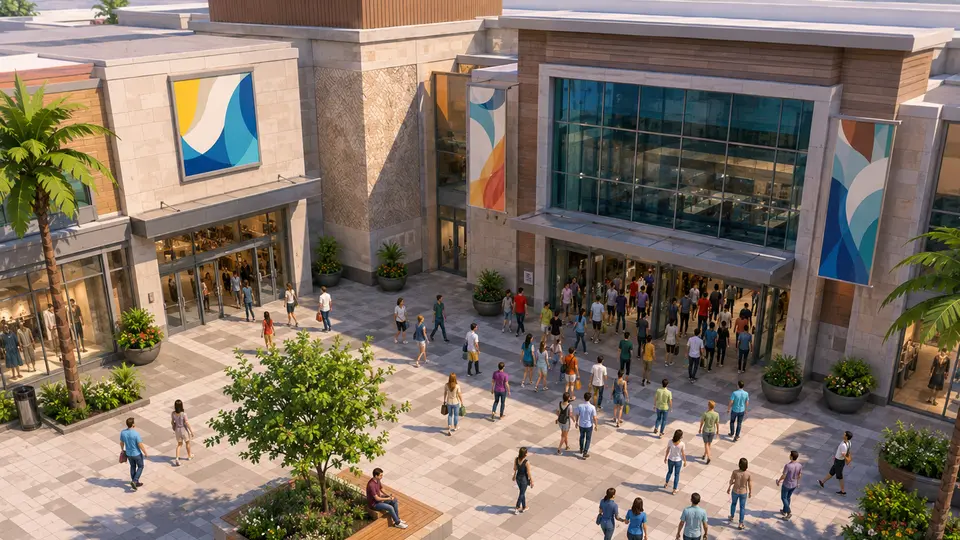
What does a mall see beyond the visitor count?
12 cases: 4 raise an alert when something happens and 8 only measure. You see each image as it is, and then with what IRIS understands on top.


And the best part
IRIS only sees what the camera shows.Where we don’t reach, we say so.
No software fixes a lens pointing the wrong way or covered in dust. Before promising anything, we say which cameras are in a state to see what you’re asking of them.
Tell us your problem and we’ll say whether IRIS understands it, or not yet.
A person answers, the same working day.