CAM-480
The line tells you when the gates should open
Saturday, seven in the evening, two hours before the concert. In front of the gate, a snake of blue barriers holds seven full lanes of people waiting their turn. The three entrances on the left take the whole flow; the two lanes on the right are set up and almost empty. More people keep arriving across the plaza from the walkway. IRIS counts how many are waiting, how many go in per minute and how long the last person in line takes to get through.

Turn on IRIS Vision
AI-generated image
What IRIS is
IRIS keeps an eye on every gate so you don't have to.
IRIS is an artificial intelligence that watches the cameras you already have at the venue and understands what's happening at the gates and in the stands. When a line forms at an entrance, a section nears capacity, or something you've asked it to watch happens, it alerts you — and whatever can be counted, like the crowd in each area, it counts in numbers. All day long, with no one needing to stare at a screen.
You tell it what you need to watch, and IRIS does it.
Take this scene: IRIS keeps count of how many people are in line, how many are getting through each gate per minute, and how long the last person in line takes to get in. That tells staff whether the line is building up faster than it's clearing. Based on that, they decide whether to open another gate or start earlier, and the next day they check whether the show kicked off on time.
Works with the cameras you already have. Nothing to replace.
A person replies, not a form.
- Your footage never leaves your premises.
- It doesn't identify people.
- Certifications →
What IRIS understands
What it recognizes in this scene
- access lanes set up and unused
- people waiting in the barrier snake
- entrance doors into the venue
- member of staff at the head of the barrier
- people arriving across the plaza
What this camera gives back
Nobody gets an alert here. Here you get numbers.
- 740People waiting right now
- 96 / minPeople going in per minute
- 14 min+5 minWait from the back of the line
- 3 / 5Lanes with a line, of those set up
- 9Staff visible at the entrance
- 19:02Time the gate opened
The figures on this screen are an example from the illustration, not any client’s measurement.
IRIS incorporates NeuralPax, a separate license approved by the Centro Español de Metrología — Spain’s national metrology institute — for people counting, occupancy and crowd-flow control. That the figure is right is guaranteed by a third party, not by us: the occupancy figure you show is measured and approved, not estimated. The approval covers that measurement — counting people — not the whole product. That approval is Spanish and it isn’t equivalent to any U.S. certification: we say so up front and not at the end.
How the counting works
Counting isn’t something you ask for. You draw a line.
A line is drawn across the threshold of the gates: whoever crosses it has gone in, and that’s the capacity figure. And an area is painted over the barrier snake, saying how many people are waiting and how long they have been there. Neither the line nor the area can be asked for in words: they’re drawn once onto the image and stay there, so a Tuesday figure and a Saturday figure are measured the same way. Counting people is the only measurement we hold approval for from the Centro Español de Metrología, Spain’s national metrology institute, and it’s NeuralPax that does it, a separate license built into IRIS. We don’t claim accuracy. We certify it. The approval is Spanish. It doesn’t stand in for a U.S. certification, and we don’t present it as one.
- line across the threshold of the gates · Counting line
- queue area · Dwell zone
And also, one rule
You decide once. IRIS applies it always.
If
the wait in line goes over fifteen minutes or one lane goes unused while another piles up
Then
- alert the gate supervisor with the gate, the lane and how many are waiting
- save the video of the minute the line stopped moving
- leave the count for that time slot in the event log
The instruction that set it up«Tell me when the wait goes over fifteen minutes, or when one lane empties out while the one next to it piles up.»
What changes
What changes for whoever runs security at the venue
With that figure, the head of security settles three things he now decides by eye: when to open the gates, how many entrances to keep open and how many staff to put on each. If the line grows faster than people go in, he sees it while it’s happening and opens another lane. And the next day he has the whole curve: how many people came, when they came and how long they waited. That’s what makes the show start on time.
What people usually ask
Can IRIS’s people counting be used to justify a capacity figure?
Yes. Counting people is the only measurement we hold approval for from the Centro Español de Metrología, Spain’s national metrology institute, and it’s NeuralPax that does it, a separate license built into IRIS. That’s why the figure stands up when it is used to measure capacity and manage crowd flow in front of whoever has to check it: it is measured and approved, not estimated. We don’t claim accuracy: we certify it. Everything else IRIS does isn’t covered by that approval, and we don’t present it as if it were. The approval is Spanish. It doesn’t stand in for a U.S. certification, and we don’t present it as one.
Does IRIS know who is standing in line?
No. IRIS does not recognize faces and does not compare them against any database. It counts bodies crossing a line and bodies inside a drawn area. It knows there are seven hundred and forty people waiting and that they have been there fourteen minutes; it does not know who any of them are, and it does not need to in order to give the figure.
Does IRIS decide when the gates open?
No. That decision belongs to the venue. What IRIS does is put the figures on the table: how many people arrive per minute, how many are waiting and how long they take to get in, event after event. With that curve in front of you, opening half an hour earlier or setting up one more lane stops being a hunch and becomes arithmetic. Whoever signs it off is still a person.
Other cameras
- CAM-481 · One gate standing idle while the next one jams
- CAM-482 · Twenty-four arrive a minute, the search line clears nine
- CAM-483 · Less room per person than three minutes ago, and nobody moves
- CAM-484 · The ramp is packed and the concourse next to it is empty
- CAM-485 · Twenty thousand people leaving at once, all through the same gate
- CAM-486 · A merchandise stall has eaten half the exit
Every simulation
Search by license plate
Show me every time that plate crossed the barrier this week, with the time and the video.
- What you’re looking for
- Where to look
- What matches
- Who looks
Next step
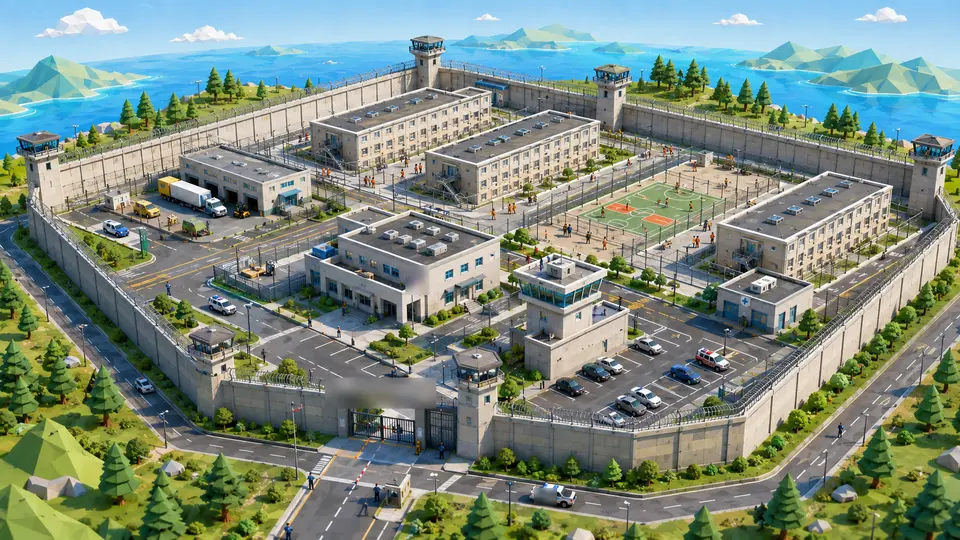
Who is watching the yard screen when the fight starts?
17 cases: 16 raise an alert when something happens and one only measures. You see each image as it is, and then with what IRIS understands on top.

How long before somebody comes down that hallway at four in the morning?
13 cases: 12 raise an alert when something happens and one only measures. You see each image as it is, and then with what IRIS understands on top.


And the best part
What happens outside the framedoesn’t exist for IRIS. No camera sees the whole world.
So the first thing we do is check what each camera covers and write it down: from here you can understand this, and not that. A dull hour that saves a lot of misunderstandings.
Tell us your problem and we’ll say whether IRIS understands it, or not yet.
A person answers, the same working day.