Solutions by typeMobility analysis
How long is it occupied without actually being used?
Occupied is not the same as in use
Two thirty-five in the hotel dining room. One table has sat for eight minutes with the previous service still on it: plates, glasses and napkin exactly as they were left. On the left three people are standing, waiting for a table, and at the back two tables are laid and free but invisible from the door. The dining room is not full. It looks full, and that is the whole difference.
3 cameras across 2 sectors
What IRIS is
IRIS watches the cameras for you.
IRIS Neural is an artificial intelligence that watches the cameras you already have and understands what happens in front of them. When something important happens —or something you told it you need to keep an eye on—, it alerts you; and whatever can be counted, it counts in numbers. All day long, without anyone having to watch a screen.
You tell it what you need to watch, and IRIS does it.
Works with the cameras you already have. Nothing to replace.
A person replies, not a form.
- Your footage never leaves your premises.
- It doesn't identify people.
- Certifications →
This is how you ask for it
«Tell me how long each bay stays occupied, and alert me when one goes past the limit while people are waiting.»
Eight minutes a table, several times a service, is several covers not served that day. In a car park it is the thirty-minute bay occupied for three hours: the people who actually came to shop drive round once and leave. And in a charging bay it is worse, because the car finished charging forty minutes ago and is still there, so the point is occupied while serving nobody. None of it breaks anything, and all of it gets paid.
You decide once
You decide this once, and it is decided by whoever runs the place. You say which bays or tables are measured, what the limit is on each, what hours it applies and who is told when it is exceeded. IRIS checks them all, all day, every day, with nobody having to go and look. If in August the limit goes from half an hour to an hour, you change the number and it is already in force.
There is no offence here, and almost never any bad faith. There is a space that is occupied and not being used, which is the quietest way of losing money that exists: nothing breaks, nobody complains and nothing appears in any log. The uncleared table. The short-stay bay with three hours on it. The car that finished charging and is still plugged in. In all three the camera was watching from the start, and the figure reached nobody.
This is asked for in two ways, and they are worth telling apart. One is measuring: how long each bay stays occupied and how many different cars pass through it in a day. That is not asked in a sentence, it is drawn: you mark the bay on the image, and from then on the time is a repeatable number, comparable across months and defensible if anyone disputes it. The other is alerting, and that one is a sentence: tell me when a table has gone five minutes uncleared and people are waiting for a seat.
Together they change how decisions get made. The number answers the big question: whether the short-stay area is the right size, whether more charging points are needed, or whether the problem was never the number of bays but the turnover. The alert solves this afternoon: it reaches the floor manager while three people are still waiting at the door and that table can still be cleared.
What changes
Before, you knew this by walking the floor, and whoever walked it did so when they could. Bay turnover was an estimate, and the uncleared table was discovered once the customer had already gone elsewhere. Now the time on each bay measures itself and the alert arrives while it can still be fixed. Whoever builds the rota decides with the week’s curve, not with what they remember.
Where we have seen it

CAM-499Eight minutes uncleared, and guests are waiting for a table
«Tell me if a table has gone more than five minutes uncleared while people are waiting for a seat.»

CAM-468Finished charging and still in the bay
«Tell me when a car has been in the charging bay for over half an hour after the charger finished.»
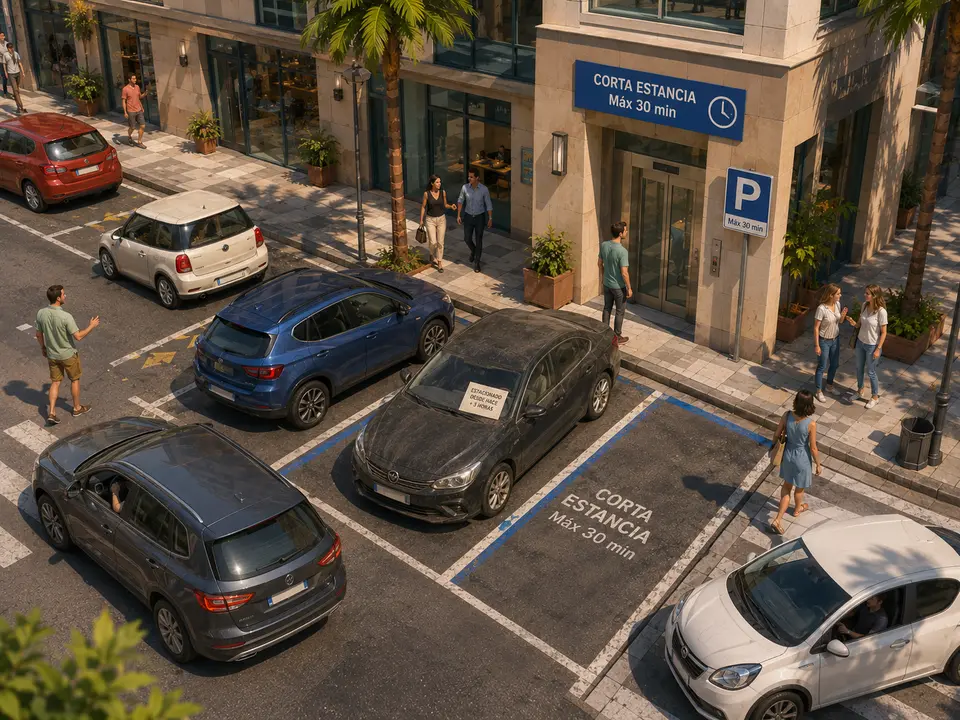
CAM-466Three hours in a thirty-minute bay
«I want to know how long each short-stay bay is occupied and how many different cars pass through it in a day.»


What it does not do
This fines nobody and lifts no barrier. It measures time and alerts; what happens next is a person’s decision. It also does not know whose car it is: it does not identify the driver and keeps no record of anyone. And if a similar vehicle parks in the same bay, the counter sees a new occupancy, not the same one. What it gives is occupancy time per bay, not a history of people.
Questions
- Do you need to read the plate to know if a car overstays?
- Not for this. What is measured is the bay, not the vehicle: the bay is marked on the image and the time it stays occupied without emptying is counted. If the car leaves and another arrives, the counter resets by itself, because the bay was empty. That already gives you turnover and overstays. Reading plates is a different thing, asked for separately, with its own personal-data rules, and it is not needed to know that a thirty-minute bay has been occupied for three hours.
- What if the table is uncleared because nobody is waiting?
- Then it should not alert, and that is why the rule carries both conditions. An uncleared table in an empty dining room is not a problem: it is a pending task. It becomes a problem when people are waiting for a seat and the table is still laid, and that is the sentence you write. The rest of the time the figure is still measured and shows up in the dining room’s status, but it does not sound. Not everything important is an alarm: sometimes it is a number you look up.
- Does it work for an electric charging point?
- Yes, and it is one of the clearest cases, because there an overstay blocks a service someone else needs. The camera sees that the car is still in the bay; the charging point knows the session has ended. Where the site allows those two to be joined, the alert is exact: half an hour occupied after charging finished. Where it cannot, only the bay’s occupancy time is measured, which already says plenty. What we do not do is promise an integration we have not verified.
- Is this for issuing fines?
- No, and it is not designed for that. IRIS measures occupancy times and alerts; it does not penalise, does not identify the driver and produces no citation. What comes out is operational data: how long each bay is occupied, how many different vehicles pass through it and which ones exceed the limit. What is done with that —an announcement, sending someone, rethinking the bays or changing the hours— is the organisation’s call, and that decision remains a person’s.
The real interface, step by step
A camera looks. IRIS understands what it sees.
An extract of the real screen, no voice-over and hands-free. Each round poses another situation. What sits behind it is a good deal bigger than what you see.
- It lands in the tray
- You open it
- You confirm or dismiss
Not seeing yours here?
These words are the ones we have built, not the ones IRIS understands. The list falls short on purpose: you ask for it in a sentence, and sentences do not run out. Tell us what is in front of your cameras and we will tell you whether it understands it, or not yet.
And the best part
A recording gets watched when nothing can be done.An alert lands while there is still time to act.
IRIS raises the alert while it is happening and says where: the camera, the time and the images from that moment. With that, whoever is on duty is still in time to act.
Tell us your problem and we will say whether IRIS understands it, or not yet.
We reply the same working day.