Solutions by typePersonal safety
What if a whole batch goes in the bin over one hair?
Here it is the product being protected
It is 06:00 and the shift is changing. There is a queue at the turnstile into the packing hall. One man skips the hand wash and goes through without a hairnet, because he is only fetching a box of caps and coming straight back. It takes forty seconds. The line is running and there is open product on the belt. Nobody saw him go in, because at that hour everyone is watching their own clock.
2 cameras across 2 sectors
What IRIS is
IRIS watches the cameras for you.
IRIS Neural is an artificial intelligence that watches the cameras you already have and understands what happens in front of them. When something important happens —or something you told it you need to keep an eye on—, it alerts you; and whatever can be counted, it counts in numbers. All day long, without anyone having to watch a screen.
You tell it what you need to watch, and IRIS does it.
Works with the cameras you already have. Nothing to replace.
A person replies, not a form.
- Your footage never leaves your premises.
- It doesn't identify people.
- Certifications →
This is how you ask for it
«Tell me if someone crosses the turnstile into the room without a hairnet or a mask, and tell me at the door, not inside.»
Nothing visible happens that day, and that is the trap. The bill arrives three weeks later, by email, with a photograph: a hair inside a sealed pack. Then you have to decide which batches to withdraw, and since nobody knows what day it got in, too many go. It is paid in scrapped product, in audit hours and in a lost customer.
You decide once
Quality decides it once, in front of the turnstile image. They mark the door, say what kit is mandatory to cross it, in which hours the room is in production and who gets the alert. And the sentence reads: if someone reaches the turnstile while the room is running, and they are not wearing a hairnet or a mask, then alert right there and keep the video.
Almost everything watched in a factory protects the person. Not this. The hairnet, the mask, the coat and the overshoes are there to protect the product, and that is exactly why they are the kit most often skipped: whoever skips them does not feel they are taking any risk. And they are right. The risk falls on the batch.
The day it goes wrong is not visible on the factory floor: it arrives three weeks later, by email, with a photograph. A hair inside a sealed pack, or a particle in a vial. Then the expensive part starts, and it is not the complaint: it is deciding which batches to withdraw, and since nobody knows what day it got in, too many go. It is paid in scrapped product, in audit hours and in a customer who takes a year to call again.
IRIS watches the turnstile and the air-shower door, and alerts at the threshold. That is where the whole difference lies: an alert inside the room prevents nothing, because the batch is already touched and all that is left is a report. An alert at the door is a person turning round, putting on a hairnet and walking in properly. It is the difference between stopping someone for a second and skipping twenty pallets.
What changes
Before, this surfaced in a customer complaint or an audit, always weeks later and never with a day attached. The answer was more training and a new sign on the door. Now the line manager gets the alert at the moment, with the turnstile camera open, and the person puts a hairnet on before going in. And at month end you know what hour it happens.
Where we have seen it
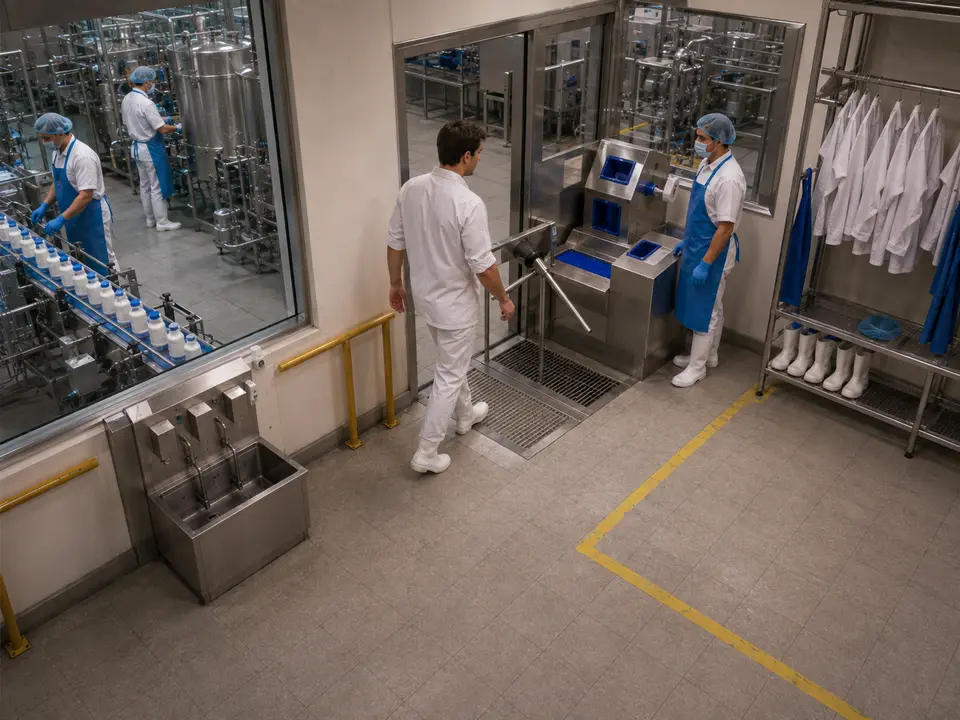
CAM-212Into the clean area with no hairnet
«Tell me if somebody goes through the turnstile into the hall with no hairnet, no coat or without using the wash trough, and tell me at the door, not inside.»
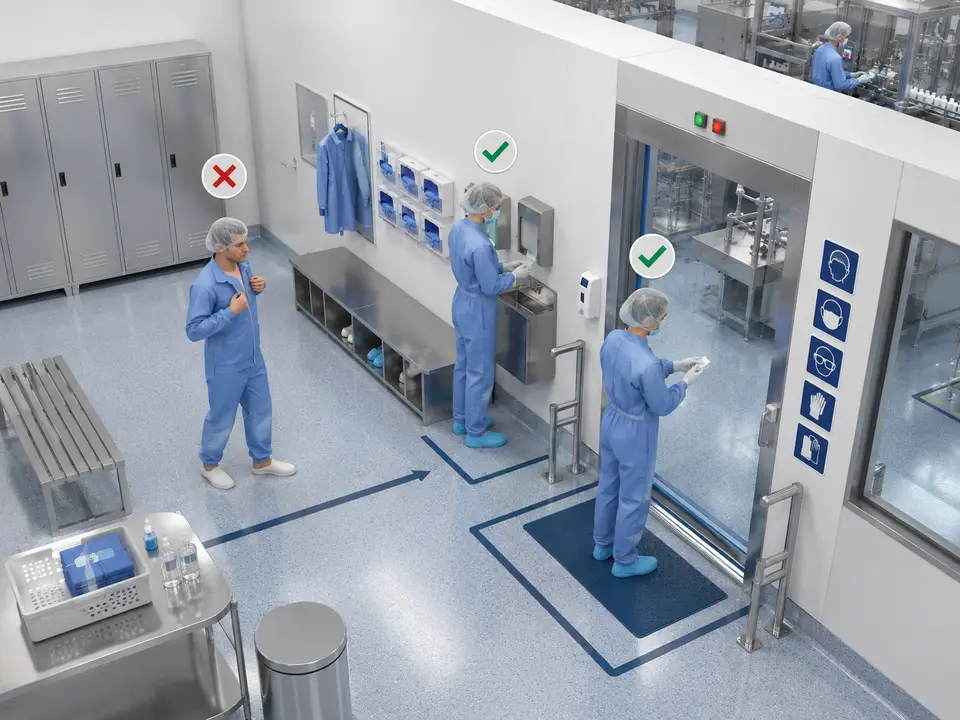
CAM-280Through the gowning room with no mask and street shoes on
«Tell me if somebody reaches the air shower door without a mask or without overshoes, before they go through.»


What it does not do
IRIS does not know whether the mask is the one the protocol calls for, or whether it is properly seated under the nose. It sees whether a hairnet and a mask are on when someone reaches the door.
Nor does it replace an access control system or an entry log. It is an eye at the threshold, and what is done with what it sees is decided by whoever runs the room.
Questions
- Does it alert before the person gets into the room?
- Yes, and in this scene that is the only thing that matters. Inside the room, the alert arrives once the product has already been exposed: it is good for the report and for deciding which batches to review, but it prevents nothing. At the door it arrives while the person can still turn round and put a hairnet on. The same detection, one metre earlier, stops costing money and starts saving it.
- Does it work for a lab changing room and air shower?
- Yes, and that is where sequence matters most. In a pharma changing room the order is half the job: footwear first, then the gown, then the mask, and only then the air shower. IRIS watches the air-shower door and alerts if someone reaches it without a mask or without overshoes, before they step through. It is the last point where it can still be fixed without consequences.
- Does it check that the mask is worn correctly?
- No. IRIS sees whether the mask is on or not, but it does not judge whether it covers the nose properly or whether it is the type the room’s protocol requires. It is a real limit and worth knowing up front: this rule solves the majority case, which is walking in with nothing at all, and it does not replace a human check in rooms with demanding protocols. In a packing area, the majority case is practically the whole problem.
- Can it also cover the hand wash and the overshoes?
- Yes, and it is usually asked for all together in one sentence, because at the door you check once and that is that. What is worth deciding beforehand is what happens when someone skips only the hand wash: whether that is as strong an alert as walking in without a mask, or a softer one reviewed at the end of the shift. IRIS flags what you ask it to; the severity of each is yours to set, and that too is decided once.
Demo · IRIS at work
A new case each time. Always the same screen.
It plays by itself and shows one case from start to finish. It is a summary: the real screen has far more functions than fit in this box.
- Cameras on the map
- You draw an area
- What passed shows up
Not seeing yours here?
These words are the ones we have built, not the ones IRIS understands. The list falls short on purpose: you ask for it in a sentence, and sentences do not run out. Tell us what is in front of your cameras and we will tell you whether it understands it, or not yet.
And the best part
You cannot describe a line with a sentence.You have to draw it on the image.
Asking is for finding; counting is for measuring. That is why the number comes out the same every day, and why people counting is certified by the Centro Español de Metrología.
Tell us your problem and we will say whether IRIS understands it, or not yet.
We reply the same working day.