CAM-447
A worker on foot between the machine and the truck
Mid-morning in the container yard. A red handling machine is carrying a blue container clear of the ground and swinging towards the row. Facing it, in the same lane, a truck waits with a loaded trailer. And right between them, walking along the painted lane, comes a worker in helmet and vest. From the cab, with the container in the way, that person is invisible. IRIS sees all three at once and alerts while the worker is still in the lane.

Turn on IRIS Vision
AI-generated image
What IRIS is
IRIS watches the dock while you get on with the job.
IRIS is an artificial intelligence that watches the cameras you already have at the port and understands what's happening at the fence, the perimeter, and the water's edge. When someone lingers where they shouldn't, gets close to the dock, or something you've asked it to watch happens, it alerts you — and whatever can be counted, like access points, it counts in numbers. All day long, with no one needing to watch a screen.
You tell it what you need to watch, and IRIS does it.
Here, for example, IRIS watches the machine, the truck and the person walking between them at the same time, exactly where the driver can't see them. The moment they step into the lane, it alerts instantly with the camera and the time. With that alert you decide whether to stop the move or change where people are allowed to cross the yard.
Works with the cameras you already have. Nothing to replace.
A person replies, not a form.
- Your footage never leaves your premises.
- It doesn't identify people.
- Certifications →
What IRIS understands
What it recognises in this scene
- worker on foot in the lane
- handling machine on the move
- container clear of the ground
- truck waiting in the same lane
- rail convoy at the back
What this camera measures
An alert says something is happening. The reading says how much.
- 1People on foot in the lane
- 2Heavy machines in shot
- 25 sTime inside the lane
- 2People in shot
- 10:24Time of the alert
The figures on this screen are an example from the illustration, not any client's measurement.
The rule
You decide once. IRIS applies it always.
If
a person on foot enters the manoeuvring lane with heavy equipment moving
Then
- call the yard coordinator on the radio with the camera and the exact spot
- save the video from the moment the person stepped into the lane
- add the crossing to the shift record of people and machines sharing the yard
The instruction that set it up«Tell me if a person on foot enters the machine lane while a machine is working or moving.»
What changes
What changes for whoever answers for the terminal
Being hit by a machine this size does not leave an injured worker: it leaves a dead one and an investigation. And it nearly always happens the same way: somebody walks where people have always walked, and the driver's blind spot is exactly there. With the camera, the yard coordinator gets the alert while the person is still walking and can call on the radio. Afterwards the video is there, mainly to change where people walk, not to find someone to blame.
What people usually ask
Can IRIS stop the machine?
No. IRIS does not act on any equipment: it does not brake a machine, does not lower a barrier and does not send anyone anywhere. It alerts, with the camera, the time and the video, whoever the port has decided. The one who stops the move is the driver or the yard coordinator. That decision belongs to a person and must stay that way: what the camera does is shorten the time until that person knows.
How does IRIS know where the machine lane is?
Because it is drawn on the image. Somebody from the port traces the lane on the camera and says what may be inside it: machines yes, people on foot no. No sensor in the ground and no device on the machine is needed. And if the yard is reorganised, the area is redrawn and the rule applies again straight away, with no works and no cabling.
Does IRIS identify the machine or its driver?
No. IRIS does not read machine plates and does not recognise whoever is in the cab. It sees heavy equipment and a person on foot sharing an area at the same instant, and that is enough to raise the alert. Which machine it was and who was driving comes from the port's work record, not from the camera. That way the alert serves to avoid the impact, not to open a file on anybody.
Other cameras
- CAM-440 · Somebody has come over the perimeter fence
- CAM-441 · Someone is swimming towards the quay
- CAM-442 · A car has sat eleven minutes where nobody ever stops
- CAM-443 · Two trucks, one single barrier opening
- CAM-444 · A container opened outside the working window
- CAM-445 · Someone has crawled under a trailer
The real interface, step by step
No extra alarms here. Just what needs looking at.
Not a recorded video, not an explanatory drawing: a summary of the real screen, with a different case every time it starts. There is a lot more behind it.
- You ask
- IRIS searches
- It shows you
See it somewhere else
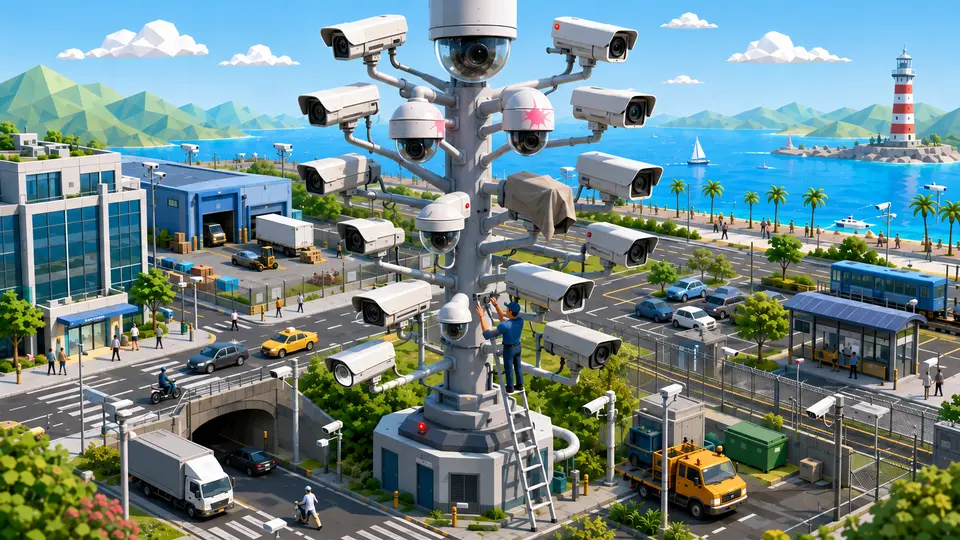
And who watches the cameras?
34 cases, and in every one of them IRIS raises an alert when something happens. You see each image as it is, and then with what it understands on top.

Who watches the cameras of a whole city?
23 cases: 18 raise an alert when something happens and 5 only measure. You see each image as it is, and then with what IRIS understands on top.


And the best part
One camera,and you already have a watchman. Four thousand cameras, and you have four thousand watchmen.
None of them tires, none of them looks away and none of them works shifts. And there is nothing to install: the cameras you already have can start understanding what they see.
Tell us your problem and we will say whether IRIS understands it, or not yet.
We reply the same working day.