Solutions by typeInfrastructure integrity
How long does it take to learn there is something on the carriageway?
Something is in the lane and the next driver has no idea
18:40 in the middle lane of a dual carriageway. A pallet and three boxes have come off a trailer, and a loose wheel has ended up a few metres further on. The car behind brakes hard and changes lane without looking. Behind it come the rest, at the same speed and with the same surprise. The load has been on the ground for forty seconds and not one call has reached the control room yet.
3 cameras across 2 sectors
What IRIS is
IRIS watches the cameras for you.
IRIS Neural is an artificial intelligence that watches the cameras you already have and understands what happens in front of them. When something important happens —or something you told it you need to keep an eye on—, it alerts you; and whatever can be counted, it counts in numbers. All day long, without anyone having to watch a screen.
You tell it what you need to watch, and IRIS does it.
Works with the cameras you already have. Nothing to replace.
A person replies, not a form.
- Your footage never leaves your premises.
- It doesn't identify people.
- Certifications →
This is how you ask for it
«“Tell me if anything falls onto the carriageway or comes down off the embankment, and tell me which lane it is in.”»
What decides how long that stays on the road today is luck: that someone stops, that someone calls, that the call gets the kilometre point right. Meanwhile, every car going past is a roll of the dice. And when it goes wrong it does not go wrong once: it is the rear-end collision, the closure, the recovery truck, the twelve-kilometre queue and a whole morning of a maintenance crew working in a coned-off lane.
You decide once
The road is known by whoever runs it. They decide which stretches are watched, what counts as an obstacle on each one — in a tunnel, anything; on a wide hard shoulder, no — what happens at night, who is notified, and whether the sign goes on before or after someone confirms. That is decided once, stretch by stretch. IRIS applies it across all four hundred at once, without taking turns between them and without getting tired at three in the morning.
A control room has more cameras than screens and more stretches of road than operators. Nobody is watching kilometre 47 at half past six in the evening, because at that hour they are watching the incident at kilometre 12. And the road surface gives no warning: a load coming off makes no noise on any screen, and neither does a slope coming down.
The tunnel is the ugly case. No hard shoulder, no visibility, no way out: rubble in the left-hand lane forces everyone to move over inside a tube, with half the drivers looking at the debris instead of the car in front. And the embankment is the slow case: the soil covering half a lane today has been moving for weeks, and at the last inspection it already looked different — only nobody had the two photographs side by side.
IRIS watches the carriageway and says three things: there is something there, which lane it is in, and since what minute. With that, the control room does what it already knows how to do — signs, patrol, call the maintenance crew — but it does it now instead of when the third phone call comes in. And with the embankment it does something different: it keeps what the slope looked like before and shows both images together, so that what changes slowly can also be seen. IRIS does not close lanes or switch on signs by itself: the operator decides that, because the operator is the one who answers for it.
What changes
Before, the first news of an obstacle was a phone call, and the call came with an approximate kilometre point and a description from someone doing a hundred and twenty. The operator had to find the camera, find the spot and confirm it. Now the alert arrives with the camera already open and the lane already named, and what the operator does is the only thing a person can do: look at the image and decide whether to close the lane or simply warn.
Where we have seen it
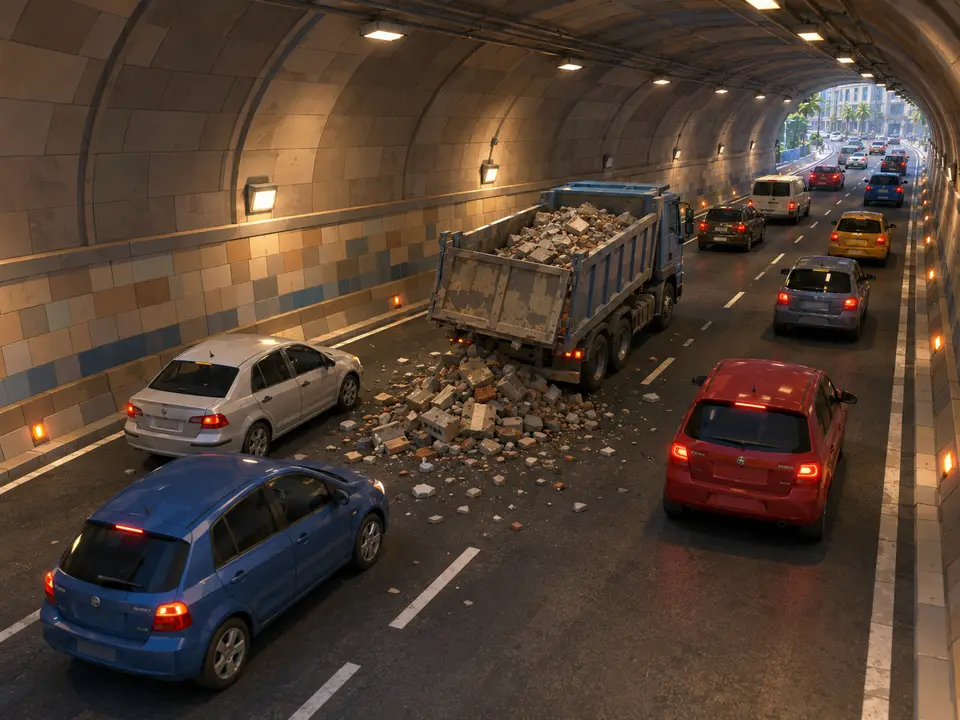
CAM-35Debris inside the tunnel
«Tell me if an obstacle appears on the tunnel roadway, and which lane it is in.»

CAM-64Load spilled across a lane
«Tell me if something falls onto the road, and which lane it has landed in.»
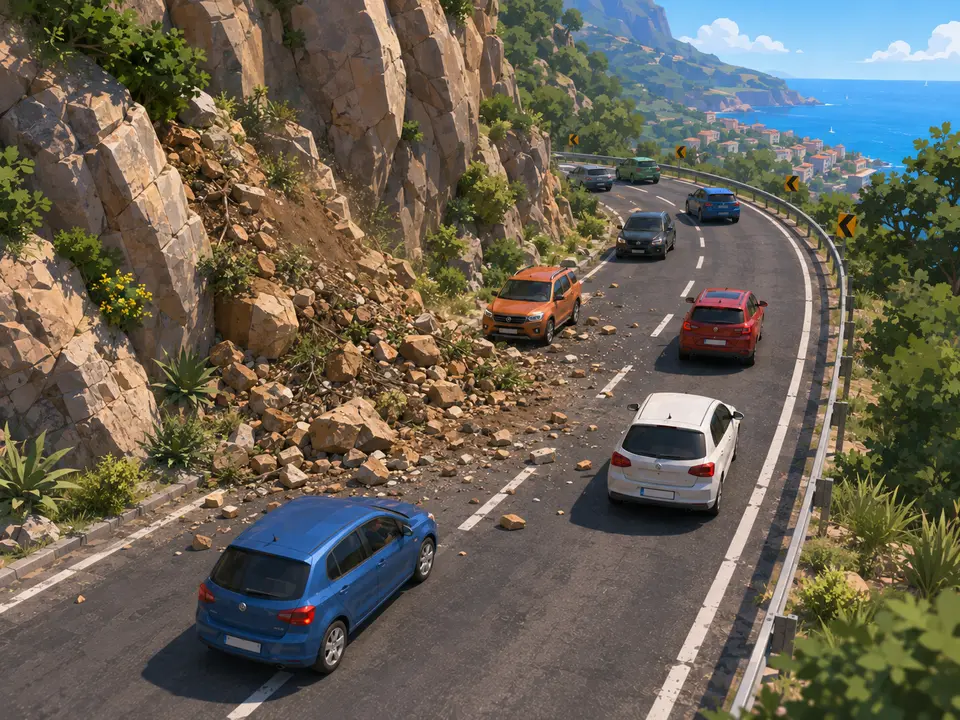
CAM-65Landslide onto the road
«Tell me if material comes down from the slope onto the road, and show me if the slope looks different from the last inspection.»


What it does not do
IRIS clears nothing, closes no road and switches on no sign by itself. Nor does it tell an empty cardboard box from a concrete block: it says there is an object in the lane and shows the image, and a person judges the size. In fog or heavy rain it sees what can be seen, which is little, and that is true of any camera. And on an embankment it does not predict landslides: it shows that the ground looks different from the last inspection.
Questions
- Can it tell a plastic bag from a wheel?
- Up to a point, yes, and it is worth saying up to which point. IRIS sees the size and shape of the object and sees whether it moves with the wind or sits still in the lane, and that leaves most bags out. What it cannot do is guess weight: an empty cardboard box and a full one look the same to a camera. That is why the alert always arrives with the image and the lane, and it is the operator who decides whether it means closing a lane. The camera shortens the time until someone looks; it does not replace the person looking.
- Does it work inside a tunnel?
- Yes, and it is where the difference shows most. Inside a tunnel the light is constant, there are no moving shadows and no sun in the lens, and the framing never changes: those are good conditions for spotting an object where there was nothing. It is also where everything else works worst, because there is no visibility, no hard shoulder and a phone call takes longer to arrive. What does need attention is lens cleaning: tunnel soot covers an objective in weeks, and a dirty camera sees nothing.
- Can it call the patrol directly?
- It can send the alert wherever the operator of the road says, and it decides nothing on its own. The usual arrangement is that the alert lands in the control room with the camera in front of the operator, and that the operator sends the patrol, switches the sign on or calls the maintenance crew, because that is the person answerable for the road. If the organisation decides that at certain hours and on certain stretches the alert should go straight to a duty phone, it is set up that way. The rule is written by whoever carries the responsibility, not by us.
- And the embankment? That does not happen in a second.
- No, and that is why it is handled differently. A slip that is already in the lane is reported like any other obstacle, straight away. But the slope above it has been changing for months, and that is not an alarm: it is a comparison. IRIS keeps what that same framing looked like at the last inspection and puts it beside how it looks today, so the engineer can see the new crack or the material that has shifted. It does not say whether it will come down or when: a geotechnical engineer says that, on site, and this image helps them decide which slope to climb first.
See it for yourself
This isn’t a video. It’s a slice of the real screen.
A summary of the real interface, played hands-free. You see one case from start to finish; what you do not see are the other screens, and there are many.
- Four cameras at once
- Each understands its own view
- The numbers climb by themselves
Not seeing yours here?
These words are the ones we have built, not the ones IRIS understands. The list falls short on purpose: you ask for it in a sentence, and sentences do not run out. Tell us what is in front of your cameras and we will tell you whether it understands it, or not yet.
And the best part
You cannot describe a line with a sentence.You have to draw it on the image.
Asking is for finding; counting is for measuring. That is why the number comes out the same every day, and why people counting is certified by the Centro Español de Metrología.
Tell us your problem and we will say whether IRIS understands it, or not yet.
We reply the same working day.