Solutions by typeMobility analysis
Who is watching what comes into the water?
Water has no doors to close
Midday in August in a cove. The sand is full, umbrellas run all the way to the rocks and the water holds more people than room. A jet ski comes in from the left, crosses inside the line of buoys and keeps going towards the middle of the bay at the same speed it had outside. In the water there are children standing waist-deep. The lifeguard is looking at the far end of the beach, which is exactly where he should have been looking.
6 cameras across 3 sectors
What IRIS is
IRIS watches the cameras for you.
IRIS Neural is an artificial intelligence that watches the cameras you already have and understands what happens in front of them. When something important happens —or something you told it you need to keep an eye on—, it alerts you; and whatever can be counted, it counts in numbers. All day long, without anyone having to watch a screen.
You tell it what you need to watch, and IRIS does it.
Works with the cameras you already have. Nothing to replace.
A person replies, not a form.
- Your footage never leaves your premises.
- It doesn't identify people.
- Certifications →
This is how you ask for it
«Alert me the moment any craft enters the marked swimming area, whatever kind it is.»
On a beach you cannot close a door or put up a fence. The swimming area is marked with buoys, and a buoy stops nothing: it only says where the limit is. When something crosses where it should not, the margin is seconds, and the person who has to react is facing the other way by pure statistics. Then come the report, the complaint and the question of why nobody saw a boat come through the mouth of the cove in broad daylight.
You decide once
You decide this once. The council or the port authority says where the buoy line runs, what may cross it and what may not, which months it applies and who gets told: the lifeguard, the municipal duty service, or both. IRIS checks it all day, all season, on every camera looking at that water. The line is drawn once on the image and never has to be explained again.
Water is watched worse than land, and not for lack of will. A cove has two hundred metres of open front, the watch is two people and a viewpoint, and what needs looking at moves every minute. A port basin is the same: the quay is fenced on the land side, but from the water you reach the edge without crossing any gate. Someone swimming up to the ladder has not climbed anything, because there was nothing to climb.
So here IRIS does two different things, and they are worth keeping apart. One is alerting: a craft inside the swimming area, a boat sitting where there is no anchorage, someone approaching the quay by swimming. That is an alert, and you ask for it in a sentence. The other is counting: how many boats cross the mouth in an hour, how many are inside the cove at once, how long each one stays. That is not asked in words, it is drawn on the image, and the number that comes out can be repeated and defended.
Together they change how a coastline is run. The first prevents today’s scare. The second answers next winter’s question: how many came in on the fifteenth of August, what time the cove filled up, and whether the anchorage someone wants to regulate really carries the traffic the residents claim or the traffic the boatmen claim. Without a number, that argument is never won.
What changes
Before, what happened on the water was known only if someone was looking at that stretch of sea at that moment, and with two hundred metres of front that is chance. Now the buoy line is drawn on the image and the alert arrives with the camera open. And at the end of the season there is a figure of boats per hour, instead of the impression the team had that August.
Where we have seen it
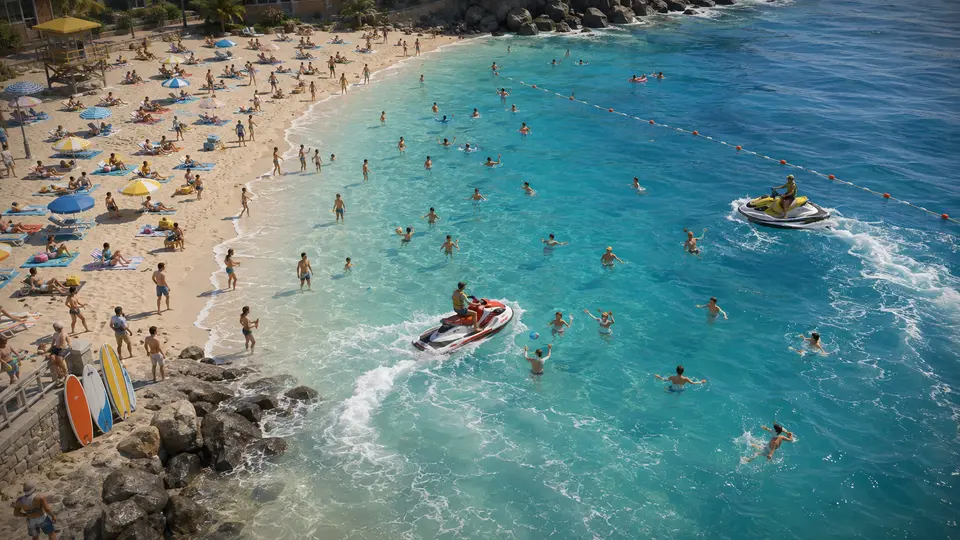
CAM-26Jet ski inside the swimming zone
«Tell me the moment a craft of any kind comes inside the buoyed swimming zone.»
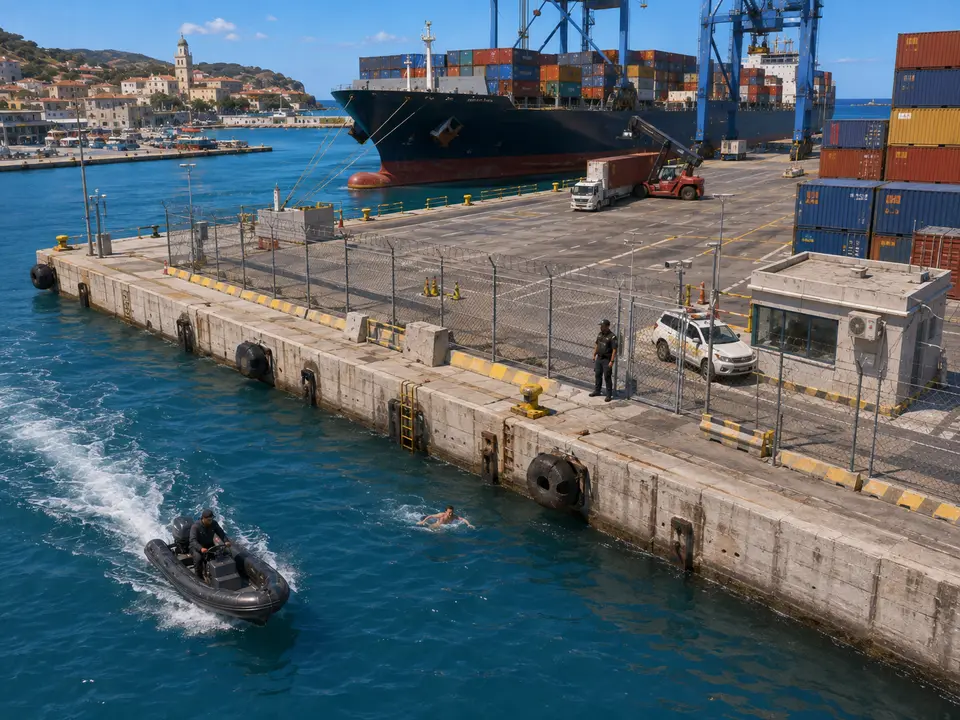
CAM-441Someone is swimming towards the quay
«Tell me if somebody swims into the basin or a small boat comes close to the quay.»
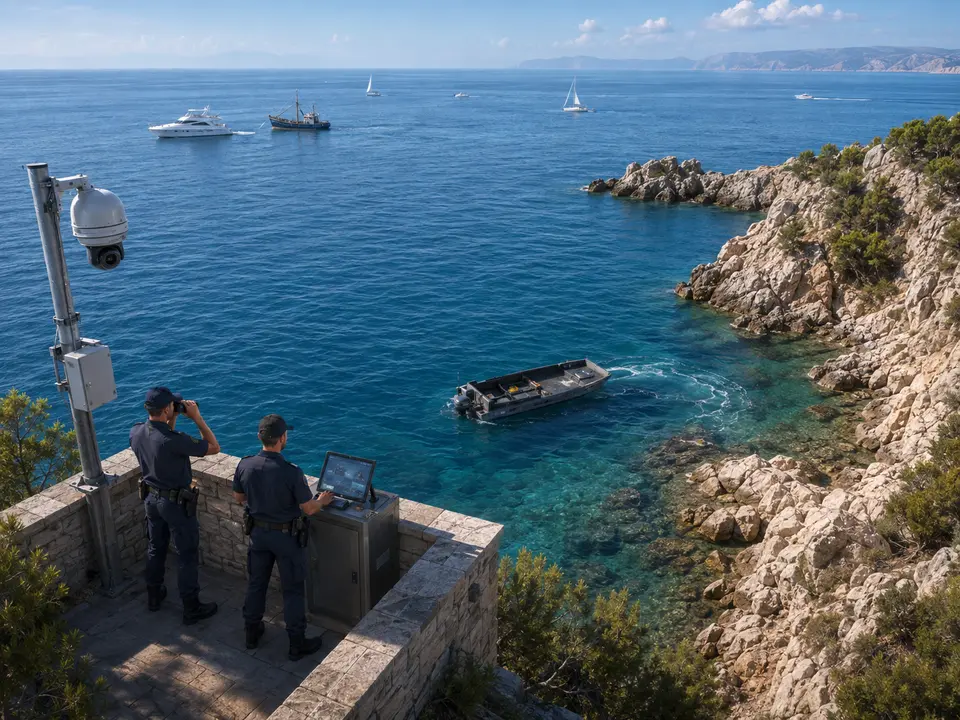
CAM-570A boat that stops where there is no anchorage, and stays there
«Tell me if a vessel stops making way inside the cove for more than four minutes.»
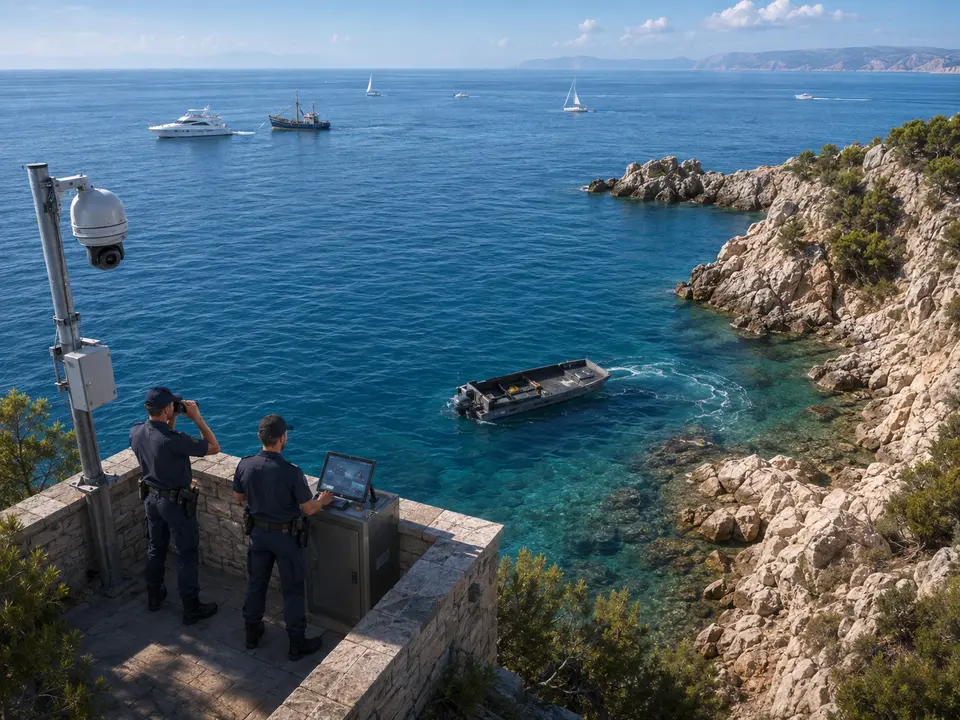
CAM-571Thirty-eight boats an hour cross the mouth of the cove
«Tell me if there are more than six vessels inside the cove at once.»
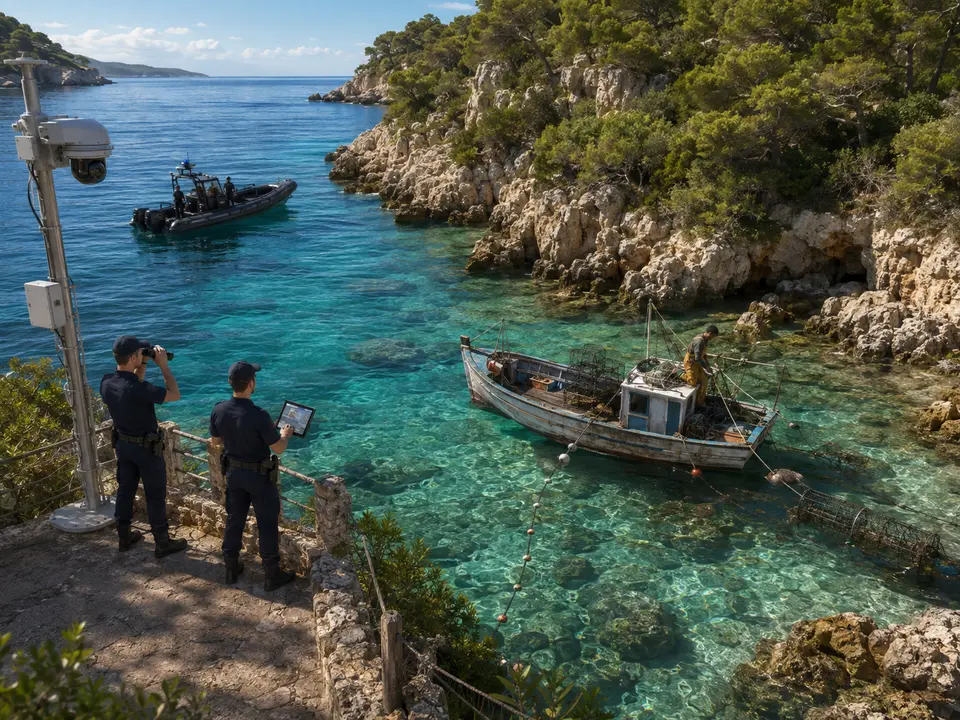
CAM-572A boat stopped on the wrong side of the line of buoys
«Tell me if a vessel stays stopped inside the line of buoys for more than five minutes.»


What it does not do
IRIS cannot tell whose boat it is, does not read its number from a distance, and does not identify anyone in the water. It sees that something has entered where it should not, and it alerts. It also does not replace the lifeguard: it does not swim, does not rescue and does not decide whether to close the beach. And in a swell or strong backlight, a head at a hundred metres is hard for anyone, including for this.
Questions
- Can it tell a jet ski from a fishing boat?
- Yes, it distinguishes types of craft, and that difference matters because the rules are not the same: a boat anchored inside a protected area is an environmental problem, and a jet ski inside the swimming area is a people-safety problem. What it does not do is know whose each one is: it does not read the hull number from a camera on a clifftop and does not know whether that boat is licensed. Whoever goes out checks that.
- Can it count the boats going in and out of the cove?
- Yes, and it is done differently. Counting is not asked for in a sentence: you draw a line across the mouth of the cove, you say which direction counts as entering, and every hull that crosses it adds one. With a second line further in you know how many stay inside and for how long. The result is a figure per hour and per day, comparable from one summer to the next. Asking is for finding; counting is for measuring, and that is why the number is drawn rather than described.
- Does it work at night, or in rough seas?
- It depends, and we would rather say so up front. In daylight and calm sea, a craft entering the swimming zone shows clearly. At night it depends entirely on the camera: without thermal or without lighting, what is not visible in the image is not visible to IRIS either. In heavy swell, foam and backlight, a small distant object is hard for any system and for a human eye too. That is why the framing is reviewed beforehand, and if a camera does not cut it, we say so.
- Is this watching the swimmers?
- Not in that sense. IRIS identifies nobody, recognises no faces and follows no one along the beach. It looks at two things: whether something enters where it should not, and how many people are on the sand so you know if capacity is reached. Capacity is a number, not a list: it says there are a lot of people, not who those people are. And whoever decides to close an access or make an announcement is always someone from the beach service.
See it for yourself
No extra alarms here. Just what needs looking at.
Not a recorded video, not an explanatory drawing: a summary of the real screen, with a different case every time it starts. There is a lot more behind it.
- You draw the line
- It counts by itself
- A number comes out
Not seeing yours here?
These words are the ones we have built, not the ones IRIS understands. The list falls short on purpose: you ask for it in a sentence, and sentences do not run out. Tell us what is in front of your cameras and we will tell you whether it understands it, or not yet.
And the best part
A wall of monitors is impressive.Nobody can read forty tiles at once.
The more tiles there are, the less each one gets looked at. IRIS watches all four thousand cameras at once and points at a single one: the one that needs someone right now.
Tell us your problem and we will say whether IRIS understands it, or not yet.
We reply the same working day.