Solutions by typeInfrastructure integrity
Who left that manhole open, and how long has it been like that?
An open hole right where people walk
It is 19:40. In the yard of the pumping station a manhole is open right in the walkway: the cover propped two metres away, the hole black, the ladder inside in plain view. No barrier, no cone, nobody beside it. Whoever opened it went down, came up and walked off to fetch a tool. The night shift crosses that yard in two hours, and by then it is dark.
6 cameras across 3 sectors
What IRIS is
IRIS watches the cameras for you.
IRIS Neural is an artificial intelligence that watches the cameras you already have and understands what happens in front of them. When something important happens —or something you told it you need to keep an eye on—, it alerts you; and whatever can be counted, it counts in numbers. All day long, without anyone having to watch a screen.
You tell it what you need to watch, and IRIS does it.
Works with the cameras you already have. Nothing to replace.
A person replies, not a form.
- Your footage never leaves your premises.
- It doesn't identify people.
- Certifications →
This is how you ask for it
«Alert me if a manhole has been open for more than ten minutes with no barrier around it.»
Most of the time nothing happens and the cover goes back. The day something does happen, it happens all at once: a leg down the hole, a broken ankle, an ambulance and an accident report asking how long that manhole had been open and unguarded. Nobody knows, because nobody wrote it down. The video exists, but you have to search backwards through hours of it to answer.
You decide once
The organisation decides what is acceptable: how many minutes a cover may be out of place, whether a barrier is always required or only in walkways, and who is called depending on the hour. That is agreed once, with the safety officer present, and written as a sentence. IRIS then applies it in every yard and every street with a camera, without depending on someone remembering to look that day.
A manhole cover is heavy, and that is why, once it comes off, it almost never goes straight back. It comes off to go down, it is left aside «for a minute», and that minute lasts as long as it takes to fetch a key, take a call or move on to another job. In a street, the hole is found by a pedestrian looking at their phone. In an industrial yard, it is found by the next shift. In both cases, whoever opened it was sure they would be right back.
And there is a second problem with chambers, which is not about safety but about discharges. An open chamber with a tanker truck beside it and no plant staff around does not by itself mean somebody is tipping what they should not, but it is exactly the scene worth looking at. Today that gets discovered weeks later, when the incoming water arrives with a load that does not add up and there is no way left to know who brought it.
IRIS watches both things through the same camera. It sees that the cover is out of its seat and counts the minutes. It sees that there is not one cone around it. And it sees a tanker parked next to a chamber at an hour when there should not be one. It names nobody and accuses nobody: it shows the picture, the time and how long it has been going on, and the person reading it decides.
And there is a third state of the same cover, the opposite of the open hole: the cover water comes out of. When a sewer runs full, the shaft turns into a fountain, the cover shifts on its own, and within a while half the carriageway is a murky river with a vacuum tanker trying to get through. Nobody opened it, and there is nobody to ask: the alert has to come from the street itself. It is the same camera, looking at the same iron circle, and the rule is just as easy to write.
What changes
Before: the open manhole was found by whoever came past next, and with luck that was a colleague and not a passer-by.
Now: the alert goes out after ten minutes, with the camera and a picture of the hole, and the person who opened it closes it. And when explanations are needed, the time it was opened and the time it was closed are both recorded, and they come out in a minute instead of an afternoon.
Where we have seen it

CAM-167The street gully choked with branches
«Tell me when a gully gets covered and stops taking water, before the street floods and a resident has to phone me about it.»
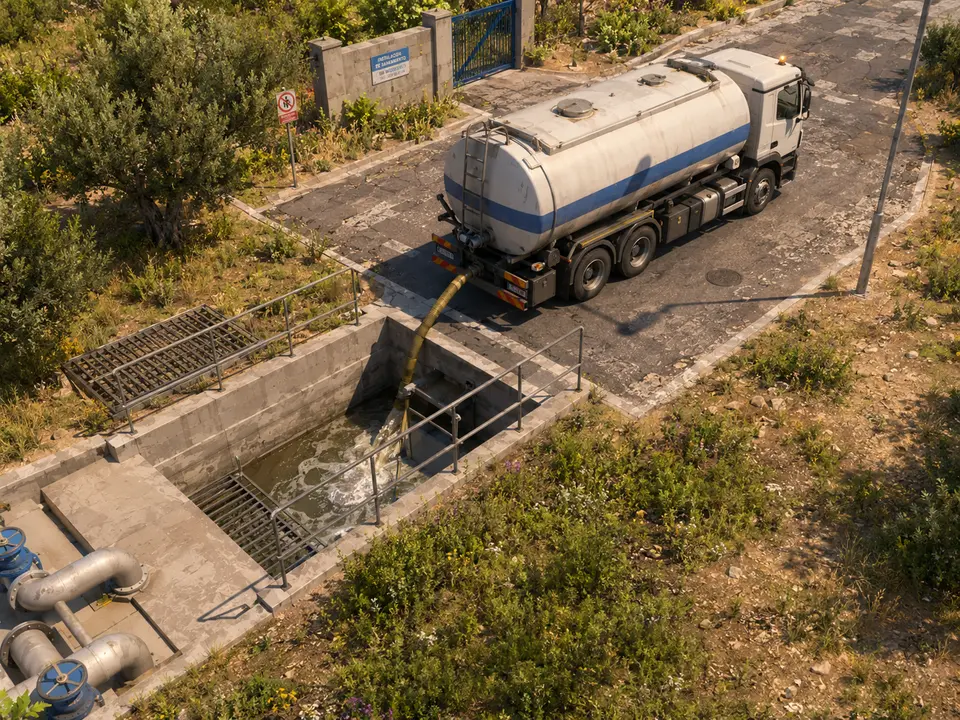
CAM-417A tanker is emptying into the chamber and nobody is there
«Tell me if a tanker unloads into the chamber outside opening hours or with nobody from the plant next to it.»

CAM-482Twenty-four arrive a minute, the search line clears nine
«Tell me when more people join the search queue than come out through the detectors, and when the back of the line gets close to the road.»
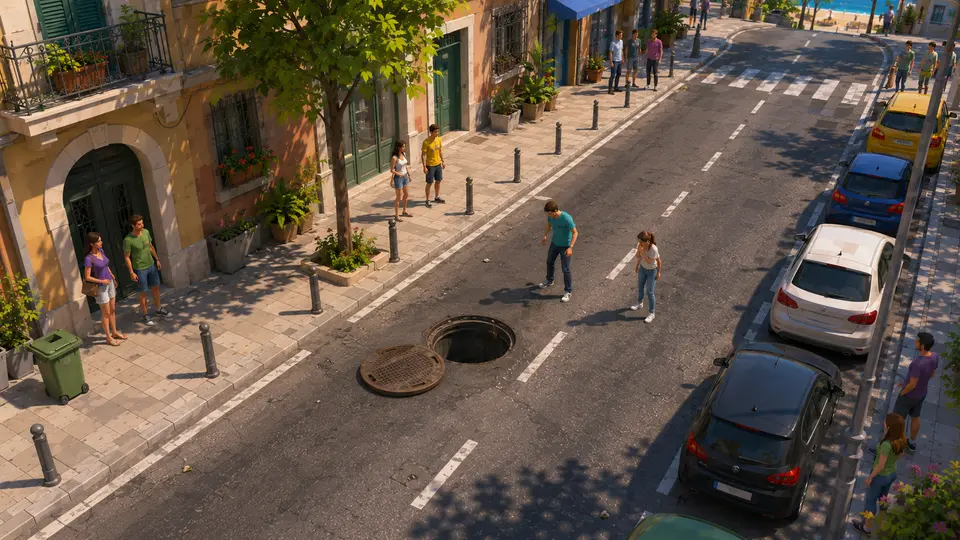
CAM-171An open manhole with nothing around it
«Tell me if a manhole cover turns up out of place and nobody has put a cone around it.»
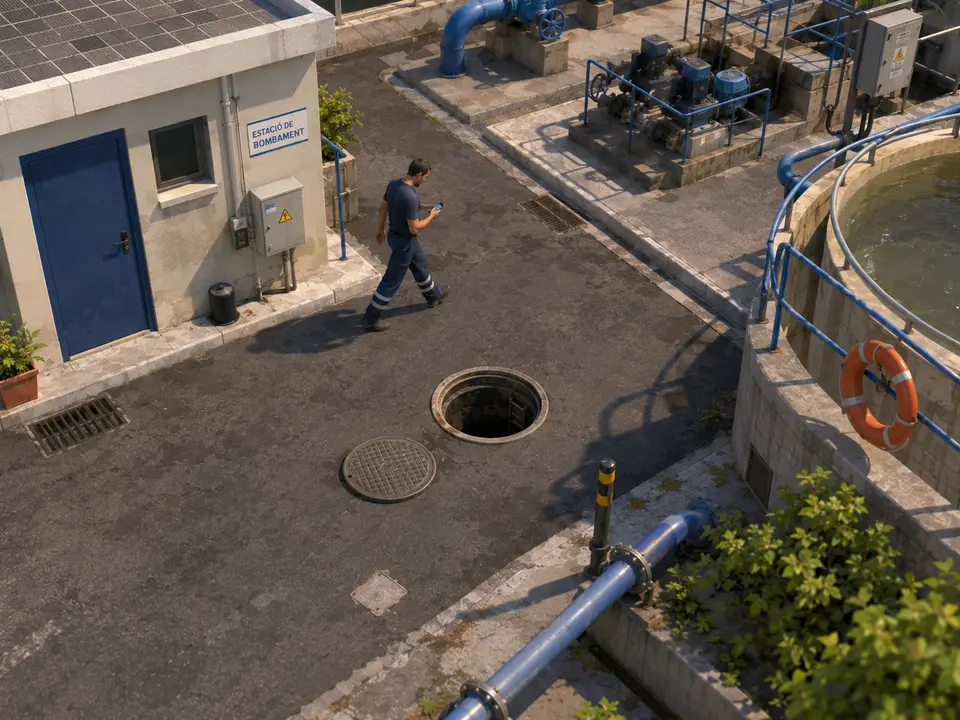
CAM-414An open chamber in the middle of the walkway, no barrier, no sign
«Tell me if a chamber has been open for more than ten minutes with no barrier around it.»
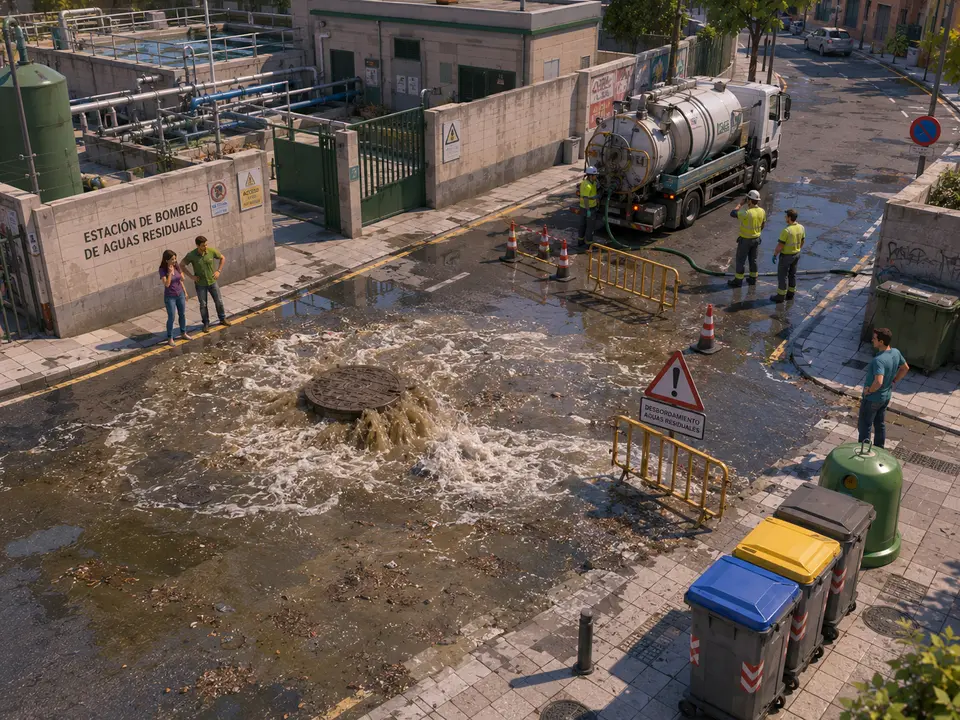
CAM-400Water is coming up through the cover and the street is a river
«Tell me if water comes up through a manhole or a cover and spreads across the street.»


What it does not do
IRIS does not close the cover, does not put out the barrier and does not know who went down: it identifies nobody and recognises no faces.
It also cannot tell a manhole opened for work from one opened by vandalism, and it does not know whether the person inside holds a confined-space permit. If the cover falls outside the frame or is hidden by a vehicle, it does not see that opening at all. It reports what can be seen, and a person decides.
Questions
- Can it tell a removed cover from a badly seated one?
- Yes, within what can be seen. IRIS compares the opening with how that opening looks when it is closed: if the cover is out of place or the hole is exposed, it says so. A cover standing on edge, half turned or shifted a few centimetres also shows up, because the shape of the spot changes. What it cannot know is whether the cover is properly seated underneath: that is told by the person who steps on it, not by a camera.
- Does it work in the street, or only inside a site?
- Both, and it is the same problem with two different owners. Inside a site the alert goes to the plant supervisor and is usually fixed in minutes. In the street it goes to the highways team, and there the difference is that today the alert comes from a resident on the phone, hours after the hole appeared. With a camera, the hole is seen the moment it appears and nobody has to call.
- What if the manhole is open because work is going on?
- Then it is right that it is open, and the rule is written with that in mind. What is watched is not the cover being off: it is the cover being off with no protection around it. If there is a barrier or cones, the scene is normal and nothing fires. If there is not, it fires after the minutes you set. That way the alert does not bother the person doing the job properly, and shows up exactly when the thing that prevents the accident is missing.
- Can it record who discharged into the chamber?
- It can show the vehicle and the time, not the person. IRIS identifies nobody and recognises no faces. What it leaves you is the video of the moment the tanker pulls up beside the chamber, with the exact time and the camera, plus the clip before and after so you can see the whole manoeuvre. With that, whoever investigates has a place to start instead of a folder full of hours. What is done with that footage is your decision and the law’s, not ours.
The real interface, step by step
A camera looks. IRIS understands what it sees.
An extract of the real screen, no voice-over and hands-free. Each round poses another situation. What sits behind it is a good deal bigger than what you see.
- It lands in the tray
- You open it
- You confirm or dismiss
Not seeing yours here?
These words are the ones we have built, not the ones IRIS understands. The list falls short on purpose: you ask for it in a sentence, and sentences do not run out. Tell us what is in front of your cameras and we will tell you whether it understands it, or not yet.
And the best part
The disk fills up on its own.The questions stay unanswered.
Storing images is easy, and it is not cheap. What was missing was someone to look at them. IRIS looks at everything you record and shows you only what is worth a glance.
Tell us your problem and we will say whether IRIS understands it, or not yet.
We reply the same working day.