Solutions by typeMobility analysis
How long has that car been sitting in the drop-off lane?
Ten minutes parked and the kerb stops working
It is 06:30 on the departures kerb. Three lanes and none of them moving: cars double-parked, a taxi sideways in the middle, an SUV with its boot open pulling out suitcases in no hurry. Behind them the queue already reaches the bend. Two passengers get out in the middle lane, between moving cars, and cross dragging their cases towards the door. Inside the terminal there is not a queue at a single desk yet.
2 cameras across 2 sectors
What IRIS is
IRIS watches the cameras for you.
IRIS Neural is an artificial intelligence that watches the cameras you already have and understands what happens in front of them. When something important happens —or something you told it you need to keep an eye on—, it alerts you; and whatever can be counted, it counts in numbers. All day long, without anyone having to watch a screen.
You tell it what you need to watch, and IRIS does it.
Works with the cameras you already have. Nothing to replace.
A person replies, not a form.
- Your footage never leaves your premises.
- It doesn't identify people.
- Certifications →
This is how you ask for it
«Alert me if a car has been sitting in the drop-off lane for more than ten minutes while others are waiting for a space.»
An arrivals kerb runs on an unwritten rule: pull in, drop off and leave within ninety seconds. The moment one car stays ten minutes, the next stops wherever it can and the one after that double-parks. Outside a hotel the price is different: the first impression of a four-hundred-euro stay is a horn and a valet running between cars.
You decide once
You decide it once, with whoever runs that kerb. You mark the drop-off lane on the image, say how many minutes standing stops being dropping off and starts being parking, how many cars waiting turn that into a problem, and who gets told: the kerbside team, the valet, the door supervisor. And separately you ask for the number: how many minutes a day that lane is blocked and at what times. IRIS applies the rule always and keeps the number always, even when nobody is watching a screen at half past six.
An airport kerb or a hotel entrance is the shortest and most contested square metre in the whole building. Everything around it is designed so that nobody stays. And yet nobody measures the one thing that makes it work, which is time.
At a hotel you see it small and with names attached. Seven in the evening, arrivals time: a car is unloading under the canopy, the valet is at the driver’s door and the guest is already out with the suitcase. Behind them another car waits, and another. If the first takes two minutes, nothing happens. If it takes ten because the driver is hunting for something in the glovebox, the fourth in line double-parks on the street and five minutes later there is a traffic warden at the door. Nobody has done anything wrong. A place that is not for staying has simply been occupied too long.
IRIS marks the drop-off lane as a zone, measures how long each vehicle is inside it and counts how many are waiting behind. When the time runs over and there is a queue, it alerts whoever is at the door, with the camera open, so they can go and sort it out by talking. And it keeps the number, which is what serves the other purpose: showing that between six and seven the kerb is blocked a third of the time, and that what is needed there is not an awareness campaign but one more person at that hour.
What changes
Before, you learned about this through the row: someone on the door complained, or a guest wrote in after missing a flight. Now there are two new things. One, the alert at ten minutes, for the person at the door who can fix it by talking. And two, the month’s curve, which is what you take to the meeting where somebody decides whether to change the signage, open another lane or put one more person on at half past six.
Where we have seen it
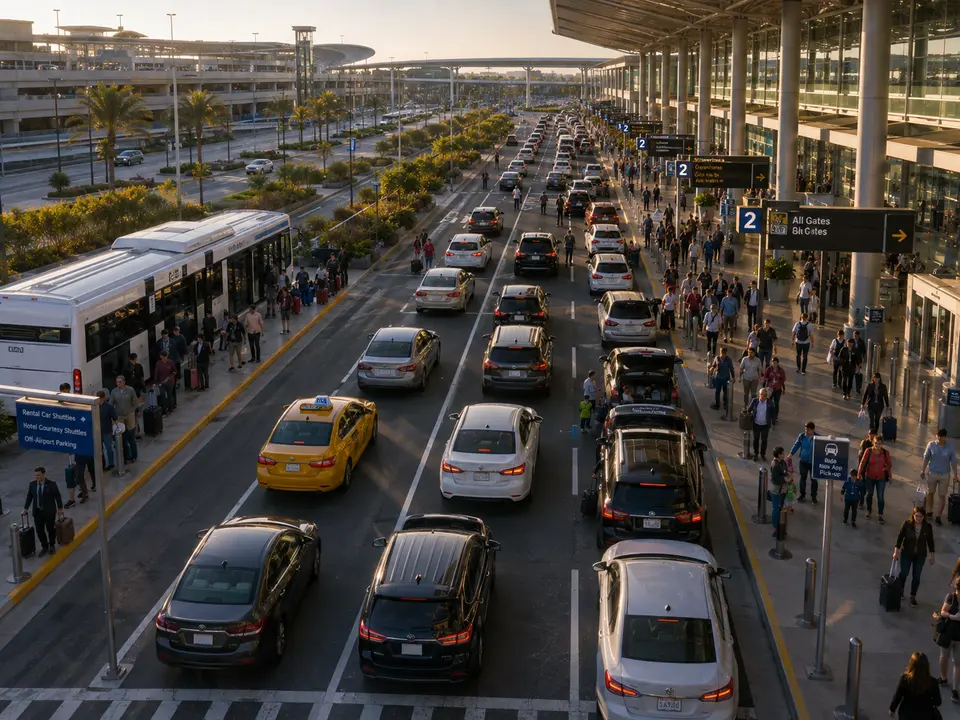
CAM-580The kerb jams before the terminal does
«Tell me if a car has been stopped in the drop-off lane for more than ten minutes and others are waiting for a gap.»

CAM-506One car unloading at the door and the queue growing behind it
«Tell me when there are more than four cars waiting at the door, or when one has been parked in the drop-off spot for more than ten minutes.»


What it does not do
IRIS measures time and counts cars. It does not know who is allowed to stop there, whether that car is unloading a wheelchair, or whether it is an authorised delivery.
It does not fine or report anyone either: the alert goes to a person who sees the image before moving. And it cannot see inside the vehicle: ten minutes stopped may be a long goodbye or a medical problem.
Questions
- Is this for fining whoever overstays?
- No. There is no penalty here: there is someone at the door who walks over and says «good morning, can I give you a hand with that case?». The vast majority of these cases are solved that way, in thirty seconds and without conflict, because the driver almost never realises they have been there ten minutes. What the alert does is make that conversation happen early, instead of when there are already four cars double-parked and somebody leaning on the horn.
- How does it know how long a car has been stopped?
- Because it marks the lane as a zone and follows each vehicle inside it from the moment it enters to the moment it leaves. It does not need to read the plate: the same object in the same position is enough. From there it runs the clock and applies whatever you set. And at the same time it counts how many vehicles are waiting behind, which is what separates a car standing there bothering nobody from a car that has blocked the whole kerb.
- What about an ambulance or someone who needs longer?
- That is what the rule is for, and that is why you write it. Whole areas can be excluded — the reserved bay, the ambulance space —, times can differ by hour band, and the threshold can be raised in the hours when the place has room to spare. And one thing never changes: the alert reaches a person who looks at the image before doing anything. If what they see is a wheelchair coming out of a boot, that person does nothing, and it took three seconds to know it.
- Is it useful to justify redesigning the kerb?
- Yes, and it is probably the most profitable part of all this. As well as alerting, IRIS keeps the number: how many minutes a day the lane is blocked, at what times, on which weekdays and how many vehicles wait on average. With that you stop arguing with impressions. You can see the problem is from six to eight and not all day, and you decide with figures whether what is needed is another sign, a longer lane, a different delivery window or one more person in that slot.
Demo · IRIS at work
A new case each time. Always the same screen.
It plays by itself and shows one case from start to finish. It is a summary: the real screen has far more functions than fit in this box.
- Cameras on the map
- You draw an area
- What passed shows up
Not seeing yours here?
These words are the ones we have built, not the ones IRIS understands. The list falls short on purpose: you ask for it in a sentence, and sentences do not run out. Tell us what is in front of your cameras and we will tell you whether it understands it, or not yet.
And the best part
What holds on camera oneholds on camera four thousand, with nothing to copy by hand.
A rule is stated once and applies everywhere. And it says the same thing on Sunday night as on Tuesday morning, whoever is on call.
Tell us your problem and we will say whether IRIS understands it, or not yet.
We reply the same working day.