Solutions by typePersonal safety
How long is it from leaning over to falling?
He climbed onto the railing
It is 17:10 on the landing. The upper tier has a chest-high railing and seven metres of drop to the concrete below. Someone leans on it, tilts a little further than usual and swings one leg over. From the guard post the whole walkway is visible, but at thirty metres and from behind, a body leaning over and a body resting on the rail are the same silhouette.
3 cameras across 2 sectors
What IRIS is
IRIS watches the cameras for you.
IRIS Neural is an artificial intelligence that watches the cameras you already have and understands what happens in front of them. When something important happens —or something you told it you need to keep an eye on—, it alerts you; and whatever can be counted, it counts in numbers. All day long, without anyone having to watch a screen.
You tell it what you need to watch, and IRIS does it.
Works with the cameras you already have. Nothing to replace.
A person replies, not a form.
- Your footage never leaves your premises.
- It doesn't identify people.
- Certifications →
This is how you ask for it
«Tell me the moment someone leans over the railing or climbs onto it.»
Seven metres has no mild version. What follows is an ambulance, a whole facility frozen for hours, an investigation and a family owed an explanation. On the riverside the arithmetic is different and worse: if the railing gives way with forty people leaning on it, one person does not fall, everyone pushing does. And in both places the video exists from the start, but nobody was watching it in that minute.
You decide once
The decision is made once, and it is drawn on the image. If a body ends up above the edge line, even for an instant, then the post is alerted immediately, that camera opens and the video is kept from before. On the riverside walk the same decision is written differently: if too many people are pressed against the railing for more than a couple of minutes, alert while the group forms.
A railing exists because the edge is there. And within a month of being installed, nobody looks at it. On a landing, on a riverside walk, on a platform in a plant: people look at what is happening in front of them, not at the line across their chest. The person on watch does not look at it either, because their job is to watch people, and at thirty metres from behind, everyone leaning on a railing looks the same.
There are two bad days and they are nothing alike. One is the person who swings a leg over on the upper tier, where all that matters is that somebody gets there before the decision does. The other is the swollen river: when the water runs high, the walkway fills with people leaning out to look and to film it, all on the same stretch, all pushing the same way. That railing was designed so nobody would fall through, not to hold forty people pressing at once.
IRIS watches the edge, which is the thing nobody watches. You draw the line once on the image, and from then on it sees two things: a silhouette above it, and people building up against it. And it alerts while the crowd is forming, not once it is packed. Here the alert is only worth something before. Afterwards it is not an alert any more: it is a phone call.
What changes
Before, whoever was on watch had to be looking at the right monitor in the right second, and everything else was seen the next day. Now they get that camera open at the exact minute and can start walking while the person is still on this side of the railing. On the riverside it is the same: two entrances get closed while the crowd is still forming.
Where we have seen it
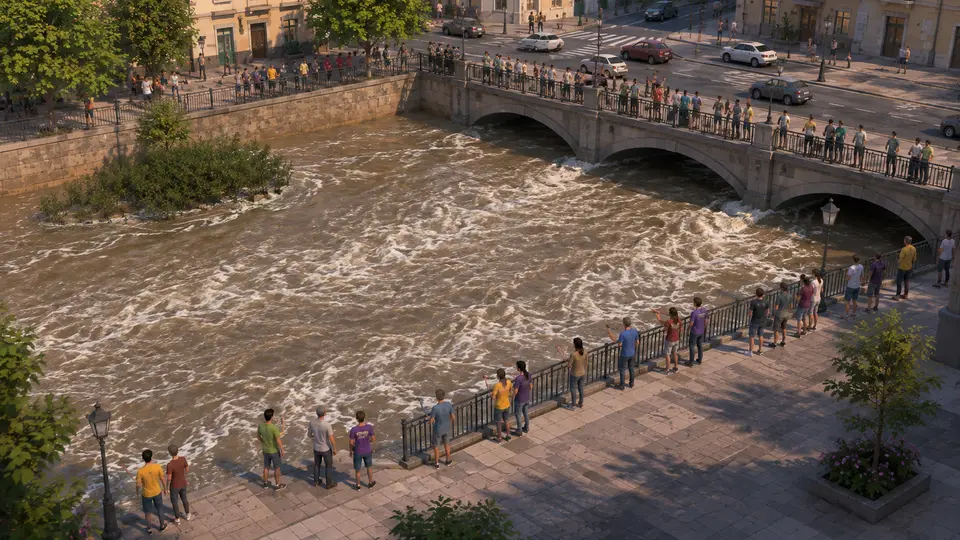
CAM-177A crowd out to watch the flood
«Tell me when too many people gather against the walkway railing with the river up, and tell me while they are still gathering.»
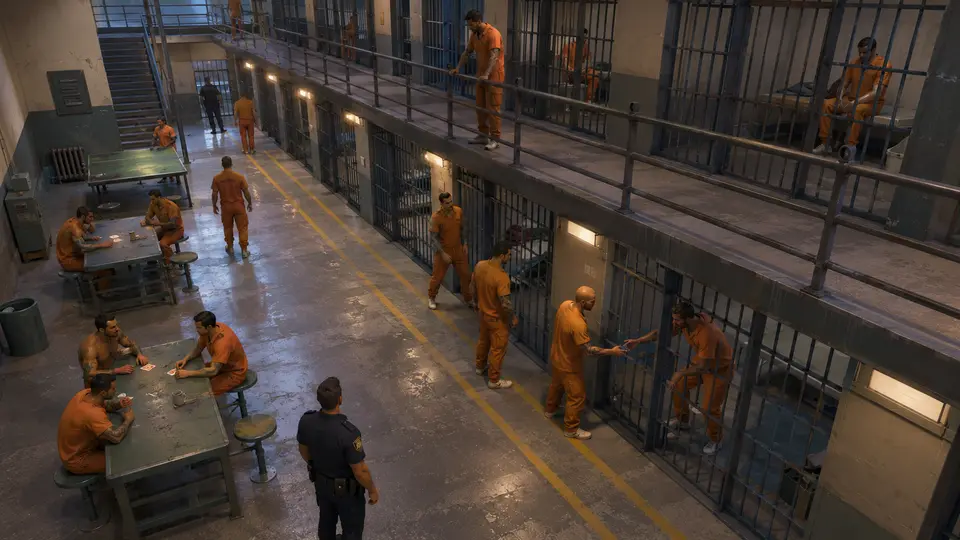
CAM-108Leaning out over the landing rail
«Tell me the moment somebody leans out over the upper landing rail or climbs onto it.»
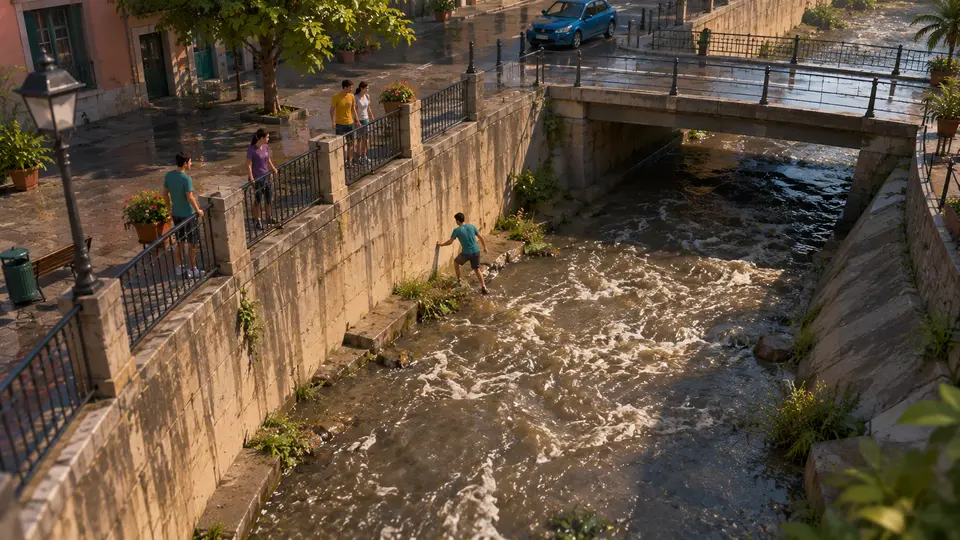
CAM-173Someone down in the channel
«Tell me the moment somebody is down in the channel, and tell me before they reach the water, not once they are already in it.»


What it does not do
IRIS does not know why someone is leaning over or what they intend, and it does not interpret it. It sees a body above a line you have drawn, or people building up against it.
Nor does it decide anything: it opens the camera and alerts. Whoever looks decides whether to run, whether to close the access or whether there is nothing there. That part is not automated, and it should not be.
Questions
- Can you mark the edge for IRIS?
- Yes, and you only do it once. You draw it on the camera image following the real edge: the railing on the upper tier, the parapet along the walk, the lip of the platform. From then on, IRIS alerts when a body crosses that line or ends up above it. This is one of the things you set up by drawing rather than by speaking, because a line cannot be described in a sentence: it has to be traced.
- Does it also alert when too many people crowd a railing?
- Yes, because a railing holds a load, not a crowd. When the river runs high, a walkway fills with people leaning out to look and to film, all pushing the same way at once. The useful alert lands while the group is forming: at that point two barriers and a car still close it off. Once fifty people are pressed against it, an alert only tells you where to start clearing.
- Does it apply on site, with scaffolds and platforms?
- Yes, and the edge is drawn the same way. What changes is the sentence: at height, the problem is not only leaning out, it is leaning out with nothing holding you. So there this rule is usually paired with the harness one, and from the same camera IRIS can flag both: someone standing on top of a machine or on the lip of a platform, and someone working at height with no harness on.
- Does IRIS interpret what that person is about to do?
- No, and it is important that it does not. IRIS does not guess intentions, does not identify anyone and puts no labels on people. All it says is what is visible: there is a body above the edge line, on this camera, in this minute. Everything else, including whether it is serious or not, comes from the person who knows the place and the people in it.
Demo · IRIS at work
A new case each time. Always the same screen.
It plays by itself and shows one case from start to finish. It is a summary: the real screen has far more functions than fit in this box.
- Cameras on the map
- You draw an area
- What passed shows up
Not seeing yours here?
These words are the ones we have built, not the ones IRIS understands. The list falls short on purpose: you ask for it in a sentence, and sentences do not run out. Tell us what is in front of your cameras and we will tell you whether it understands it, or not yet.
And the best part
What happens outside the framedoes not exist for IRIS. No camera sees the whole world.
So the first thing we do is check what each camera covers and write it down: from here you can understand this, and not that. A dull hour that saves a lot of misunderstandings.
Tell us your problem and we will say whether IRIS understands it, or not yet.
We reply the same working day.