Solutions by typeInfrastructure integrity
How long has that water been running?
Water under pressure, and nobody knows since when
Half past five in the afternoon. A water main has burst and the pipe is exposed in the middle of the carriageway. The water has flooded the whole junction and cars keep driving through it, throwing up sheets of spray. Under the tarmac that still looks intact, the jet has been washing the ground away for a good while. Nobody has called yet, because from inside a car this looks like a large puddle.
9 cameras across 7 sectors
What IRIS is
IRIS watches the cameras for you.
IRIS Neural is an artificial intelligence that watches the cameras you already have and understands what happens in front of them. When something important happens —or something you told it you need to keep an eye on—, it alerts you; and whatever can be counted, it counts in numbers. All day long, without anyone having to watch a screen.
You tell it what you need to watch, and IRIS does it.
Works with the cameras you already have. Nothing to replace.
A person replies, not a form.
- Your footage never leaves your premises.
- It doesn't identify people.
- Certifications →
This is how you ask for it
«Tell me if water is building up on the carriageway, and how far it has reached.»
Water under pressure does not sit still: it works underneath and takes the ground with it. What is a puddle at half past five can be a hole with a wheel in it by nine. In a plant the same thing happens to the slab and to the cable trench. And in parallel runs the other bill, the invisible one: cubic metres leaving the system and showing up three months later in the balance, when there is no way left of knowing what day they started going.
You decide once
You decide this once. You say which floors must always be dry — the pipe yard, the pumping apron, the skid — how much a puddle has to grow before it counts, what hours it applies and who gets told: if a jet appears at a joint or a puddle keeps growing, alert the on-call team with the camera, the spot and the time it started. IRIS checks that at every hour, and the point is that it also does it on a Sunday night, which is when a burst spends the whole night on its own.
A burst almost never starts as a flood. It starts as a thin jet against concrete, or a damp patch on the tarmac that looks like yesterday’s rain. What makes it different from water that simply pools is pressure: this water does not wait, it works underneath and takes the ground with it. That is why the difference between finding it at half past five and finding it at eleven at night is not measured in litres, it is measured in whether the road holds.
In a plant the criterion is simpler still: there are places where the floor has to be dry, full stop. The pipe yard. The pump train, where a dark stain spreads slab by slab with four people working next to it. And the version that is not water at all, which shows why this matters: a casting hall at half past nine at night, the ladle stream falling outside the mould and liquid metal running across the floor.
IRIS watches the ground that must stay dry and the joints that must not spray. It says there is a jet, or a puddle that is growing, where it is, since when and how far it has reached. And it says how many people are nearby at that moment, which is what separates a call to maintenance from an order to get out. What happens next is decided by a person: IRIS closes no valves.
What changes
Before, you found out in one of three ways: a neighbour called, the pressure dropped, or the quarterly bill arrived. All three come late and none of them says since when. Now, while the puddle is still the size of a paving slab, someone gets the image with the exact spot and the time it started, and goes out with a wrench rather than a pump set. And if there are people nearby, that is in the same alert.
Where we have seen it

CAM-32Burst water main
«Tell me if water is building up on the road, and how far it has spread.»
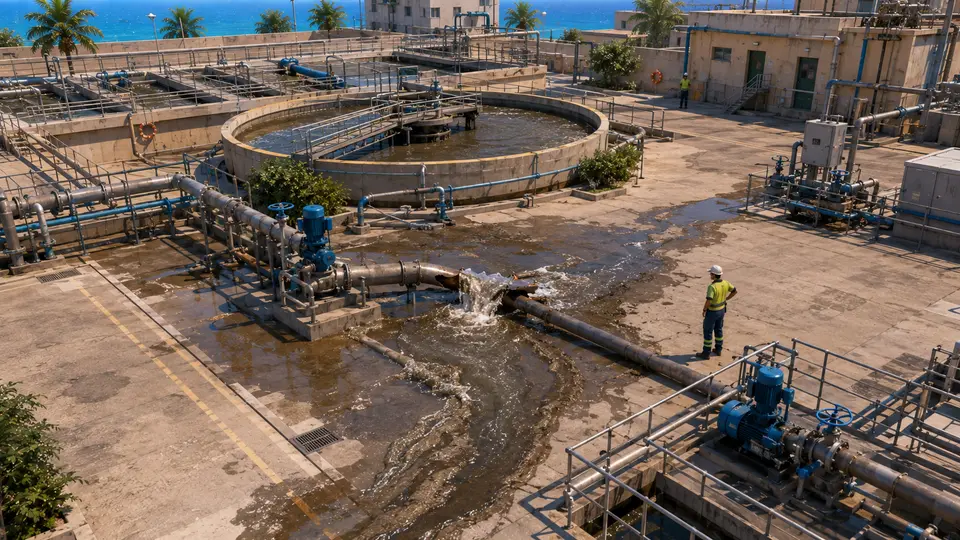
CAM-151A burst in a pipe run
«Tell me when water shows up in the pipe yard, because that floor is meant to be dry.»

CAM-268A burst, soaked box about to go on the truck
«Tell me if a parcel reaches the dispatch table torn, crushed or wet, and keep the photo for me.»
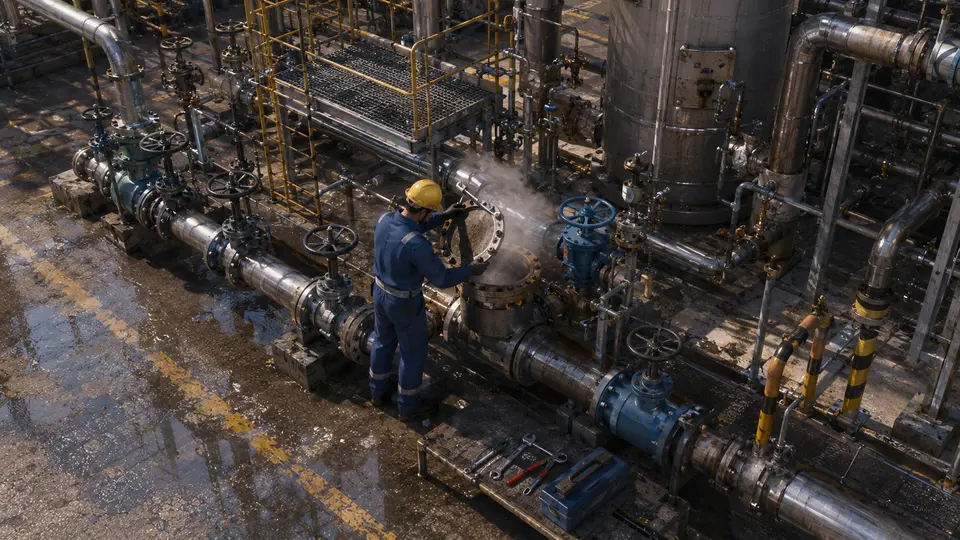
CAM-327The flange was opened before the line was isolated
«Tell me if anyone opens a flange on this line without the isolation having been seen fitted first.»
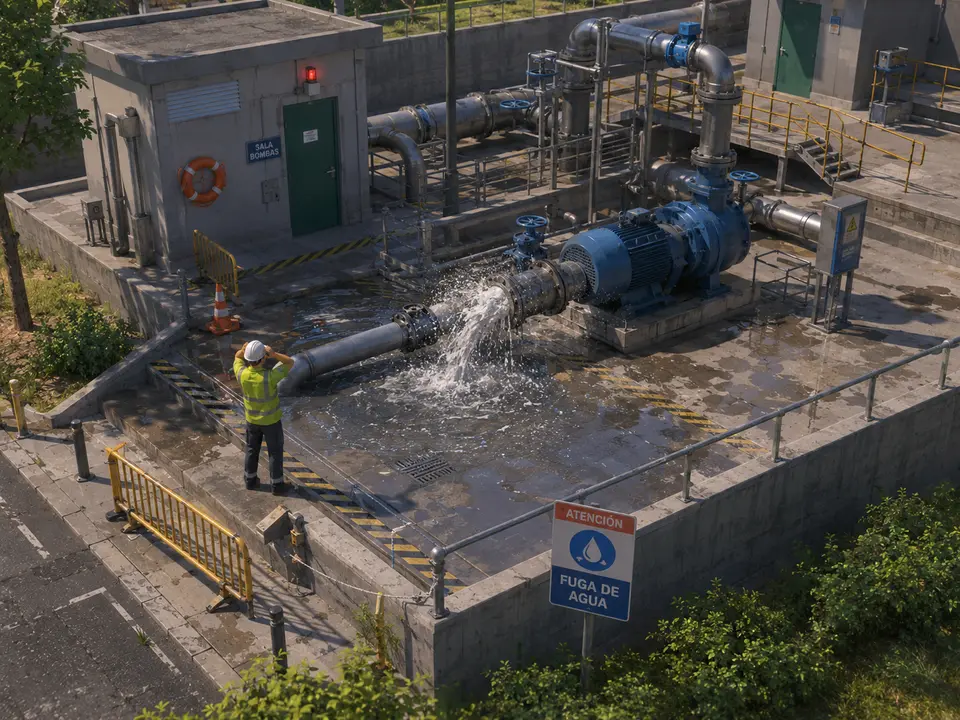
CAM-404A jet is spraying from the flange and the puddle keeps growing
«Tell me if a jet sprays from a joint or a puddle grows around a pump.»

CAM-361The ladle stream has missed and molten metal is running across the floor
«Alert me the moment metal falls outside the mould or the runner, and tell me how many people are in the bay right then.»
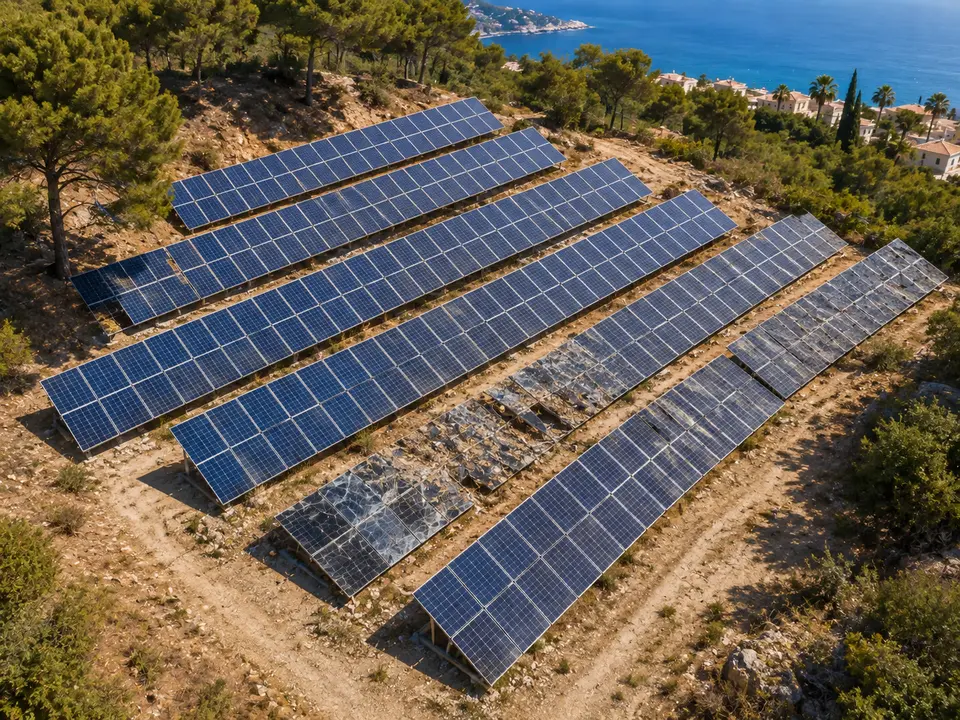
CAM-354Three rows of panels with the glass shattered
«Tell me if broken, dirty or displaced panels show up in any row of the field.»
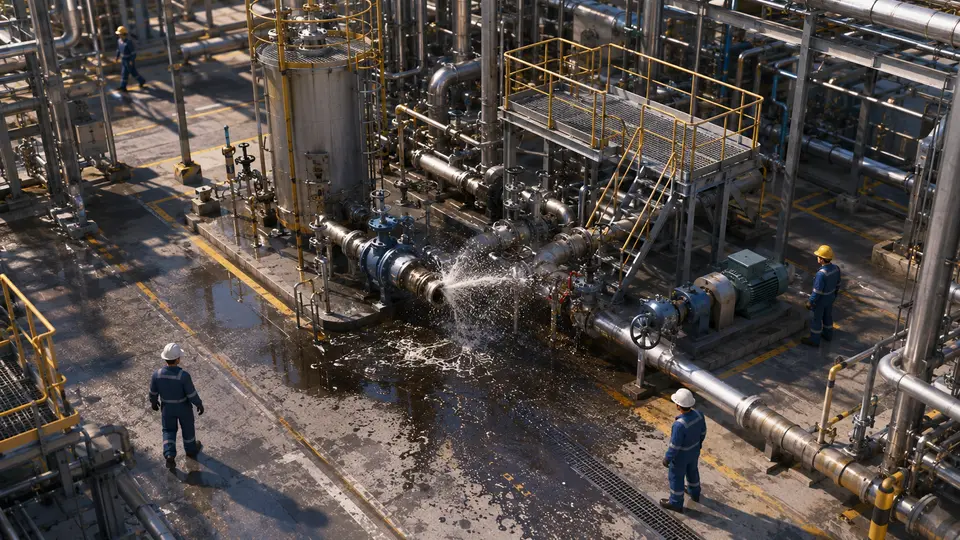
CAM-320A jet from the pump and a pool that keeps growing
«Tell me as soon as liquid sprays out of a pump or a pool starts growing on the skid floor, and show me the video from the first second.»


What it does not do
IRIS does not close a valve, does not cut the supply and does not know which liquid is coming out. It sees a jet and a growing puddle, and says where and since when.
And there is one big limitation worth stating first: a buried leak that never reaches the surface cannot be seen. Acoustic pre-location and district metering exist for that. What IRIS adds is the moment it breaks through, which is still long before anyone phones in.
Questions
- Can it detect a buried leak before it reaches the surface?
- No, and that is the single most important limitation of this word. A camera sees what is visible, and a leak travelling underground without breaking through is not visible. Acoustic pre-location, night flow and district metering exist for that, they are the usual tools and they are still needed. What IRIS adds is the moment the water breaks through, which in the street is usually hours before anyone reports it, and with the image of the exact spot.
- Can it tell leak water from rainwater?
- In large part yes, because it looks at the place and the shape. Rain wets the whole frame evenly and drains away on its own; a leak always comes from the same point, grows from there and does not stop when the rain does. Even so, in a downpour a puddle rule produces more alerts than on a dry Tuesday, which is why rules get written with rain in mind: here the jet at the joint matters more than the puddle on the ground, because rain never produces a jet.
- And when what comes out is not water?
- The criterion does not change, but the urgency does, and that goes into the rule. A puddle growing on a pump skid, a dark stain spreading slab by slab or a plume at a flange are all just as visible as water. What IRIS does not know is which product it is or whether it is hazardous: the plant knows that, which is why the rule for a process line alerts a different person with a different priority from the one for the pipe yard. The camera sees; you classify the risk.
- How long does it take to alert?
- You decide, and that is the honest answer. In the rule you write how long the thing has to last before anyone is told: a jet at a joint can be reported straight away, because nothing justifies it; a puddle on an apron is worth letting grow for a few minutes so as not to call out for a mopping bucket. We do not quote a laboratory figure because it would depend on the camera, the light and the place. What we do say is that the alert goes out while it is happening, not on the next morning’s round.
The real interface, step by step
A camera looks. IRIS understands what it sees.
An extract of the real screen, no voice-over and hands-free. Each round poses another situation. What sits behind it is a good deal bigger than what you see.
- It lands in the tray
- You open it
- You confirm or dismiss
Not seeing yours here?
These words are the ones we have built, not the ones IRIS understands. The list falls short on purpose: you ask for it in a sentence, and sentences do not run out. Tell us what is in front of your cameras and we will tell you whether it understands it, or not yet.
And the best part
By the eighth hour of a shiftnobody watches the way they did in the first. That is not a flaw.
It is being human. A camera has no eighth hour: at four in the morning it understands what it understood at noon, and it speaks up just the same.
Tell us your problem and we will say whether IRIS understands it, or not yet.
We reply the same working day.