Data centresProduction efficiency
CAM-554
A unit leaves the rack and no work order is open for it
Rack aisle, close to midnight. Someone has opened a cabinet door, slid a unit out of its rails and is holding it with both hands. Two steps away a cart is parked with an empty tray, and at the end of the aisle is the exit. IRIS does not say who that person is or why they are there. It says something else: a unit has come out of its slot, it is moving down the aisle, and at this hour there is no work order open for that cabinet.

Turn on IRIS Vision
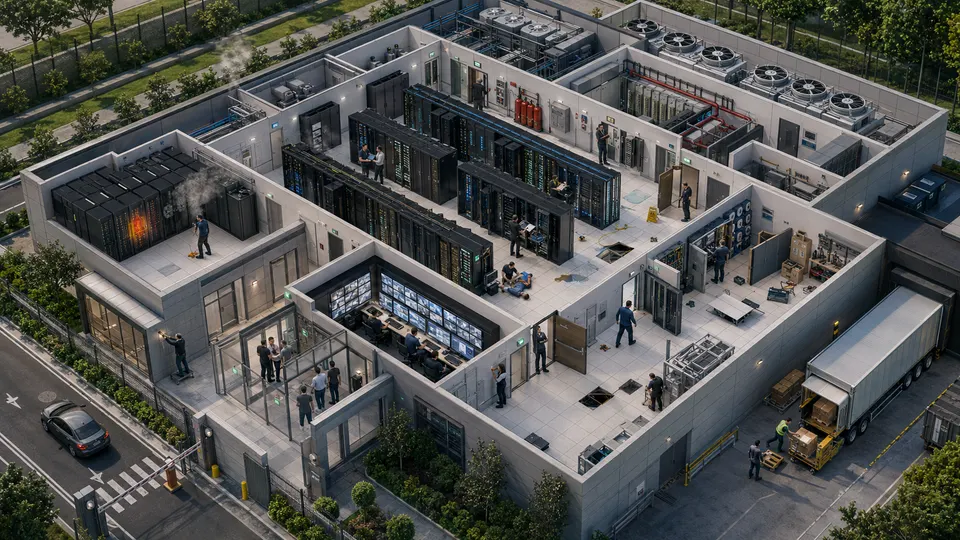
AI-generated image
What IRIS is
IRIS guards the data centre for you.
IRIS is an artificial intelligence that looks at the cameras you already have and understands what's happening at entrances, rooms and racks. If someone gets in without authorisation, two people slip through on one badge, or something you want to track happens, it alerts you right away; and whatever can be counted, it counts in numbers. All day long, without anyone having to stare at a screen.
You tell it what you need to watch, and IRIS does it.
Here, for example, IRIS sees that a unit has come out of its slot in the cabinet and is moving down the aisle, and checks whether there's a work order open for that cabinet at this hour. The alert lands within a minute, with the exact time and video starting before the door was opened. With that you decide whether it's a planned removal nobody logged, or something to stop right now.
Works with the cameras you already have. Nothing to replace.
A person replies, not a form.
- Your footage never leaves your premises.
- It doesn't identify people.
- Certifications →
What IRIS understands
What it recognises in this scene
- unit out of the cabinet
- person working at the cabinet
- transport cart standing by
- gap left in the cabinet
- cabinet door open
- exit with turnstile at the far end
- reader next to the exit
- row of cabinets
What this camera measures
An alert says something is happening. The reading says how much.
- 1Units out of the cabinet
- 2 min 10 sOut of the cabinet for
- 0Open work orders
- 11 mDistance to the exit
- 23:41:06Video starts at
The figures on this screen are an example from the illustration, not any client's measurement.
The rule
You decide once. IRIS applies it always.
If
a unit comes out of a cabinet and moves along the aisle
And alsoNo work order is open for that cabinet
Then
- alert the hall manager with the camera, the aisle and the time
- follow the unit through the cameras along the route to the exit
- save the video from one minute before the cabinet was opened
The instruction that set it up«Tell me if a unit comes out of a cabinet and moves down the aisle when no work order is open for that cabinet.»
What changes
What changes for whoever answers for physical security on site
Three weeks later, at the quarterly inventory, a piece of equipment is missing. The question is always the same: when did it leave the rack, which way and with whom. A data centre knows very well what comes in through the loading bay and rather less well what leaves the building, so that means hours of video and an access list. Almost always the explanation turns out to be the dullest one: a planned removal nobody got round to logging. With this camera that explanation arrives in a minute instead of a week, with the exact time and the video starting before the rack door was opened. And when the explanation does not appear, the alert has already gone out while the equipment is still inside the building.
What people usually ask
Is this accusing somebody of taking something?
No, and it is worth saying plainly. The alert is about the unit, not about the person: what IRIS sees is that a piece of kit has left its place and is moving. It does not know who is carrying it, it does not recognise faces and it does not judge intentions. Almost every time the explanation is the simplest one: planned work that somebody forgot to record. Who decides whether that is fine or not is a person, watching the video, with the work sheet in front of them.
How does IRIS know there was no work order?
On its own it does not, and that is the limit of this camera. IRIS sees the fact: the unit has come out and it is moving. Whether it was planned is told by another system, the work-order one, and it has to be connected. When the two pieces of data meet, the alert only goes off when it really means something. If it is not connected, IRIS still raises the alert and a person checks it in ten seconds, which is still far better than finding out at the quarterly stock count.
What if the unit is swapped for an identical one?
IRIS sees the movement and sees the gap: it knows something came out, when, and from which cabinet, and that something went in afterwards. What it does not do is read serial numbers or keep the inventory: that belongs to another system. The camera provides the time and the image; the inventory provides the name of the part. Together, a swap stops being a line on a sheet and becomes a line with video.
Other cameras
- CAM-547 · Two people go through and only one showed a badge
- CAM-548 · Both of them inside the airlock, inner door still open
- CAM-549 · Someone alone in an aisle where nobody goes unescorted
- CAM-550 · A wooden wedge holding the hall door wide open
- CAM-551 · It looks like routine maintenance, and it probably is
- CAM-552 · The cabinet was left open and nobody is standing at it
See it for yourself
You set the rule once. IRIS applies it every time.
You will see a summary of the interface, played step by step and hands-free. Each round starts with another case. The complete tool does not fit in a demo.
- Four cameras at once
- Each understands its own view
- The numbers climb by themselves
See it somewhere else

What can a camera see without pointing at anyone?
13 cases: 9 raise an alert when something happens and 4 only measure. You see each image as it is, and then with what IRIS understands on top.
What if the outage does not start with an attack?
13 cases, and in every one of them IRIS raises an alert when something happens. You see each image as it is, and then with what it understands on top.


And the best part
You decide the rule onceand it is applied the same way every time.
At three in the morning it means what it means at noon, on camera one and on camera four thousand. It does not depend on who is on shift, or how tired they are.
Tell us your problem and we will say whether IRIS understands it, or not yet.
We reply the same working day.