Will this hold fifty sites, and how many ports does it need open?
One open port, fifty sites, and every product limit in writing
A large video system almost never fails because of the artificial intelligence. It fails over the list of ports someone has to open, over the cost of running fifty sites as if they were one, and over what happens the day something breaks. IRIS opens one port, 443, and the whole system comes and goes through it, encrypted. Every site keeps working on its own if the link drops, and the product limits are published so you can size the job instead of taking it on faith.
What IRIS is
IRIS watches the cameras for you.
IRIS Neural is an artificial intelligence that watches the cameras you already have and understands what happens in front of them. When something important happens —or something you told it you need to keep an eye on—, it alerts you; and whatever can be counted, it counts in numbers. All day long, without anyone having to watch a screen.
You tell it what you need to watch, and IRIS does it.
Works with the cameras you already have. Nothing to replace.
A person replies, not a form.
- Your footage never leaves your premises.
- It doesn't identify people.
- Certifications →
At a glance
What it can do
One port only: 443
The interface, live video, recordings, maps, artificial intelligence and the programming interface all travel over the same port, encrypted. No channel goes anywhere else, and none goes unencrypted.
Thirteen rules nobody has to ask for
The system listens on fourteen ports: one public, thirteen that never leave the machine. That is thirteen firewall exceptions the network team never has to open, justify to an auditor, or review every year.
Many sites, a single view
One installation runs servers spread across sites, countries and time zones. Organisations nest as a tree and each carries its own local time: the eight-in-the-morning peak means eight in the morning at that site, not at headquarters.
Link down, site still running
Every site captures, detects, records and drives its own relays locally. Only events and measurements travel to the centre, never frames. An outage does not stop surveillance: when the link returns, the site publishes everything it stored.
No internet, no third parties
The models and the mapping are our own and live inside the customer installation. Not one image and not one query leaves the building, there is no per-query bill, and there is no outside service to depend on next year.
All eight limits, in writing
The product publishes all eight of its limits along with how each one is shared out: three are solved by adding machines and five are a hard wall. With that you can size an installation; without it you can only believe in one.
When something breaks
Machines send a heartbeat. One that stops beating is marked unhealthy and routing skips it; its cameras move to healthy machines and come back when it recovers. And a service missing configuration does not half-start: it waits and states exactly what is missing.
It plugs into what is already there
Cameras from any manufacturer over standard protocols, relays for barriers and turnstiles, alerts by email and messaging, pushes to external systems and spreadsheet export. Plus a programming interface that speaks the same vocabulary as the screens. All over the same port.
The calculator that says no
The product ships a sizing calculator: twelve questions, and it tells you what hardware is needed and which resource runs out first. When a sizing crosses a limit that cannot be shared out, it does not say risky: it says unfeasible.
Only what changed moves
Adding or removing a machine only moves the cameras that were on the machine that changed; the rest of the installation is not reshuffled. And when a machine comes back from an outage, it takes back its own cameras and only its own.
Everything it sees becomes a series
Every crossing, every dwell and every occupancy is stored as a time series: seven metrics, sixteen ways to group them and eight time levels, from the minute to the year, all refreshed on their own. Comparing two periods or two sites recalculates nothing: it reads the right level.
No configuration files
Everything is set from the web interface: no files to edit on each server and no console session needed. The only thing left outside is how to reach the data, and a service missing configuration does not half-start: it waits with the port closed and writes down exactly what is missing.
Platform
The questions from the people who have to install it
A network team never opens with what the camera detects: it opens with which ports have to be opened. IRIS listens on fourteen, but only one crosses the firewall, 443. The other thirteen listen inside the machine only, and that is not buried in the program: it is a policy you can see and edit from the web interface. For the customer that means thirteen exceptions nobody has to request, document, justify to an auditor or review every year, and thirteen doors nobody will leave open long after the component that needed them is gone. Across a distributed installation it also means thirteen fewer negotiations with each branch, and branches tend to have their own rules; anyone who has ever fought a network team knows exactly what that is worth. And when something goes wrong, the entire network check comes down to one question: does 443 get through.
A single installation runs servers spread across sites, countries and time zones, and they are handled as if they were one. Organisations nest to any depth — group, country, region, customer, site — and access is delegated accordingly: a site manager touches their own site, the centre sees everything. Every organisation, every server and every camera carries its own time zone, so comparing the rush hour of four countries never skews a series. And here is what matters most: this is not a central brain that surveillance depends on. Each site captures its cameras, detects, applies its rules, records and drives its relays locally, and only events and measurements travel to the centre, never frames. If the link drops, the site keeps working and publishes what it stored the moment the link is back.
The product states more than one hundred thousand servers and more than five million cameras, but the number on its own proves nothing: anyone can write it. What holds it up is that all eight product limits are published, each with the unit it is shared out by, and that three are solved by adding machines while five are a hard wall you have to respect. One of the shareable ones: sixty-four cameras fit per capture process, so five thousand cameras are seventy-nine processes spread over as many machines as it takes. That is an engineering answer, and publishing your own walls is the strongest proof of confidence in a product there is: anyone can write scalable, almost nobody publishes their eight limits. And the arithmetic does not live in a sales spreadsheet: there is a calculator inside the product that asks twelve questions, states what hardware is needed, flags which resource runs out first, and declares a sizing unfeasible — not risky — when it crosses a limit that cannot be shared out. Every number it returns carries where it came from, and it says in writing what has not yet been measured in that particular installation.
Whatever the system measures can be taken out of it. Ask it for its data catalogue and it returns everything it knows how to calculate and everything you can group by, names already translated: the same vocabulary the screens use, so there is no second-class interface for outsiders. The limits are stated up front, which is what anyone writing code against it appreciates: a date range is mandatory, a response carries at most fifty thousand rows, and a query that is too broad is rejected with the reason spelled out rather than quietly degrading. Outwards, the system talks to cameras from any manufacturer over standard protocols, drives barrier, turnstile and siren relays, alerts by email and messaging, calls external systems and exports to a spreadsheet. And all of it runs under the same user identity and over the same port: there is no separate user directory for integrations.
All eight limits, one by one, because that is exactly what an integrator will ask in a demonstration. Three share out: 64 cameras per capture process, 8,192 live connections at the entry point and the 1,000 a single instance serves at once; all three are solved by adding processes or entry points. The other five are a hard wall: 64 consumers per camera — every recorder, every detector and every viewer takes one — 16,384 temporary ports from the operating system, which is not even our limit and is the reason for the previous one, 8 frames per batch in the detection engine, 600 frames held per consumer, the multiplier that sends memory through the roof as soon as resolution goes up, and one graphics card per process, because a model is not split in half between two: either it fits whole or you need two copies. Those five are not fixed by buying more machines, and that is exactly why they are written down instead of hidden. With this list and the calculator, an integrator can size an installation without calling us.
The analytics is not a separate module copying data: it is the same source the screens use, aggregated. Seven metrics, sixteen dimensions to group and filter by, twenty-seven visualisation types and five export formats generated in the browser itself, offline. And here is the detail that gives away someone who has actually done this: the metrics that cannot be re-aggregated without lying — distinct objects, dwell time and time-weighted average occupancy — are marked as such and served from detail, because a sum of sums means nothing. The programming interface returns the same thing under the same rules: a date range is mandatory, pagination does not degrade as you advance, and a permissions error, a vocabulary error and a range error are never confused with one another. And the scope of what can be seen is resolved on the server from the permissions of whoever is asking: a request can narrow what it sees, never widen it.
The figures
Counted, not estimated
- 443The only open port. The whole system comes and goes through it, encrypted.
- 13Internal ports that never leave the machine: thirteen firewall rules nobody has to ask for.
- 8Product limits published with the unit each is shared out by: three share out, five are a hard wall.
- 5,000,000Cameras stated per installation, alongside more than one hundred thousand servers.
- 64Cameras per capture process: the limit that does share out. Five thousand cameras are seventy-nine processes.
- 12Questions asked by the calculator built into the product. Its answer can be: unfeasible.
Questions
How many ports have to be opened in the firewall?
One: 443. The interface, live video, recordings, maps, artificial intelligence, conferencing and the programming interface all travel over it, encrypted. The system listens on fourteen ports in total, but the other thirteen are reachable only inside the machine and never cross the network. For the network team that is thirteen exceptions nobody has to open, justify or maintain, and a single check when something goes wrong.
What happens if the link between a site and the centre goes down?
The site keeps running. Each location captures its cameras, detects, applies its rules, records and drives its relays locally; only events and measurements travel to the centre, never frames. An outage leaves the centre without a live view of that site, but it stops neither the surveillance nor the recording, and when the link returns the site publishes everything it stored. That is why bandwidth between sites is sized by events, and why video only crosses the network when somebody asks for it.
How far does it really scale?
The product states more than one hundred thousand servers and more than five million cameras, but what lets you check it are the eight published limits, each with the unit it is shared out by: three are solved by adding machines and five are a hard wall. For example, sixty-four cameras fit per capture process, so five thousand cameras are seventy-nine processes spread over as many machines as needed. The calculator built into the product does that arithmetic from twelve questions, says which resource runs out first, and declares a sizing unfeasible when it crosses a limit that cannot be shared out.
The installation is outgrowing us. What do we add, and what has to be redone?
You add a machine and nothing gets redone. You generate a registration code from the central interface, install the service on the new machine and give it that code: the machine enrols itself, with its own identity, and shows up in the fleet. Then you declare what kinds of work it can take and tag cameras with them; until it declares at least one it receives no work, and the interface says so out loud instead of leaving it silent. Routing adjusts by itself and only the cameras that change machine actually move: the whole installation is not reshuffled. What does have to be recalculated is the sizing, if the growth crosses one of the five limits that do not share out, and the calculator says so before anything is bought.
How do you update an installation spread across many sites?
Every server publishes its version, its build identifier and its start time, so version drift across the fleet is visible on screen instead of being discovered the day something breaks. Updating goes machine by machine, not as a general blackout: while one site updates, the others keep capturing, detecting and recording locally, because none of them needs another to work. And there are no configuration files to reconcile server by server: everything lives in the system and is edited from the web, so an update does not drag a trail of local tweaks behind it. If a service is missing something after an update, it does not half-start: it waits with the port closed and writes down exactly what is missing. What we will not promise is a schedule: the calendar of a distributed installation is set by the customer and their maintenance window, not by us.
The real interface, step by step
You set the rule once. IRIS applies it every time.
You will see a summary of the interface, played step by step and hands-free. Each round starts with another case. The complete tool does not fit in a demo.
- Checks the whole system
- Flags what is failing
- Puts it on one screen
See it somewhere else
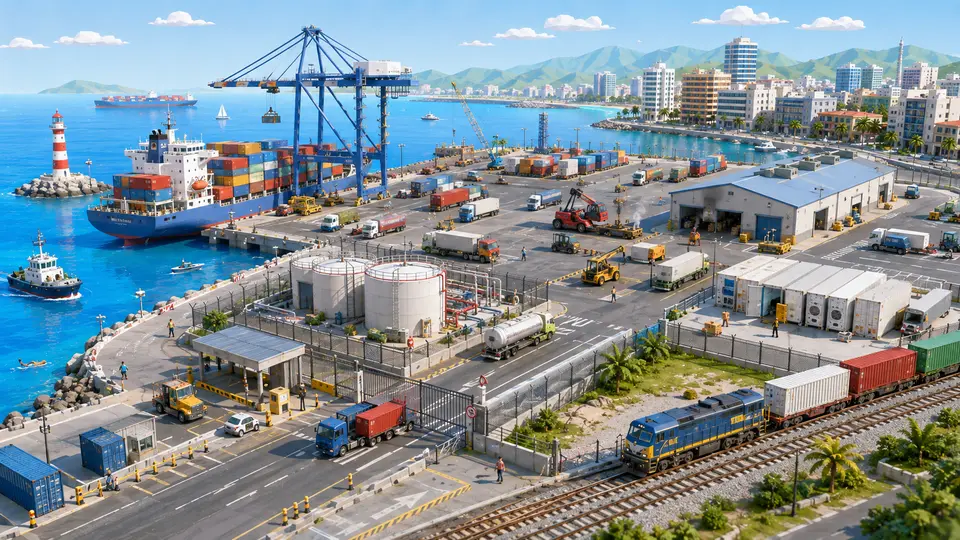
Who is watching a whole quay at three in the morning?
14 cases: 13 raise an alert when something happens and one only measures. You see each image as it is, and then with what IRIS understands on top.

Who is watching the cameras of a whole branch network?
13 cases: 12 raise an alert when something happens and one only measures. You see each image as it is, and then with what IRIS understands on top.


And the best part
Behind one camera you can put a person.Behind four thousand you cannot put anyone.
Adding a camera costs little; adding another pair of eyes does not. So the cameras keep growing and the attention does not. IRIS watches all four thousand at once and flags what matters today.
Tell us your problem and we will say whether IRIS understands it, or not yet.
We reply the same working day.