Solutions by typeInfrastructure integrity
What if water gets in where the switchgear is?
There is water on the floor and nobody will walk past
Four in the morning in a plant room. A thin jet of water runs from a downpipe against the column, silently, and there is already a sheet of it spreading across the tiles towards the floor grilles. On one side of the aisle sit the cooling units; on the other, the cabinets, powered up. There is nobody in the room, and there will be nobody until seven. The water reaches the grille long before that.
3 cameras across 2 sectors
What IRIS is
IRIS watches the cameras for you.
IRIS Neural is an artificial intelligence that watches the cameras you already have and understands what happens in front of them. When something important happens —or something you told it you need to keep an eye on—, it alerts you; and whatever can be counted, it counts in numbers. All day long, without anyone having to watch a screen.
You tell it what you need to watch, and IRIS does it.
Works with the cameras you already have. Nothing to replace.
A person replies, not a form.
- Your footage never leaves your premises.
- It doesn't identify people.
- Certifications →
This is how you ask for it
«“Tell me if water shows up on the floor of any plant room, even a little, and tell me which aisle.”»
A puddle at four in the morning costs a mop. The same puddle at seven costs something else: a wet cabinet, kit going down, a service stopped and an insurer asking questions. And the worst part is that it is almost never anyone’s fault: a twelve-euro hose has split, and the price of nobody seeing it for three hours is a whole morning of people standing in front of a dead cabinet.
You decide once
The room is known by the people who run it, not by the camera. The organisation decides which rooms are covered, how much water already deserves a phone call — here, almost always any at all — who gets called at night, and what happens before they arrive: cut power, pump out, open the door. That is decided once, with the floor plan in front of you. After that IRIS applies it every night, including the twenty-fourth of December, without depending on anyone remembering to look at that camera.
In a plant room the enemy makes no noise. No smoke, no alarm, nobody shouting: a sheet of water spreading across the floor at the speed water spreads, which is slow and relentless. And three things bring it, nearly always: cooling condensate, a split hose on the sprinkler main, and a downpipe from the floor above. None of the three announces itself.
The place where it hurts most is exactly where it is hardest to see. Under a raised floor, behind a closed door, in a switchgear building out in the middle of the plant, in an underground vault you climb down a ladder to reach. Down there water does not only ruin things: if someone is inside when it pours through the wall opening, it is no longer a fault, it is a rescue, and the first question the duty manager asks on the phone is how many people are down there.
IRIS watches the floor. It sees the shine of water where there was dry tile, says which room and which aisle, and says since what time it has been visible. If it is an underground vault with people in it, it also says how many people are in frame at that moment, without knowing who they are, because getting them out needs the number and not the name. Then the alert reaches a person, with the camera and the video from just before, and that person decides whether this is a bucket or a long night.
What changes
Before, water was discovered through its consequences: kit shutting down, a breaker tripping, someone opening the door in the morning and stepping in it. The round of the rooms happened once or twice a shift, and between rounds there were hours of nothing. Now the round still happens, but the puddle at four in the morning is seen at four in the morning, with a picture of the aisle, and whoever is on call decides whether to drive in or wait for the handover.
Where we have seen it

CAM-557Water falling in the aisle and creeping towards the floor grilles
«Tell me if water shows up on the floor of any plant room, even a little, and tell me which aisle.»
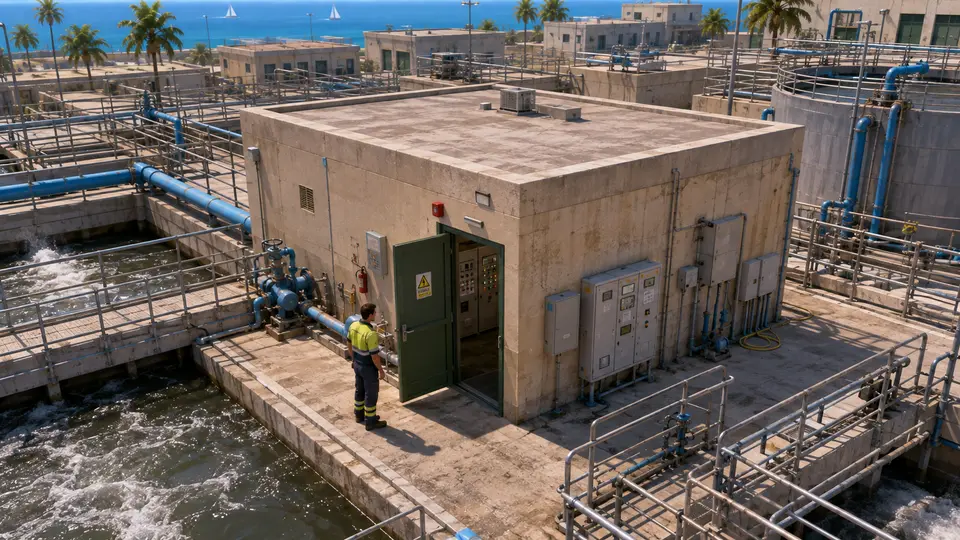
CAM-156Critical room door left open
«Tell me if the switchroom door is left open for more than a few minutes.»
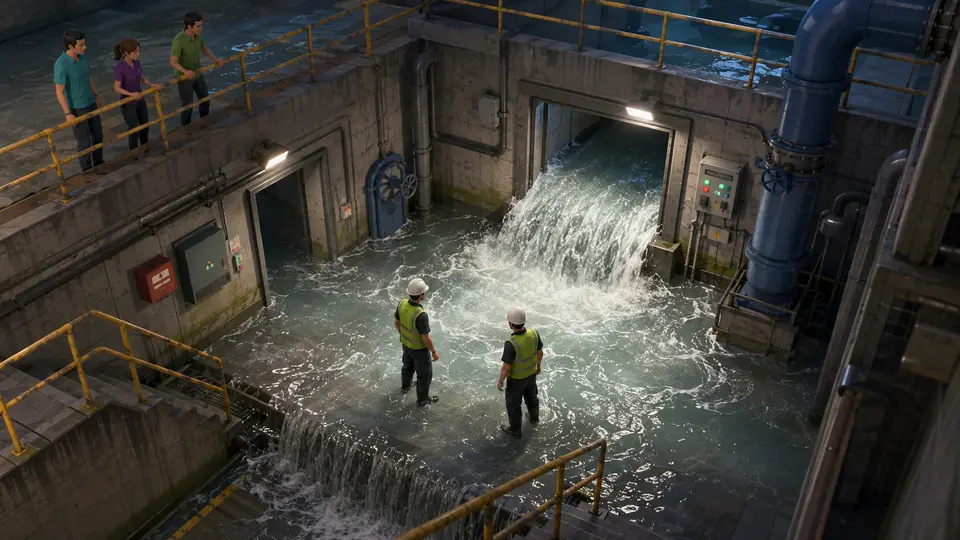
CAM-166Water pouring into the underground chamber
«Alert me the moment water comes in through the chamber opening, and tell me how many people are inside right then.»


What it does not do
IRIS closes no valve and pumps nothing out. It does not know where the water comes from, whether it is clean, or whether it is from the cooling circuit or the sprinkler main, and it does not measure how many litres there are. Nor does it see what happens under a raised floor or inside a suspended ceiling: it only sees the surface left in view. If the water is hidden, you still need the flood sensor you have always needed.
Questions
- Does it pick up a small puddle, or does the room have to flood?
- It sees a thin sheet as soon as the floor changes appearance, and that is the point: the shine of water on a dry tile shows up before there is any volume. That said, there is a sensible minimum, and a few drops next to someone’s foot will not be seen. The rule is tuned on the real floor of that room — how it reflects, what light it has, where the grilles are — and you decide what size already deserves a call at four in the morning. In a room full of live cabinets, the usual answer is that any size does.
- Does it replace the flood sensors?
- No, and we do not want it to. A flood sensor is cheap, reliable and sits on the floor exactly where it should. The catch is that it only knows about its own spot: if the water comes in two metres away and drains off elsewhere, it never finds out. The camera sees the whole aisle and says which way the water is going. Given the choice, fit both: the sensor for the critical point, the camera for everything else and for being able to see what is happening without going down there.
- Does it know how many people are inside a flooded room?
- Yes: it counts how many people are in frame, and it does not know who they are. It does not recognise faces, keeps no record of anyone and cannot tell an operator from a contractor. For what the figure is for — telling whoever is on their way how many people have to come out of an underground vault — the number is what matters and the name adds nothing. And if someone is out of frame, they are not counted: the figure given is the figure for what is visible, and it is stated that way.
- What about rooms with no camera?
- There IRIS sees nothing, and that is worth saying before anyone signs. This works with the cameras that exist, and a room with no camera is a room with no eyes, however good the rule is. What usually turns out to be true is that there are more cameras than people think: in many buildings the technical corridors are already covered for security, and those same images work for this without changing anything. The list of covered rooms gets checked at the start, not after the first scare.
The real interface, step by step
You set the rule once. IRIS applies it every time.
You will see a summary of the interface, played step by step and hands-free. Each round starts with another case. The complete tool does not fit in a demo.
- The rule gets built
- It goes to every camera
- Published, it watches alone
- And then it fires
Not seeing yours here?
These words are the ones we have built, not the ones IRIS understands. The list falls short on purpose: you ask for it in a sentence, and sentences do not run out. Tell us what is in front of your cameras and we will tell you whether it understands it, or not yet.
And the best part
By the eighth hour of a shiftnobody watches the way they did in the first. That is not a flaw.
It is being human. A camera has no eighth hour: at four in the morning it understands what it understood at noon, and it speaks up just the same.
Tell us your problem and we will say whether IRIS understands it, or not yet.
We reply the same working day.