Solutions by typeMobility analysis
How fast does traffic really go past here?
They speed here and nobody measures it
It is 08:52 on the street outside the school. A van crosses the zebra so fast that it blurs in the image itself. Beside the crossing, a mother has just thrown out an arm to stop three children who already had a foot on the road. No crash, no report, no phone call. In twenty minutes the street will be empty and nobody will be able to say how fast that van was going.
3 cameras across 3 sectors
What IRIS is
IRIS watches the cameras for you.
IRIS Neural is an artificial intelligence that watches the cameras you already have and understands what happens in front of them. When something important happens —or something you told it you need to keep an eye on—, it alerts you; and whatever can be counted, it counts in numbers. All day long, without anyone having to watch a screen.
You tell it what you need to watch, and IRIS does it.
Works with the cameras you already have. Nothing to replace.
A person replies, not a form.
- Your footage never leaves your premises.
- It doesn't identify people.
- Certifications →
This is how you ask for it
«Tell me how fast traffic passes the school gate and at what times, and alert me when someone goes well over what we have set for this street.»
That street has been in the parents’ complaints and on the council agenda for two years. What is missing is a number. And with no number the answer is always the same: send a patrol car for two mornings, nothing happens while it is parked there, and the day it leaves everything goes back to normal. The day a child is hit, the press, the insurer and the question of why nothing was done all arrive together.
You decide once
You decide this once. You mark the stretch on the image, say what speed belongs to that street, which hours matter and who gets told: between eight and nine, if someone goes well over, alert the municipal duty service with the camera and the time. IRIS applies that every school day and on every camera looking at that stretch. Meanwhile it keeps the number for everyone else, which is what ends up changing the street.
Speed is the one traffic risk everybody notices and almost nobody measures. You know cars race down a street because neighbours say so, because they sound different, because parents stand at the crossing with an arm out. But when it is time to decide on a speed hump, a narrower lane or a different patrol slot, there is nothing written down. And what is not measured gets argued about forever.
It is not only outside schools. On a car park ramp, a car coming up the down lane is dangerous for going the wrong way and for going fast: on a blind curve between two levels, those two together are a head-on. And on a dual carriageway at dusk, with wet tarmac and headlights bouncing back, the safe speed is not the one on the sign; it is a good deal lower, and the driver only finds out when braking.
IRIS measures on the image of the camera that is already there. It gives the approximate speed of whatever crosses the stretch you marked, keeps it by hour and by day, and alerts when someone is well over what you set. Both matter: the alert, for the driver two hundred metres from the school gate, and the number, for the meeting where somebody has to decide what to do with that street. One has an effect today. The other changes the street.
What changes
Before, finding out whether a street was being raced down meant ordering a survey: someone laid a rubber tube across the tarmac for two days and a report came back with the average of those forty-eight hours. Now the camera already on the pole gives you a whole month, hour by hour, and the alert arrives while someone is going well over, not three weeks later.
Where we have seen it
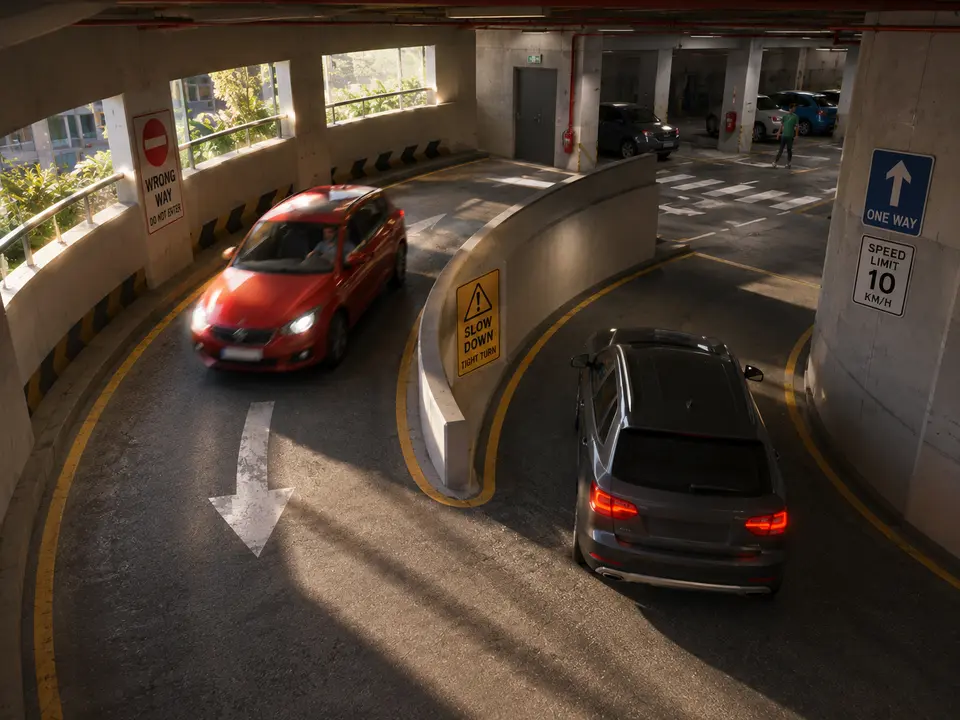
CAM-469A car coming up the ramp the wrong way
«Tell me when a car comes up the down ramp or goes above the speed we have set.»
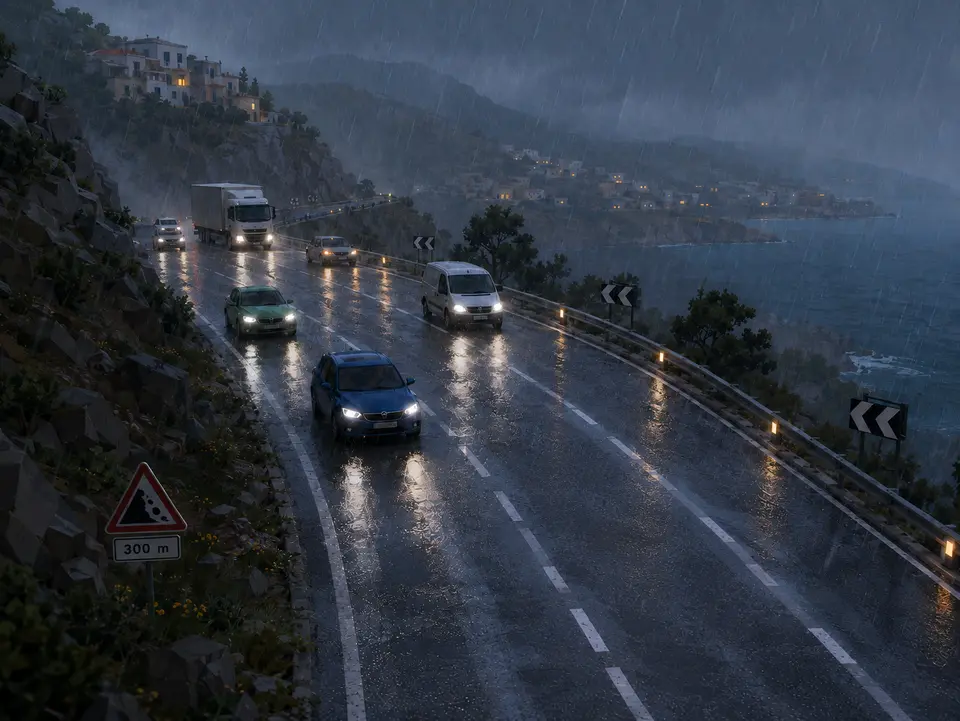
CAM-67Heavy rain at dusk
«Tell me when the stretch is wet and visibility drops, so I can lower the speed before someone has a fright.»
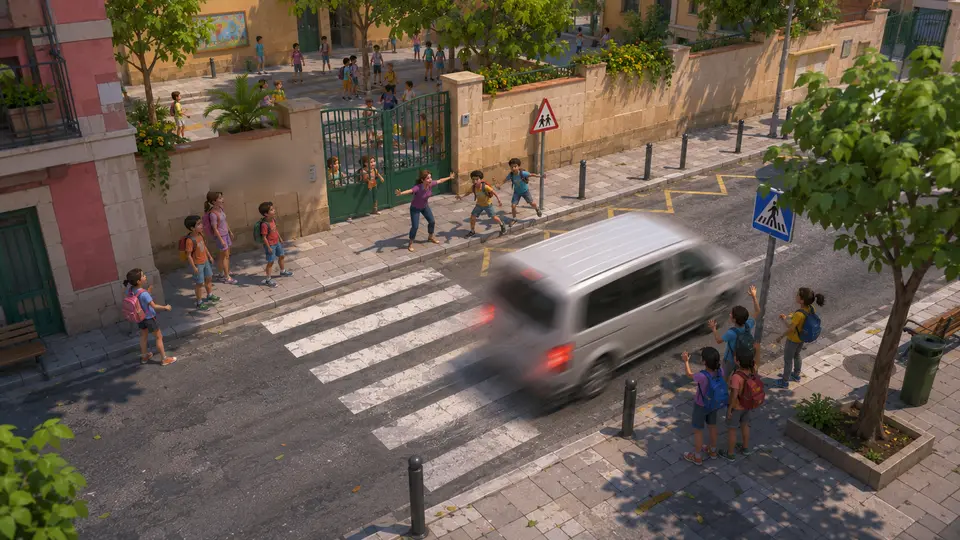
CAM-141Cars speeding past the school gate
«Tell me how fast people drive past the gate and at what hours, and alert me when someone goes well over what we have set for this street.»


What it does not do
IRIS is not a type-approved speed camera and its number cannot be used to issue fines. It gives an approximate speed, measured on the image, good for comparing hours, days and months at the same spot.
And it does not know who is driving: it does not recognise faces. The plate is read when it is clearly visible; at night, in rain or from behind, often it is not.
Questions
- Can it be used to issue fines?
- No. IRIS is not a type-approved speed camera and its reading has no legal force for penalties. What it does is different: it tells you how fast traffic passes a spot, hour by hour and day by day, and alerts you when someone is well over the figure you set. That is what you use to redesign the street, to decide where a hump goes, to back up a request and to send someone while it is happening. If the council wants to fine, it needs approved equipment; IRIS tells it where and when to put it.
- Do I need a special camera?
- No. The camera already looking at that stretch will do, as long as the road surface is clear and vehicles do not hide each other. All you need is to tell IRIS the real distance between two points in the image: the width of a zebra crossing, the gap between two lampposts, the length of a painted line. From there it can work out the speed of whatever crosses. If the camera is very high, very far or head-on to the traffic, the figure is coarser and it shows; check it before trusting it.
- Can it alert only when someone is far too fast?
- Yes, and that is the sensible setup. If every car slightly over triggers an alert, within two days nobody reads them. What works is setting a high figure, the one that genuinely frightens people on that street, and alerting only above it, in the hours that matter: school drop-off and pick-up, for instance. Everything else raises no alert but still counts: at the end of the month you have the full curve and know whether the problem is four cars or two hundred.
- Does it measure the same at night or in the rain?
- Yes, as long as the camera still sees the stretch clearly, but the figure gets coarser. At night, with wet tarmac and reflected headlights, some vehicles are harder to see and others hide each other. The honest approach then is to treat the reading as a trend rather than a precise value: it is enough to show that at seven on a rainy evening people drive faster than anyone thinks, which is exactly what you need to bring the speed down before somebody gets a fright.
A different case every time
Watch what happens. Then watch what IRIS does with it.
Not a recorded video and not a drawing: it is a summary of the real tool, with a different case each time round. The whole tool does not fit in a box.
- You ask
- IRIS searches
- It shows you
Not seeing yours here?
These words are the ones we have built, not the ones IRIS understands. The list falls short on purpose: you ask for it in a sentence, and sentences do not run out. Tell us what is in front of your cameras and we will tell you whether it understands it, or not yet.
And the best part
Behind one camera you can put a person.Behind four thousand you cannot put anyone.
Adding a camera costs little; adding another pair of eyes does not. So the cameras keep growing and the attention does not. IRIS watches all four thousand at once and flags what matters today.
Tell us your problem and we will say whether IRIS understands it, or not yet.
We reply the same working day.