Solutions by typeProduction efficiency
What if the check gets skipped by whoever is in a hurry?
The step that got skipped
First thing in the morning at the quarry checkpoint. On the left lane there is a queue: a truck is stopped on the weighbridge with the barrier still down. On the right, a truck loaded with rock leaves by the free lane without weighing, kicks up dust and takes the haul road. Nobody said anything, because nobody was watching that lane. In this hour’s report that truck will not appear.
5 cameras across 4 sectors
What IRIS is
IRIS watches the cameras for you.
IRIS Neural is an artificial intelligence that watches the cameras you already have and understands what happens in front of them. When something important happens —or something you told it you need to keep an eye on—, it alerts you; and whatever can be counted, it counts in numbers. All day long, without anyone having to watch a screen.
You tell it what you need to watch, and IRIS does it.
Works with the cameras you already have. Nothing to replace.
A person replies, not a form.
- Your footage never leaves your premises.
- It doesn't identify people.
- Certifications →
This is how you ask for it
«Tell me when a loaded truck leaves without crossing the weighbridge, and keep the plate for me.»
What does not cross the weighbridge is not invoiced, does not balance the stock and is not recorded anywhere. At month end the gap is not attributed to a particular truck: it is spread across all of them and called shrinkage. Nobody is stealing anything; there was a queue and the driver had another load at nine. But the stockpile figure does not add up, nobody knows why, and the meeting ends up arguing over a difference that cannot be explained.
You decide once
You decide this once, and whoever owns the procedure decides it. You say what the mandatory sequence is, who may skip it and for what reason, and who is told when it is not followed: if a loaded truck leaves the site without crossing the weighbridge, alert production control with the plate, the time and the video of the exit. IRIS applies it to every exit, including when there is a queue, and above all when there is a rush.
The step that gets skipped is almost never important to the person skipping it. That is the crux, and it explains why it happens so often. Weighing the truck is no use to the driver: it is of use to whoever invoices, three weeks later. Running the box across the inspection table is no use to whoever is pushing it down the rollers: it is of use to whoever will handle the complaint in two months. The benefit of a check is always collected by somebody else, and almost always later.
That is why checks get skipped when there is a queue, when time is short or when a machine fails. The box that does not go straight to the inspection table at the split and takes the direct chute to sealing. The slab that at the transfer car enters a bay other than the one on its plate. The loaded truck that comes down from the stockpile on the dirt track instead of crossing the weighbridge. The problem shows up weeks later, when somebody tries to reconstruct what happened and finds no trace at all of the missing step.
IRIS does not watch the step: it watches the sequence. It knows that truck was at the stockpile at 08:12 and at the exit at 08:19 without having been on the weighbridge in between. And at the hygiene airlock it does the only thing that really helps: it alerts at the door, not inside the room, because an alert that arrives once the person is already next to the product arrives late.
What changes
Before, the missing step turned up when the month was reconciled, or when a complaint arrived — and by then there was no way to know who or when. Now the alert arrives at the moment and at the place: the plate that leaves without weighing, the box that reaches sealing without crossing the table, the person who goes through the turnstile without washing their hands. And it reaches whoever can stop it, not whoever will have to explain it.
Where we have seen it
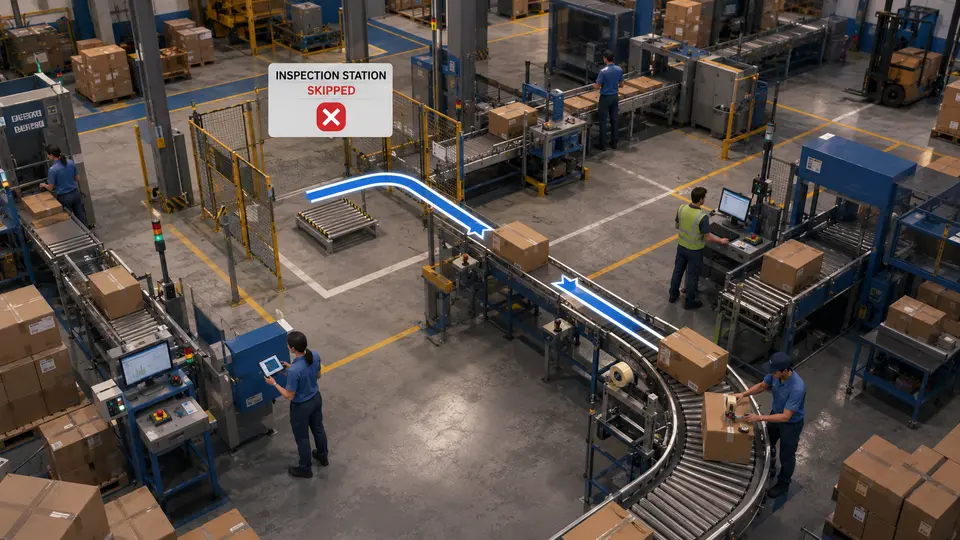
CAM-246The box takes the bypass and skips inspection
«Tell me if a box reaches the taping station without having gone over the inspection table.»
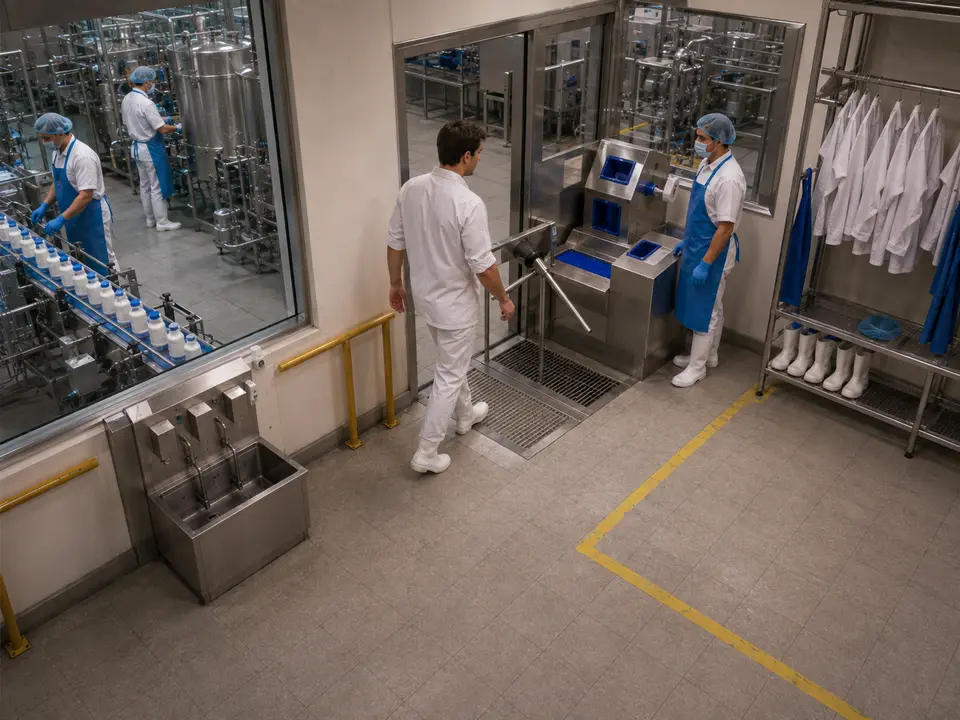
CAM-212Into the clean area with no hairnet
«Tell me if somebody goes through the turnstile into the hall with no hairnet, no coat or without using the wash trough, and tell me at the door, not inside.»
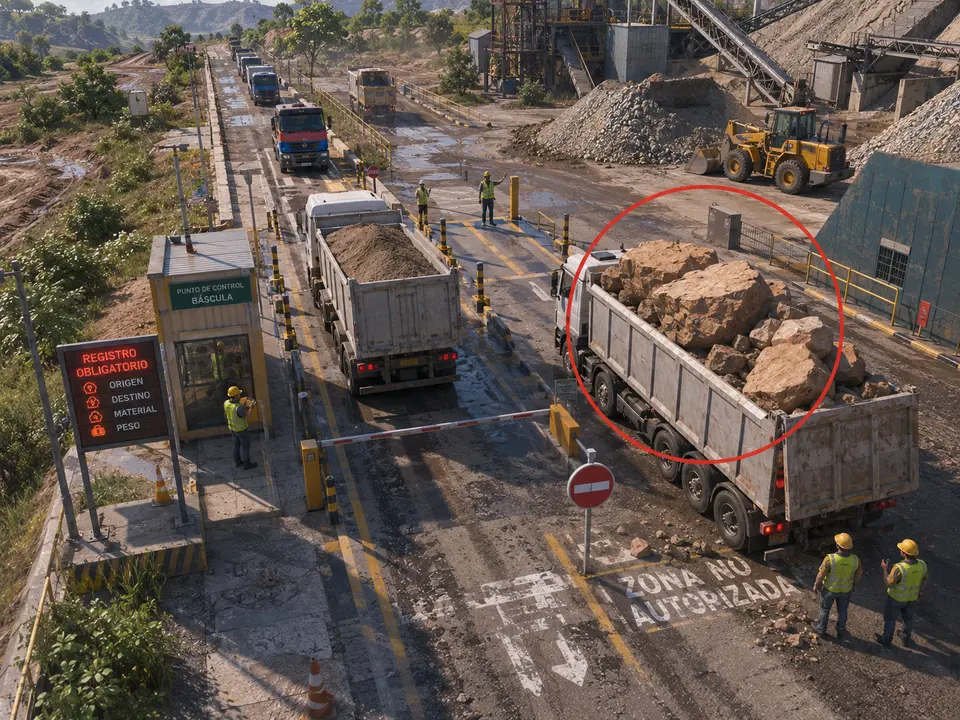
CAM-386A loaded truck slipping past the weighbridge
«Tell me when a loaded truck leaves the quarry without crossing the weighbridge, and keep the plate for me.»
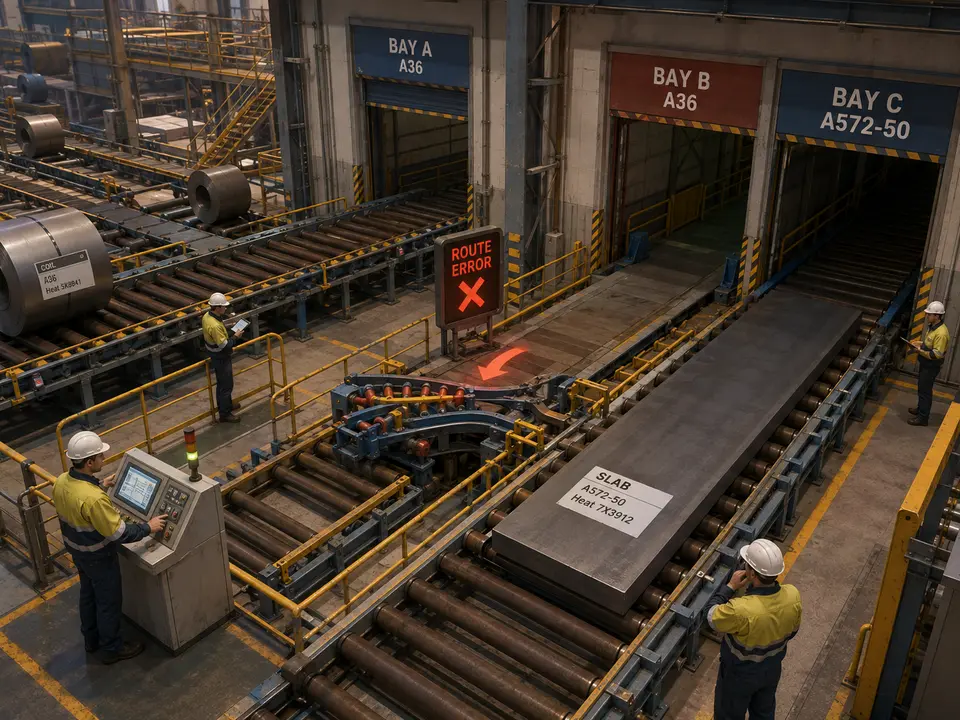
CAM-367The slab has taken the wrong turnout
«Tell me if a slab or a coil goes into a bay that does not match its plate.»
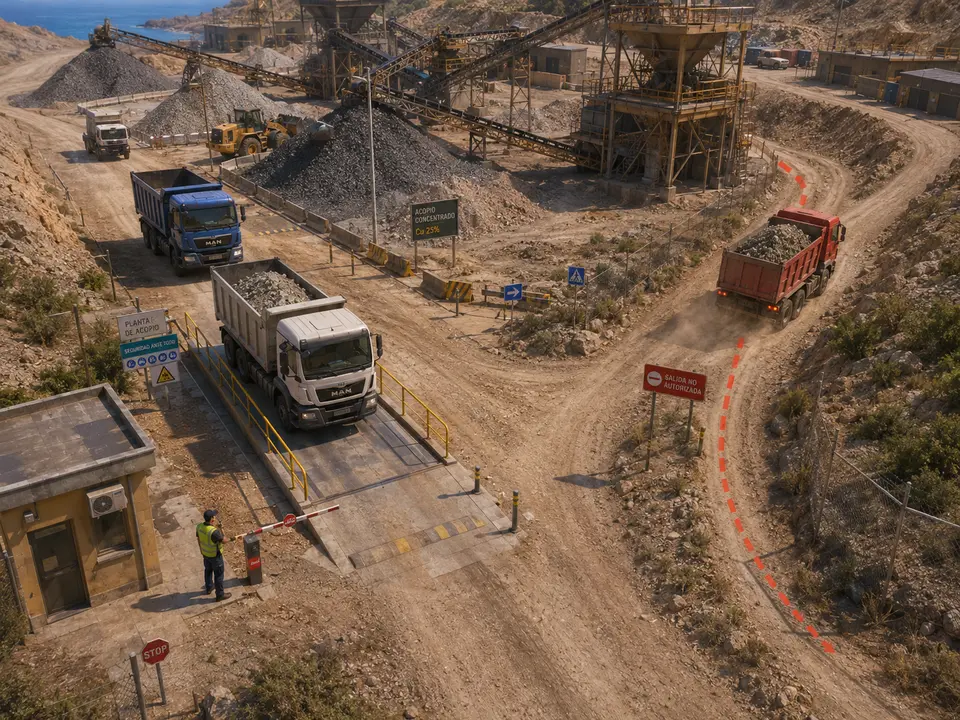
CAM-380A loaded truck leaves by a way that is not a way out
«Tell me if a loaded truck leaves the stockpile by the lower track instead of going over the weighbridge.»


What it does not do
IRIS does not know whether somebody had permission to skip the step. There are legitimate exceptions every day: a service truck, an authorised exit through another gate. IRIS sees the sequence and alerts; whoever knows the context decides whether it was fine.
And it only sees steps that happen in a place. If the missing step is a signature on a screen, that is not in the image and no camera can check it.
Questions
- How does IRIS know a step has been skipped?
- By the sequence, not by the isolated step. You mark the points that have to be passed — the stockpile, the weighbridge, the exit — and in what order. If something turns up at the last point without having been at the one in between, that is what triggers the alert. With vehicles the plate is followed; with product the item is followed from one camera to the next. You do not need a reader at every point: you need a camera where each step happens.
- What if the truck was allowed to leave that way?
- Then the alert is closed in ten seconds and nothing happens. IRIS does not know who has permission or what for: the person receiving the alert knows that, opens the image, sees it is the usual maintenance truck and dismisses it. That is exactly why the alert carries the plate, the time and the video: so that checking costs ten seconds instead of a phone call. And if one case keeps repeating, the rule gets adjusted rather than endured.
- Does it work for the hygiene airlock into a clean room?
- Yes, and there what matters is where the alert lands. The useful rule is not «tell me if somebody is in the room without a hairnet», because by then the product is already exposed. The useful rule is «tell me at the door, before they cross the turnstile»: no hairnet, no coat, or no stop at the wash basin. The airlock area is marked on the image and the alert arrives at the crossing, not in the room. Anything else documents a problem instead of preventing it.
- Does it replace the weighbridge or the access control?
- No. The weighbridge keeps weighing and the access control keeps opening the door to whoever is entitled; IRIS touches neither. What it adds is exactly what those systems miss by definition: what happens with whoever does not go through them. A weighbridge knows what it weighed; it does not know what left without weighing. A turnstile knows who crossed it; it does not know whether that person washed their hands first. IRIS watches that, and alerts whoever can act.
See it for yourself
This isn’t a video. It’s a slice of the real screen.
A summary of the real interface, played hands-free. You see one case from start to finish; what you do not see are the other screens, and there are many.
- Four cameras at once
- Each understands its own view
- The numbers climb by themselves
Not seeing yours here?
These words are the ones we have built, not the ones IRIS understands. The list falls short on purpose: you ask for it in a sentence, and sentences do not run out. Tell us what is in front of your cameras and we will tell you whether it understands it, or not yet.
And the best part
At four in the morning,the camera is still watching just as it does at noon.
No heavy eyelids, no distractions, no shift change. What happens at night is understood at night, not the next morning.
Tell us your problem and we will say whether IRIS understands it, or not yet.
We reply the same working day.