Solutions by typeInfrastructure integrity
How long has that been dripping?
A puddle that was not there yesterday
It is 11:20 in the storage yard. A white IBC is dented and sagging on one side, resting on a broken wooden pallet. Underneath, the concrete is dark and wet, and the stain has almost reached the joint. Somebody has laid an absorbent pad and gone to fetch more. Nobody knows whether this has been dripping for ten minutes or since yesterday afternoon, and that is exactly the question that will be asked.
4 cameras across 4 sectors
What IRIS is
IRIS watches the cameras for you.
IRIS Neural is an artificial intelligence that watches the cameras you already have and understands what happens in front of them. When something important happens —or something you told it you need to keep an eye on—, it alerts you; and whatever can be counted, it counts in numbers. All day long, without anyone having to watch a screen.
You tell it what you need to watch, and IRIS does it.
Works with the cameras you already have. Nothing to replace.
A person replies, not a form.
- Your footage never leaves your premises.
- It doesn't identify people.
- Certifications →
This is how you ask for it
«Tell me if a jet comes out of a joint or if a puddle grows around a pump.»
A drip costs little while it stays inside the bund. Once it reaches the drain, the price changes scale: analysis, clean-up, a notification to the authorities and a file that takes months to close. On a pump, the jet coming out of a flange also ends in a shutdown, because what is escaping there is the discharge pressure. And in both cases the bill is set by how long it ran without anyone seeing it.
You decide once
It is decided once: which floors have to be dry, which puddle is tolerable and which is not, how many minutes a stain may grow before an alert goes out, and who is called outside working hours. It is an operations and environment decision, not a technical setting. IRIS then applies it in the yard, in the pump room and in the storage building, on every shift, without anyone having to remember.
Hardly any leak starts out as a leak. It starts as a joint that weeps, an IBC that took a knock from a forklift, or a pallet that gave way at one corner. Somebody sees it, lays an absorbent pad and tells themselves they will look at it later. That «later» is the problem: between someone seeing it and someone fixing it, whole shifts go by, and during those shifts the puddle does not stop.
And there is one detail that sets the cost: the start time. When the inspector or the insurer arrives, the question is not «was there a leak?», it is «since when?». Today that answer is pieced together by hand, searching backwards through video, and it almost always ends in «we cannot say for certain». That sentence loses arguments that were never lost because of the leak, but because nothing could be shown.
IRIS watches the floor and the equipment. It sees that the concrete has darkened where it was dry, it sees the stain growing, it sees the jet arcing over the pipework and it sees the deformed drum on the broken pallet. It alerts with the camera, the time and the video of the moment it became visible. And that start time, the thing most needed and hardest to find, is already written down.
And there is a place where water is the problem and not the liquid escaping: the scrap basket hanging over a furnace. At quarter to six in the morning, with snow still lying on the material and three sealed drums in among the scrap, what is up there is trapped moisture about to enter an incandescent bath. Nobody is dripping anything: somebody is about to put water where it does not fit. It is the same look — what is wet and what should not be — with a margin of seconds instead of shifts.
What changes
Before: the drip was found by whoever walked past, and the start time was a guess.
Now: the alert goes out when the stain starts to grow, it is dealt with on the shift it happened, and the time is recorded with its image. The operator no longer walks round checking floors: they go to the one spot where something is wet today that was dry yesterday.
Where we have seen it
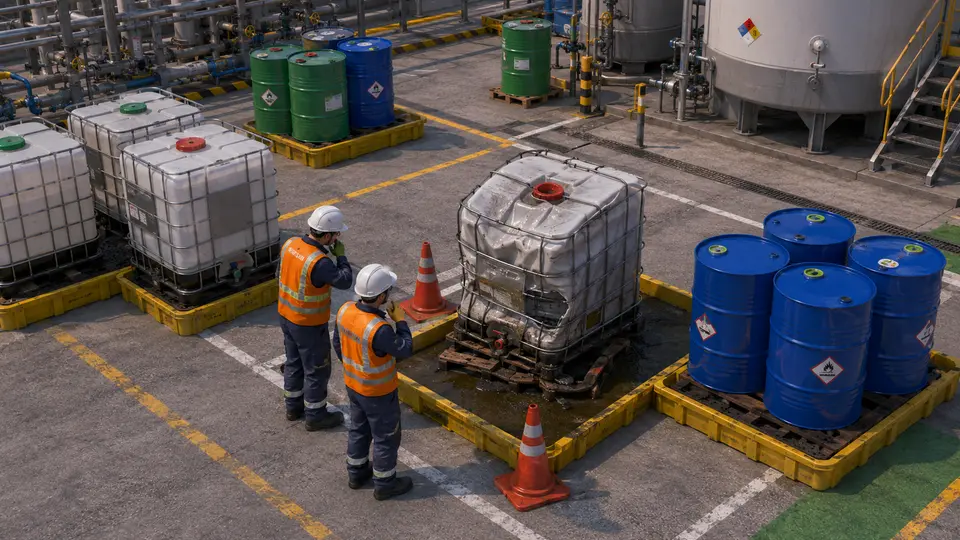
CAM-305The IBC has sagged onto a broken pallet and is dripping on the floor
«Tell me if any drum or IBC in the yard turns up deformed, on a broken pallet or with liquid underneath.»
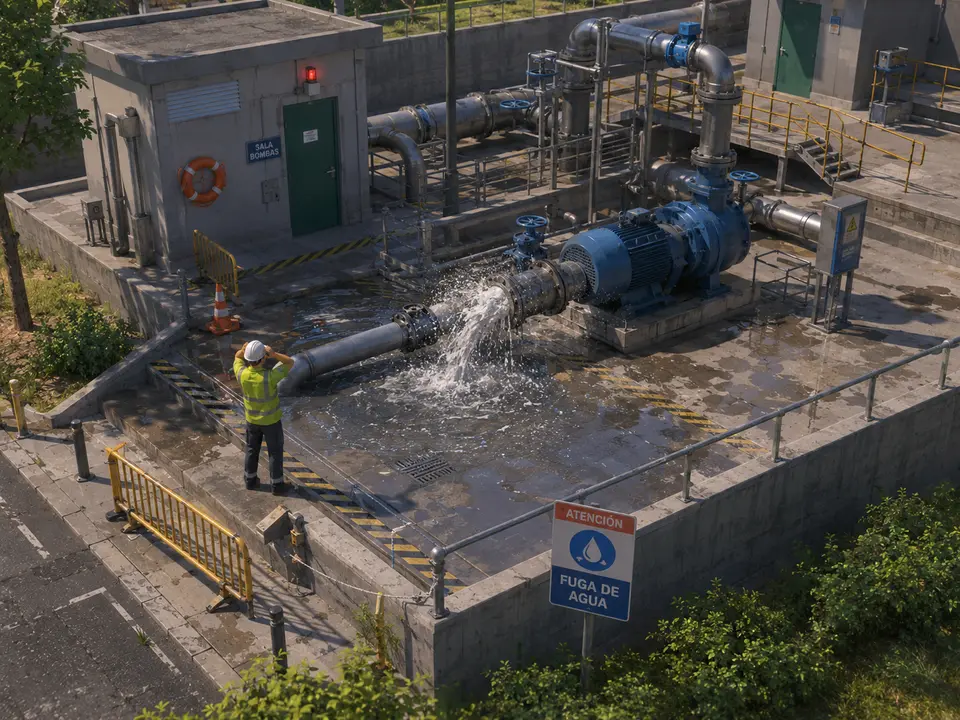
CAM-404A jet is spraying from the flange and the puddle keeps growing
«Tell me if a jet sprays from a joint or a puddle grows around a pump.»

CAM-74Half the shop floor in the dark
«Tell me if the lights go out in one part of the floor and tell me which part, even if the rest of the store is still lit.»
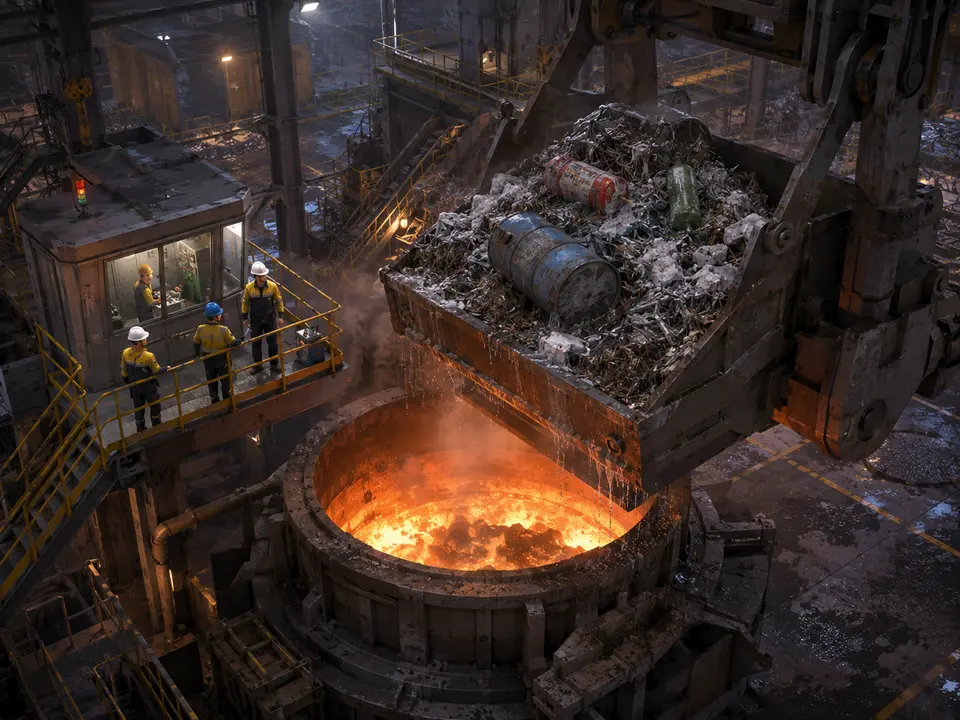
CAM-362Snow and closed drums in the basket, still hanging over the furnace
«Tell me if there is snow, ice or a closed drum in the basket, and tell me before the crane takes it over the furnace.»


What it does not do
IRIS does not know what the liquid is. It sees a growing stain and a floor that has changed colour; whether that is water, oil or product is said by the person who goes to look, not by the picture.
It also cannot see what is out of sight: a leak inside a cabinet, under a tank or in a buried pipe appears on no camera. And it does not replace bund sensors or process instrumentation: it is added to them.
Questions
- Can it tell water from a chemical?
- No, and that should be said before anyone asks. A camera sees that the floor has got wet and that the stain is growing; it analyses nothing. That is why the rule is written by place and not by liquid: if the floor of the chemical yard has to be dry, anything wet there is worth an alert, whatever it is. The person who goes to look decides whether it is rainwater or something that has to be contained.
- Does it detect a small drip?
- It depends on how big it is in the image, and it is more honest to explain that than to promise. A few drops on concrete from a camera ten metres away are invisible. A puddle growing under a pallet is not. A jet coming out of a joint and arcing over the pipework is not either, and it shows up straight away. If the spot is critical and the drip is fine, the answer is not to push the camera: it is to move it closer.
- Can it tell how long it had been leaking?
- Yes, and it tends to be the most appreciated part. The alert carries the time the stain became visible and the video of that moment, so the answer to «since when?» stops being an estimate. That is useful for the internal report, for the insurer and for the conversation with the authorities. It does not make the leak a smaller problem, but it does turn an argument without data into one with images and times.
- Do we need to change the cameras in the yard?
- Not necessarily. If the ones you have show the floor around the equipment in enough detail, they will do. The usual problem is not the camera, it is the framing: many are set up to watch the gate or the fence line, and the yard floor is far away or seen at a glancing angle. In that case you move one or add one, and it is usually a single camera per critical spot, not a rebuild of the installation.
Every simulation
Something has spilled
Tell me if there is liquid or foam outside its place and it is still there two minutes later.
- The sentence
- Where it applies
- What it finds
- The same rule
Not seeing yours here?
These words are the ones we have built, not the ones IRIS understands. The list falls short on purpose: you ask for it in a sentence, and sentences do not run out. Tell us what is in front of your cameras and we will tell you whether it understands it, or not yet.
And the best part
Finding something in yesterday’s videoshould take as long as asking for it.
No more scrubbing back through six hours with your finger on the mouse. You type what you are after, in plain words, and the matching moments come up. Same cameras as always.
Tell us your problem and we will say whether IRIS understands it, or not yet.
We reply the same working day.