Solutions by typeMobility analysis
When does a lot of people stop being busy and start being a problem?
By the time it is full, you are late
Eight twenty-five, half an hour before the gates open. The people who three minutes ago were spread across the forecourt have converged into a solid block that narrows towards the gate. Twenty paces back you can still walk normally. At the front, not any more. Nobody has done anything strange: they simply all arrived at once, and the gap they have to pass through is the same one as always.
5 cameras across 5 sectors
What IRIS is
IRIS watches the cameras for you.
IRIS Neural is an artificial intelligence that watches the cameras you already have and understands what happens in front of them. When something important happens —or something you told it you need to keep an eye on—, it alerts you; and whatever can be counted, it counts in numbers. All day long, without anyone having to watch a screen.
You tell it what you need to watch, and IRIS does it.
Works with the cameras you already have. Nothing to replace.
A person replies, not a form.
- Your footage never leaves your premises.
- It doesn't identify people.
- Certifications →
This is how you ask for it
«Alert me when there are more than four people per square metre in front of a gate and the group has not moved for two minutes.»
Capacity is controlled by counting entries, and that says nothing about where people are once inside. There can be plenty of room in the venue and a dangerous pinch point in front of one gate. By the time the control room can see the problem there is no manoeuvre left: you cannot open a new access or divert anyone, because moving needs space and there is none. What is left is shoving, people going down and a report to write.
You decide once
You decide this once, and it is decided by whoever signs the safety plan. You say which zones are measured, how many people per square metre is a warning and how many is an alarm, how long without moving counts, and who is called at each level. IRIS applies it at every concert, every trade fair and on every camera looking at that forecourt, with nobody having to remember the number.
Density is one of the few things you cannot judge by eye. A square with two hundred people can be perfectly calm or about to have a problem, and the difference is not how many there are: it is how many fit where they are, and whether the group is moving or has stopped. A platform packed wall to wall with people walking towards the exit is a normal evening. The same platform, the same people, and the stair queue at a standstill, is something else entirely.
So two things are measured here at once: how many people there are per metre, and whether that metre is moving. The first alone is misleading. The second alone says nothing. Together they give the alert that is worth having, and above all they give it early: not when nobody else fits, but while it is filling, which is the only moment when something can still be done. Open the second gate, hold people back on the stairs, send two staff to the mouth of the corridor.
And here nobody is doing anything wrong. That is the hardest part to explain and the one that matters most: the camera is not looking for anyone. It does not identify, does not recognise faces and keeps no track of who is who. What it sees is a surface, how much of that surface is occupied, and how that changes from one minute to the next. The result is a number, and a number has no names.
What changes
Before, the decision to open another gate came from someone looking at a screen and saying «that looks bad». They were often right and just as often late, and afterwards it was impossible to explain why it was done. Now there is a written threshold, an alert when it is crossed and the video of the minute it was crossed. The decision is still a person’s, but it stops being a hunch.
Where we have seen it
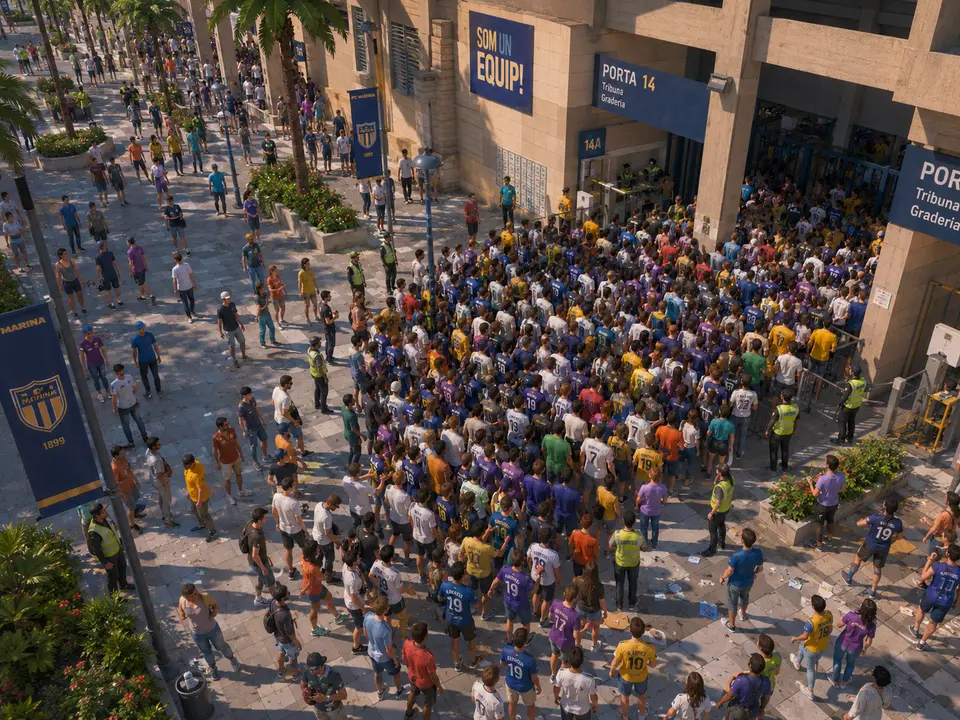
CAM-483More people per square metre than three minutes ago, and nobody moves
«Tell me when there are more than four people per square metre in front of a gate and the group has not moved for two minutes.»
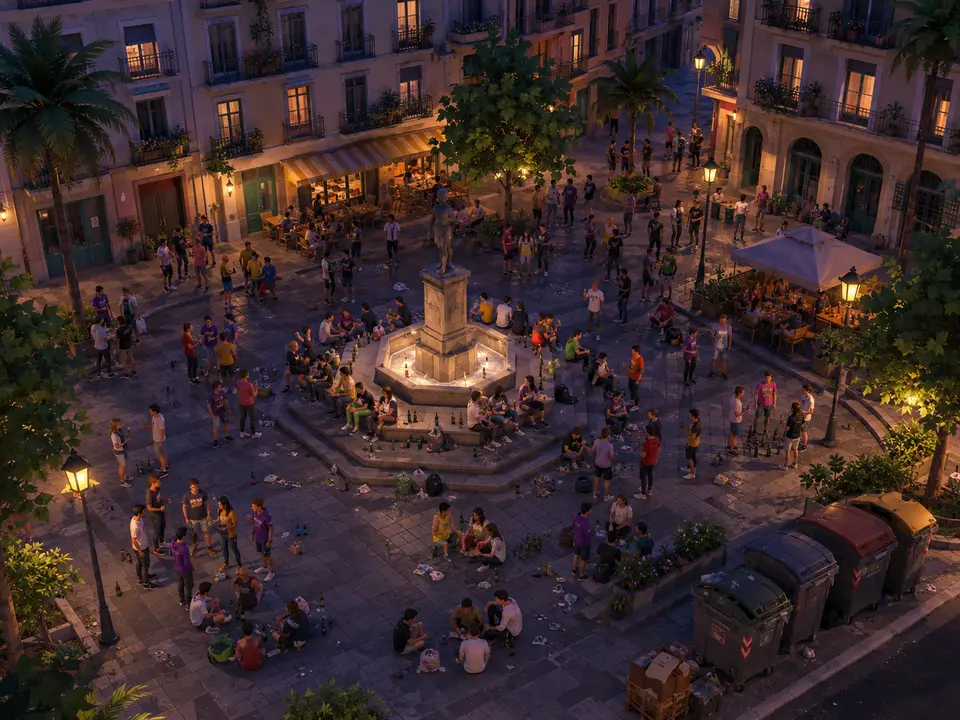
CAM-22Night gathering in the square
«Tell me if people gather in the square above the threshold at night, and how full the bins are.»
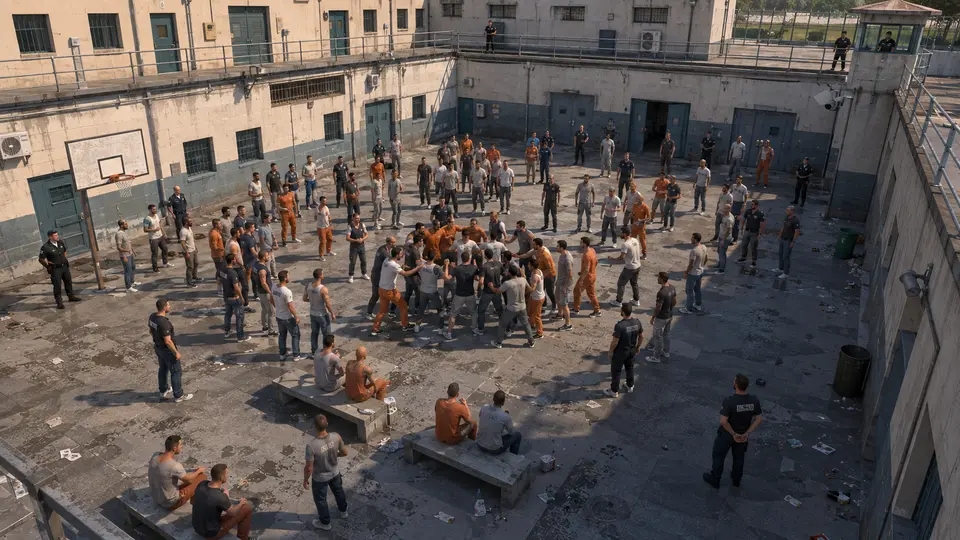
CAM-103A ring closes in the yard
«Tell me when the people in the yard stop being spread out and all bunch up in one spot, because a closed ring hides what is inside it and you can't see in from the tower.»
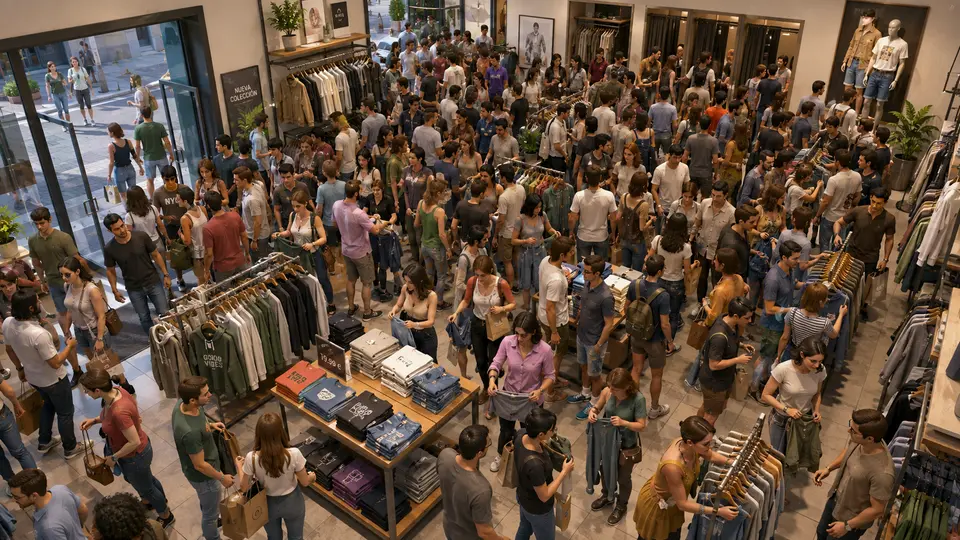
CAM-71Shop floor over capacity
«Tell me when the floor gets so full that people can't get between the rails, and tell me while it is filling up, not once nobody else fits.»
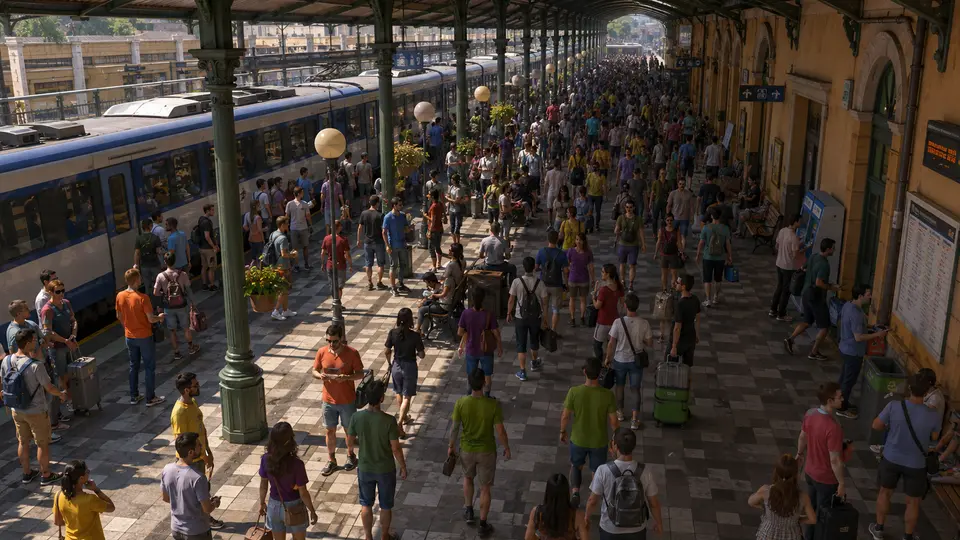
CAM-83Platform over capacity
«Tell me when a platform fills up so much that people can no longer step back from the edge.»


What it does not do
This does not count heads one by one in a crowd, and saying so matters. It measures how much space is taken and how that changes, so it gives a density, not an exact census. With a very high or very oblique camera the figure loses accuracy, and that is checked before any threshold is set. And it decides nothing: it warns that an area is closing up, and whoever orders a hold, an opening or an evacuation is the responsible person.
Questions
- Does it count exactly how many people are there?
- No, and it matters to understand that before setting a threshold. In a compact crowd people hide one another, and no honest system can say there are four hundred and twelve rather than three hundred and ninety-seven. What is measured is density: how much of that surface is taken up by people, and how it changes minute by minute. To decide whether to open another gate, that is exactly what you need. If what you need is an exact headcount, that is done by counting entries on a line, which is a different camera and a different way of asking.
- Why alert before it is actually full?
- Because once it is full there is nothing left to do. Diverting people takes space, and space is exactly what is missing when the alert arrives late. That is why the rule has two parts: the density and the time without moving. A tight group that is moving dissolves on its own; a tight group that has been still for two minutes is the one that turns into a problem. Alerting at that point is what buys the margin to open an access or hold people on the stairs.
- Does it identify anyone in the crowd?
- No. IRIS does not recognise faces, does not identify people and does not follow anyone around the venue. On this camera it does not even need to: what it looks at is a surface and how much of it is taken. The result is a number per zone, and a number has no names. If someone asks what is kept, the answer is the usual one: the video that was already recording, and the record of when the threshold was crossed. Nothing more, and nothing about who was there.
- Is it useful for the safety plan?
- Yes, and that is where it is used most. A plan sets capacities and action levels, and until now checking whether they were being met depended on someone watching the right screen. With the thresholds written down, every crossing leaves the time, the zone and the video, so afterwards you can show what was known and when. The person deciding is still the plan’s owner: IRIS gives them the alert in time and the proof that they had it.
Every simulation
Something has spilled
Tell me if there is liquid or foam outside its place and it is still there two minutes later.
- The sentence
- Where it applies
- What it finds
- The same rule
Not seeing yours here?
These words are the ones we have built, not the ones IRIS understands. The list falls short on purpose: you ask for it in a sentence, and sentences do not run out. Tell us what is in front of your cameras and we will tell you whether it understands it, or not yet.
And the best part
What happens outside the framedoes not exist for IRIS. No camera sees the whole world.
So the first thing we do is check what each camera covers and write it down: from here you can understand this, and not that. A dull hour that saves a lot of misunderstandings.
Tell us your problem and we will say whether IRIS understands it, or not yet.
We reply the same working day.