CAM-285
A pink carton moving among identical blue ones
Mid-afternoon in the cartoning room. Identical blue cartons move along the belt, one after another. Among them travels a pink carton, from a different presentation. An operator in blue coveralls, hood, mask and gloves has picked a carton off the belt and is looking at it closely. At the head of the run a colleague takes notes on a tablet. Further back, a third one works the cartoner screen. IRIS sees that one pack does not look like the rest and flags it as it goes by.

Turn on IRIS Vision
AI-generated image
What IRIS is
IRIS watches the plant for you.
IRIS looks at the cameras you already have on the plant floor and understands what it sees: a stopped line, someone inside a robotic cell, someone without their safety gear on, jammed parts. When something like that happens, it alerts right away; and whatever can be counted, it counts in numbers. All day long, with no one needing to watch the screen.
You tell it what you need to watch, and IRIS does it.
Here, for example, IRIS sees that one box doesn't match the rest on the belt and alerts you while it's still going through, with the exact time and the video of that stretch. That way you know right away, not at the end-of-batch review or, worse, once the product has already left the building. With that alert you decide whether to pull one unit or stop the line to check the whole batch.
Works with the cameras you already have. Nothing to replace.
A person replies, not a form.
- Your footage never leaves your premises.
- It doesn't identify people.
- Certifications →
What IRIS understands
What it recognises in this scene
- carton unlike the rest of the batch
- identical cartons of the batch in progress
- operator checking a carton
- operator taking notes on the tablet
- cartoner at the end of the run
What this camera measures
An alert says something is happening. The reading says how much.
- 1Odd cartons counted
- 46Cartons on the run
- 35 sTime in shot
- 3People in shot
- 16:05Time of the alert
The figures on this screen are an example from the illustration, not any client's measurement.
The rule
You decide once. IRIS applies it always.
If
a pack goes down the cartoning belt that does not match the batch pattern
Then
- alert the line manager with the camera, the time and the image of the carton
- save the video of the run from the moment the carton entered the shot
- leave the alert on the batch record for the later review
The instruction that set it up«Tell me if a carton goes down the cartoning belt that is not like the ones in the batch we are running.»
What changes
What changes for whoever answers for the plant
Mid-afternoon, and the pink carton has been travelling among identical blue ones for forty seconds. A crossed-over carton reaches the packaging supervisor late: at the end-of-batch review, or worse, when the product has already gone out of the door. With the camera he gets the alert while the carton is still on the belt, with the exact time and the video of that stretch. With that he decides whether to pull one unit or to stop and check the whole batch. The difference between the two is usually a few minutes.
What people usually ask
Does IRIS read what the label says?
That is not what it does here. IRIS sees that one pack does not look like the others on the belt: different colour, different size, different presentation. That difference is what triggers the alert. Checking that the printed dose, language and batch number are correct is the job of the line coding control and of the person who inspects the carton. The camera contributes the image and the exact minute.
What if the right carton and the wrong one look the same outside?
Then the camera does not see it, and that has to be said plainly. IRIS detects what stands out in the image: colour, format, orientation, a leaflet that should not be there, an open carton. If two presentations are identical outside and only a printed number differs, the line coding control has to resolve that. The camera does not replace that control: it puts the image and the time alongside it.
Does the camera identify the operator who put the carton there?
No. IRIS does not recognise faces and does not store who anyone is. What it records is that a different carton entered the belt at a specific time and at which point of the run. Who was there and what happened is decided by a person watching the video, and the plant governs that review with its own rules. The camera detects situations, not identities.
Other cameras
- CAM-280 · Through the gowning room with no mask and street shoes on
- CAM-281 · Both airlock doors open at the same time
- CAM-282 · Eight people in the room and the routes crossing
- CAM-283 · The previous batch is still on the table
- CAM-284 · A green-lidded drum where it does not belong
- CAM-286 · A quarantine pallet sitting on the released zone line
See it for yourself
A new case each time. Always the same screen.
It plays by itself and shows one case from start to finish. It is a summary: the real screen has far more functions than fit in this box.
- The hour, as a grid
- You look where it's dark
- You jump to that minute
See it somewhere else
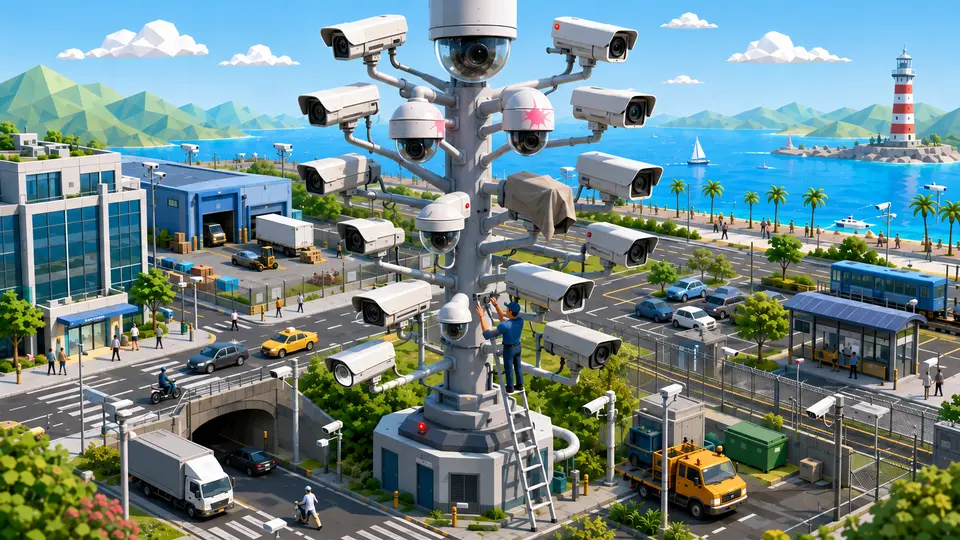
And who watches the cameras?
34 cases, and in every one of them IRIS raises an alert when something happens. You see each image as it is, and then with what it understands on top.

Who watches the cameras of a whole city?
23 cases: 18 raise an alert when something happens and 5 only measure. You see each image as it is, and then with what IRIS understands on top.


And the best part
Video is late by definition:you watch it once the thing has already happened.
IRIS tells you while it is happening, with the camera, the time and what it saw. Arriving in time changes the end of almost any story, and no new cameras are needed for that.
Tell us your problem and we will say whether IRIS understands it, or not yet.
We reply the same working day.