CAM-559
Someone on the floor and an aisle you cannot get through
At the end of the aisle there is a person lying still on the floor. Between them and the rest of the hall a cart is standing across the way, leaving seventy centimetres to get past, and halfway along a raised-floor tile is lifted with the opening exposed. At the other end, the containment door of the aisle is open and somebody is holding it while working. A second person is already heading for the far end. IRIS sees all four things at once and puts them in order: first, the person who is not moving.

Turn on IRIS Vision
AI-generated image
What IRIS is
IRIS guards the data centre for you.
IRIS is an artificial intelligence that looks at the cameras you already have and understands what's happening at entrances, rooms and racks. If someone gets in without authorisation, two people slip through on one badge, or something you want to track happens, it alerts you right away; and whatever can be counted, it counts in numbers. All day long, without anyone having to stare at a screen.
You tell it what you need to watch, and IRIS does it.
Here, for example, IRIS puts four things in order at once, in the same aisle: someone has been lying still for almost a minute at the far end, the way through is down to seventy centimetres because of a cart, and there's an open gap in the floor halfway along. The alert arrives with that order and the picture, so whoever responds knows how to get in before they go in. The camera doesn't measure temperature — the sensors do that — but IRIS gives you the exact time the door was opened and why.
Works with the cameras you already have. Nothing to replace.
A person replies, not a form.
- Your footage never leaves your premises.
- It doesn't identify people.
- Certifications →
What IRIS understands
What it recognises in this scene
- person motionless on the floor
- cart narrowing the way
- open hole in the raised floor
- lifted floor tile
- containment door held open
- person holding the door
- person heading to the far end
- aisle beacon lit
What this camera measures
An alert says something is happening. The reading says how much.
- 48 sMotionless for
- 1People heading over
- 0,70 mClear width to the far end
- 3 minContainment door open for
- 04:02:11Video starts at
The figures on this screen are an example from the illustration, not any client's measurement.
The rule
You decide once. IRIS applies it always.
If
a person has been lying still on the floor of a hall for more than thirty seconds
Then
- alert the medical service and the duty shift with the hall, the aisle and the time
- say whether anything narrows the way or there is an open hole on the route
- save the video from one minute before the fall
The instruction that set it up«Tell me if somebody has been still on the floor of a hall for more than thirty seconds, and tell me whether the aisle to them is clear.»
What changes
What changes for whoever answers for physical security on site
Four facts in one aisle, and none of them is odd on its own: carts get left, tiles get lifted, doors get held. What changes is the order in which they have to be dealt with. The alert arrives in order: somebody has not moved for almost a minute at the end of the aisle, the way there is down to seventy centimetres, and there is an open hole in the floor halfway along that anybody running can fall into. With that, whoever responds knows how to get in before going in, and whoever calls the emergency services knows what to tell them. Last on the list is the thermal part: the open door lets the cold air out. How much the temperature rises is not measured by a camera, it is measured by the building's sensors; what IRIS adds is the exact time the door opened and why, so that reading has an explanation with pictures.
What people usually ask
Does IRIS say what has happened to the person?
No, and it is not going to. IRIS does not diagnose: what it sees is that there is a person lying still where nobody lies down, and how long they have been like that. Who that person is it does not know either, and does not need to. What it delivers is a place, a minute and a live picture, so that the people who do know what to do get there sooner. In a big hall with few people in it, that 'sooner' is the whole difference.
And do the cart, the floor hole and the open door raise their own alerts?
Yes, each has its own rule and its own urgency: a cart in the middle of an aisle is a note, an unguarded open hole is a warning, a containment door left open a long time is another. What this camera does is that, when they coincide with a person on the floor, they stop being three loose notes and become one single thing: the way through to whoever needs help. That is the order, and that order is decided once and applied every time.
Does IRIS measure how much the temperature rises with the door open?
No. An ordinary camera does not measure temperature, and saying otherwise would be a lie. The building's sensors measure that, and they are already installed. What IRIS adds is the other half: what time the door opened, how long it stayed open and what was being done in that aisle. When the manager sees a temperature spike on the graph, instead of an unexplained hour there is a three-minute video that explains the whole thing.
Other cameras
- CAM-547 · Two people go through and only one showed a badge
- CAM-548 · Both of them inside the airlock, inner door still open
- CAM-549 · Someone alone in an aisle where nobody goes unescorted
- CAM-550 · A wooden wedge holding the hall door wide open
- CAM-551 · It looks like routine maintenance, and it probably is
- CAM-552 · The cabinet was left open and nobody is standing at it
The real interface, step by step
Everything comes in. Only what matters gets through.
This sums up what IRIS does with one alert, from the moment it appears until it is closed. The real screen holds far more; this is the main thread.
- Cameras on the map
- You draw an area
- What passed shows up
See it somewhere else

Who is watching when the load swings over somebody?
11 cases: 9 raise an alert when something happens and 2 only measure. You see each image as it is, and then with what IRIS understands on top.
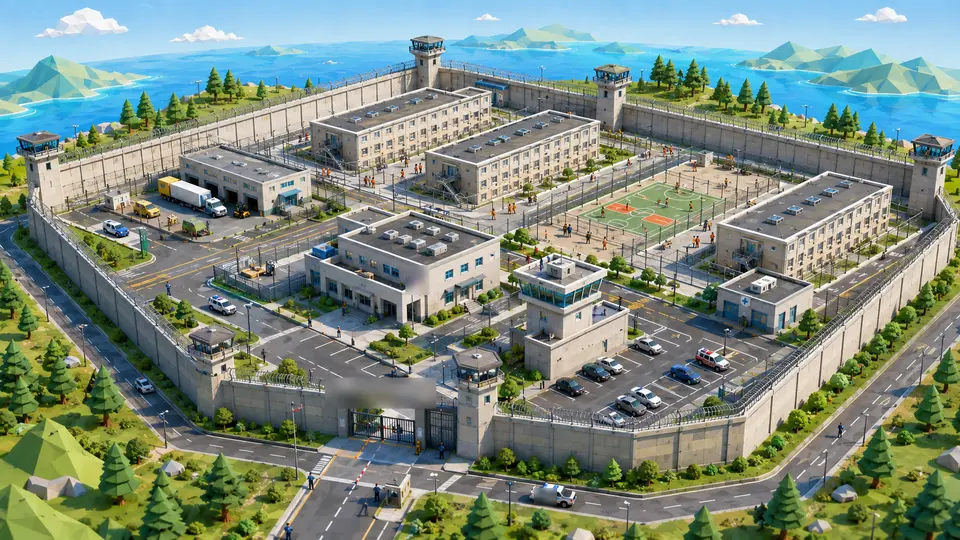
Who is watching the yard screen when the fight starts?
17 cases: 16 raise an alert when something happens and one only measures. You see each image as it is, and then with what IRIS understands on top.


And the best part
Video is late by definition:you watch it once the thing has already happened.
IRIS tells you while it is happening, with the camera, the time and what it saw. Arriving in time changes the end of almost any story, and no new cameras are needed for that.
Tell us your problem and we will say whether IRIS understands it, or not yet.
We reply the same working day.