Solutions by typePersonal safety
What if today someone has to get through there fast?
The cart has blocked the door for twenty minutes
It’s 11:15 a.m. in the second-floor hallway of a hospital. An empty gurney has been left across a double door while the transporter goes in for a patient. He leaves by the other door and never comes back for it. The next four people to pass turn sideways to squeeze through the gap. The gurney has been there for twenty minutes and nobody has moved it out of the way.
5 cameras across 4 sectors
What IRIS is
IRIS watches the cameras for you.
IRIS Neural is an artificial intelligence that watches the cameras you already have and understands what happens in front of them. When something important happens —or something you told it you need to keep an eye on—, it alerts you; and whatever can be counted, it counts in numbers. All day long, without anyone having to watch a screen.
You tell it what you need to watch, and IRIS does it.
Works with the cameras you already have. Nothing to replace.
A person replies, not a form.
- Your footage never leaves your premises.
- It doesn't identify people.
- Certifications →
This is how you ask for it
«Tell me when something is left standing in front of a through door and nobody has moved it for a few minutes.»
Nobody complains, because everyone fits through sideways. The cost turns up the day somebody has to get past fast: a crash gurney that won’t go through the door, a wheelchair that has to go around by the other hallway, two minutes lost in the worst possible place. In a prison gallery the cost is the same in different clothing: the team that has to get there finds furniture in front of the gate.
You decide once
The hospital decides once which doors must stay clear and how long is tolerable. If something’s left standing in front of one of those doors, for more than five minutes, and nobody’s beside it moving it, then the floor desk is alerted with the camera and the time. It’s decided in one meeting and applies on all four floors and all three shifts, without anyone having to remind anybody every morning.
A walkway doesn’t get closed out of ill will. It gets closed because a hallway has nowhere to put anything and all the kit has to go somewhere. A gurney, a dressings cart, a linen cage, a pallet of sacks in front of a gate. Because it’s work material, nobody counts it as an obstacle: they count it as work. And because everyone fits through sideways, nobody raises a hand.
The day it goes wrong, the person in a hurry doesn’t fit. A crash gurney is wide and doesn’t turn sideways. A team entering a gallery has its hands full. In a hallway between reactors, two people carrying an injured colleague can’t get through a gap that takes one person in profile. Those two minutes appear in no report, and they’re exactly the two minutes everyone was trying to save.
IRIS watches the gap that has to stay clear and counts the time. If something stays there longer than agreed, it says so with the camera and the hour, and if it’s still there ten minutes later, it says so again. None of this is urgent the day it happens. All of it is urgent the day it matters, and by then it can’t be fixed.
What changes
Before, the walkway got cleared when somebody complained. There was no way of knowing whether that door was blocked once a month or four times a day, and since the material was work kit, nobody logged it as an incident. Now an alert arrives after five minutes with the photo, and by the end of the month you can see which doors are always blocked and at what hour. It’s nearly always the same one, and nearly always about where the kit is stored.
Where we have seen it
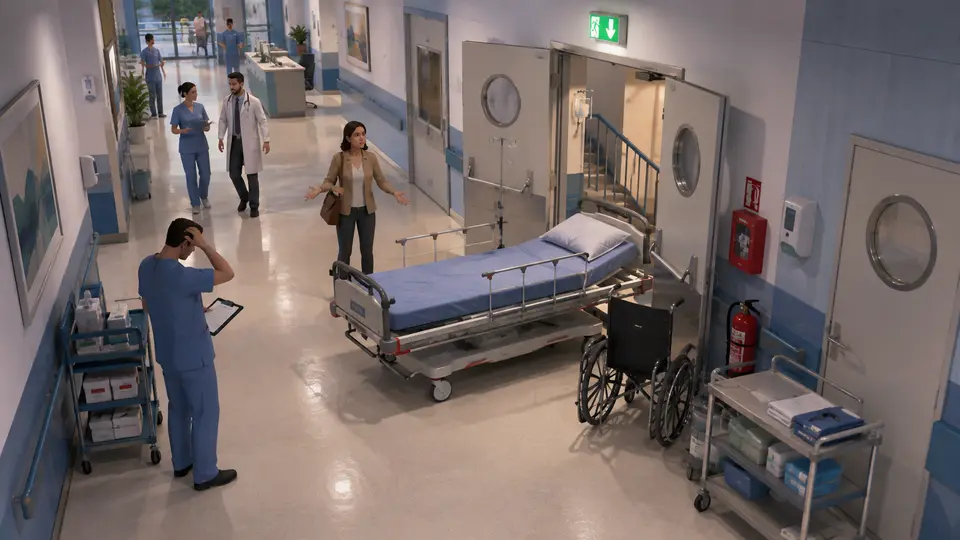
CAM-123A bed left blocking the way
«Tell me when something is left standing in front of a doorway and nobody has moved it within a few minutes.»
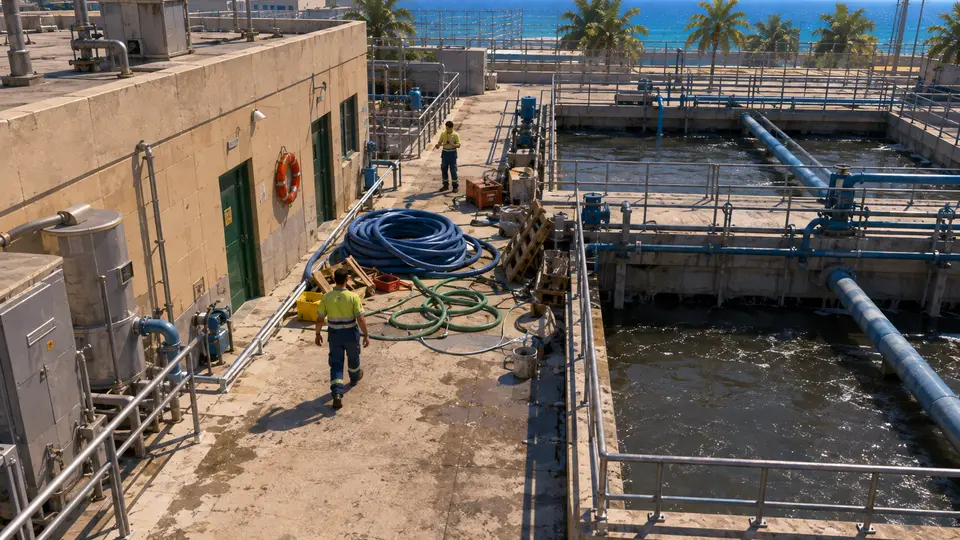
CAM-157Blocked walkway between the reactors
«Tell me if the walkway between the reactors is left with less clear width than we need, and do not let it slide just because it is work kit.»
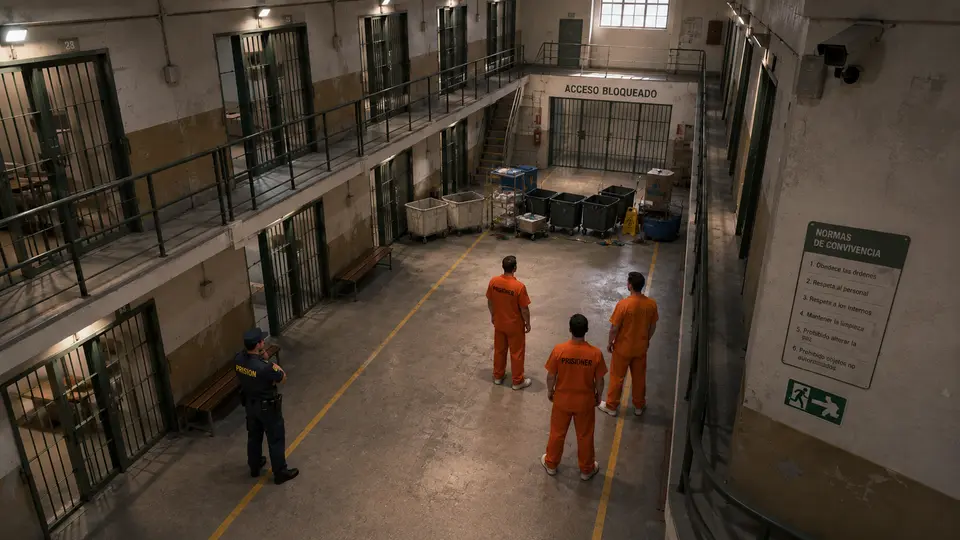
CAM-101Blocked access on the landing
«Tell me if anything is left in front of a door or a barred gate and stays there, because that is the way we have to get through.»

CAM-483Less room per person than three minutes ago, and nobody moves
«Tell me when each person in front of a gate has less than three square feet of room and the group has not moved for two minutes.»


What it doesn’t do
IRIS does not measure in inches the clear width the rules require, and it does not know whether the thing in the way is essential there. It sees that the marked area is occupied and it counts the time.
Nor can it tell a gurney in active use from an abandoned one, beyond whether somebody is moving beside it. That is why the rule uses minutes rather than a switch.
Questions
- Is this the same as a blocked fire exit?
- No. A fire exit is needed the day of an evacuation, which almost never comes. A walkway is needed every day: gurneys, food carts, maintenance teams and whoever has to get there fast all go through it. That’s why the time margin is usually shorter and the alert goes to the floor itself rather than to the safety department. Two similar rules with two different recipients.
- Does it alert even when the obstruction is work material?
- Yes, and that’s exactly the case worth catching. Almost nothing that blocks a walkway is trash: it’s gurneys, carts and pallets that somebody needed at some point. That’s precisely why nobody removes them and nobody logs them. The rule does not judge what the object is, only whether the gap that must stay clear has been occupied too long. The rest is decided by someone who knows the floor.
- Does it measure the clear width your own rules call for?
- No. IRIS works on an area you have drawn on the image and reports whether it’s occupied and since when, not how many inches are left. Measuring the clear width a regulation demands is a job for a person with a tape measure, and it stays that way. What IRIS adds is that the check stops being a once-a-month event: the area is watched every day and it flags the same day it narrows.
- Does it work in a prison gallery or a hallway between reactors?
- Yes, and those are two of the places where it shows most. In a gallery, whatever is left in front of a gate sits exactly in the path of the team that has to get in, which is why the rule usually asks for an immediate alert rather than one after ten minutes. In a hallway between reactors, work material piles up without anyone deciding it, and the same rule keeps the passage clear without depending on the weekly round.
A different case every time
Watch what happens. Then watch what IRIS does with it.
Not a recorded video and not a drawing: it’s a summary of the real tool, with a different case each time round. The whole tool doesn’t fit in a box.
- You ask
- IRIS searches
- It shows you
Not seeing yours here?
These words are the ones we have built, not the ones IRIS understands. The list falls short on purpose: you ask for it in a sentence, and sentences don’t run out. Tell us what is in front of your cameras and we’ll tell you whether it understands it, or not yet.
And the best part
Counting isn’t watching over anyone.It’s knowing how many went through, and when.
It’s what lets you compare: two Tuesdays, two doors, two seasons. Because it’s measured the same way every day, the comparison stands on its own.
Tell us your problem and we’ll say whether IRIS understands it, or not yet.
A person answers, the same working day.