Solutions by typePersonal safety
How long has that hole been open with no barrier?
An open hole and not one cone
It is 20:05 on a street in an industrial estate. A manhole cover is propped on edge against the kerb and the hole has been open since mid-afternoon. The crew has moved on to another fault and the cone stayed in the van. In an hour it starts to get dark, and the afternoon shift will come down that pavement with their eyes on their phones. And not one street light has come on yet.
3 cameras across 2 sectors
What IRIS is
IRIS watches the cameras for you.
IRIS Neural is an artificial intelligence that watches the cameras you already have and understands what happens in front of them. When something important happens —or something you told it you need to keep an eye on—, it alerts you; and whatever can be counted, it counts in numbers. All day long, without anyone having to watch a screen.
You tell it what you need to watch, and IRIS does it.
Works with the cameras you already have. Nothing to replace.
A person replies, not a form.
- Your footage never leaves your premises.
- It doesn't identify people.
- Certifications →
This is how you ask for it
«Tell me if a manhole cover turns up out of place and nobody has put a cone around it.»
Someone puts a leg through a spot they have walked over for twenty years. A broken ankle and a face against an iron rim. Then comes the expensive part: the claim, the insurer’s report and the photo somebody took on their phone, in which you can see perfectly well that there was no barrier and no cone. Defending that takes months, and in most cases it cannot be defended at all.
You decide once
The decision is made once, at a desk, and it holds for the whole city. If a cover turns up out of place, for more than ten minutes at a stretch, and there is no barrier and no cone around it, then the duty crew is alerted with the camera, the exact spot and the time it was opened. Those ten minutes exist so as not to nag while a crew is working beside it.
An open manhole is not dangerous because it is open. It is dangerous because it is open and not visible. The barrier and the cone are the only things that turn a hole into an obstacle people step around without thinking. They are also the first things left in the van, because putting the signing out costs five minutes and taking it in costs another five, and the next fault is already waiting.
The day it goes wrong, the person who falls is always someone who walks that way every day. Nobody looks at the ground on a street they know. In a treatment plant it is the same with hatches: a chamber cover left open up on a gantry where nobody looks down, because there has never been anything to look at. Everyone walks straight past until one person does not.
IRIS knows what that spot normally looks like, because a manhole cover is one of the stillest things on a street: same place, every day, every hour. When it sees the iron out of its seat, it counts the time and checks whether anything has been placed around it. If ten minutes later there is still nothing, it says so. The hole takes a minute to open and twenty to forget. IRIS is the one that remembers.
What changes
Before, you found out in one of two ways: a neighbour phoning at ten at night, or a claim letter a month later. Now the duty crew gets an alert with the camera, the street and the exact time it was opened, and can send someone to put a barrier up before dark. And at the end of the month there is a list of which points get left open most often, and it is almost always the same four.
Where we have seen it
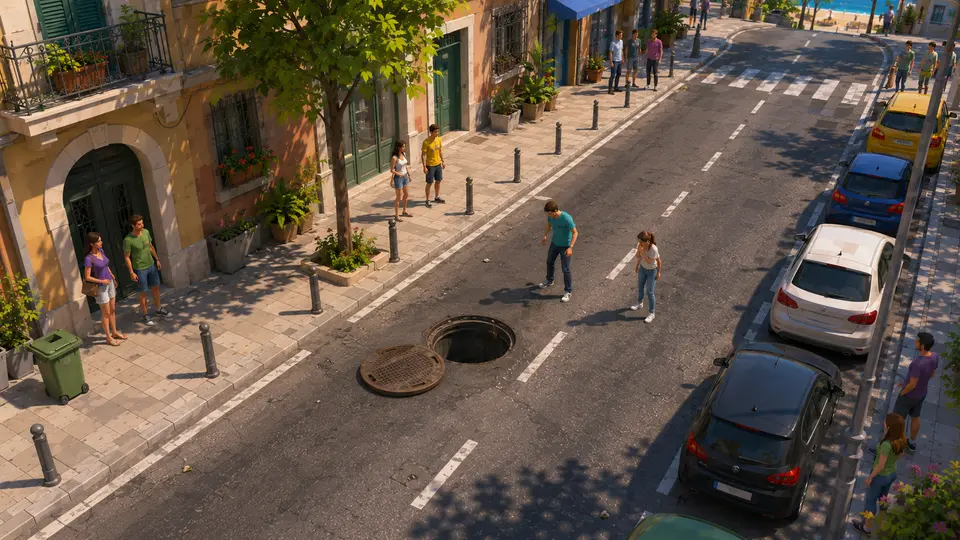
CAM-171An open manhole with nothing around it
«Tell me if a manhole cover turns up out of place and nobody has put a cone around it.»
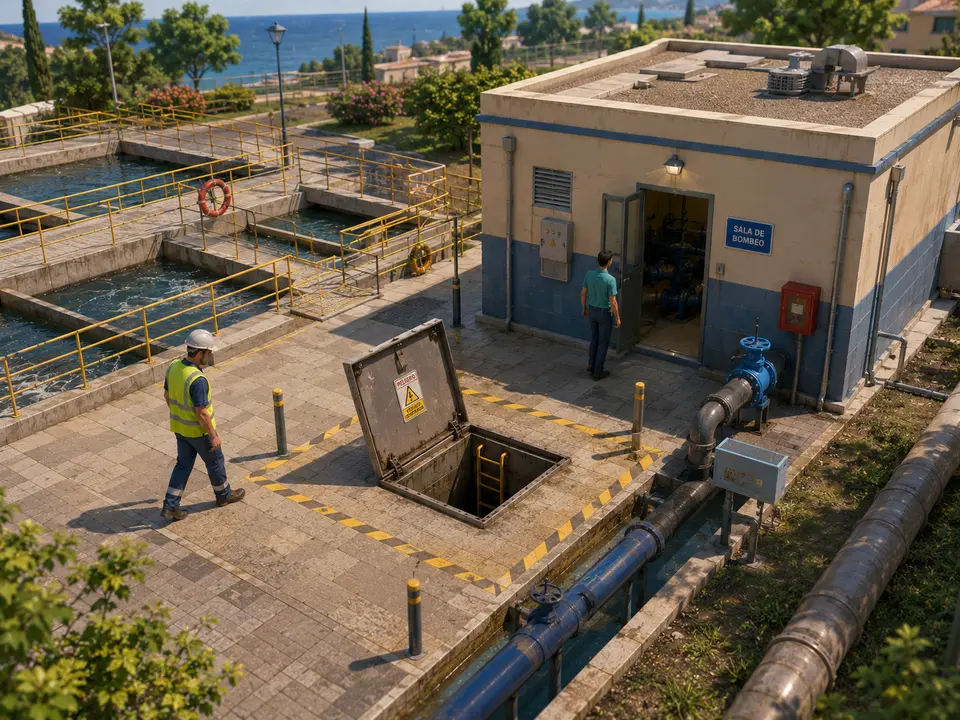
CAM-409An open hatch and everybody walking straight past
«Tell me if a hatch or a door is left open for more than twenty minutes with nobody beside it.»
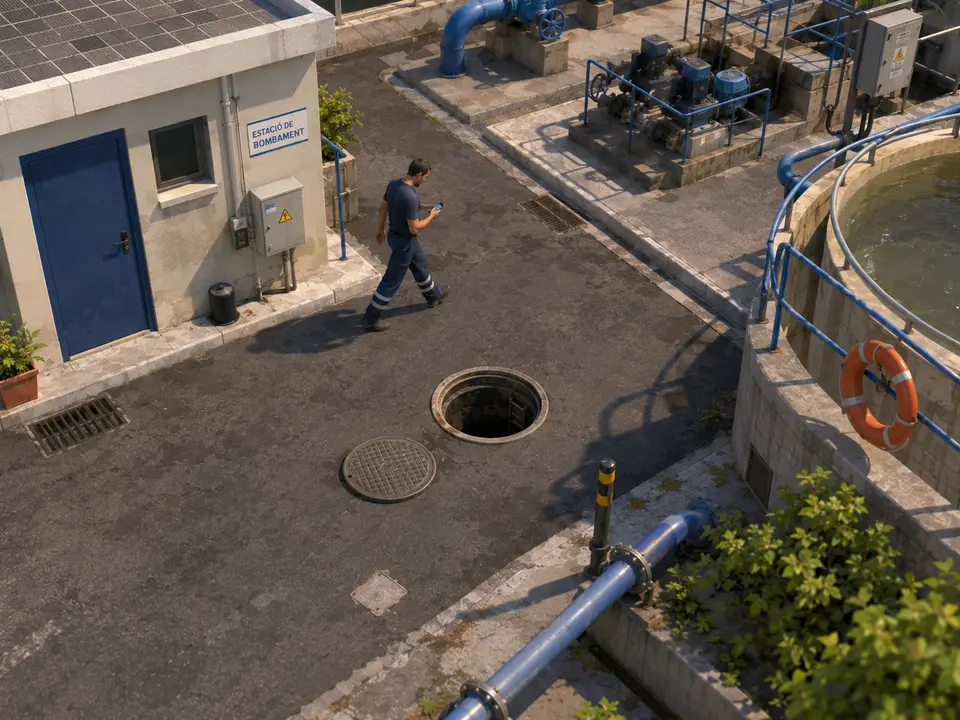
CAM-414An open chamber in the middle of the walkway, no barrier, no sign
«Tell me if a chamber has been open for more than ten minutes with no barrier around it.»


What it does not do
IRIS does not tell certified signing from a bucket placed on top, and it does not know whether the works are authorised. It sees the cover out of place, counts the time and checks whether anything has been placed around it.
And it depends on light: on an unlit street at night, an ordinary camera sees very little. If that spot has no light, the honest thing is to say so before setting the rule.
Questions
- Does IRIS know when a cover is out of place?
- Yes, because a manhole cover is one of the stillest things on a street: same spot, every day, every hour. When IRIS sees the cover lifted, propped against the kerb, or the black gap where the iron should be, it knows the scene has changed. You do not have to describe the cover to it: it is enough that today does not look like every other day at that particular point.
- Does it alert as soon as the manhole is opened?
- No, and that is deliberate. Opening a manhole is normal; leaving it open is not. While a crew is working around it, the hole is supervised and there is no reason to bother anyone. The problem appears when the crew leaves and the hole stays. That is why the sentence has a time in it: ten or twenty minutes open with nobody beside it, and then yes, an alert.
- Does it also cover hatches and plant room doors?
- Yes, and it is the same problem in another shape. A tank hatch left open up top, a plant room door left ajar, a floor trap on a gantry. They all have one thing in common: somebody opened them for a good reason and nobody closed them. IRIS watches the cover, counts how long it has been like that and alerts when too much time passes with nobody in front of it.
- Can it tell proper signing from just anything put on top?
- No, and it is worth knowing that before relying on it. IRIS sees that something is around the opening: a cone, a barrier, a drum or a bucket. Whether that something meets the signing standard is not for a camera to judge. What it does solve is the case that actually hurts people: the open hole with absolutely nothing around it and nobody beside it.
See it for yourself
No extra alarms here. Just what needs looking at.
Not a recorded video, not an explanatory drawing: a summary of the real screen, with a different case every time it starts. There is a lot more behind it.
- You draw the line
- It counts by itself
- A number comes out
Not seeing yours here?
These words are the ones we have built, not the ones IRIS understands. The list falls short on purpose: you ask for it in a sentence, and sentences do not run out. Tell us what is in front of your cameras and we will tell you whether it understands it, or not yet.
And the best part
You decide once what matters to you.It stops depending on who happens to be on shift.
You say it in your own words and it stays written down. Nobody has to remember anything at the start of a shift: what you decided is already in place, and still there tomorrow.
Tell us your problem and we will say whether IRIS understands it, or not yet.
We reply the same working day.