Solutions by typeCustomer experience
How long has that dish been sitting under the heat lamp?
The dish is ready and still sitting at the pass
Half past nine, service at full tilt. The pass is lined with finished plates under the heat lamps. Five floor staff wait beside it: one picks up two plates, one looks towards the kitchen, the rest wait their turn. One dish has been there four minutes. Nobody has moved it because nobody has that table. By the time it goes out, the sauce will have split.
2 cameras across 1 sectors
What IRIS is
IRIS watches the cameras for you.
IRIS Neural is an artificial intelligence that watches the cameras you already have and understands what happens in front of them. When something important happens —or something you told it you need to keep an eye on—, it alerts you; and whatever can be counted, it counts in numbers. All day long, without anyone having to watch a screen.
You tell it what you need to watch, and IRIS does it.
Works with the cameras you already have. Nothing to replace.
A person replies, not a form.
- Your footage never leaves your premises.
- It doesn't identify people.
- Certifications →
This is how you ask for it
«Tell me when a dish has sat at the pass for more than two minutes and three or more floor staff are waiting.»
That dish goes out cold or gets remade. If it goes out cold, the guest does not complain: they pay, they leave, and that night they write a review two hundred people will read before booking. If it is remade, the kitchen loses the product and fifteen minutes at the worst moment of the shift, dragging every table behind it. And the head chef finds out the next day reading the review, not while a single sentence could still have fixed it.
You decide once
You decide it once: how many minutes are too many in your house, how much of the floor team has to be waiting for it to count as a real jam, and who gets told — the section head, the maître d’ or the kitchen screen. Two minutes on a set lunch is not two minutes on a long à la carte: you set the number, it does not come out of a box. IRIS applies it every service, every day, with nobody watching the clock at the pass while doing six other things.
The pass is where two teams that never see each other meet. The kitchen finishes a plate and leaves it under the lamp. The floor has to take it before it dies. When service is calm, a shout solves it. When forty covers land at once, the shout is lost: there is noise, there is the bell, there are five floor staff and every one of them assumes that plate belongs to someone else.
Nobody did anything wrong. The cook called the dish, the waiter was serving the next table, the maître d’ was at the door with a booking. The plate simply stayed there, and under a heat lamp a piece of fish lasts far less than a piece of meat. The problem is not that people are missing: it is that nobody can carry the clock of the pass in their head while doing six other things at once.
IRIS watches the pass and measures how long a dish has stood still. When it passes the limit you set and there is floor staff waiting too, it says so: which camera, how many minutes, and the video. Nobody has to drop what they are doing to go and check. And after a month something more useful than the single alert appears: what time your pass jams, on which days and with which menu. That is not fixed by running faster. It is fixed by changing a shift or taking a dish off the card.
And the next month brings the conversation that actually changes something. If the jam repeats on Thursdays between half nine and ten, always with the same part of the menu, the problem is not the shift: it is that three dishes take the same time and land together. Then you change a dish, you bring a prep forward, or you add half an hour of cover. None of those three decisions can be taken from the memory of a bad service, and all three are easy with four weeks of numbers in front of you.
What changes
Before, a jam at the pass surfaced through a complaint at a table or a two-star review written at one in the morning. Now the alert lands at minute three, someone glances at the camera from wherever they are, picks up the plate and takes it. Most of the time it is nothing and it is over in twenty seconds. That is exactly why it works: checking costs so little that it always gets checked.
Where we have seen it

CAM-502The tray is empty and the guest is already standing there
«Tell me when a buffet tray has been empty for more than five minutes with guests in front of it, or when there is food on the floor.»
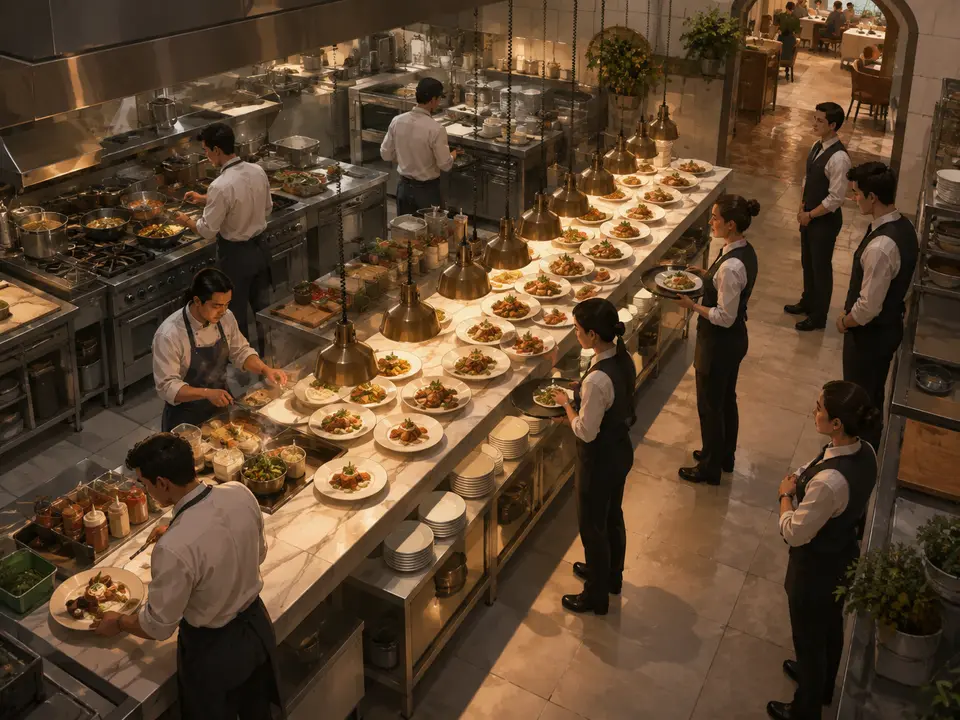
CAM-501The dish has been ready for four minutes and still has not left
«Tell me when a dish has been sitting on the pass for more than two minutes and three or more floor staff are waiting.»


What it does not do
IRIS does not know what is on the plate, whether it is any good, or which table it belongs to. It sees that something is at the pass and measures how long it has been there without moving.
And it does not rate anyone. It does not say who was supposed to take it or how long each waiter takes, because it does not identify people. It counts how many are waiting, not who they are.
And it does not know whether the jam comes from the kitchen or from the floor. It sees a plate standing still and people waiting; who was running behind that night is a conversation between people, not a figure that comes out of a camera.
Questions
- Is this a way of monitoring the waiting staff?
- No, and it is worth saying plainly. IRIS does not recognise faces, does not identify anyone and keeps no tally of what each person does. What it measures is the plate: how many minutes it has stood at the pass. If you wanted to use it to single someone out, it would not give you that, because it does not have it. What it does give you is where and when service jams, which is almost always an organisation problem and almost never one person.
- What if the plate is waiting on purpose, because another one for that table is not ready?
- It happens constantly, which is why the alert has two conditions and not one. A stationary plate on its own triggers nothing: floor staff must also be waiting, and that is the sign the jam is real rather than a normal table wait. And you set the limit: if in your kitchen a plate routinely waits three minutes for the rest of the table, you set the alert at four. An alert that fires when nothing is wrong stops being looked at within a week.
- Do I have to change my kitchen screens or my ordering system?
- No. This works with a camera that sees the pass, and it touches neither your ordering system nor your screens. If later on you want to cross the two sets of data, that is possible, but it is not the condition for starting. The reason is simple: the problem is not inside the software, it is in the minutes a plate spends under the lamp, and no ordering system records that time.
- Does it also work for the buffet or the bar?
- Yes. It is the same kind of looking: something that should be moving has stopped. At a buffet it is the tray that has been empty for minutes with guests in front of it; at the bar it is the order left on the shelf while two others go out. What changes is where you draw the area and how many minutes are too many, but the idea is identical: measuring how long something has stood still where it should not.
A different case every time
Watch what happens. Then watch what IRIS does with it.
Not a recorded video and not a drawing: it is a summary of the real tool, with a different case each time round. The whole tool does not fit in a box.
- You ask
- IRIS searches
- It shows you
Not seeing yours here?
These words are the ones we have built, not the ones IRIS understands. The list falls short on purpose: you ask for it in a sentence, and sentences do not run out. Tell us what is in front of your cameras and we will tell you whether it understands it, or not yet.
And the best part
Nobody covers the night shift:the camera that is already on covers it.
It does not tire, it does not blink and it does not go for coffee. What happens at night is understood just as it would be at midday, and whoever is on duty hears about it while it is happening.
Tell us your problem and we will say whether IRIS understands it, or not yet.
We reply the same working day.