Solutions by typeProduction efficiency
How do I know nothing is left from the previous product?
We are starting, and the last batch is still here
Half past six in the morning, between two production runs. The filler is already set for the new product and the supervisor is waiting for the go-ahead. But the table next to it is still covered in orange labels from the previous format, with the old tooling on top and two containers on the floor by the leg. Nobody sees them, because nobody is looking at them: everyone is watching the machine.
1 cameras across 1 sectors
What IRIS is
IRIS watches the cameras for you.
IRIS Neural is an artificial intelligence that watches the cameras you already have and understands what happens in front of them. When something important happens —or something you told it you need to keep an eye on—, it alerts you; and whatever can be counted, it counts in numbers. All day long, without anyone having to watch a screen.
You tell it what you need to watch, and IRIS does it.
Works with the cameras you already have. Nothing to replace.
A person replies, not a form.
- Your footage never leaves your premises.
- It doesn't identify people.
- Certifications →
This is how you ask for it
«Before we start, tell me if anything from the previous product is left on the table or on the floor: labels, packaging or tooling.»
If it starts like that, what is at stake is not an hour of production. It is a whole batch put on hold the day an orange label turns up inside a box of the new product, and a call to the customer that nobody wants to make. And if the previous product carried an allergen the new one does not, it stops being a quality problem and becomes a health problem. The checklist was signed. The table was still full.
You decide once
You decide this once. You say which part of the room has to be seen empty, what counts as a leftover —labels, packaging, tooling—, when the check happens and who has to sign it off: as soon as the start is requested, IRIS looks at the table and the area beside it and, if anything is left, alerts the supervisor with the photo and the time before the line begins to fill. IRIS does that on every changeover, including the one at three in the morning on a Sunday, with half the crew and everyone in a hurry.
The changeover is the most fragile moment in a food plant, and not because anyone is doing a bad job. Three things collide: the line is stopped and that costs money, the shift wants to finish, and the check depends on somebody looking at the whole room while already thinking about the start-up. The checklist exists, it is well written and it gets signed. But it gets signed in front of the machine, not in front of the table three metres to the left.
And the leftovers that do damage are small. Not a pallet of the previous product, which you can see from the door. Four labels stuck to the edge of a table, one container fallen behind a leg, the tooling part someone left on the trolley so as not to fetch it again. Any of those three can end up inside a box of the new batch, and that box can end up on a supermarket shelf.
IRIS looks at the room at the moment the start-up is requested and says what it sees: if material from the previous format is still on the table or on the floor of the marked area, it flags it with the photo and the time. It signs nothing and releases nothing: the quality person releases, as always. What changes is that this person now looks at an image of the room taken this second, instead of the memory of having walked through ten minutes ago.
What changes
Before, the check was a box ticked from memory and, when something went wrong, the video served to see who had signed. Now, the minute the start is requested a photo of the room arrives with the time, and if anything is left it is seen before the first container is filled. The check takes just as long, but it no longer depends on whether somebody turned their head to the left that morning.
Where we have seen it
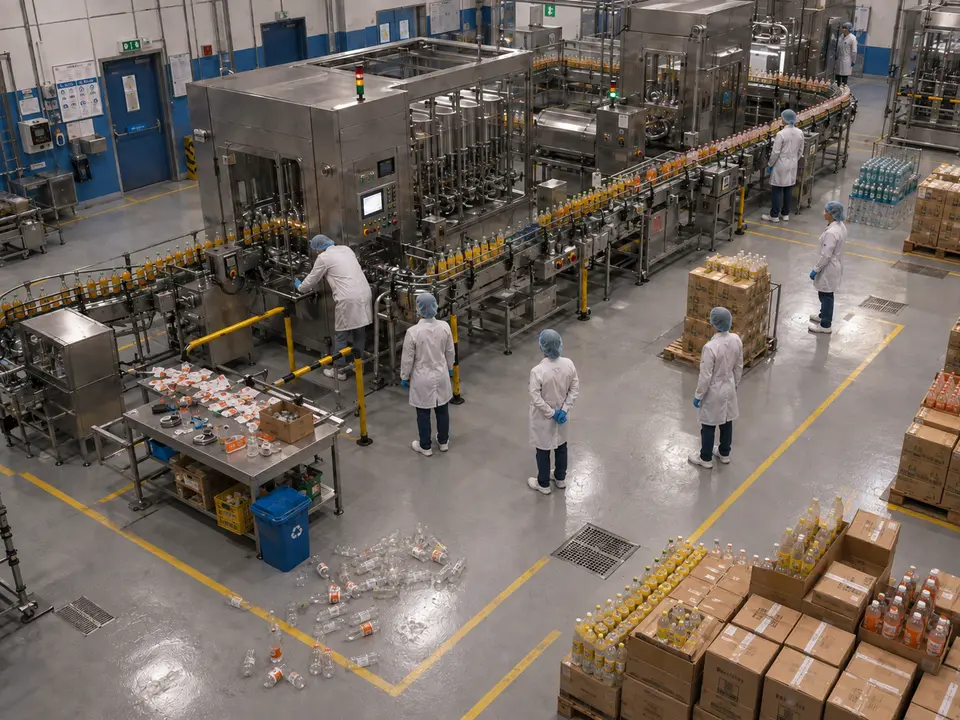
CAM-206The changeover is not finished
«Before we start up, tell me if anything from the previous product is still on the table or on the floor: labels, packs or tooling.»

What it does not do
IRIS does not read the batch code printed on a label from a ceiling camera, and it does not know which allergen each product carries. It sees that there are labels, packaging or tooling in the marked area, and it says so before the start-up.
And it releases nothing. Line clearance is signed by whoever has to sign it, following their procedure. IRIS is the second pair of eyes that always looks at the same spot, not the one deciding whether to start.
Questions
- Can IRIS tell a label from the old format from a new one?
- Yes, when they look different and the camera sees them in enough detail: colour, shape, size, the kind of packaging. That is the normal case in a changeover, because formats are made to look different so they do not get mixed up. What IRIS does not do is read a batch code printed in small type from a ceiling camera. If your changeover depends on reading that code, it gets checked up close with a reader, and IRIS takes care of what is visible in the room.
- Does it replace the changeover checklist?
- No, and it should not. The checklist stays as it is and the same person signs it. What IRIS does is fill in the weakest item on that list: the one that says «area clear», which today gets ticked from memory because really checking it means walking the room looking at the floor. IRIS looks at that part of the room every single time, on every changeover, and attaches the photo with the time. The signature stays human; what stops being human is remembering to look.
- Does this hold up in an audit?
- Yes, because there is an image of the room with the exact time of the changeover, and that image is kept the same way the rest of the video is kept. An auditor does not ask whether you have a procedure: they ask how you show it was followed last Thursday at 06:30. With this, the answer stops being «the supervisor signed it» and becomes «this is the room at that minute». What does not change is where responsibility sits: still with you.
- What about changeovers at night or at the weekend?
- Yes, it works the same, and that is exactly when it earns its keep. The three-in-the-morning Sunday changeover is done by fewer people, with less supervision and more appetite to finish. The rule does not know what day it is: it looks at the same area, with the same criteria, and alerts whoever you put on that time slot. If there is nobody from quality on site during that shift, the alert is kept with its photo and its time so it can be reviewed in the morning.
Demo · IRIS at work
A new case each time. Always the same screen.
It plays by itself and shows one case from start to finish. It is a summary: the real screen has far more functions than fit in this box.
- Cameras on the map
- You draw an area
- What passed shows up
Not seeing yours here?
These words are the ones we have built, not the ones IRIS understands. The list falls short on purpose: you ask for it in a sentence, and sentences do not run out. Tell us what is in front of your cameras and we will tell you whether it understands it, or not yet.
And the best part
Video is late by definition:you watch it once the thing has already happened.
IRIS tells you while it is happening, with the camera, the time and what it saw. Arriving in time changes the end of almost any story, and no new cameras are needed for that.
Tell us your problem and we will say whether IRIS understands it, or not yet.
We reply the same working day.