Solutions by typePersonal safety
Which way do people leave if one day they have to?
The fire exit is behind six pallets
It is 10:20 on a Tuesday in the despatch bay. A lorry arrives with more on it than expected and six pallets have to go somewhere. The handiest gap is the one in front of the green door, that yellow square that is always empty. They go there, just for a moment. The afternoon lorry brings four more. By Friday nobody sees the pallets any more: they are part of the aisle.
6 cameras across 6 sectors
What IRIS is
IRIS watches the cameras for you.
IRIS Neural is an artificial intelligence that watches the cameras you already have and understands what happens in front of them. When something important happens —or something you told it you need to keep an eye on—, it alerts you; and whatever can be counted, it counts in numbers. All day long, without anyone having to watch a screen.
You tell it what you need to watch, and IRIS does it.
Works with the cameras you already have. Nothing to replace.
A person replies, not a form.
- Your footage never leaves your premises.
- It doesn't identify people.
- Certifications →
This is how you ask for it
«Tell me when something is left in front of the fire exit for more than ten minutes.»
Nobody writes it in any report, because nothing happened. What does happen is that on inspection day three people spend two hours clearing aisles, and the safety report closes with a finding that was already fixed by the time it was signed. And if one day people really have to get out, the nearest door is useless and everyone heads for the next one, forty metres away.
You decide once
You decide this once and it applies from then on. The site decides where the square that must stay clear is, how many minutes something may sit there and who gets told. If an object appears inside that area, for more than ten minutes, and nobody is working with it, then an incident opens, the camera is sent and the image is kept. It gets written on a Tuesday morning and runs every day, including the Saturday when the office is empty.
A fire exit is never blocked all at once. It gets blocked a moment at a time. A pallet, a cleaning trolley, an empty cage, a box someone will move later. Everyone walks past it fifteen times a day and stops seeing it, because whatever is always there is no longer an obstacle: it is part of the floor. On inspection day it is cleared in twenty minutes and everybody breathes out. A month later the pallets are back.
The day it goes wrong there is no time to clear anything. Smoke comes up in a public area and people head, all at once, for the nearest door. If that door has six pallets in front of it, it is not an exit: it is a plug with a green light above it. In a car park it is a car parked over the hatching. In a school it is a stack of chairs at the foot of the stairs. It is always something someone left, and it has always been there longer than anyone remembers.
IRIS watches the square in front of the door and nothing else. If something appears and is still there after the agreed minutes, it says so: camera, time and image. It is not an urgent alert, it is a boring one, the kind you fix today with a pallet truck. And that is the whole point: the exit gets cleared on Tuesday afternoon instead of on the morning of the inspection.
What changes
Before, this turned up on the monthly safety walk or on the day the inspector came. Someone wrote aisle obstructed on a sheet and the photo got taken once it was already clear. Now the site manager gets the image at 10:35 with the door and the time, sends someone with a pallet truck, and by 10:50 it is done. The same finding that used to take a month closes in a quarter of an hour.
Where we have seen it
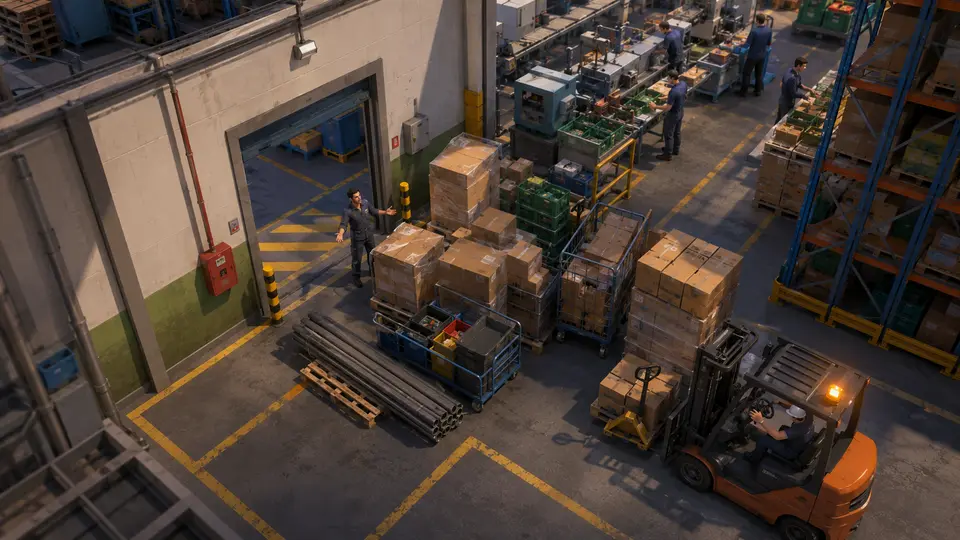
CAM-255The emergency exit is behind six pallets
«Tell me when something is left in the yellow zone in front of the exit for more than ten minutes.»
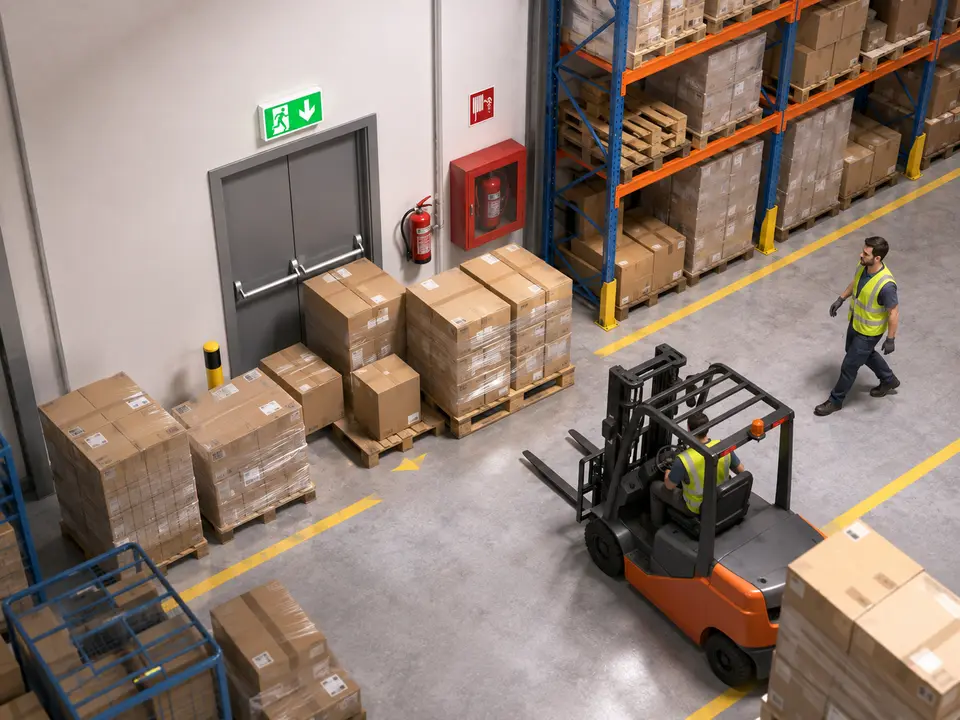
CAM-274Pallets in front of the emergency exit
«Tell me when there are goods in front of the emergency exit or covering the extinguisher for more than five minutes.»

CAM-546There is smoke, and the exit people would have to use is blocked
«Tell me if there is smoke in a public area, or if an emergency exit has had something in front of it for more than five minutes.»
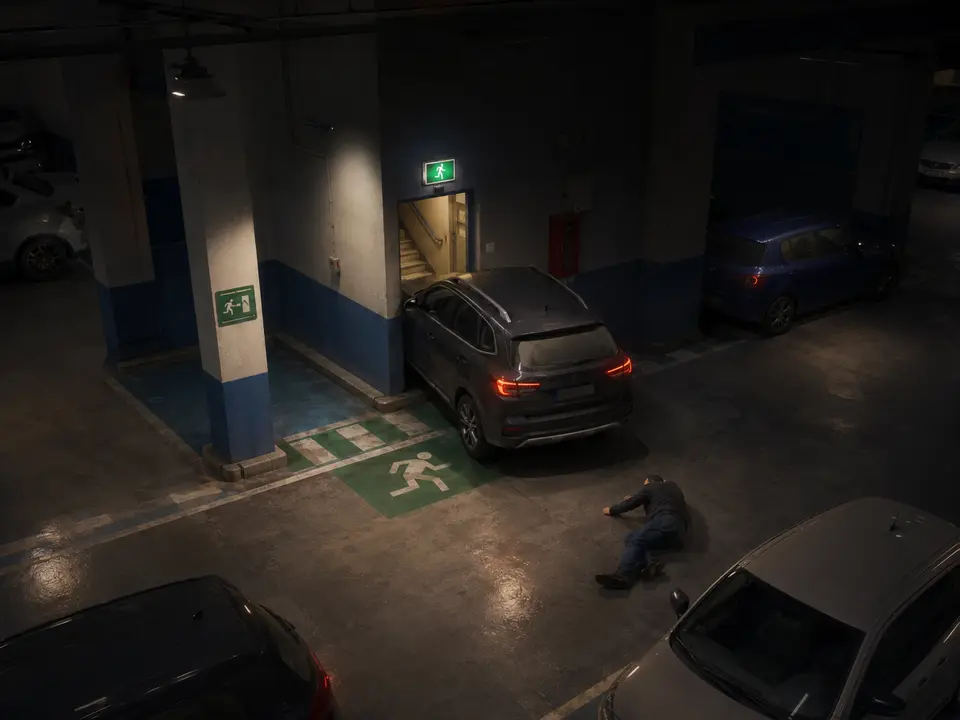
CAM-474The emergency exit blocked by a car and a person on the ground
«Alert me if anyone parks on the emergency exit or if there is a person on the ground not moving.»
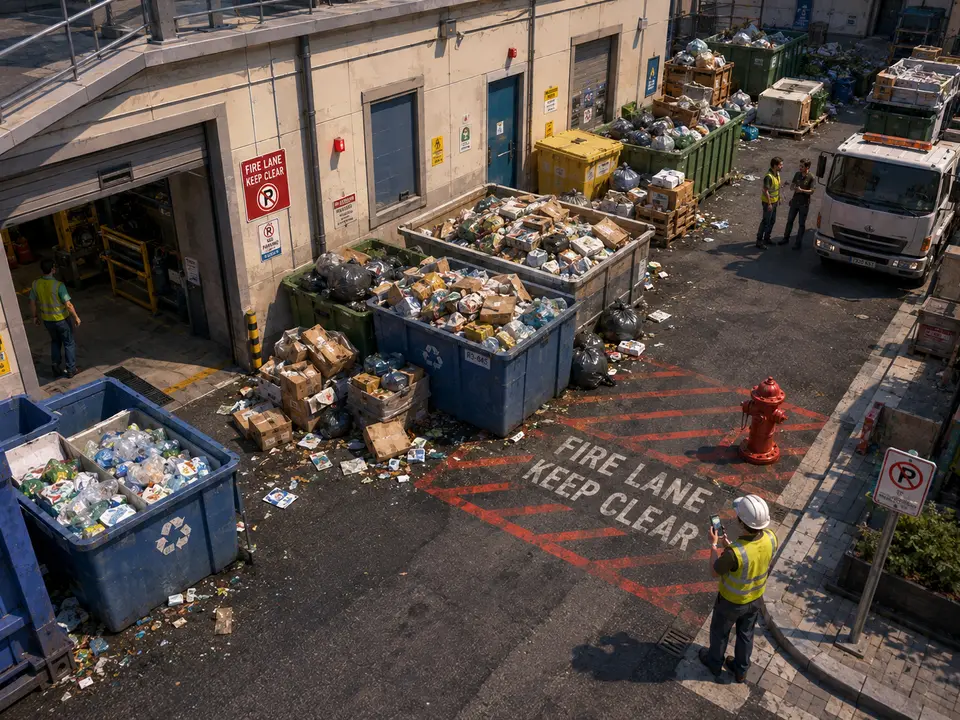
CAM-437The emergency lane is packed with skips and pallets
«Tell me if anybody leaves something on the painted emergency lane or in front of the hydrant.»
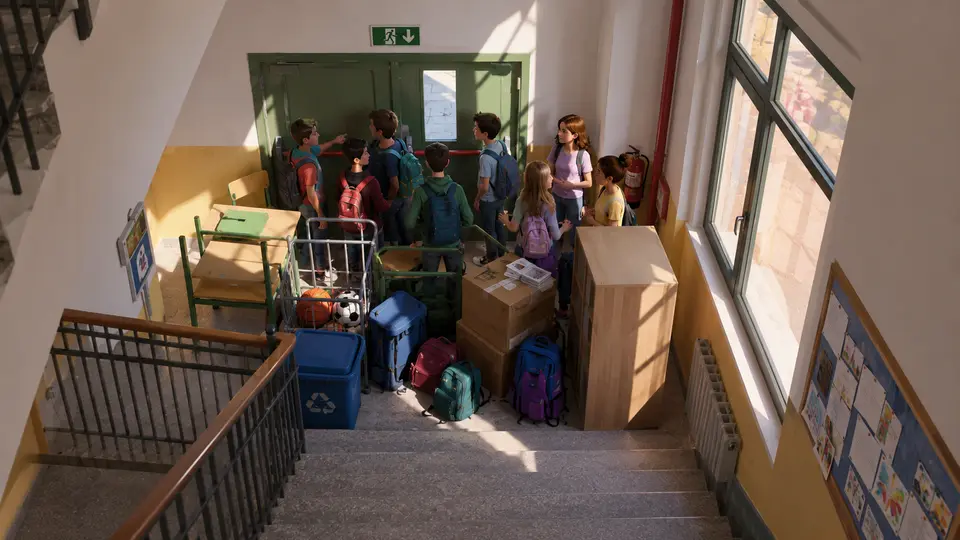
CAM-137The fire exit, blocked
«Tell me if anything is left standing in front of a fire exit or in a stairway passage, and tell me today, not in six months' time.»


What it does not do
IRIS does not know whether what sits in front of the door will be moved in five minutes or whether it is goods in transit. It sees that the marked area is occupied and it counts the time.
Nor does it measure in centimetres the clear width the rules demand, or replace a safety officer’s inspection. A person does that, with a tape measure in hand.
Questions
- Does it alert even for a pallet that is only passing through?
- No. The rule has a clock, not a switch: while someone is working with those goods, they move, and no alert arrives. It only fires when something has stayed there longer than the agreed minutes, usually between five and ten. The problem is never the pallet passing through: it is the one that stays over the weekend. If loading takes longer in your building, you raise the margin and IRIS only mentions what has genuinely settled.
- Does it cover fire lanes and extinguishers too?
- Yes, and it is exactly the same kind of rule. You mark on the image the painted fire lane, the hatching in front of a hydrant or the space kept for an extinguisher, and you ask for an alert if something settles on it. This is the kind of lapse nobody writes into a report and that gets discovered on the day it is needed, when there is no fixing it any more.
- Does it replace the safety inspection?
- No. The inspection keeps doing what it does well: checking widths, signage, emergency lighting and the state of the doors. What IRIS adds is the rest of the month, the thirty days when nobody walks round with a checklist. The walk tells you whether the exit is well designed; IRIS tells you whether it is clear today. Two different questions, and you need both.
- Can you find out how often the same exit gets blocked?
- Yes, and it is usually the figure that fixes the problem at its root. Every alert is stored with its time and its door, so by the end of the month you can see that one particular exit gets blocked nine times and the others never. That is not careless people: that door has nowhere to put pallets. Change where the drop zone is and the alerts stop on their own.
Every simulation
Something has spilled
Tell me if there is liquid or foam outside its place and it is still there two minutes later.
- The sentence
- Where it applies
- What it finds
- The same rule
Not seeing yours here?
These words are the ones we have built, not the ones IRIS understands. The list falls short on purpose: you ask for it in a sentence, and sentences do not run out. Tell us what is in front of your cameras and we will tell you whether it understands it, or not yet.
And the best part
Behind one camera you can put a person.Behind four thousand you cannot put anyone.
Adding a camera costs little; adding another pair of eyes does not. So the cameras keep growing and the attention does not. IRIS watches all four thousand at once and flags what matters today.
Tell us your problem and we will say whether IRIS understands it, or not yet.
We reply the same working day.