Solutions by typeIntrusion detection
What if the airlock stops being an airlock?
Both doors open at the same time
It is 10:15. The staff airlock of a packaging plant. Both leaves are open at the same time. On the left, someone waits in a blue cap and shoe covers; on the right, another person holds the inner leaf with their hip, because both hands are carrying a box. It lasts eleven seconds. The badge reader logged one valid entry, and there is nothing odd in that day’s access list.
3 cameras across 3 sectors
What IRIS is
IRIS watches the cameras for you.
IRIS Neural is an artificial intelligence that watches the cameras you already have and understands what happens in front of them. When something important happens —or something you told it you need to keep an eye on—, it alerts you; and whatever can be counted, it counts in numbers. All day long, without anyone having to watch a screen.
You tell it what you need to watch, and IRIS does it.
Works with the cameras you already have. Nothing to replace.
A person replies, not a form.
- Your footage never leaves your premises.
- It doesn't identify people.
- Certifications →
This is how you ask for it
«Tell me if there is more than one person inside the airlock at once, or if both doors stay open at the same time.»
An airlock only works if the two doors never open at once. Eleven seconds with both open means corridor air entering a clean room, or a person going through with no record that they were inside. Nobody sees it, because the access list says everything is fine. It surfaces weeks later, when someone reviews a batch or looks up who entered that room that afternoon.
You decide once
You decide this once. You say which airlocks count, how many people may be inside, how many seconds of overlap are tolerated — opening both for two seconds to pass a pallet may be normal, eleven is not — at what hours, and who gets it: the shift supervisor’s screen, the quality inbox, or both. IRIS checks it on every passage, on every shift, without anyone having to watch.
An airlock is two doors that never open at the same time, with a small space in between. That space is the only thing stopping two worlds from touching: corridor air and clean-room air; the street and the room with the racks; the dirty side and the clean side of an industrial kitchen. If both doors open together, the space disappears and the two worlds touch. The door is still there, but it has stopped doing the job it was installed for.
The badge reader knows nothing about this. It knows a valid card went through. It does not know that two people came in on one card, or that someone held the inner leaf with their hip because their hands were full. The door contact knows whether a leaf is open, but not how many people were in the middle. That is why airlock misuse is one of the failures that leaves the least trace: on paper, everything was fine.
IRIS watches the airlock the way a person sitting in front of it all day would — which is exactly what nobody is going to do. It counts how many bodies are inside the space, sees whether both leaves are open at once and for how long. When that does not match what you decided, it says so at that moment, with the camera and the seconds, instead of turning up in an audit three months later, when nobody remembers that morning.
And airlocks are not only where you would expect them. There is one at the entrance of a data centre and another between the changing room and the clean room; there is one at the chilled store of a bakery and one between a bank lobby and the cash area. The same thing happens in all of them: they were installed for a serious reason, they are used a hundred times a day, and nobody ever checks whether they are used the way they were meant to be. The rule is the same in all four; what changes is the number of seconds you tolerate in each.
What changes
Before, misuse showed up in an audit weeks later, when someone reviewed a batch or an access list and nobody remembered that morning any more. The deviation was written from what could be inferred. Now the shift supervisor gets it the same day with the eleven seconds of video, talks to the person carrying the box, and the deviation is documented with what actually happened. And whoever held the leaf learns something while it is still fresh, which is when people learn.
Where we have seen it
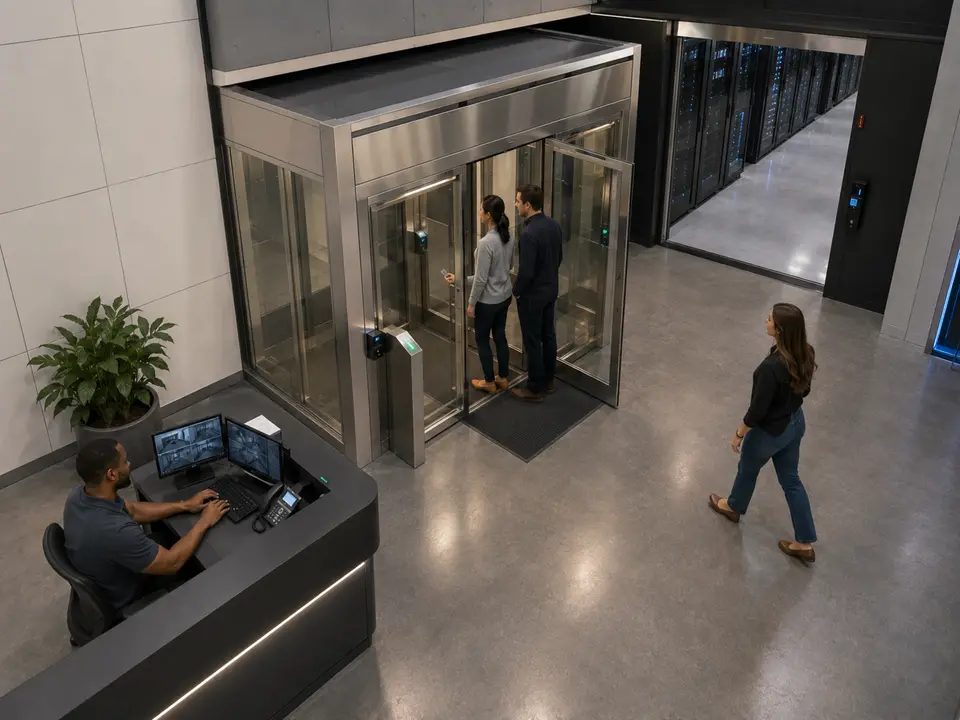
CAM-548Both of them inside the airlock, inner door still open
«Tell me if there is more than one person inside the airlock at the same time.»

CAM-535How many people come in through each door, and when
«Tell me if one of the two doors stops adding people while the centre is open.»
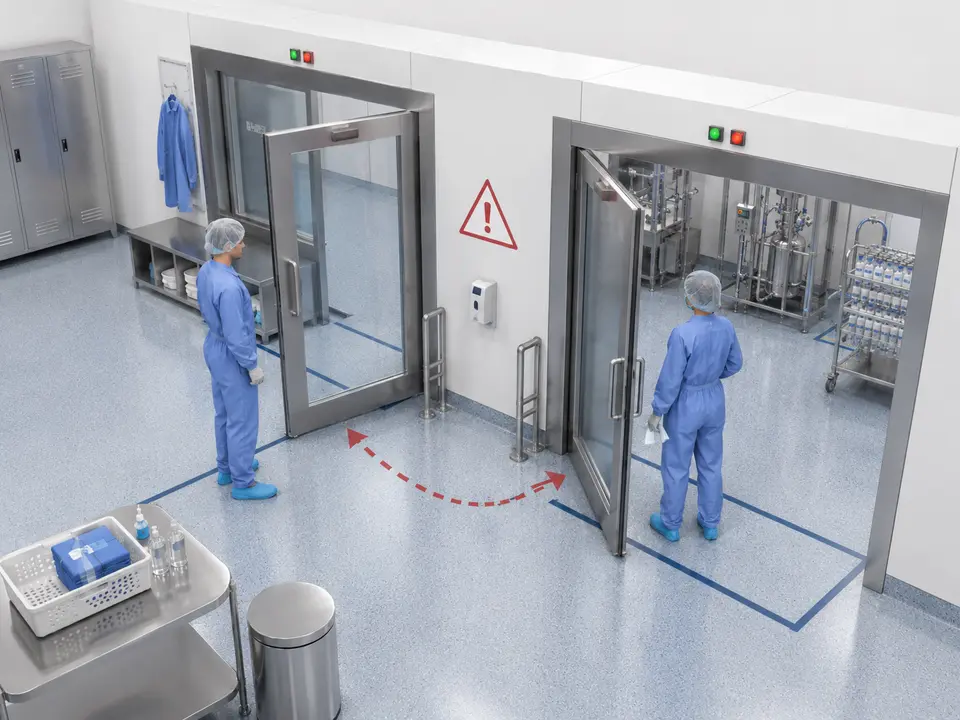
CAM-281Both airlock doors open at the same time
«Alert me the moment both airlock doors are open at the same time, even for a few seconds.»


What it does not do
IRIS does not know who the people in the airlock are or whether their badge was valid. It counts bodies and watches the leaves. It does not measure pressure, airflow or particles either: that is the building system’s job, not a camera’s.
And it does not see what is out of frame. If the camera only covers one leaf, it cannot say both were open. In a small airlock the camera has to see the whole space and both doors, and that is checked before the rule is signed off.
Questions
- Does it replace the badge reader?
- No. They answer two different questions, and you need both. The reader tells you whether the badge was valid and whose it is. IRIS tells you how many people actually went through and whether both leaves were open at once. A reader will never know that two people entered on one badge, and a camera will never know whose badge it was. Together they close the gap that airlock misuse slips through.
- What if we open both doors for two seconds to move a pallet?
- You can, and it produces no alert if that is what you decided. You set the tolerance: how many seconds of overlap are normal in that airlock and at what hours. Many plants have a materials airlock where two seconds are part of the job, and a staff airlock where not even one is acceptable. Those are two different rules for two different doors, and each lives where it belongs. What IRIS does not do is invent the limit.
- Does IRIS know who went in with whom?
- No. IRIS does not recognise faces and does not identify anyone: it only counts how many people are inside the space. What you get is the alert with the camera, the exact time and the video of those seconds. Who each of them was is something the shift supervisor knows the moment they watch it, because they know their people and because the reader says which badge went through. IRIS supplies the number; the name is your organisation’s call.
- Is the video any use in an audit?
- Yes, and it is worth saying how far it goes. What happened is on record: which airlock, what time, for how many seconds, with the video kept under the retention policy you set. That is far more than the usual, which is an access list and somebody’s memory. Whether it counts as formal evidence is for your quality system and your auditor to say, not for us. Our job is that the record exists and cannot be tidied up afterwards.
See it for yourself
This isn’t a video. It’s a slice of the real screen.
A summary of the real interface, played hands-free. You see one case from start to finish; what you do not see are the other screens, and there are many.
- Four cameras at once
- Each understands its own view
- The numbers climb by themselves
Not seeing yours here?
These words are the ones we have built, not the ones IRIS understands. The list falls short on purpose: you ask for it in a sentence, and sentences do not run out. Tell us what is in front of your cameras and we will tell you whether it understands it, or not yet.
And the best part
Nothing changes on the wall.On the screen, everything changes.
Same brackets, same cabling, same cameras. The only difference is that those images are now understood as they come in, instead of waiting for someone to open them.
Tell us your problem and we will say whether IRIS understands it, or not yet.
We reply the same working day.