The cityEnvironment and cleanliness
CAM-23
Graffiti on a facade
Five people are spray-painting the wall of the underpass. There are cans all over the ground, a stepladder against the wall and onlookers filming with their phones.

Turn on IRIS Vision
AI-generated image
What IRIS is
IRIS watches the street for you.
IRIS looks at the cameras you already have on streets and squares and understands what's happening: a fight, a spill, an overflowing bin or a crowd building up. When something important happens, it alerts you; and whatever can be counted, it counts. All day long, with no one watching a screen.
You tell it what you need to watch, and IRIS does it.
Here, for example, the moment it sees someone spray-painting the wall, IRIS sends an alert right away with the camera open and the exact time. That way you know it's happening right now, not the next day once the paint has already dried. With that alert you decide whether to send someone out that night, or whether it's time to protect the wall instead of repainting it over and over.
Works with the cameras you already have. Nothing to replace.
A person replies, not a form.
- Your footage never leaves your premises.
- It doesn't identify people.
- Certifications →
What IRIS understands
What it recognises in this scene
- person painting
- spray cans
- onlookers
- bus
- bicycle
The rule
You decide once. IRIS applies it always.
If
a person paints on a wall or a facade
Duringmore than 30 seconds
Then
- alert the municipal duty service
- keep the video from the start
- open a cleaning job for that wall
The instruction that set it up«Tell me if someone is painting a wall, and keep the video from the very start.»
What changes
What changes for whoever runs the city
The maintenance engineer knows that wall: he repaints it three times a year and he always sees it the next morning, already dry. The tagging happens at night, in an underpass nobody walks through, and nothing survives of it: no image, no time, nobody to bill. With IRIS the alert goes out while it is happening, with the camera open, and the municipal duty service decide whether to go. If nobody goes that night, what is left is the video from the first stroke and a record for that wall: with it the engineer can ask to protect the surface instead of repainting it again.
What people usually ask
Can IRIS tell a commissioned mural from illegal graffiti?
No, IRIS does not tell an authorised mural from illegal graffiti on its own: it recognises that someone is painting a wall, not whether they have permission. What the council does is mark the authorised walls and the dates of each commission on the map, and IRIS stays quiet there. It is the usual idea: the organisation sets the rule once, IRIS applies it every day.
Does IRIS alert while they are painting or once the graffiti is done?
IRIS alerts while they are painting, not once the graffiti is done. That is the difference from checking the wall the next morning: the alert goes out there and then, with the camera open, and there is still time to act. If nobody picks it up that night, the video, the time and the exact spot are still on record, which is already a good deal more than there usually is today.
Does IRIS detect graffiti at night, with little light?
IRIS detects graffiti at night as long as the camera at that spot gives a usable picture with the street lighting or infrared, and it is calibrated on that night-time image, not on the midday one. Where the light does not reach, detection becomes less reliable, and that is stated in the point-by-point survey rather than promising that everything is visible.
Demo · IRIS at work
We won't just tell you. We'll show you.
It is a summary of the real screen: it plays by itself, step by step, and shows only the path of one case. The actual tool has far more than fits in here.
- It lands in the tray
- You open it
- You confirm or dismiss
See it somewhere else
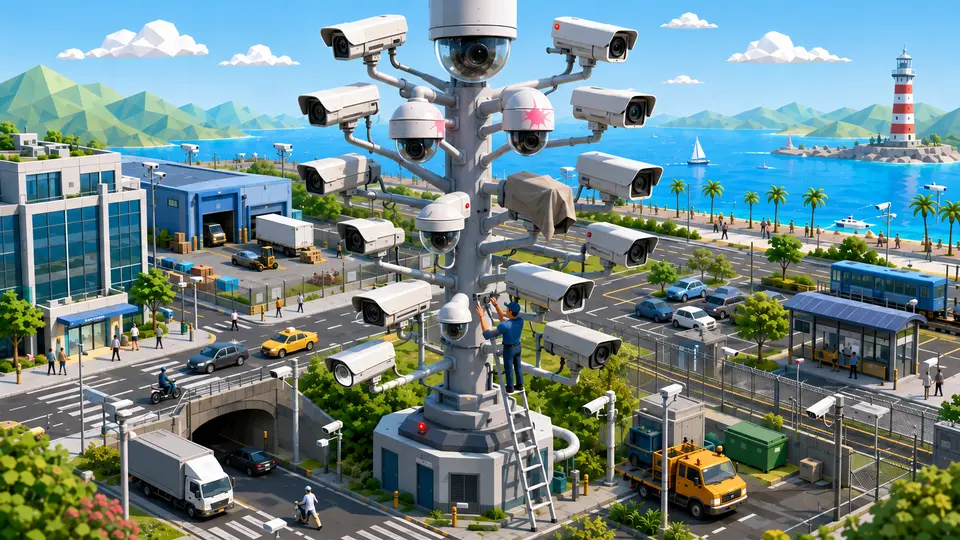
And who watches the cameras?
34 cases, and in every one of them IRIS raises an alert when something happens. You see each image as it is, and then with what it understands on top.

Who watches the cameras of a whole city?
23 cases: 18 raise an alert when something happens and 5 only measure. You see each image as it is, and then with what IRIS understands on top.


And the best part
Nobody covers the night shift:the camera that is already on covers it.
It does not tire, it does not blink and it does not go for coffee. What happens at night is understood just as it would be at midday, and whoever is on duty hears about it while it is happening.
Tell us your problem and we will say whether IRIS understands it, or not yet.
We reply the same working day.