Solutions by typeMobility analysis
How long has that been lying in the lane?
Something is in the lane and nobody has seen it
Twenty past eleven in the morning, inside a tunnel. A truck has shed part of its load on the bend: two burst boxes, some tubes and a pallet lying across take up the right-hand lane. The truck has driven on and knows nothing about it. The cars behind swerve into the next lane as they come, one after another, and whoever arrives in forty seconds won’t see it until they come out of the bend.
3 cameras across 2 sectors
What IRIS is
IRIS watches the cameras for you.
IRIS Neural is an artificial intelligence that watches the cameras you already have and understands what happens in front of them. When something important happens —or something you told it you need to keep an eye on—, it alerts you; and whatever can be counted, it counts in numbers. All day long, without anyone having to watch a screen.
You tell it what you need to watch, and IRIS does it.
Works with the cameras you already have. Nothing to replace.
A person replies, not a form.
- Your footage never leaves your premises.
- It doesn't identify people.
- Certifications →
This is how you ask for it
«Alert me if something falls onto the roadway, and tell me which lane it landed in.»
An object on the roadway doesn’t move, doesn’t flee and doesn’t own up. It stays there until somebody sees it and reports it, and that somebody’s usually the driver who has already braked hard. Inside a tunnel the margin is even smaller: no shoulder, no visibility, and a chain of hard braking is what turns a pallet into a multi-vehicle crash and a tunnel closed for half a morning.
You decide once
You decide this once. You say which stretches are watched, what lanes each one has, what counts as an obstacle and who’s told: the control center, the maintenance patrol, or both at once. IRIS applies it on every camera along those stretches, day and night, and it doesn’t depend on anyone having that quadrant open. If a new stretch opens, you add it to the rule.
This is the opposite of almost everything else a camera does. There’s no movement to detect here: there’s something sitting still where nothing should be. A pallet in the middle lane, rubble covering the left one, a loose wheel that has rolled sixty feet further on. None of it moves, none of it draws the eye on a screen, and yet every second it stays there is one more car arriving at a hundred and twenty without knowing.
The value is in the lane, not the object. That there’s something on the road eventually gets known. What changes the response is knowing which lane it is in and at exactly what point, because that determines whether one lane is closed or two, which sign lights up, which mile the patrol is sent to and whether tunnel traffic has to be stopped. That detail is what gets lost today in a driver’s call saying “there is something lying around near the toll.”
And then there’s the part only the video holds: where it came from. With the recording you know which vehicle shed it and at what time, and that stops being an argument about who pays for the clean-up. The same camera that flags the obstacle keeps the minute it fell, which is the only evidence that exists for something that left no other trace.
What changes
Before, the control center found out by phone, and whoever called was driving and couldn’t name the lane or the exact mile. A patrol was sent out to find it. Now the alert arrives with the camera, the point and the lane occupied, so the sign lights up sooner and the patrol sets off knowing what it’s going to and what it’ll find.
Where we have seen it
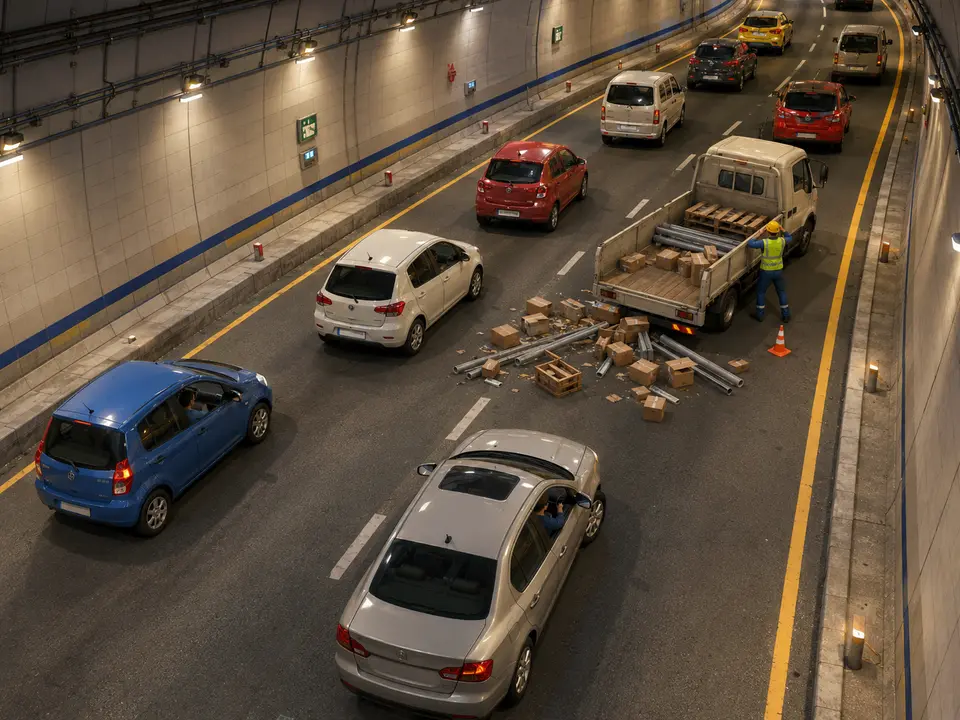
CAM-13Load spilled on the road
«Tell me if a vehicle drops its load on the road, and which lane it is blocking.»

CAM-64Load spilled across a lane
«Tell me if something falls onto the road, and which lane it has landed in.»
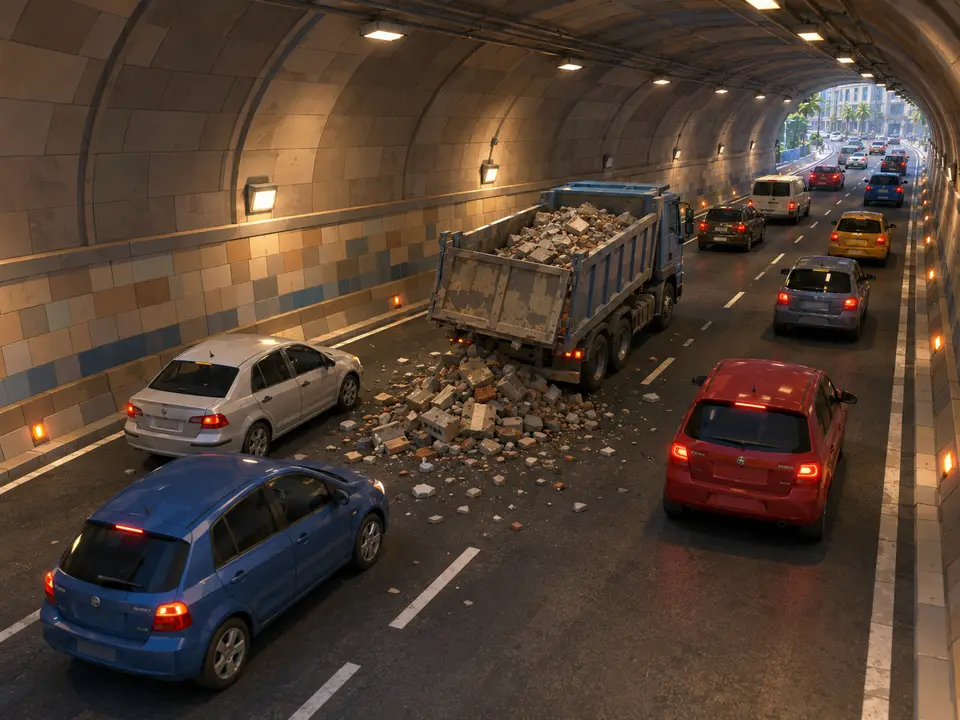
CAM-35Debris inside the tunnel
«Tell me if an obstacle appears on the tunnel roadway, and which lane it is in.»


What it doesn’t do
IRIS does not remove the load or close the lane: it alerts, says where it is and opens the image, and from there a person acts. It also does not know what the object is: it tells that something is on the roadway that should not be, not whether it is a pallet or a cardboard box. And in a dimly lit tunnel, or on wet road full of reflections, a low dark object is hard for anyone to see.
Questions
- Does it detect any object, or only large ones?
- It depends on its size in the image, and that’s the honest answer. A pallet lying across a lane shows up without trouble; a small part two hundred yards from the camera may fall below what the image resolves. What we do at commissioning is check camera by camera how far each one reaches and above what size it alerts. We’d rather say “beyond this point we do not guarantee it” than promise everything’s seen, because the second falls apart on the first trial.
- Does it say which lane it ended up in?
- Yes, and it’s the most used piece of information. Lanes are marked once on each camera’s image, so the alert doesn’t say “there is something on the road”: it says which lane it is in and at what point. Everything downstream depends on that, from which sign lights up to whether a lane is closed or the tunnel is stopped. Without the lane, the alert forces someone to watch the video and work it out, and those are minutes that count on a fast road.
- Can we find out which vehicle it fell from?
- Yes, if it went past the camera. Because the alert is kept with its exact time, you can go to the video of the preceding seconds and see the vehicle that shed it. That turns an argument about who pays for the removal into a verifiable fact. What we don’t do is promise the plate under any conditions: that depends on the camera, the speed, the light and the angle, and it’s checked stretch by stretch before we say yes.
- And at night, or inside a lit tunnel?
- It works, with caveats worth knowing beforehand. A tunnel has constant lighting, which helps, but also reflections on wet road, abrupt light changes at the portals and long vehicle shadows. A low, dark object in those conditions is hard for any system and for a driver too. That’s why the tuning is done with the tunnel’s real cameras and not from a catalog, and if a particular stretch can’t be guaranteed, we say so and the framing is reinforced.
The real interface, step by step
A camera looks. IRIS understands what it sees.
An extract of the real screen, no voice-over and hands-free. Each round poses another situation. What sits behind it is a good deal bigger than what you see.
- It lands in the tray
- You open it
- You confirm or dismiss
Not seeing yours here?
These words are the ones we have built, not the ones IRIS understands. The list falls short on purpose: you ask for it in a sentence, and sentences don’t run out. Tell us what is in front of your cameras and we’ll tell you whether it understands it, or not yet.
And the best part
IRIS only sees what the camera shows.Where we don’t reach, we say so.
No software fixes a lens pointing the wrong way or covered in dust. Before promising anything, we say which cameras are in a state to see what you’re asking of them.
Tell us your problem and we’ll say whether IRIS understands it, or not yet.
A person answers, the same working day.