Solutions by typeLogistics efficiency
How long do trucks really wait in my yard?
Nobody knows how long a truck waits
It is 09:05. Seven trucks are stopped nose to tail along the access road, from the blue tractor unit at the front to the two at the back by the trees. Opposite, the manoeuvring apron is empty and the row of dock doors is shut: not one has a truck in front of it. A worker in a hi-vis vest walks across the yard. Seven waiting and nine free docks at the same moment, and there is no piece of paper anywhere that records it.
1 cameras across 1 sectors
What IRIS is
IRIS watches the cameras for you.
IRIS Neural is an artificial intelligence that watches the cameras you already have and understands what happens in front of them. When something important happens —or something you told it you need to keep an eye on—, it alerts you; and whatever can be counted, it counts in numbers. All day long, without anyone having to watch a screen.
You tell it what you need to watch, and IRIS does it.
Works with the cameras you already have. Nothing to replace.
A person replies, not a form.
- Your footage never leaves your premises.
- It doesn't identify people.
- Certifications →
This is how you ask for it
«Count how many trucks are waiting on the access road, how long each one waits and how many docks are free at the same time.»
The haulier says an hour, the warehouse says twenty minutes, and since nobody writes anything down, whoever talks loudest wins. Meanwhile you pay for waiting time you cannot verify, you reshuffle booking slots blind, and the yard manager walks into the monthly review with an impression instead of a number. And the costliest part: nobody knows whether the problem is that everyone arrives at once or that the docks do not open on time.
You decide once
Here you do not write a sentence: you draw. You mark on the image the line a truck crosses when it enters the access road and the zone of each dock, and you decide which windows matter: hourly, per shift, per day. All of that is done once. From then on IRIS counts the same way every day, without depending on who was on shift or whether anyone remembered to write it down that morning.
This camera is not there to give anyone a fright. Nothing pops up, nobody is doing anything wrong and there is no incident to open. It is there so that a number exists where there used to be an argument.
The yard manager knows perfectly well that there are bad days. What he does not know is how many, at what hour, or whether Monday is worse than Thursday. When the review with the haulage company comes round, each side brings its own version: one has the times the drivers reported, the other has the feeling that the docks were open. And they leave that meeting having decided something on the basis of nothing.
What IRIS does here is boring, and that is why it works. It counts the truck as it crosses the line and starts a clock on it. Every hour it records how many were waiting and how many docks were free. At the end of the shift it publishes the summary, with the longest wait and the video in case anyone wants to see it. It does not say whose fault anything is. It puts on the table the same figure measured the same way every day, which is the only thing you can use to move a time slot, renegotiate a contract or show that the yard is not the bottleneck.
What changes
Before, the yard manager answered with what he remembered and what came over the radio, and when someone asked for data it meant spending a whole afternoon scrubbing through recordings by hand. Now he opens the shift summary and sees how many trucks waited, how long the worst wait was and how many docks stood idle at the same time. The conversation with the haulier stops being a tug of war and becomes two people looking at the same table.
Where we have seen it
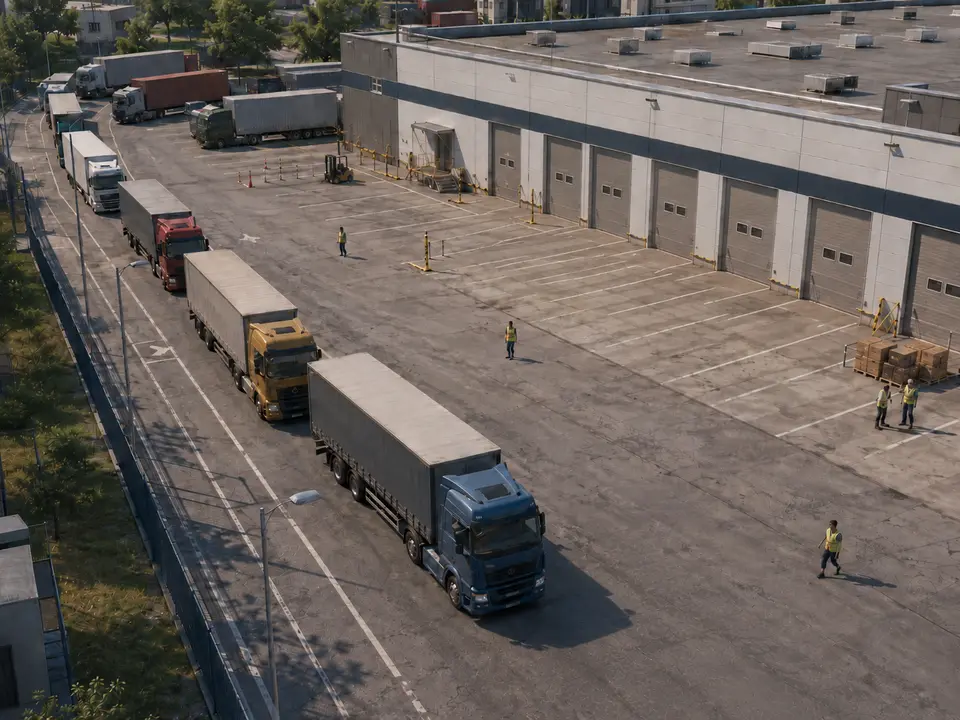
CAM-278Seven trucks waiting on the lane, nine docks standing idle
«Count how many trucks are waiting on the lane, how long each one waits and how many docks are free at the same time.»

What it does not do
IRIS measures, it does not explain. It counts trucks and times waits, but it does not say why the queue formed: whether everyone arrived at once, whether staff were short or a dock was out of service is supplied by whoever watches the video. And if you want an alert on top of the number, that is asked for separately: counting and alerting are not the same thing.
Questions
- Does this camera alert or measure?
- It measures. Nothing goes off: there is a number by hour, by shift and by day. How many trucks were waiting, how long the worst wait was, how many docks stood idle. You can add an alert if the queue passes a certain size, but the value of this camera is in the data series, not in the fright. It is the least spectacular part of IRIS and, in a yard, usually the part that ends up being used most.
- How is a counting camera set up?
- By drawing. An alert is asked for in a sentence; a count is traced on the image: you mark the line the truck crosses entering the road and the zone of each dock. A line cannot be described in speech, it has to be drawn, because the number depends on exactly where it runs and in which direction. That is why the figure comes out the same tomorrow as today and can be audited. Asking is for finding; counting is for measuring, and they are not done the same way.
- Is the number good enough to negotiate with a haulier?
- Yes, because it is repeatable and has video behind it. The same line, the same zone and the same criteria every day. You can show the time of entry onto the access road, the time the truck took a dock and each vehicle’s wait, and check it against the recording if anyone doubts it. IRIS counts vehicles and times them: it does not identify the driver or compare them against anything. What goes on the table is a measured time, not an accusation.
- Does IRIS know why the queue formed?
- No. IRIS measures what can be seen: how many trucks are waiting, since when, and how many docks are free meanwhile. The cause — everyone arriving together, a forklift driver missing, a dock out of service — comes from whoever watches the video or from the warehouse system. And often the number itself points at where to look: seven waiting with nine free docks is not a capacity problem, it is an opening problem.
See it for yourself
This isn’t a video. It’s a slice of the real screen.
A summary of the real interface, played hands-free. You see one case from start to finish; what you do not see are the other screens, and there are many.
- Four cameras at once
- Each understands its own view
- The numbers climb by themselves
Not seeing yours here?
These words are the ones we have built, not the ones IRIS understands. The list falls short on purpose: you ask for it in a sentence, and sentences do not run out. Tell us what is in front of your cameras and we will tell you whether it understands it, or not yet.
And the best part
Nothing to drill, nothing to rip out:the cameras already on your walls can start understanding.
No building work, no new cabling, no swapping equipment. It connects to what is already there, and what is already there starts telling you what it sees.
Tell us your problem and we will say whether IRIS understands it, or not yet.
We reply the same working day.