Solutions by typeInfrastructure integrity
Who is reading the level at six in the morning?
The level gets looked at once it is already spilling
Ten past six in the morning at the tank farm. Product is pouring in a curtain over the roof rim of one of them, soaking the whole shell and pooling inside the bund. From the low corner of the bund a thin stream is already running towards the drain. In the control room, that tank’s level has been showing exactly the same figure for six hours, and because it does not move nobody has looked at it again.
10 cameras across 4 sectors
What IRIS is
IRIS watches the cameras for you.
IRIS Neural is an artificial intelligence that watches the cameras you already have and understands what happens in front of them. When something important happens —or something you told it you need to keep an eye on—, it alerts you; and whatever can be counted, it counts in numbers. All day long, without anyone having to watch a screen.
You tell it what you need to watch, and IRIS does it.
Works with the cameras you already have. Nothing to replace.
A person replies, not a form.
- Your footage never leaves your premises.
- It doesn't identify people.
- Certifications →
This is how you ask for it
«Tell me the moment product goes over the rim of a tank or liquid builds up in the bund, and say how long it has been going.»
What goes over the side of a tank does not come back. You pay for it by cleaning out the bund, stopping the operation, notifying whichever authority applies and explaining in writing how long it went on. And there is a second bill that never shows on the first: trust in the instrument. Once someone discovers the level had been frozen for six hours, they stop trusting every level in the plant, and from that day on somebody gets sent out to look every time.
You decide once
You decide this once, and here you decide it by drawing. You trace on the image the warning mark on the gauge, the rim of the bund and the threshold that must not be crossed, and you say how long it has to stay above before it counts and who gets told: if the water covers the warning mark and keeps rising, alert the on-call team with the image and the time it covered it. IRIS checks that at three on a Sunday morning exactly as it does mid-morning on a Tuesday, with nobody having to remember to look.
Almost every tank has an instrument measuring the level, so measuring is not the problem. The problem is who reads that number at three in the morning, and what happens on the day it is the instrument itself that fails: a seized float, a probe reading the foam, a signal stuck on the same value for hours. A level that does not move looks like a calm tank. It is exactly the opposite of what you should be looking at.
And there is a second half to this word, much smaller and asking the same question: how much is inside compared with how much should be. A bottle that leaves the filler half empty and drains out along the belt. Nobody calls that a tank level, but it is the same sentence: this does not hold what it should.
Here the rule is not written with words alone: it is drawn. Asking is how you search, but measuring is something else, and a line cannot be described in a sentence. You trace the alert level on the image, the rim of the bund, the door threshold, and from then on the reference never changes, so the alert is repeatable and can be audited. IRIS reads the image against those marks, says when the level covers them and keeps rising, says how long it has been like that and shows how it got there. Then a person decides.
What changes
Before, the level was checked by whoever walked past, or by the probe with nobody checking the probe. If the number sat still, it looked like good news. Now there are two independent eyes on the same thing: the instrument gives the figure and the camera looks at the liquid. When both say the same, nothing happens. When the camera sees product running down the shell while the screen stays calm, someone gets the image and goes out to look.
Where we have seen it
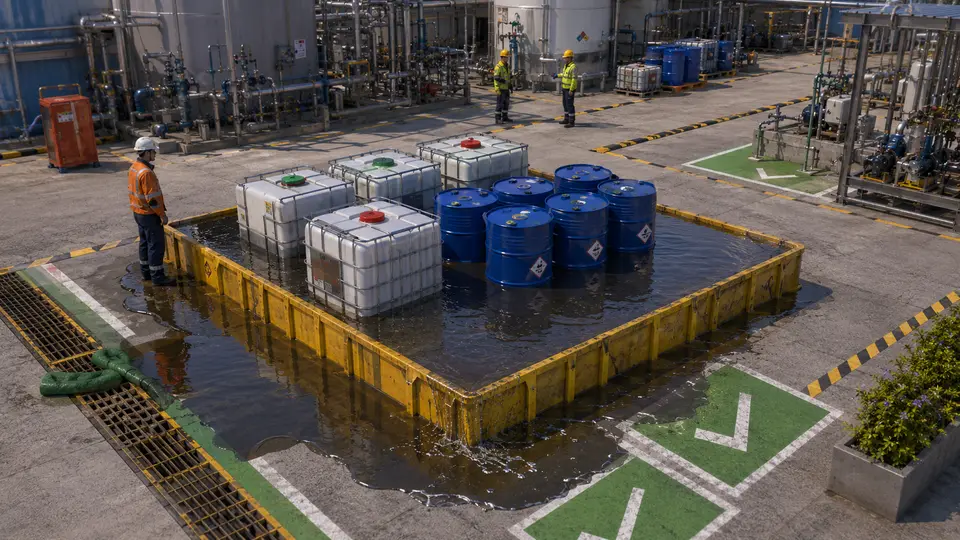
CAM-307The bund is full to the brim and already spilling over
«Tell me if the level in a bund reaches the rim, or if liquid starts running outside towards a drain.»
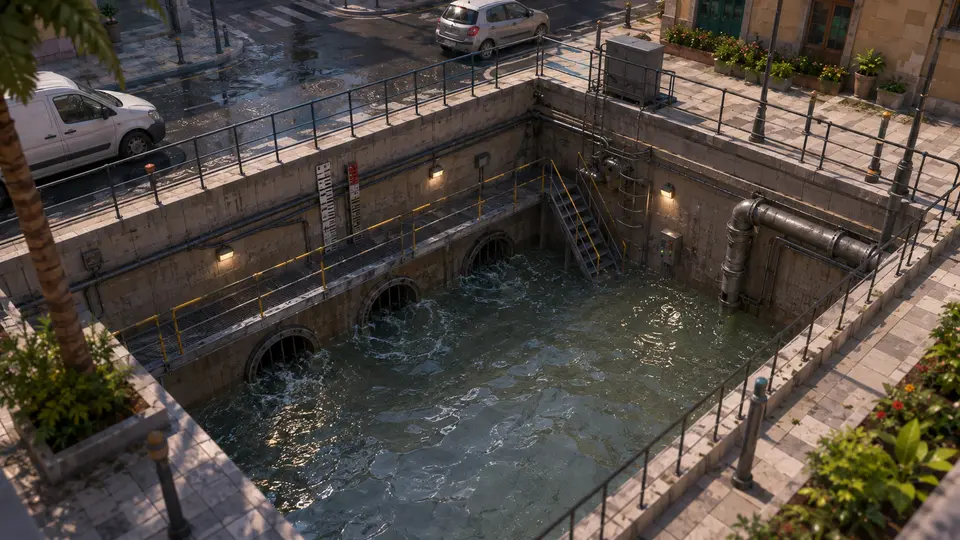
CAM-165The storm tank close to the brim
«Tell me when the water in the tank goes over the alert mark on the gauge and keeps rising, even at four in the morning with nobody in the office.»
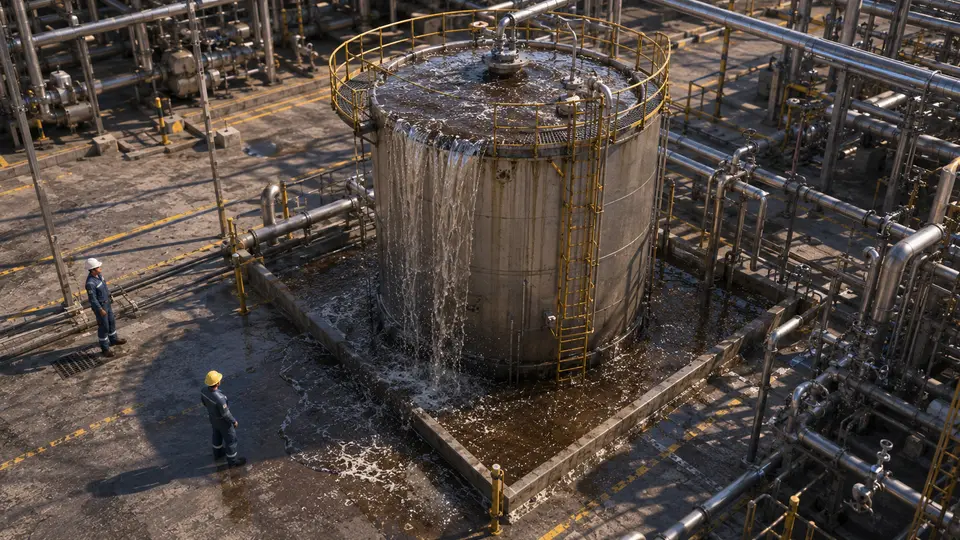
CAM-323The tank is overflowing from the top
«Tell me as soon as product comes over the rim of a tank or liquid gathers in the bund, and tell me how long it has been going.»
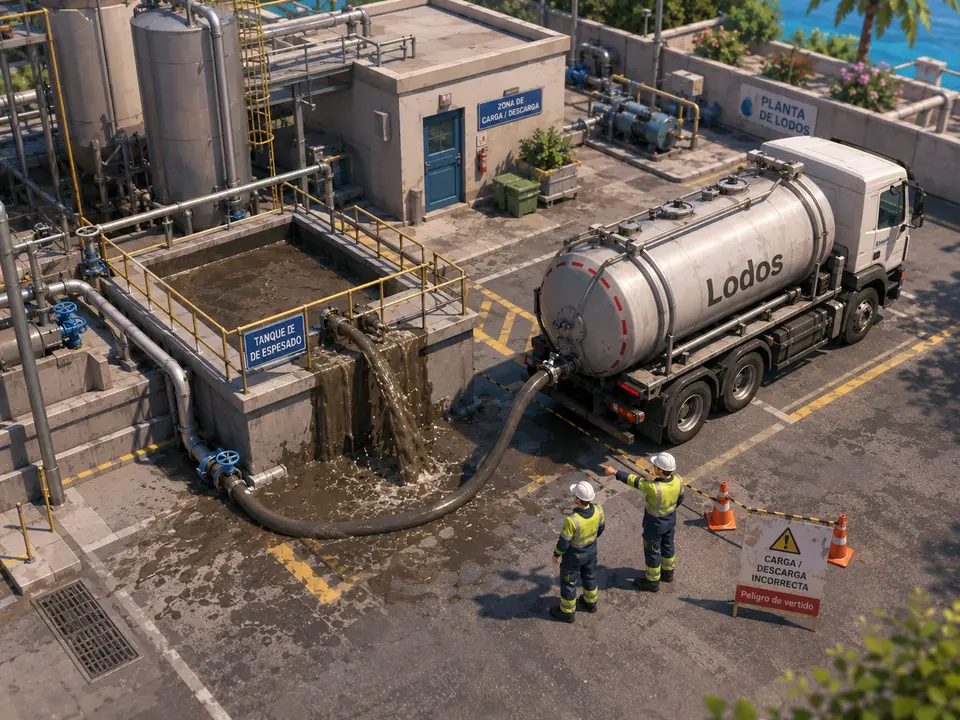
CAM-418The thickener is overflowing and the tanker keeps unloading
«Tell me if sludge appears outside the tank during an unload, or if the truck hooks up outside the marked point.»


What it does not do
IRIS is not a level transmitter and does not give a certified figure. It reads the image against the marks you draw: it covers the mark or it does not, it is rising or it is not.
And it cannot see inside a closed tank. What it sees is what is visible: the gauge, the rim, the bund, the wet shell, the sheet of liquid. If the level that matters is inside a tank with no window, the instrument rules there, and IRIS can only speak up once it is coming over the side.
Questions
- Can it give me the exact level figure?
- Not the way the instrument does, and we are not going to pretend otherwise. What IRIS gives you is the reading against the mark: the water covers the alert level, it has been above it for twenty minutes and it is still rising. For the plant’s balance the meter rules. For finding out at night, for having the image of the moment, and for knowing that the frozen number on the screen did not match what was visible, the mark on the image is enough, and it is often all there was.
- Why do you have to draw the mark instead of just asking in words?
- Because a line cannot be described in a sentence. Asking is how you search; measuring is something else, and it has to be drawn. If you say «tell me when it gets high», every person will picture a different height and today’s alert will not be comparable with next week’s. If you draw the alert level on the image, the reference stops moving: same point, same camera, same criterion. That is why the figure is repeatable, and why it can be audited afterwards.
- What if the instrument and the camera disagree?
- Then you have had a good day. That disagreement is the most valuable alert of all, because it means one of the two is wrong and until now there was no way of knowing. It is almost always the instrument: a fouled probe, a seized float, a signal that stopped moving. IRIS does not say which of the two is right, that is not its job. It says they do not match, shows the image and sends someone out to look, which is exactly what should happen.
- Does it also work for the fill level of a bottle or a vial on a line?
- Yes, and the rule is written the same way. You mark on the image the line every unit has to reach, and ask to be told when one goes past that does not reach it, or one that is empty, or one leaking product onto the belt. The difference is speed: a line runs many containers a minute, so the alert is there to stop and check, not to walk over and study one at leisure. The criterion, though, is exactly the same: this does not hold what it should.
The real interface, step by step
You set the rule once. IRIS applies it every time.
You will see a summary of the interface, played step by step and hands-free. Each round starts with another case. The complete tool does not fit in a demo.
- The rule gets built
- It goes to every camera
- Published, it watches alone
- And then it fires
Not seeing yours here?
These words are the ones we have built, not the ones IRIS understands. The list falls short on purpose: you ask for it in a sentence, and sentences do not run out. Tell us what is in front of your cameras and we will tell you whether it understands it, or not yet.
And the best part
You already record.The hard part was always watching it.
Years of video that only get opened once something has gone wrong. IRIS understands those same images as they arrive, so the answer no longer lives only in the archive.
Tell us your problem and we will say whether IRIS understands it, or not yet.
We reply the same working day.