Solutions by typeCustomer experience
How long does a room really take to be ready?
It is three o’clock and the room is not ready
Half past eleven in a guest corridor. Four housekeeping trolleys are spread along it: one parked at a door, one crossing the corridor, one pushed against the wall and one in the foreground. Reception has eight check-ins at three in the afternoon and does not know how many of those rooms will be ready. Neither does the head housekeeper: to find out she would have to walk all four floors.
1 cameras across 1 sectors
What IRIS is
IRIS watches the cameras for you.
IRIS Neural is an artificial intelligence that watches the cameras you already have and understands what happens in front of them. When something important happens —or something you told it you need to keep an eye on—, it alerts you; and whatever can be counted, it counts in numbers. All day long, without anyone having to watch a screen.
You tell it what you need to watch, and IRIS does it.
Works with the cameras you already have. Nothing to replace.
A person replies, not a form.
- Your footage never leaves your premises.
- It doesn't identify people.
- Certifications →
This is how you ask for it
«Tell me when a trolley has stood at the same door for more than forty-five minutes, or when a floor is piling up unfinished doors as check-in time approaches.»
At three the guest arrives and the room is not ready. They get sat down in the bar with a drink, asked for patience, sometimes compensated. Repeated day after day, that is the most common front-desk complaint of the year, and the one that stings most: nobody travels four hours in order to stand in a lobby. Meanwhile, inside the hotel nobody knows whether the problem is short staffing, one slower floor, or three rooms with a maintenance fault.
You decide once
You decide it once, with the head housekeeper in the room: how many minutes at the same door are too many, at what hour the floors start being watched — you set check-in time, not the system — and who gets told. IRIS applies it every day, in August and on a Tuesday in February, on all floors at once. And it does it by watching the corridor: the door and the trolley, never the inside of a room.
Housekeeping is the only department in a hotel that works where nobody can look. You do not put a camera inside a room, and you should not. So the picture of how the morning is going is built by hand: radio calls, a sheet with rooms ticked off, and a head housekeeper walking floors to see where each person has got to.
The problem is not willingness. It is that at half past eleven the fourth floor may be fine while the second has lost forty minutes because one room was worse than expected. Reception does not know until it calls, and it calls once the guest is already at the desk. Nothing can be reorganised with that: only apologies can be handed out.
IRIS watches the corridor, not the room. It sees where the trolleys are, how long each one has stood at a door, and how many doors are left on each floor as check-in approaches. That alone is enough to move somebody between floors at noon instead of at three. And after a few weeks something appears that the hotel never had: how long a room really takes, by floor, by weekday and by room type. You can plan a season with that. You cannot plan one with the memory of a bad morning.
And there is a case that repeats far more than you would think. The trolley has stood at the same door for fifty minutes because there is a fault inside: a leaking cistern, an air conditioner that will not start, a mattress that has to be replaced. The person cleaning has known since minute five, but reporting it means going down, finding somebody and coming back up. With the alert, maintenance finds out mid-morning and comes up with the part in hand, instead of finding out at three when there is already somebody waiting downstairs.
What changes
Before, reception learned the room was not ready when the guest was already at the desk. Now, mid-morning, somebody sees the second floor running late and moves a person before lunch. Most days nothing needs doing. On the days it does, the alert arrives with enough time that the guest never finds out there was a problem at all.
Where we have seen it
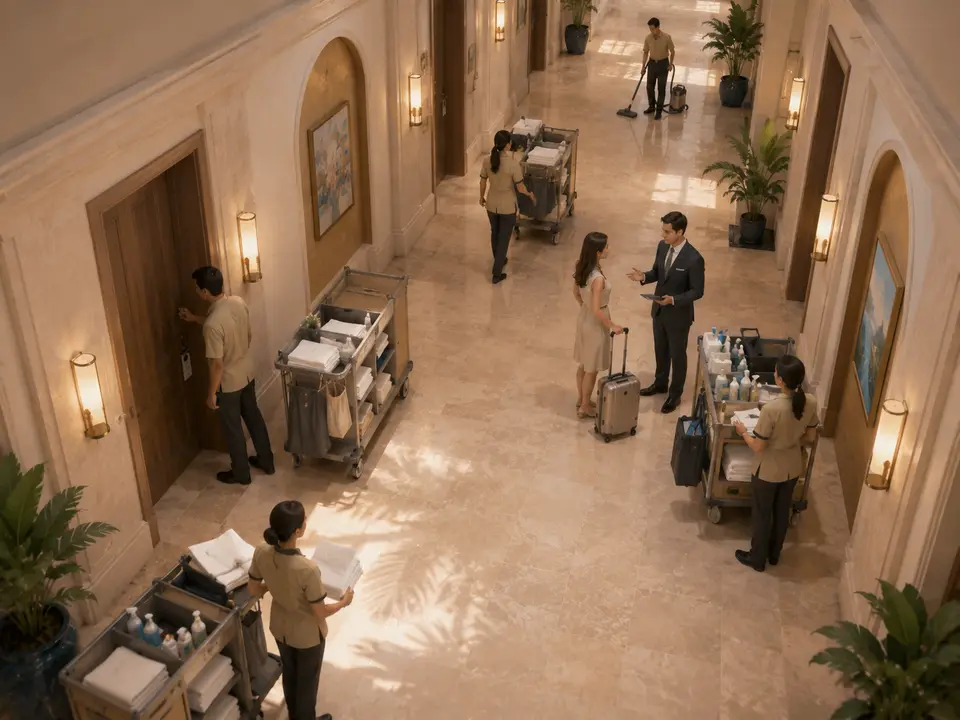
CAM-504How long a room takes to be ready, without going into any of them
«Tell me when a trolley has been at the same door for more than forty-five minutes, or when a floor still has unfinished rooms by check-in time.»

What it does not do
IRIS does not go into the rooms. The camera watches the corridor, and there it sees doors and trolleys, not identified people: it does not recognise faces and does not know who is cleaning which room.
And it does not know whether a room has been done well. It knows the door closed and the trolley moved on. Quality is checked by a person, exactly as before.
And there are corridors where this does not work. An L-shaped corridor, or one where the doors sit almost edge-on, leaves trolleys and doors out of sight. That is checked floor by floor before anything is promised, because in a hotel not all floors are built the same way.
Questions
- Is a camera put inside the rooms?
- No, never, and it is not negotiable. The camera goes in the corridor and watches doors and trolleys. No camera goes inside a room, not for this and not for anything, because that is where a guest has the highest expectation of privacy. Everything on this page comes from the corridor: which door is open, where each trolley is and how long it has been there. That is enough, which is exactly why the line never has to be crossed.
- Is this a way of monitoring how fast the cleaners work?
- No, and it is worth saying early because it is the first thing people think. IRIS does not recognise faces and does not identify anyone: it cannot tell you who cleaned a room or how long a specific person takes. What it measures is the door and the trolley, and the figure belongs to the floor and the day, not to a worker. If someone wanted to use this against an individual, they would not find the data, because it does not exist anywhere in the system.
- What if the trolley is parked because someone is restocking the store cupboard?
- It happens every morning, which is why the alert gets tuned before it is switched on. The minute threshold is set after watching a few days of how your team actually works, not in the abstract: in a hotel with large rooms forty-five minutes is normal, in one with small rooms it is already a signal. And parts of the corridor, like the service room or the store cupboard door, are left out of the rule precisely because a parked trolley there means nothing.
- Does it help me know when I can safely promise an early check-in?
- Yes, and it is usually the use that earns the most. Once you have the history of how many rooms are ready at each hour, by floor and by weekday, reception can offer early check-in knowing it will hold, instead of promising and hoping. And it works the other way round too: on days when the history says it will not happen, you know hours ahead and can tell the guest before they set off.
Every simulation
Something has spilled
Tell me if there is liquid or foam outside its place and it is still there two minutes later.
- The sentence
- Where it applies
- What it finds
- The same rule
Not seeing yours here?
These words are the ones we have built, not the ones IRIS understands. The list falls short on purpose: you ask for it in a sentence, and sentences do not run out. Tell us what is in front of your cameras and we will tell you whether it understands it, or not yet.
And the best part
There are nights of thick fogwhen the image gives you nothing. We do not dress that up.
Backlight, heavy rain, a street lamp that has blown. IRIS works with what the camera puts in front of it; when there is no image, it says so instead of inventing an answer.
Tell us your problem and we will say whether IRIS understands it, or not yet.
We reply the same working day.