Solutions by typeProduction efficiency
How many parts are we making twice?
The rework area has swallowed the aisle
It is 14:10 in the machining shop. You can barely see the floor: containers of parts stacked in front of the machines and across the walkways, and a pallet truck has to leave the aisle to get past. At the bench at the back, six people are hand-finishing parts that were already made once. Nobody has raised anything: this is not a breakdown, this is Tuesday.
1 cameras across 1 sectors
What IRIS is
IRIS watches the cameras for you.
IRIS Neural is an artificial intelligence that watches the cameras you already have and understands what happens in front of them. When something important happens —or something you told it you need to keep an eye on—, it alerts you; and whatever can be counted, it counts in numbers. All day long, without anyone having to watch a screen.
You tell it what you need to watch, and IRIS does it.
Works with the cameras you already have. Nothing to replace.
A person replies, not a form.
- Your footage never leaves your premises.
- It doesn't identify people.
- Certifications →
This is how you ask for it
«Tell me if there are more containers than usual in the rework area by mid-afternoon.»
Those hours get paid twice and appear nowhere, because the part ends up good and is never declared as scrap. By the end of the quarter the cost per part has gone up and the explanation gets spread between material prices and machine hours. And there is a second invoice nobody looks at: the blocked aisle. The day somebody has to leave that shop in a hurry, they will be dodging containers.
You decide once
You decide this once. You draw the rework area on the image, say how many containers are normal there, at what time it gets checked and who gets the alert: if at four in the afternoon there are more than eight containers in that area, tell the production manager, with the photo. IRIS counts them every day at the same time, without arguing, and keeps the number. After a month you have a curve, and that curve is the first time rework has ever appeared on paper.
Rework is the most expensive and worst documented waste in a factory. Scrap gets declared because the part goes in the skip and somebody has to write the material off. Rework does not: the part gets fixed, comes out good and goes into the order. On paper everything went fine. In hours, it was made twice.
The only honest thing on the shop floor is the pile. If there are six containers in the area one Tuesday and fourteen the next, something has changed in a machine, a material batch or a shift, and nobody has noticed yet. Everyone sees that pile and nobody counts it, because counting boxes is nobody’s job and because, seen every day, a pile stops standing out. And as it grows it eats the aisle: containers end up in front of the machines and across the walkways, which is exactly where they should not be.
IRIS watches that area and counts how many containers are there, at the same time every day. When they go past the number you set, it says so with the photo. And with that, next time someone asks how much rework there is in machining, the answer will not be an impression: it will be a thirty-day chart with the peaks marked, and the peaks almost always line up with something you can name.
What changes
Before, the shop manager said there was a lot of rework and the cost controller said it did not show up in the system, and both were right. Now there is a number a day, with a photo, and both of them look at the same chart. The first consequence is usually not an improvement plan: it is that somebody goes and clears the aisle.
Where we have seen it
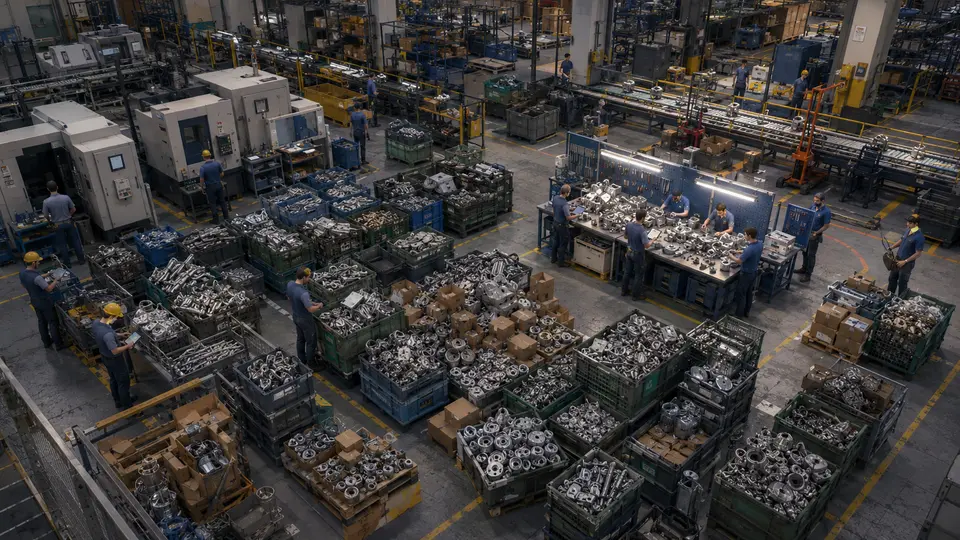
CAM-248The rework area has swallowed the aisle
«Tell me if, mid-afternoon, there are more stillages than usual in the rework area.»

What it does not do
IRIS does not know what is inside the containers or why that part came back. It counts items in the area you drew and speaks up when they pass the number you set; your people supply the cause.
And it does not replace your quality system. If you already log defects there by part number and by machine, that data beats counting boxes.
Questions
- Does IRIS know which part is inside each container?
- No. IRIS sees containers, not part numbers. It counts how many containers are inside the area you drew, what they look like and how long they have been there; what is inside them it does not know. And it does not need to for this to be useful: the signal you are after is that there are fourteen today where there were six yesterday. When someone goes to find out why, that is where you need a person with the works order in hand.
- Does the quality system not tell us this already?
- It tells you what gets declared, and rework almost never gets declared. Scrap is declared, because the material has to be written off, and customer complaints are declared, because they arrive in writing. The part that gets hand-finished at the back bench and goes into the order leaves no trace in any system. Counting the pile is less precise than a declaration, but it has one huge advantage: it exists every day, without anyone having to fill anything in.
- Can it also flag that the aisle is blocked?
- Yes, and it usually goes on the same camera. They are two different things sharing one view: one counts containers inside the rework area, the other alerts when something stays inside the marked walkway longer than the minutes you set. The first gives you a number at the end of the month. The second gives you an alert right away, because a blocked aisle is a problem for today, not a trend.
- How long before the data is worth anything?
- A few weeks, and not because of the system: because of you. On day one the number says nothing, because you do not know whether eight containers is a lot or a little. After three or four weeks you have your own normal, and then the number starts to speak: Mondays are worse, the week the supplier changed it doubled, since that machine was adjusted it dropped and never came back up. That is where counting stops being data and becomes a tool.
See it for yourself
This isn’t a video. It’s a slice of the real screen.
A summary of the real interface, played hands-free. You see one case from start to finish; what you do not see are the other screens, and there are many.
- Four cameras at once
- Each understands its own view
- The numbers climb by themselves
Not seeing yours here?
These words are the ones we have built, not the ones IRIS understands. The list falls short on purpose: you ask for it in a sentence, and sentences do not run out. Tell us what is in front of your cameras and we will tell you whether it understands it, or not yet.
And the best part
Video is late by definition:you watch it once the thing has already happened.
IRIS tells you while it is happening, with the camera, the time and what it saw. Arriving in time changes the end of almost any story, and no new cameras are needed for that.
Tell us your problem and we will say whether IRIS understands it, or not yet.
We reply the same working day.