Solutions by typePersonal safety
How long does a splash take to reach an eye?
A splash gives no warning
It is 07:30 at the transfer point. Caustic soda has to go from a drum into a tank and the pump takes four minutes. The operator leans in to watch the level rise: his face is half a metre from the opening. He has gloves and boots on, but the goggles stayed in his locker because they fog up. The pump spits once when it starts. It always spits once when it starts.
2 cameras across 1 sectors
What IRIS is
IRIS watches the cameras for you.
IRIS Neural is an artificial intelligence that watches the cameras you already have and understands what happens in front of them. When something important happens —or something you told it you need to keep an eye on—, it alerts you; and whatever can be counted, it counts in numbers. All day long, without anyone having to watch a screen.
You tell it what you need to watch, and IRIS does it.
Works with the cameras you already have. Nothing to replace.
A person replies, not a form.
- Your footage never leaves your premises.
- It doesn't identify people.
- Certifications →
This is how you ask for it
«Tell me if someone transfers product in this area without goggles on.»
If nobody sees it, the transfer goes fine, like the eight hundred before it. The day the hose spits the wrong way, the bill starts with twelve metres to the eyewash station with both eyes shut. Then come months off work, a job somebody has to cover and an investigation. All for a piece of kit thirty metres away, in a locker.
You decide once
It is decided once, with the area manager looking at the image. They mark the transfer point, say what kit is mandatory there and who gets the alert. The sentence reads: if someone takes up that position, and they are not wearing goggles, then tell the shift supervisor, open the camera and keep the video. If tomorrow the product needs a face shield, you change the sentence.
An eye burned by a caustic does not come back. There is no rehabilitation and no second chance: there is a person who no longer sees on that side and a job they can no longer do. In a chemical plant, transfers are routine — twenty a day, fifty — and the kit is nearly always worn. The missing piece is nearly always the same one: the goggles. They fog up, they sit badly over prescription glasses, and anyway it is only four minutes.
The day it goes wrong there is no bang and no noise. The hose spits as it starts, one drop comes in from the side of the face, and that is that. What follows is a twelve-metre run to the eyewash station with both eyes shut, counting from memory. Those twelve metres, groping, are what decide how much sight is left.
IRIS watches that exact spot: the drum opening, the pump, the place where the person stands. It sees whether goggles are on when someone takes up that position, and it alerts before the valve is opened, not after. It does not know who they are — it recognises no faces and identifies nobody — only whether there is something in front of those eyes. Goggles that fog up can be wiped. An eye cannot.
What changes
Before, compliance was measured in the monthly briefing and on the safety officer’s round, which passes twice a week and always at the same hour. Everything outside those rounds was invisible. Now the shift supervisor gets the alert before the valve is opened, with the camera and the video. And at month end there is a real count of how often it happened.
Where we have seen it
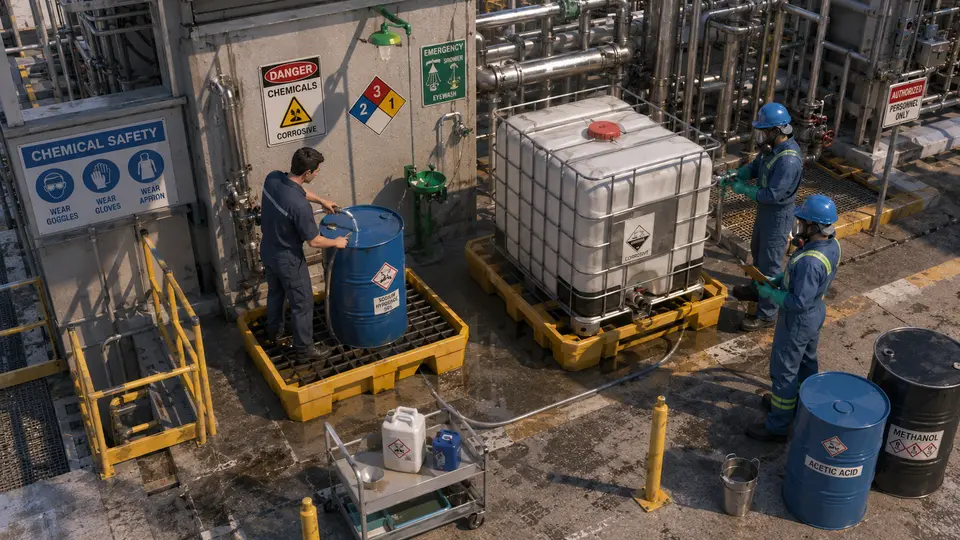
CAM-313Decanting a caustic with no goggles, no gloves and no apron
«Tell me if anyone transfers product in this bay without the goggles, the gloves and the apron.»
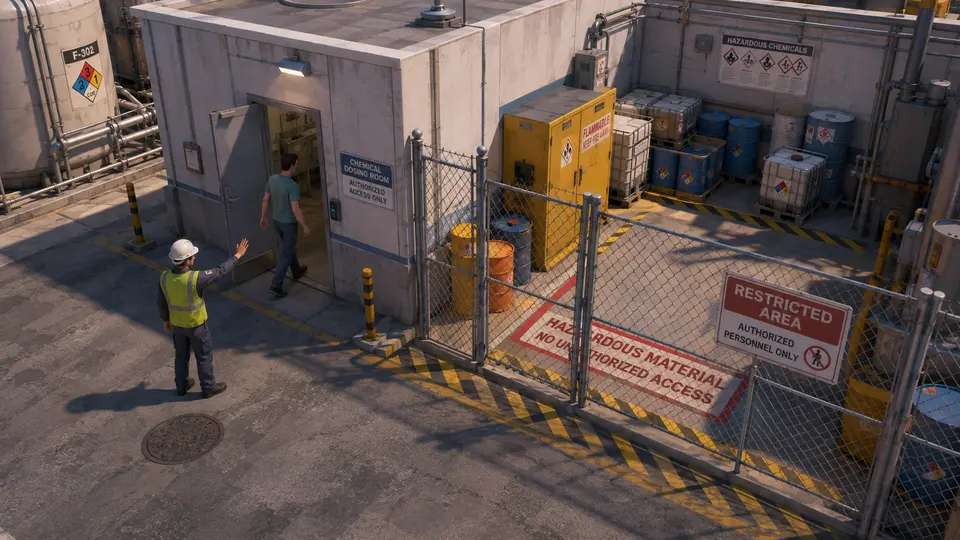
CAM-317Into the dosing room without the area kit
«Tell me if anybody goes into the dosing room without a hard hat, a vest and goggles.»


What it does not do
IRIS cannot tell certified goggles from sunglasses, and does not know whether the face shield is the right one for that product. It sees whether something is in front of the eyes or not.
Choosing the right kit for each product still belongs to whoever knows the safety data sheet. IRIS checks that something is worn, not that it is the correct thing.
Questions
- Does IRIS recognise the person’s face?
- No. IRIS does not recognise faces and identifies nobody, and this scene has no need of it. What it looks at is whether something is in front of the eyes of whoever is working at that spot. It is the difference between seeing that someone is working at that spot and knowing their name: only the first is needed here. The alert gives camera, time and what is missing, and never who.
- Does a face shield count instead of goggles?
- Yes, if you say so in the sentence. You write that either counts and that is that: this is one of the advantages of asking in plain words rather than filling in a box, because the rule ends up written the way the area manager would say it. If the procedure changes tomorrow and that transfer requires a shield, you change the sentence, and no camera needs touching and nobody needs calling.
- Can you ask for the whole kit in one sentence?
- Yes, and in a transfer area that is the normal way: goggles, gloves and apron in one sentence. Bear in mind the alert then fires even if only one item is missing, which is exactly what you want. If you also want to see which item is always skipped, ask for them separately and count: there is nearly always one that takes all the alerts, and that is the one actually worth fixing.
- Can it tell safety goggles from sunglasses?
- No, and it is a limit worth being clear about before buying anything. IRIS sees that something is in front of the eyes; it does not read markings or certificates, and it does not know whether that frame would survive a splash. In practice it is rarely a problem, because nobody wears sunglasses at a transfer point, but it is only honest to say it: this rule checks that something is worn, not that it is the right thing.
See it for yourself
This isn’t a video. It’s a slice of the real screen.
A summary of the real interface, played hands-free. You see one case from start to finish; what you do not see are the other screens, and there are many.
- Four cameras at once
- Each understands its own view
- The numbers climb by themselves
Not seeing yours here?
These words are the ones we have built, not the ones IRIS understands. The list falls short on purpose: you ask for it in a sentence, and sentences do not run out. Tell us what is in front of your cameras and we will tell you whether it understands it, or not yet.
And the best part
The door was left open at two.Finding out at nine is no use to anyone.
The video tells you at nine. IRIS says it at two, with the camera, the time and the images from that moment. The difference between the two is whether someone can go.
Tell us your problem and we will say whether IRIS understands it, or not yet.
We reply the same working day.