Solutions by typeProduction efficiency
What if one unit leaves wrong and nobody sees it until the warehouse?
One bottle leaves with no cap and goes with the rest
Twenty past four in the afternoon on a juice line. The bottles come out of the capper in a row and every one has its green cap, except one: its neck is open, the thread on show, moving along among the others towards the belt that climbs to packing. One operator watches the line from the aisle, another follows the high section. To the right, pallets of shrink-wrapped product are waiting. The bottle goes past and nobody has looked at it.
3 cameras across 2 sectors
What IRIS is
IRIS watches the cameras for you.
IRIS Neural is an artificial intelligence that watches the cameras you already have and understands what happens in front of them. When something important happens —or something you told it you need to keep an eye on—, it alerts you; and whatever can be counted, it counts in numbers. All day long, without anyone having to watch a screen.
You tell it what you need to watch, and IRIS does it.
Works with the cameras you already have. Nothing to replace.
A person replies, not a form.
- Your footage never leaves your premises.
- It doesn't identify people.
- Certifications →
This is how you ask for it
«Tell me as soon as a bottle with no cap comes out of the capper, and tell me before it reaches packing.»
A bottle with no cap does not stay on the line: it goes with the others, gets shrink-wrapped onto the pallet and turns up in the customer’s warehouse, wet, with the product lost. On a vial line the price is different: the short or empty unit reaches the end of the process, already capped, labelled and inside a box, and shows up at final inspection as a surprise.
You decide once
The line decides what counts as off-pattern and what happens next: how much cap tilt is accepted, how far the level may drop against its neighbours, which stretch is watched and who gets told. If a vial comes out of the capper with no cap or with the cap crooked, alert the line manager with the image saved. IRIS applies that standard to the image and hands over the evidence: camera, time and video. The decision about the product is always taken by a person.
It is always one unit. One bottle among thousands that leaves the capper with its neck bare. Three vials on the accumulation table: one missing its cap, one with the cap crooked, one with the cap half seated. One vial sitting below the line of all the others and one that goes past completely empty. The machine carries on, the queue carries on, and that unit goes with the rest.
Watching every bottle in a shift is not a question of willpower. At the speed a belt runs, a person sees the line, not each container. That is why the discovery comes at the end: at final inspection, in the customer’s warehouse, or once the batch is closed and the investigation costs more than the product. What is lost is not the unit. It is the moment when it could still have been pulled out.
IRIS does not measure: it compares. It looks at the neck of every bottle that goes past and at each vial’s liquid line against those beside it, and flags the one that falls outside the pattern, with the image of that unit and the time. On the accumulation table there are nearly a hundred vials in view and it looks at them in every frame, as readily in the seventh hour of a shift as in the first. That does not replace line inspection or a laboratory test: it accompanies them, and it moves the discovery forward to the moment when the unit is still on the belt.
What changes
Before, the bad unit showed up at final inspection or in the customer’s warehouse, and then a whole pallet had to be decided on. Now the alert arrives while that bottle is still on the belt, with its image and the time, and it gets pulled before packing. The line manager also knows from which minute to review and how many units left like that in the hour.
Where we have seen it
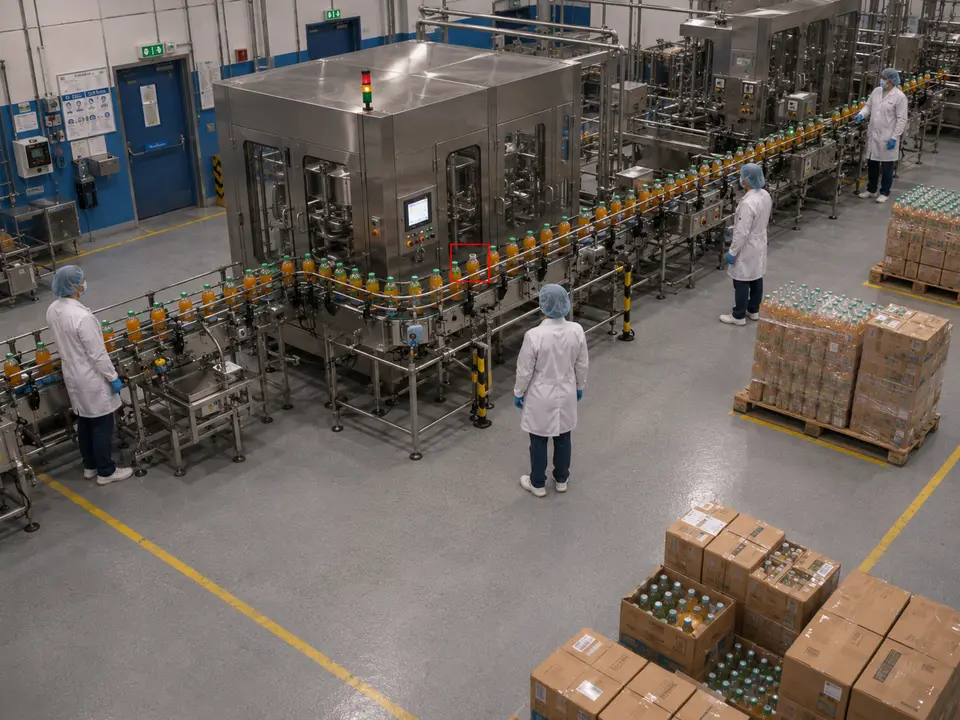
CAM-208A bottle that leaves with no cap
«Tell me the moment a bottle goes past the capper outlet with no cap, and tell me before it reaches packing.»
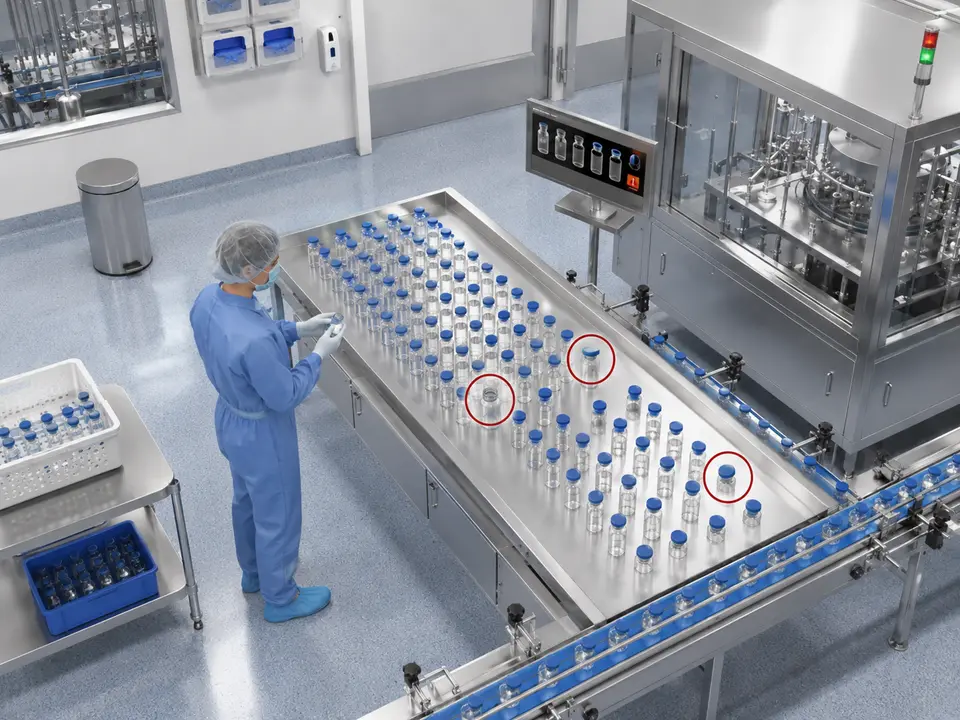
CAM-287Three vials have left the capper with the cap wrong
«Tell me if a vial leaves the capper with no cap or with the cap crooked, and save me the image.»
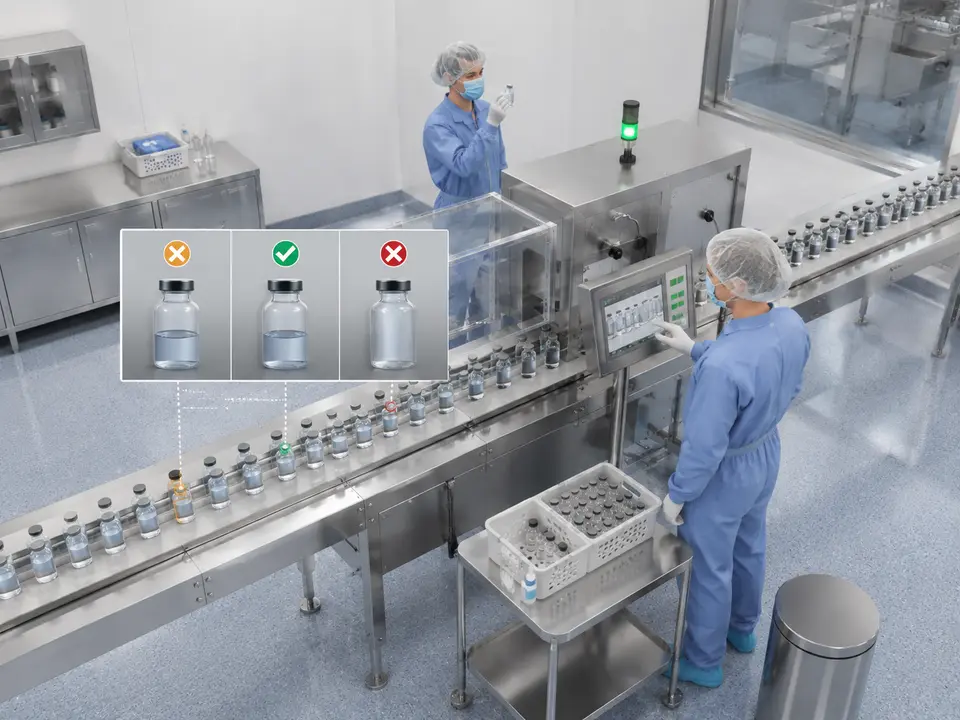
CAM-289One vial is short and another goes by empty
«Tell me if a vial with less liquid than the rest, or an empty one, goes down the belt.»


What it does not do
The camera does not measure volume: it compares. It sees each container’s liquid line against those of its neighbours. And the integrity of a closure is proven by a test, not by an image.
Two things break this rule and are worth knowing before the camera goes up: opaque packaging, and a label covering the level. In those cases you have to measure another way.
Questions
- Does IRIS measure the millilitres in the container?
- No. The camera does not measure volume: it compares. It sees each container’s liquid line against those of its neighbours and flags the one that falls outside the pattern. The exact volume comes from the scale or the machine’s fill control, which is what they are for. What IRIS adds is the image of that particular container and the minute it passed the section, so it can be pulled before it moves on.
- Does IRIS confirm the closure is airtight?
- No, and it cannot be claimed. The integrity of a closure is proven by a laboratory test. What the camera sees is the visible part: a missing cap, a tilted one, one left half seated. Nor can it judge the torque on a thread or the tightness of a tamper band. It is an early warning on the line, with image and time, not a quality result and not a substitute for the test.
- Can one slip past it?
- Yes, and it is worth saying. If one bottle passes hidden behind another, if the reflection off stainless steel puts the neck in backlight, or if the belt is so full it cannot be seen, that bottle may be missed. IRIS does not promise to catch them all: it promises to look at every bottle for the whole shift, which is more than a person can do at that speed, and to leave the image of every alert so it can be checked.
- Does this stop the line or remove the unit?
- It does neither. IRIS alerts, it does not act: it does not stop the filler, does not divert the bottle and does not trigger any rejector. It sends the alert with the camera, the time and the video to whoever is at the line, and that person decides. If the plant wants the line stopped or the unit ejected, its own control system does that. Responsibility for stopping a machine stays where it belongs.
The real interface, step by step
You set the rule once. IRIS applies it every time.
You will see a summary of the interface, played step by step and hands-free. Each round starts with another case. The complete tool does not fit in a demo.
- The rule gets built
- It goes to every camera
- Published, it watches alone
- And then it fires
Not seeing yours here?
These words are the ones we have built, not the ones IRIS understands. The list falls short on purpose: you ask for it in a sentence, and sentences do not run out. Tell us what is in front of your cameras and we will tell you whether it understands it, or not yet.
And the best part
Nothing changes on the wall.On the screen, everything changes.
Same brackets, same cabling, same cameras. The only difference is that those images are now understood as they come in, instead of waiting for someone to open them.
Tell us your problem and we will say whether IRIS understands it, or not yet.
We reply the same working day.